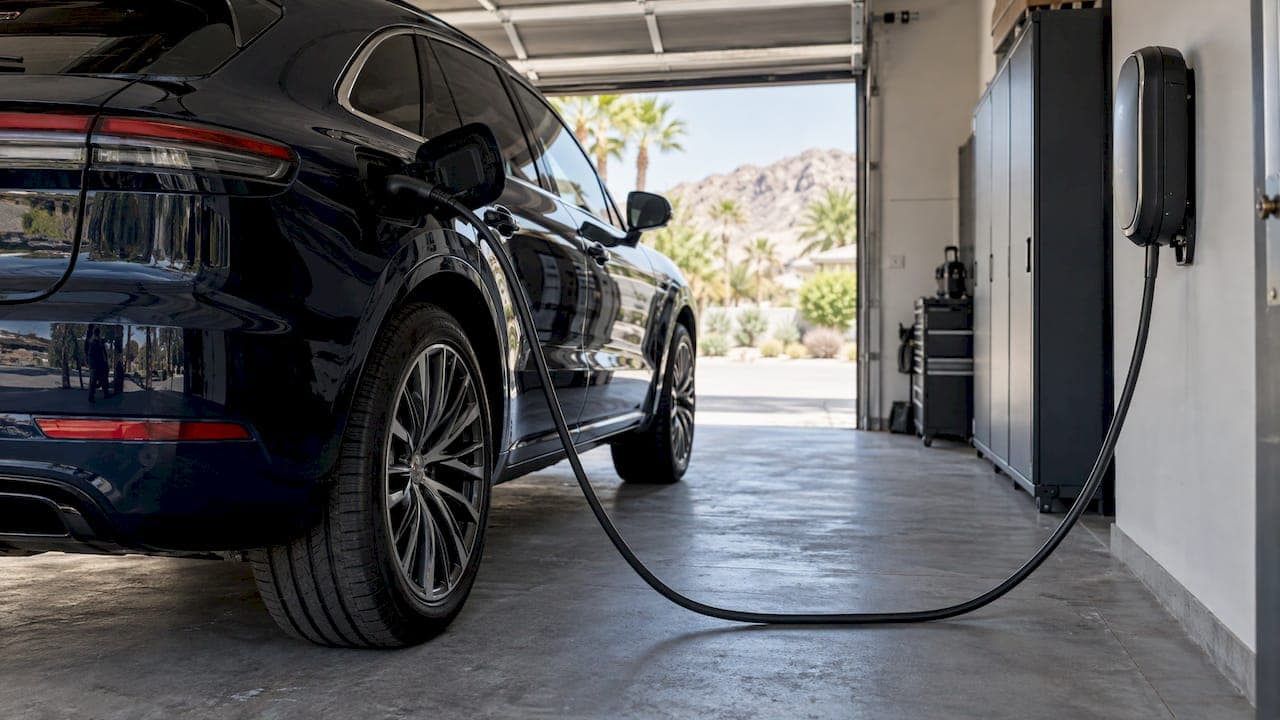
For most Las Vegas households, the ideal arrangement is a dedicated 240-volt Level 2 circuit near the parking space, installed under a permit by a licensed electrician and paired with an NV Energy time-of-use rate that favors overnight charging. Level 1 suffices for some drivers, yet a residence of real distinction, with a garage, a casita or a motor court, deserves infrastructure that anticipates more than one vehicle. What follows explains the charger levels, the electrical and permit questions, the utility rates and the checks a buyer or relocating family should make before closing.
TL;DR
- Level 1 uses a standard 120-volt outlet and adds roughly 3 to 5 miles of range per hour; Level 2 uses 240 volts and typically adds about 25 to 40 miles per hour.
- A new Level 2 circuit is permanent electrical work, so plan on a permit; which office issues it depends on the property's exact address.
- NV Energy publishes optional time-of-use rates with a lower overnight EV-recharge price, effective July 1, 2026 for Southern Nevada.
- Before buying, confirm panel capacity, the distance from panel to parking, and whether the property sits in the City of Las Vegas, Henderson, North Las Vegas or unincorporated Clark County.
Table of Contents
- Level 1 or Level 2: choosing the right pace
- What the home must provide: panel, wiring and parking
- Permits and inspections in the valley
- What installation costs, and why quotes vary
- NV Energy rates and incentives
- Questions to ask before you buy a Las Vegas property
- Let us find the right home, charged and ready
- Frequently asked questions
- Sources
Level 1 or Level 2: choosing the right pace
Every electric vehicle arrives with a cord that plugs into an ordinary outlet, and that is Level 1. The EPA's home charging guidance describes it as 120 volts, typically adding about 3 to 5 miles of range per hour, while Level 2, at 240 volts, typically adds about 25 to 40 miles per hour. The Department of Transportation frames the same difference in hours: Level 1 generally takes 40 to 50 hours or more to bring a battery-electric vehicle from empty to 80 percent, whereas Level 2 generally takes 4 to 10 hours. It also cautions that these are typical estimates, since battery size, temperature and the condition of the equipment all influence the result.

The right choice depends on how you live rather than on any universal rule. The Department of Energy's Alternative Fuels Data Center observes that many drivers can meet their daily needs with the vehicle-supplied Level 1 cord on a dedicated branch circuit, while Level 2 suits longer commutes, irregular schedules and larger batteries. In Las Vegas, where a drive to Summerlin, Henderson, Lake Las Vegas or a weekend run to Southern California can arrive without warning, a household with two vehicles or a long-range battery will usually find Level 2 the more graceful solution.
DC fast charging, the kind found at roadside stations, is generally impractical for a residence, as FuelEconomy.gov notes. For the home, the decision is between a standard outlet and a 240-volt circuit.
What the home must provide: panel, wiring and parking
A Level 2 charger is only as capable as the electrical service behind it. The Alternative Fuels Data Center advises that Level 1 can meet daily needs when a dedicated-branch-circuit outlet sits near the parking location, and that an electrician can assess whether the home has adequate electrical capacity for more. Outdoor installations, such as a charger on a side wall or a gated motor court, require outdoor-rated equipment.
Three physical questions determine the scope of work:
First, the panel. A modern luxury residence often has a 200-amp service with room to spare, but a custom home with pool equipment, a guest house, wine storage and multiple air-conditioning systems may already be carrying a considerable load. If the panel is full or near its limit, an upgrade becomes part of the project, and that is the single largest variable in the final cost.

Second, the distance. The farther the parking position is from the panel, the longer the cable run and the heavier the conductor required. A garage that backs onto the panel wall is a very different proposition from a detached casita at the far end of a lot.
Third, the amperage. Chargers are available in a range of outputs, and the wiring must be sized for continuous load. A homeowner weighing a higher-output unit will find a clear explanation of Level 2 charger wiring for 32 to 60 amp circuits, including how breaker and conductor sizes relate to the charger's rating. Whatever output you choose, the circuit should be designed by a licensed electrician who has inspected the actual panel.
For a condominium or high-rise residence, the picture changes. The Alternative Fuels Data Center notes that multifamily charging involves additional considerations and can resemble public charging more than a single-family arrangement, with association rules, shared meters and assigned parking all coming into play.
Permits and inspections in the valley
Installing a Level 2 charger is not a plug-in task. The City of Las Vegas states in its permit guidance that a permit is required to install or alter permanent wiring or an electrical device, to run additional wiring for an outlet, or to change, upgrade or relocate the main electrical panel. Routine exceptions, such as replacing a broken outlet or breaker with an identical one, do not extend to new circuits, so a new 240-volt line for a charger should be treated as permit work. The city also publishes a list of inspections required with electrical permits, which assigns distinct codes to panel change-outs and service changes, a useful reminder that a panel upgrade carries its own inspection.
Clark County takes a similar line. Its field inspection guideline, written in the context of solar projects, states that any new load or circuit, including a vehicle charger, requires a separate permit.
The practical point is jurisdiction. A mailing address that says Las Vegas may fall within the City of Las Vegas, within unincorporated Clark County, or elsewhere in the valley, and North Las Vegas and Henderson each operate their own building departments. Confirm the correct office from the parcel's exact address before work begins, and ask your electrician to pull the permit in their name rather than proceeding informally. An unpermitted circuit can surface during a future sale inspection, and it is precisely the kind of detail a sophisticated buyer's due diligence will uncover.
What installation costs, and why quotes vary
Installation pricing in Southern Nevada ranges widely, and we would rather you not rely on a single headline number. A short run from a roomy panel to an attached garage is a modest project; a long trench to a detached structure, an outdoor-rated installation, or a panel upgrade is a substantially larger one. The charger itself is a separate line item, and a connected Level 2 unit may also be a requirement for utility incentives, discussed below.
To compare quotes meaningfully, ask each electrician to itemize the following: the charger and its rated output, the breaker and wire size, the length and route of the run, the permit and inspection fees, and any panel work. Request a site visit rather than a phone estimate, because photographs of the panel and the parking location do not substitute for an inspection of the actual conditions.
NV Energy rates and incentives
What you pay to charge matters as much as what you pay to install. NV Energy's Southern Nevada rate schedule effective July 1, 2026 lists optional single-family time-of-use rates, including an EV-recharge rate of $0.06589 per kWh in summer and $0.07807 per kWh in winter, before other listed charges. The same document explains that bundled rates include generation, transmission and distribution, and that a Universal Energy Charge of $0.00039 per kWh applies, subject to the schedule's conditions. Rates are revised periodically, so read the current schedule before enrolling.
NV Energy also publishes its optional residential schedules separately from the standard residential schedule, with daily demand pricing, time-of-use and critical-peak options. A household that charges overnight and keeps daytime consumption modest is the natural candidate for a time-of-use plan; one that runs pool pumps and air conditioning hard on summer afternoons should model the full bill, not the EV rate alone.
For multifamily residences, NV Energy's Southern Nevada EV recharge rider defines a special EV period from 12:01 a.m. to 8:00 a.m. daily, with a summer period from June through September and a winter period from October through May. Eligibility requires the applicable multifamily time-of-use schedule and proof of EV registration.
There is also a utility program worth investigating. NV Energy's Residential Managed Charging Program handbook describes a one-time enrollment incentive plus performance payments for demand-response participation, capped at the purchase price of the equipment or service. It requires a qualifying connected ENERGY STAR Level 2 charger, participation in managed charging and a minimum 36-month enrollment. Funding is limited and application windows change, so consult NV Energy for the current status before purchasing a charger.
Questions to ask before you buy a Las Vegas property
A residence should be evaluated for charging with the same care given to its pool, its roof and its cooling systems. The Alternative Fuels Data Center's guidance reduces to two essentials: is there an outlet on a dedicated branch circuit near the parking location, and does the home have adequate electrical capacity, as an electrician can determine. We would extend this into a short walk-through for any property under consideration:
Begin with the panel: its amperage, its available breaker spaces, and its age. Then look at the parking: garage bay, carport, motor court or detached structure, and the distance from each to the panel. Ask the seller whether any existing EV circuit was permitted and inspected, and request the documentation. If the home is in a managed community, read the association's rules on exterior equipment, and for a condominium, ask whether the assigned space can accommodate a charger and who pays for the electricity.
Include an electrician in your inspection period when charging is a priority. The cost of an assessment is trivial against the cost of discovering, after closing, that the service cannot support the vehicle you have already ordered. Buyers relocating from California or New York, where many have already lived with garage charging or public charging, tend to arrive with expectations of convenience, and meeting them is simply a matter of asking the right questions early. If you are coordinating a distant purchase, our guide to how to plan a cross-country move addresses the sequence of decisions around a long-distance relocation.
Our perspective
A great Las Vegas residence is judged by how effortlessly it supports the life lived within it, and for a growing number of families that life includes one or more electric vehicles. We regard charging readiness as a genuine component of a home's value, much as a well-conceived garage, a resilient cooling system or a thoughtfully sited motor court has always been.
What our clients gain from working with us is perspective at the moment it matters: before an offer is written, not after the keys are exchanged. Through our off-market access and our relationships across the valley, we are often able to see a property's quality, its electrical capacity and its potential for improvement before it is widely known, and we advise buyers to weigh those details alongside lifestyle and long-term investment merit.
For out-of-state families, our relocation concierge exists to remove uncertainty from the process, so that questions about panels, permits and utility rates are answered in sequence rather than discovered in haste. Backed by the global reach of Sotheby's International Realty, we aim to bring the same care to sellers, presenting a property's modern amenities, including charging infrastructure, in a manner that commands the attention it deserves.
Yelena
Let us find the right home, charged and ready
If you are searching for a luxury residence in Las Vegas, we help buyers and investors weigh the details that shape daily life, from off-market opportunities to the electrical readiness of the property, and we guide out-of-state families through every step of the move.

Sellers, too, benefit from a presentation that highlights modern infrastructure. To discuss buying, selling or relocating, begin with Yhluxrealestate.
Frequently asked questions
Do I need Level 2 charging at home, or is a standard outlet enough?
It depends on your driving. The Department of Energy notes that many drivers can meet their daily needs with Level 1 on a dedicated branch circuit, while Level 2 suits longer commutes, irregular schedules and larger batteries. If you have two vehicles or often need a quick turnaround, Level 2 is usually the more comfortable choice.
How long does it take to charge an electric vehicle at home?
The Department of Transportation says Level 1 generally takes 40 to 50 hours or more to reach 80 percent from empty, while Level 2 generally takes 4 to 10 hours. Most drivers top up from a partial charge overnight rather than from empty. Actual times vary with battery size, temperature and equipment.
Do I need a permit to install a home EV charger in Las Vegas?
In most cases, yes. The City of Las Vegas requires a permit to install or alter permanent wiring or run additional wiring for an outlet, and Clark County treats a new vehicle-charger circuit as a separate permit item. The right office depends on your exact address, so confirm it with your electrician before work starts.
Does NV Energy offer a special rate for EV charging?
Yes. NV Energy's Southern Nevada rate schedule effective July 1, 2026 lists optional time-of-use EV-recharge rates for single-family homes, with separate summer and winter prices. Rates and program terms change, so review the current schedule on NV Energy's site before choosing a plan.
What should I check about charging when buying a home in Las Vegas?
Confirm that the panel has capacity and open breaker space, note the distance from the panel to the parking location, and ask whether any existing EV circuit was permitted. Have an electrician assess the property during your inspection period, and verify which building department has jurisdiction.
Sources
- Getting Started with Home EV Charging, US EPA
- Charger Types and Speeds, US Department of Transportation
- Charging Electric Vehicles at Home, Alternative Fuels Data Center
- Electric Charging, FuelEconomy.gov
- When Do I Need a Permit, City of Las Vegas
- Inspections Required with Electrical Permits, City of Las Vegas
- Field Inspection Guideline, Clark County
- Nevada Power Company Electric Rates, effective July 1, 2026
- Nevada Power Optional Electric Rate Schedules
- Residential Multi-Family Electric Vehicle Recharge Rider, NV Energy
- Residential Managed Charging Program Handbook, NV Energy
- Level 2 charger wiring for homeowners