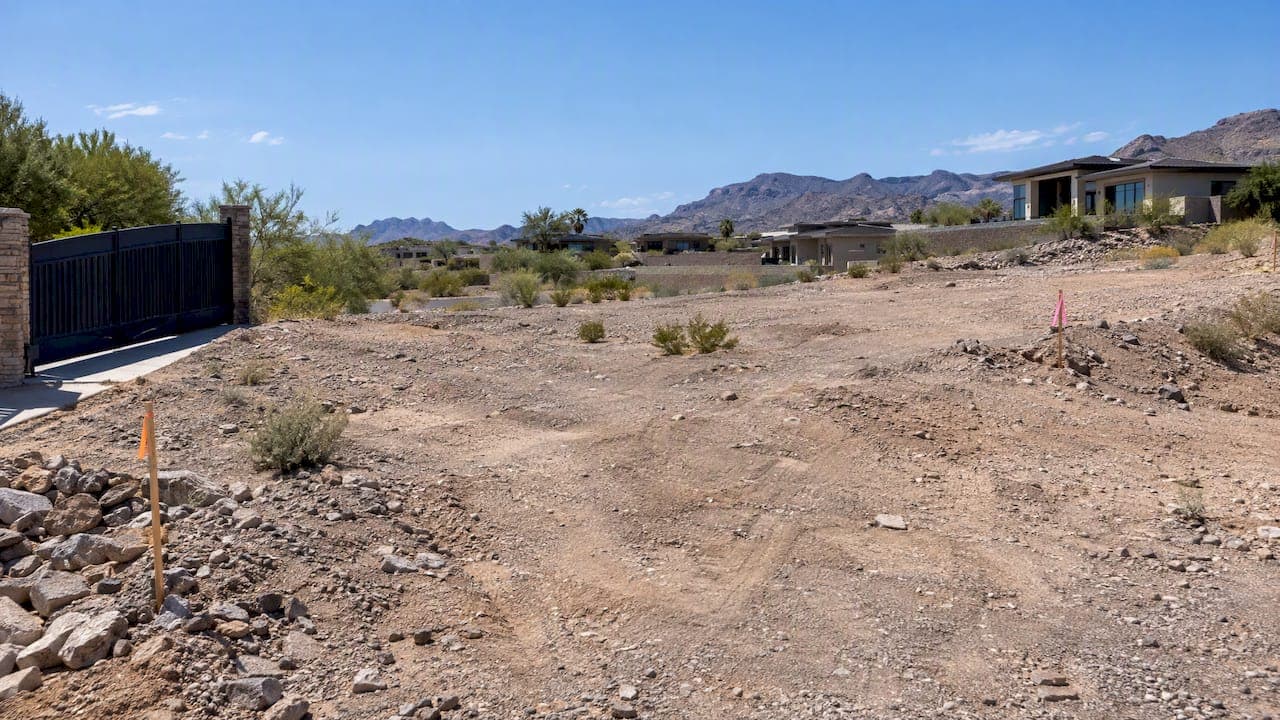
Choosing a custom lot in Las Vegas is, at its heart, an exercise in risk management dressed as an exercise in aspiration. The parcel that frames the Strip at dusk or the Red Rock escarpment at dawn must also drain properly, accept utilities at a reasonable cost, and carry a zoning designation that permits the home you have imagined. The buyers who fare best evaluate the land as rigorously as they admire it, and they do so before the purchase contract becomes unconditional.
This guide walks through that evaluation in the order a seasoned advisor would take it: the questions of purpose and budget, the physical diligence, the regulatory path, the contract protections, and the question of whether to pursue a lot that is publicly listed or one that is quietly available.
TL;DR
- Treat lot selection as a feasibility study: soils, topography, drainage and utilities can alter a project's economics before an architect draws a line.
- Make the lot purchase contingent on a professional site evaluation, so that you can withdraw if the findings are unfavorable.
- Confirm zoning, deed restrictions, grading requirements and permitting jurisdiction (City of Las Vegas, Clark County or Henderson) before you commit.
- Plan for the whole build, not only the land: construction timelines in the West are measured in many months, not weeks.
- Some of the best parcels trade privately, which is where a broker with off-market access and negotiating experience earns the engagement.
Table of Contents
- Begin with the life you intend to lead
- The physical diligence: what the land can and cannot hold
- Zoning, deed restrictions and the permitting path
- Budgeting for the whole project, not merely the land
- Protecting yourself in the contract
- Choosing a community: matching the lot to the lifestyle
- Our perspective: the quiet parcel and the patient negotiation
- Working with us on your lot search
- A practical sequence to follow
- FAQ
- Sources
Begin with the life you intend to lead
Before a single parcel is toured, it is worth settling a few matters that no survey can answer. Will this be a primary residence, or a second home that you occupy for part of the year? Is the property a lifestyle acquisition, an investment with an eye to long-term value, or both? The answers shape everything that follows, from the size of the lot to the tolerance for a lengthy build.
The market itself is moving in a direction that favors the discerning custom buyer. Realtor.com reports a growing number of buyers who intend to live in the valley full-time rather than simply own a second home, and a corresponding appetite for guard-gated neighborhoods, custom estates, larger lots and homes designed around indoor-outdoor living. Those preferences are worth naming early, because they tell you what you are competing for.
For out-of-state families, particularly those relocating from California or New York, a further consideration arises: you will be making decisions about land you cannot visit every week. That argues for a trusted local representative, a disciplined checklist, and a schedule that places the heaviest decisions on the days you are physically present.
The physical diligence: what the land can and cannot hold
A lot that appears flawless from the curb may conceal a substantial expense. Builders who work in the valley describe the selection phase as a matter of risk, noting that a parcel which looks buildable may require extensive grading or drainage mitigation that shifts a project's financial feasibility before the design is finalized. The same builders advise that a lot-purchase contract be contingent upon a professional site evaluation.
The documents that matter most are few, and they are best commissioned early. One Henderson builder observes that the first month of a custom build typically consists of a soils report, a topographic survey and a civil walk to confirm what the lot can hold, and that these documents change the design more than any conversation in a design center. The wise buyer obtains them before closing on the land rather than after.
Soils and topography
The soils report tells you what lies beneath the surface and how the foundation must respond. The topographic survey records the slope, and slope is rarely neutral: a steep lot can deliver the dramatic view you want while demanding retaining walls, stepped foundations and a more complicated driveway. Neither condition is disqualifying; both belong in the budget before you commit.
Drainage and grading
In a desert valley where rainfall is infrequent and sudden, the movement of water across and off a parcel deserves particular attention. Clark County publishes its grading permit guidance, which notes that land use approval from the Planning Commission or Board of County Commissioners may be required, and that grading plans are reviewed by several county offices. In other words, grading is not a formality to be settled by the contractor at the last moment; it is a regulated process with its own timeline.
Utilities and access
Confirm that water, sewer, electric and gas are available at or near the property line, and ask what extending them would cost. A lot evaluation checklist from a Las Vegas builder lists utility availability alongside location, size, shape, topography and orientation for views and solar exposure. Those are sensible categories, and we would add one: the practical question of how construction vehicles will reach the site.
Orientation, views and the sun
Las Vegas rewards careful orientation. A west-facing glass wall that captures a spectacular sunset will also collect afternoon heat for much of the year, and a view that is protected today may not be tomorrow. Ask what can legally be built on the neighboring parcels, and walk the lot at different hours. If you are weighing parcels near the airport corridor, our note on aircraft noise patterns in the valley is a worthwhile companion read.
Zoning, deed restrictions and the permitting path
Zoning determines what the land may be used for; deed restrictions and community design guidelines determine what the home may look like. Builders advise evaluating the lot for zoning compatibility, utility access, soil conditions, drainage and deed restrictions before purchase, and this is sound counsel. Many of the valley's established custom communities maintain architectural review committees that must approve your plans, and their requirements on height, materials, setbacks and even landscaping can be more exacting than the municipal code.
Jurisdiction matters as well. A parcel may sit within the City of Las Vegas, unincorporated Clark County or Henderson, and each has its own procedures. The City publishes an overview of its building and offsite permits, which begins with the simple step of confirming that you are within city limits and then asks whether your permit requires a plan. It is a modest instruction, but a surprising number of buyers discover late that they have been preparing for the wrong office.
If you intend to use a builder's standard plan rather than a fully bespoke design, note that Clark County reviews standard plans on a lot-specific, subdivision basis, meaning that only the plans approved for the particular subdivision may be built there. That detail matters if you are considering a semi-custom path on a lot within a master-planned community.
Budgeting for the whole project, not merely the land
The price of the lot is the most visible figure and rarely the largest. Site work, utility connections, retaining structures, pool and landscape, architectural and engineering fees, and the cost of carrying the property during construction all follow. A buyer who allocates the entire budget to the land will find the design compromised before it begins.
Time is a cost too. Custom building is a gated sequence, not a straight line. Local practitioners point out that two milestones, framing inspection and the passage of rough mechanical, electrical and plumbing inspections, dictate whether a project advances, and that without a clear two-week look-ahead schedule, trade bottlenecks can postpone the certificate of occupancy by months because local labor is tightly booked. If you are relocating, plan your housing in the interim accordingly.
One of the builders in this market describes the process as eight distinct phases, beginning with lot evaluation and architect coordination. Whatever the exact count in your case, the principle holds: the lot decision is the first and least reversible of many.
Builder incentives and financing
Where a builder offers a lot together with a plan, incentives may be available, and they deserve scrutiny rather than enthusiasm. We discuss how to weigh them in our guide to builder incentives in Las Vegas. Construction financing differs from a conventional mortgage, so speak with a lender experienced in construction loans before you make an offer on land, and ask the lender what documentation will be required on the parcel.
Protecting yourself in the contract
The purchase agreement is where careful diligence becomes enforceable. The most important provision is the contingency that lets you conduct, and act on, a professional site evaluation. A buyer who waives that right in a competitive moment assumes every defect the land may hold. For a general view of how inspection scope works on new construction, this explanation of a pre-drywall inspection illustrates the logic of verifying work at defined stages; the specifics differ by state, but the discipline carries over.
A sound agreement for a custom lot generally addresses a few matters: a diligence period long enough to commission the soils report, survey and civil review; the right to terminate and recover your deposit if the findings are unfavorable; confirmation of access and utilities; and a clear understanding of any association or architectural review obligations. Title deserves its own attention, and our overview of title insurance in Las Vegas explains why.
The diligence period is also where competitive pressure bites. In a market where desirable parcels attract several interested parties, how you structure the offer matters as much as the number. Our piece on multiple-offer strategies addresses how to remain competitive without surrendering your protections.

Choosing a community: matching the lot to the lifestyle
Las Vegas offers a surprising range of custom environments, from gated hillside enclaves with sweeping valley views to larger-parcel areas closer to the center of the city, and the waterfront setting of Lake Las Vegas. Each has its own character, its own approval process and its own price logic. Prices for estate lots vary enormously by community and by position within it, and published figures change quickly, so verify any number against a current listing rather than an article.
A few questions help to narrow the field. Do you want the privacy and security of a double-gated community, or the individuality of a less uniform streetscape? Is the view a priority, and if so, is it protected? How far are you willing to be from the airport, the schools, the clubs and the medical centers you will use? For those drawn to the water, our guide to Lake Las Vegas waterfront living sets out what distinguishes it.
If you are comparing the broader route of purchasing a lot and commissioning a builder with other approaches, it helps to read about choosing a lot for a custom home from a builder's perspective, and our own notes on the design-build approach in Las Vegas to see where the two overlap.
Our perspective: the quiet parcel and the patient negotiation
We approach lot selection as curators of opportunity as much as advisors on diligence. The most compelling parcels in Las Vegas are not always those with a sign at the curb; some are available privately, to buyers whose representatives are known and trusted, and access to those opportunities is among the advantages we bring to our clients. Our affiliation with Sotheby's International Realty extends that reach beyond the valley, connecting us to a global network of buyers and sellers.
We counsel clients to resist the romance of the first view. A lot that moves you deserves exactly the scrutiny of one that does not: the soils report, the survey, the zoning letter, the utility letters, and a candid conversation with a builder about what the land will cost to prepare. When the findings are favorable, the buyer proceeds with conviction; when they are not, the contingency allows a graceful retreat, and the search continues.
Negotiation, too, is a matter of positioning. The terms that matter on a custom lot, such as the length of the diligence period, the allocation of site costs and the timing of closing, are often more valuable than a marginal reduction in price, and we structure our approach accordingly. For out-of-state buyers, our relocation concierge coordinates the practical matters of arriving in Las Vegas so that decisions about land are made calmly and with the right people at the table.
— Yelena
Working with us on your lot search
If you are considering a custom home in Las Vegas, whether as a primary residence, a second home or an investment, our team offers buyer representation, expert negotiation, new construction guidance, financing insight, and a relocation concierge for out-of-state clients. We would be pleased to discuss your criteria and the parcels, public and private, that may suit them. Begin at Yhluxrealestate.
A practical sequence to follow
For readers who prefer a clear order of operations, the sequence below reflects how we advise most custom-lot buyers. Begin by defining your purpose, your budget for the entire project and your tolerance for construction time. Identify two or three communities that match your lifestyle and review their design guidelines. Tour candidate parcels at different hours and ask about the neighboring land.
Once a lot is under serious consideration, place it under contract with a diligence period and a contingency for professional site evaluation. Commission the soils report, topographic survey and civil review promptly. Confirm the permitting jurisdiction and the approvals required, including any association review. Obtain a preliminary estimate of site work and utility costs from a builder, and speak with a construction lender. Only when those findings are in hand should you remove the contingency and proceed to closing.

This sequence is unglamorous, and it is precisely what separates a residence that rises on schedule from one that stalls. The beauty of a finished estate is the reward for the patience exercised at the start.
FAQ
How much does a custom lot cost in Las Vegas?
Prices vary widely by community, view and position within the neighborhood, and they change often. Estate and hillside lots in the most prestigious gated communities can reach well into seven figures, while larger parcels in other areas are priced differently. Review current listings and recent sales with an advisor rather than relying on a published range.
What should I check before buying a lot for a custom home?
Obtain a soils report, a topographic survey and a civil review of what the lot can hold, and confirm zoning, deed restrictions and utility availability. Verify which jurisdiction issues your permits and whether an architectural review committee must approve your plans. Make your purchase contingent on these findings.
Do I need a contingency when buying a vacant lot?
We strongly recommend one. Builders in the valley advise that the lot-purchase contract be contingent upon a professional site evaluation, since grading or drainage work can change the economics of a project. Your agent and attorney can help you draft the diligence period and termination rights.
How long does it take to build a custom home after buying the lot?
It depends on the size, complexity and the availability of trades. Local builders emphasize that projects are gated by required inspections and that poor scheduling can delay occupancy by months. Ask any builder you consider for a realistic schedule specific to your design and lot.
Can I find custom lots that are not publicly listed?
Yes. Some parcels change hands privately, and a broker with off-market access may be able to introduce them before they reach the public market. Availability changes constantly, so the best approach is to share your criteria with an advisor early.
Sources
- Custom Home Builder Las Vegas, Lot to Occupancy
- Custom Home Build Process in Henderson, NV
- Custom Home Building Las Vegas Guide
- Clark County Grading Building Permit Guide BPG062
- Clark County Standard Plan Process, BPG186
- City of Las Vegas, Building & Offsite Permits
- Las Vegas Luxury New Home Construction
- Realtor.com: Las Vegas and the luxury real estate renaissance