
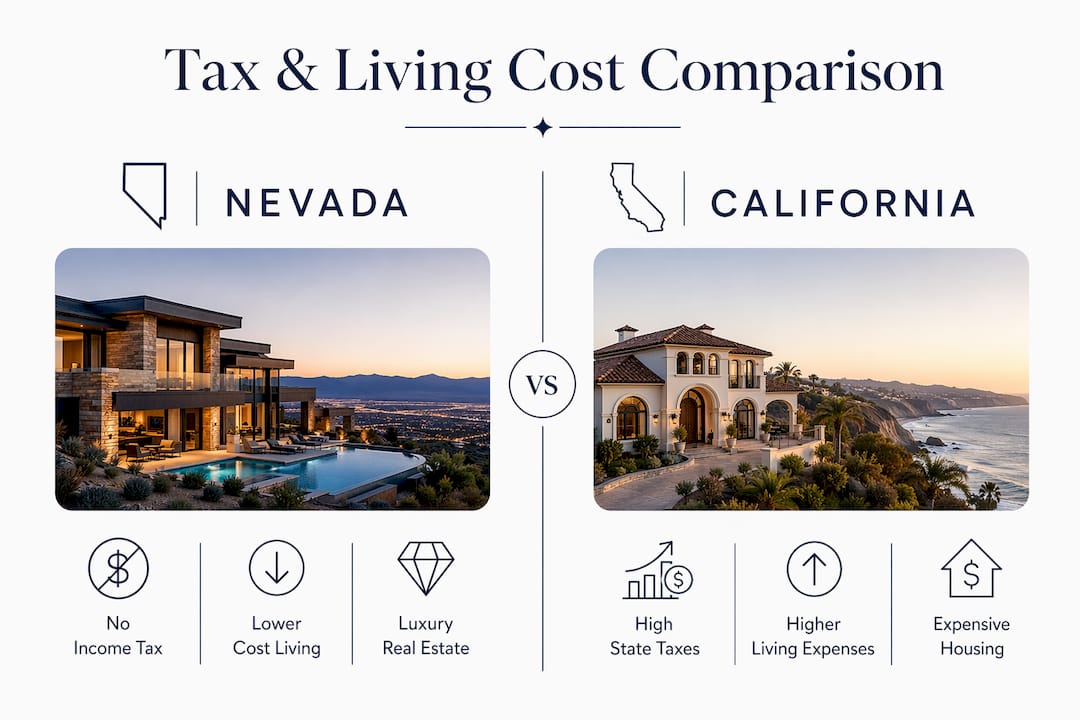
Silicon Valley buyers choose Las Vegas because Nevada eliminates state income, corporate, and inheritance taxes entirely, a direct contrast to California's top marginal rate of 13.3%. That single financial fact drives a migration that has reshaped the Las Vegas luxury market from a tourist economy into a residential destination for high-net-worth professionals. The millionaire household count in the Las Vegas metro surged 166% since 2019, growing from roughly 330 to nearly 900. Las Vegas now offers a rare convergence of fiscal discipline, luxury living, and an emerging tech culture that resonates deeply with the Silicon Valley mindset.
Why Silicon Valley buyers choose Las Vegas for financial freedom
Nevada's tax structure is the most immediate reason tech professionals and investors relocate from California. No state income tax, no corporate tax, and no inheritance tax create a fiscal environment that California cannot match. A founder who exits a company at $10 million in California faces a state tax bill exceeding $1.3 million. That same exit in Nevada costs nothing at the state level.
The cost-of-living advantage compounds the tax benefit. The cost of living in Las Vegas sits approximately 13% below the national average in 2026. For a household spending $250,000 annually, that gap represents real, recurring savings that accumulate over years.

Real estate pricing delivers perhaps the most visible contrast. A luxury home in Las Vegas that commands $2 million would cost $4 million or more in Palo Alto or Los Altos. Silicon Valley investors arriving with coastal equity find their purchasing power dramatically amplified. That amplification is one of the clearest reasons to buy in Las Vegas for buyers who have already built wealth in California.
The wealth influx is measurable and accelerating. Out-of-state buyers account for 57% of home views in Las Vegas, with Los Angeles and San Jose leading all search volumes. That data reflects a structural shift in buyer composition, not a temporary trend.
Pro Tip: If you are a California resident planning a move, consult a tax attorney before establishing Nevada domicile. The state requires genuine residency, not just a mailing address, to qualify for its tax benefits.
How has the Las Vegas luxury real estate market evolved?
The Las Vegas luxury market has matured significantly, moving well beyond its casino-adjacent origins into a residential tier that competes with coastal enclaves. The entry-level luxury price rose from approximately $752,891 in 2019 to $1.2 million in 2026. That growth reflects both rising demand and a fundamental shift in who is buying.
Las Vegas has shifted its economic focus from volume tourism to targeting high-value full-time residents. Guard-gated communities now feature wellness centers, resort-style pools, pickleball courts, and concierge services that mirror the amenities Silicon Valley buyers expect. Communities in Summerlin, Henderson, and MacDonald Highlands have set a new standard for what luxury residential living means in the desert Southwest.
California buyers bring specific expectations around indoor-outdoor living, natural light, and architectural sophistication. Luxury buyers' preferences for California-style indoor-outdoor flow, wellness amenities, and gated security are now the primary drivers of value retention in Las Vegas properties. Developers have responded with open floor plans, disappearing glass walls, and resort-caliber outdoor kitchens that speak directly to that sensibility.
The value-per-square-foot comparison remains compelling. A 5,000-square-foot home in a guard-gated Las Vegas community typically prices at a fraction of what a comparable property costs in Atherton or Hillsborough. That gap has not closed as quickly as some predicted, which means the window for acquiring Las Vegas luxury real estate at a relative discount remains open.
| Feature | Las Vegas luxury market | Coastal California equivalent |
|---|---|---|
| Entry-level luxury price | $1.2 million (2026) | $3 million and above |
| Square footage at $2M | 5,000+ sq ft typical | 2,000–3,000 sq ft typical |
| Property tax rate | Approximately 0.5–0.7% | 1.1–1.2% (plus Mello-Roos) |
| State income tax on gains | None | Up to 13.3% |
Pro Tip: When evaluating Las Vegas luxury communities, prioritize lot positioning and floor plan over the community name itself. A well-positioned lot in a secondary community often outperforms a poorly positioned lot in a marquee address at resale.
What lifestyle factors draw Silicon Valley professionals to Las Vegas?
Las Vegas offers a quality of life that has little to do with the Strip. The city has built a residential culture centered on outdoor recreation, world-class dining, professional sports, and wellness that appeals to professionals who want more than a tax address. The Las Vegas Raiders, Golden Knights, and Aces franchises have created a sports culture that feels genuinely civic rather than transactional.
Remote work levels remain above 25% of paid workdays nationally, which means Silicon Valley professionals can maintain their careers and compensation while living in Nevada. That flexibility has removed the primary barrier to relocation. A senior engineer at a Bay Area company can now live in Summerlin, pay no state income tax, and fly back to San Francisco twice a month without disrupting their career.
The city's entertainment infrastructure also serves a residential function that outsiders underestimate. Access to Michelin-recognized restaurants, luxury retail at Fashion Show and Crystals, and a calendar of world-class concerts and residencies creates a cultural richness that was absent a decade ago. For professionals accustomed to San Francisco's cultural density, Las Vegas now offers a credible, if different, alternative.
Urban revitalization efforts have added a community dimension that resonates with entrepreneurially minded transplants. The Downtown Project, associated with urban innovation advocate Zach Ware, targeted tech-focused urban revitalization and helped establish a community culture in downtown Las Vegas that attracts founders and creatives who want more than a suburban enclave.
How is Las Vegas building a tech ecosystem for Silicon Valley investors?
Las Vegas is developing a tech identity that complements rather than copies Silicon Valley. The city's approach is realistic: it targets remote-friendly founders, early-stage startups, and tech-adjacent businesses that benefit from lower operating costs and a pro-business regulatory environment. Nevada's pro-business tax climate gives startups more financial runway than California's cost structure allows.
The practical advantages for tech founders in Las Vegas are concrete.
- Zero state tax on business income means more capital stays in the company during early growth stages.
- Operating costs for office space, talent, and services run materially lower than Bay Area equivalents.
- University of Nevada, Las Vegas has expanded its computer science and engineering programs to address the local tech workforce gap, producing graduates who prefer to stay in Nevada.
- Local government support for tech-sector growth has accelerated permitting and created incentive programs for companies relocating from California.
- Geographic proximity to California keeps Las Vegas founders within a one-hour flight of their investors, clients, and former colleagues.
Las Vegas will not replicate the venture capital density or talent concentration of Silicon Valley in the near term. The city's tech ecosystem is developing as a complementary alternative, focused on remote-friendly, builder-culture startups rather than Series B unicorn factories. That distinction matters for founders who want to build without the overhead and competitive noise of the Bay Area.
Pro Tip: If you are launching a startup in Las Vegas, register your LLC in Nevada from day one. The state's corporate structure offers liability protections and tax advantages that are difficult to replicate retroactively.
Key Takeaways
Silicon Valley buyers choose Las Vegas because Nevada's zero-tax structure, lower cost of living, and maturing luxury real estate market create a financial and lifestyle advantage that California cannot match.
| Point | Details |
|---|---|
| Nevada tax advantage | No state income, corporate, or inheritance tax saves high earners over $130,000 per $1M in income versus California. |
| Luxury market growth | Entry-level luxury prices rose from $752,891 to $1.2M since 2019, reflecting strong demand and rising buyer sophistication. |
| Out-of-state buyer dominance | 57% of Las Vegas home views come from out-of-state buyers, with San Jose and Los Angeles leading all searches. |
| Remote work as enabler | Remote work above 25% of paid workdays lets Silicon Valley professionals relocate without leaving their careers behind. |
| Resale value discipline | Floor plan, lot position, and construction quality matter more than community name when buying for long-term resale. |
What I have learned watching Silicon Valley buyers enter this market
The buyers I work with from the Bay Area arrive with a clear financial thesis and a less clear picture of how Las Vegas actually works as a residential market. They have done the tax math correctly. Where they sometimes stumble is in treating Las Vegas like a smaller, cheaper version of Palo Alto, expecting the same neighborhood legibility and resale predictability they knew in California.
Las Vegas is a builder-driven market. That means the same community can contain floor plans that appreciate beautifully and floor plans that sit on the market for months, separated by nothing more than a lot number and a ceiling height. I have seen buyers overpay for a community name and underperform at resale because they did not scrutinize the specific unit. The resale value in Las Vegas ties to floor plan and lot positioning, not to the gate at the entrance.
My honest counsel to Silicon Valley buyers is this: bring your financial discipline to the property selection itself, not just to the tax planning. The market rewards buyers who understand what the next buyer will want, and that requires local knowledge that no amount of online research fully provides. The opportunity here is genuine and the growth trajectory is real. Approaching it with the same rigor you would apply to a Series A investment is what separates a great acquisition from a costly lesson.
— Yelena
Yhluxrealestate: your guide to Las Vegas luxury real estate
Yhluxrealestate, led by Yelena Horton and backed by Sotheby's International Realty's global network, specializes in serving out-of-state buyers who arrive with high standards and limited time. The firm provides exclusive access to off-market luxury properties that never reach public listings, a critical advantage in a market where the best homes move before they appear online.

Yhluxrealestate's relocation concierge handles the logistical complexity that Silicon Valley buyers face when purchasing from a distance, from neighborhood evaluation to financing coordination and closing. Every engagement is built around one outcome: placing the right buyer in the right property, with the negotiation positioning and market intelligence to protect that investment for years to come.
FAQ
Why do Silicon Valley buyers prefer Las Vegas over other low-tax states?
Las Vegas combines Nevada's zero-tax structure with a one-hour flight to San Francisco, luxury real estate at a fraction of California prices, and a growing residential culture that appeals to tech professionals. That combination of proximity, savings, and lifestyle is difficult to replicate in states like Texas or Florida.
What taxes do California residents avoid by moving to Nevada?
Nevada has no state income tax, no corporate income tax, and no inheritance tax, directly contrasting California's top marginal income tax rate of 13.3%. Establishing genuine Nevada domicile eliminates these liabilities on income earned after the move.
How much does luxury real estate in Las Vegas cost compared to Silicon Valley?
The entry-level luxury price in Las Vegas reached $1.2 million in 2026, while comparable properties in Silicon Valley communities like Atherton or Los Altos typically start at $3 million or more. Buyers from California routinely find they can purchase significantly more square footage and amenities for the same budget.
Is Las Vegas becoming a real tech hub or just a tax haven?
Las Vegas is developing a genuine tech ecosystem focused on remote-friendly startups and founder-culture businesses, supported by UNLV's expanded engineering programs and Nevada's pro-business regulatory environment. It is not positioned to replace Silicon Valley's venture capital density, but it offers a credible, lower-cost alternative for founders who want to build without Bay Area overhead.
What should Silicon Valley buyers know before purchasing in Las Vegas?
Floor plan selection and lot positioning matter more than community reputation when buying for long-term value. Resale performance in Las Vegas ties to specific unit characteristics, so working with an advisor who knows the local builder market is essential before committing.