
Luxury rentals are defined as premium residential properties that generate materially higher income and deliver superior lifestyle value compared to standard rental options. The case for high-end rental advantages has never been stronger: professionally managed luxury assets generate 2.2–4.7 times more gross revenue than mid-range listings, with Average Daily Rates running 15–25% higher when active management is applied. High-net-worth individuals increasingly choose to lease rather than own, preserving liquidity and maintaining the geographic flexibility that ownership cannot provide. For investors and renters alike, understanding why luxury rentals outperform standard rentals requires a clear look at pricing power, operational discipline, and the evolving profile of the modern affluent tenant.
Why luxury rentals outperform standard rentals: pricing power and revenue management
Premium pricing is the single most decisive factor separating luxury rental performance from standard rental performance. Luxury rental ADR rose 5.2% in early 2026 even as national occupancy declined 1.5%. That divergence is not accidental. It reflects a structural advantage: well-differentiated luxury properties face far less direct competition than mid-tier listings, which are crowded with near-identical options.
Supply and demand dynamics reinforce this insulation. Luxury supply grew 4.2% while demand held at 4.1%, keeping the premium segment in near-perfect equilibrium. Mid-tier supply, by contrast, has outpaced demand for several consecutive quarters, compressing rates and squeezing margins for standard rental owners. Luxury investors who understand this dynamic position their assets to capture the full benefit of constrained supply.
Professional revenue management amplifies the pricing advantage further. Dynamic pricing models, calibrated to seasonal demand curves and local event calendars, allow luxury managers to hold rates firm during high-demand periods rather than discounting to fill calendars. This discipline compounds into materially superior annual returns.
- Set a rate floor and hold it. Discounting a luxury property to fill a vacancy signals low value to the market and erodes long-term ADR.
- Use dynamic pricing tools calibrated to local demand signals, not national averages.
- Track ADR monthly, not annually, to catch rate drift before it becomes structural.
- Benchmark against comparable luxury properties, not the broader rental market.
Pro Tip: Luxury rental operating costs consume 45–55% of gross revenue, compared to 35–45% for mid-range properties. The higher cost is not a liability. It funds the service layers that justify premium rates and retain high-value tenants.
How operational excellence and service layers define luxury rental success
Operational excellence is not a differentiator in luxury rentals. It is the baseline. Ultra-high-net-worth guests treat concierge services, privacy-forward design, and frictionless living as core features, not amenities. A property that lacks these elements does not compete in the luxury segment regardless of its square footage or location.

The service architecture of a well-run luxury rental typically includes several non-negotiable layers. Dedicated concierge coordination handles everything from airport transfers to restaurant reservations, removing friction from the tenant's daily life. Pre-integrated smart-home systems control lighting, climate, security, and entertainment from a single interface. Wellness amenities, including private fitness studios, spa facilities, and curated outdoor spaces, address the physical and emotional expectations of discerning renters.
Turnkey readiness is equally critical. Properties must be fully optimized before move-in to retain ultra-high-net-worth renters, who prioritize emotionally compelling environments over size or price alone. A luxury tenant who encounters a half-finished smart-home system or an unstocked kitchen on move-in day will not renew. That single failure can cost an investor months of premium income.
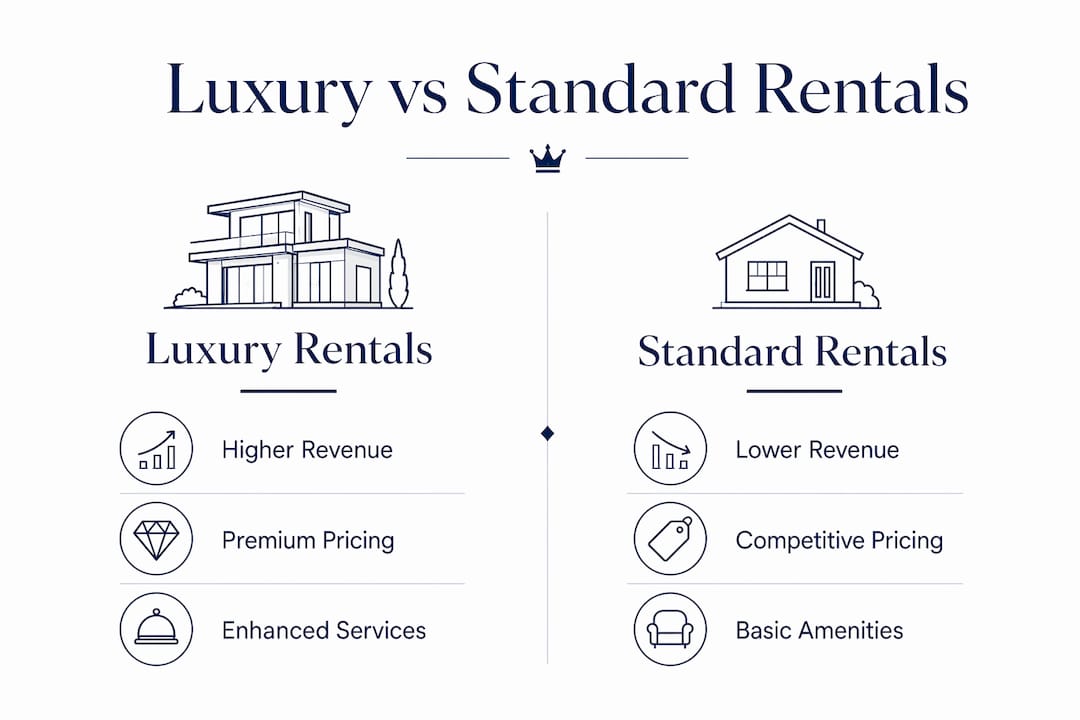
Active management also means accepting vacancy. Conscious vacancy acceptance during low-demand cycles protects ADR discipline and prevents brand dilution. This is the precise opposite of the "race to fill" mentality that governs standard rental management, and it is one of the clearest structural reasons why luxury assets outperform over time.
Pro Tip: Treat every vacancy as a brand decision, not a revenue loss. A luxury property that holds its rate through a slow month retains its market position. One that discounts trains the market to wait for lower prices.
Luxury rentals vs. homeownership: financial and lifestyle advantages
Renting a luxury property and owning one are not equivalent financial decisions. For high-net-worth individuals, leasing often represents the more disciplined capital allocation. Luxury home sales take 6–24 months to complete, locking capital in an illiquid asset during a period when markets may be moving rapidly. Leasing converts that capital into deployable liquidity, available for higher-yield investments.
The comparison between luxury leasing and ownership breaks down clearly across several dimensions.
| Factor | Luxury rental | Luxury ownership |
|---|---|---|
| Capital liquidity | Preserved for investment | Locked in property |
| Geographic flexibility | Pivot within 30 days | Sale process: 6–24 months |
| Maintenance exposure | Predictable monthly cost | Unpredictable capital events |
| Tax planning | Flexible residency options | Constrained by asset location |
| Market risk | None | Full exposure to price cycles |
The rentvestment strategy formalizes this logic. High-net-worth individuals rent their primary residence in a desirable location while deploying capital into diversified, higher-yield portfolios. The result is a lifestyle that matches or exceeds the quality of ownership, without the illiquidity, the maintenance burden, or the concentration risk.
Surprise maintenance costs represent one of the most underappreciated disadvantages of luxury ownership. A roof replacement, a pool system failure, or a structural issue can generate six-figure expenses with no warning. Luxury renters face none of this exposure. Their monthly cost is fixed, predictable, and inclusive of the property's full operational excellence.
What high-end renters look for: the modern luxury tenant profile
The modern luxury renter is not someone who cannot afford to buy. The modern luxury renter is someone who has chosen not to. Super-prime renters treat flexibility as the ultimate luxury, valuing the ability to relocate, reassess, and recalibrate their living situation without the friction of a property transaction.
This tenant profile carries specific expectations that shape how luxury rentals must be positioned and managed.
Affluent renters increasingly use luxury leasing as a strategic soft landing, evaluating a new market before committing capital to ownership. A corporate executive relocating to Las Vegas, for example, may lease a fully furnished luxury residence for 12 months while assessing neighborhoods, tax implications, and lifestyle fit. This behavior drives sustained demand for turnkey luxury rentals in high-growth markets.
The emotional and experiential dimensions of a property matter as much as its physical specifications. Curated art, considered lighting design, and thoughtfully composed outdoor spaces create an environment that resonates at a sensory level. Tenants who feel that a property reflects their identity and aspirations stay longer, refer others, and accept rate increases without resistance.
Smart-home integration is no longer a premium feature. It is an expectation. A luxury renter who must manually adjust thermostats or navigate a complicated security system will interpret that friction as a signal that the property is not truly luxury. Full pre-integration before move-in is the standard, not the exception.
Strategies for investors: how to maximize returns through luxury rental investments
Luxury rental investment rewards discipline and penalizes passivity. The investors who generate the strongest returns treat their properties as managed, branded products rather than passive income assets. That distinction shapes every decision, from pricing to maintenance scheduling to tenant selection.
- Position the property as a brand. Define its identity through design, service, and privacy features before listing it. A property without a clear identity competes on price. A property with a clear identity commands a premium.
- Select markets with regulatory and demand advantages. High-growth urban markets and resort destinations with limited new luxury supply offer the strongest pricing power. Las Vegas, for example, combines strong corporate relocation demand with a constrained luxury rental supply, creating favorable conditions for premium returns.
- Invest in concierge infrastructure. Branded management with concierge services and privacy-forward design drives premium performance. This is not optional for investors who want to compete in the top tier of the market.
- Accept vacancy as a management tool. Holding rates through slow periods protects long-term ADR and signals market confidence. Investors who discount to fill vacancies train tenants to expect lower prices and erode the property's brand position.
- Monitor operating cost ratios closely. Operating costs at 45–55% of gross revenue are normal for luxury properties. Costs that exceed this range signal management inefficiency, not market weakness.
Yhluxrealestate applies exactly this philosophy in the Las Vegas luxury market, combining off-market property access, expert negotiation, and a global network backed by Sotheby's International Realty to position investor clients for superior returns.
Key Takeaways
Luxury rentals outperform standard rentals because premium pricing power, operational discipline, and affluent tenant demand create a compounding structural advantage that mid-tier properties cannot replicate.
| Point | Details |
|---|---|
| Revenue advantage | Luxury properties generate 2.2–4.7x more gross revenue than mid-range listings. |
| ADR resilience | Luxury ADR rose 5.2% in 2026 even as national occupancy declined. |
| Vacancy discipline | Accepting vacancy to protect ADR compounds into higher annual returns than discounting to fill. |
| Tenant profile | Super-prime renters choose flexibility over ownership, sustaining luxury rental demand. |
| Investor strategy | Treat luxury rentals as managed brands, not passive assets, to defend premium pricing. |
What I have learned about luxury rental performance that most guides miss
Most investment guides treat luxury rentals as a volume play with a higher price tag. That framing misses the point entirely. The real advantage of luxury rental investment is structural, not incidental. It comes from operating in a segment where the rules of competition are fundamentally different.
Standard rental markets are driven by occupancy. Luxury rental markets are driven by identity. A tenant paying a premium monthly rate is not just paying for square footage or a view. They are paying for an environment that reflects who they are and how they want to live. The moment a property fails to deliver that experience, the premium evaporates.
What I have found in the Las Vegas market is that the investors who struggle are almost always the ones who underestimate operational costs and overestimate the power of location alone. A beautifully located property with mediocre management will underperform a well-managed property in a secondary location every time. Service is the product. Everything else is the setting.
The other insight that rarely appears in investment analyses is the compounding value of vacancy discipline. Holding a rate through a slow month feels costly in the short term. Over three years, the investor who holds rates consistently will have built a market position that commands materially higher rents than the investor who discounted. That gap is real, and it is large.
— Yelena
Yhluxrealestate: your guide to premier luxury rental opportunities
Investors and renters who want to act on the advantages detailed here need more than market data. They need a trusted partner with direct access to the properties and the expertise to position them correctly.
Yhluxrealestate, led by Yelena Horton and backed by Sotheby's International Realty, offers exclusive access to off-market luxury properties in Las Vegas, a market where constrained luxury supply and strong corporate relocation demand create ideal conditions for premium returns. The service includes a relocation concierge for out-of-state clients, expert negotiation strategies, and a global network that opens doors unavailable through standard listing channels. Whether you are an investor seeking superior yield or a discerning renter seeking turnkey excellence, Yhluxrealestate delivers the caliber of service the luxury segment demands.
FAQ
Why do luxury rentals generate higher returns than standard rentals?
Luxury rentals generate 2.2–4.7 times more gross revenue than mid-range listings, driven by premium ADR and affluent tenant demand. Professional management and service layers sustain that pricing advantage over time.
What does ADR mean in luxury rental investing?
ADR stands for Average Daily Rate, the average income earned per rented day. Luxury rental ADR rose 5.2% in early 2026, demonstrating pricing resilience even as broader occupancy declined.
Why do high-net-worth individuals rent instead of buy luxury homes?
High-net-worth individuals rent to preserve liquidity, avoid the 6–24 month sale process of luxury ownership, and maintain the flexibility to relocate or adjust tax residency within 30 days.
What services do luxury renters expect as standard?
Super-prime renters expect concierge coordination, pre-integrated smart-home systems, wellness amenities, and full turnkey readiness before move-in. These are baseline requirements, not premium add-ons.
How should investors handle vacancies in luxury rental properties?
Investors should accept vacancy rather than discount rates during slow periods. Holding ADR discipline protects brand position and compounds into materially higher long-term returns than a race-to-fill approach.