
When luxury inventory rises, buyer leverage increases and perceived exclusivity falls, compressing achievable prices with a swiftness that often surprises even seasoned participants. The mechanics are threefold: bargaining power shifts toward buyers, scarcity signaling erodes, and wealth-effect transmission amplifies every move the market makes. Kearney's 2026 Global Luxury Outlook links equity-market volatility directly to pauses in high-net-worth transaction velocity, illustrating how quickly the trophy bid book can thin. For buyers and sellers navigating U.S. luxury real estate, understanding why luxury market inventory affects pricing is not an academic exercise; it is the foundation of every negotiation posture and every listing decision. Yhluxrealestate serves as a practitioner resource for precisely this kind of market intelligence, particularly across Las Vegas's most coveted enclaves.
- Rising inventory increases buyer leverage and weakens scarcity signaling.
- Wealth-effect transmission links equity-market conditions to transaction velocity.
- Distribution control, not price alone, preserves long-term pricing power.
Table of Contents
- How does supply and demand work differently in luxury real estate?
- Why luxury pricing behaves differently than mainstream markets
- How does rising inventory translate into lower sold prices?
- What metrics should you monitor for luxury inventory pressure?
- What should sellers do when luxury inventory rises?
- How should buyers act when luxury inventory rises?
- Why do off-market listings preserve pricing power?
- Key Takeaways
- The inventory signal most sellers misread
- Protect your position in a shifting luxury market
- Useful sources
How does supply and demand work differently in luxury real estate?
Months of inventory, the standard absorption-rate metric, governs price discovery in every housing tier, yet its effects at the luxury level are both slower to appear and more severe once they arrive. A market with fewer than five months of supply generally favors sellers; above seven months, buyers gain meaningful negotiating room. In luxury enclaves, those thresholds can shift, but the directional logic holds.
- Inventory increase leads to longer time on market.
- Longer marketing periods produce more visible price reductions.
- Price reductions lower sale-to-list ratios and reset comparable sales.
- Reset comps suppress appraisal values and future list prices.
Consider a prime neighborhood where active listings double over two quarters. Sellers who priced to the prior market find their homes sitting; buyers, sensing the shift, submit offers with inspection contingencies and closing-cost requests that would have been dismissed six months earlier. The transmission, however, is not identical to the broader market. Roughly 50–60% of trophy-tier transactions close without a mortgage, meaning interest-rate movements matter far less than equity-portfolio health and confidence. Cash dominance slows the rate channel but does not insulate the market from inventory pressure.
Why luxury pricing behaves differently than mainstream markets
Luxury price is, at its core, a signaling mechanism rather than a straightforward cost reflection. Buyers at the top tier are not purchasing square footage alone; they are purchasing identity, exclusivity, and the social grammar that a rare address communicates. Behavioral pricing mechanisms — scarcity, identity signals, and consistency bias — explain why visible inventory can erode price far more quickly in luxury categories than in mainstream ones.

Mainstream pricing optimizes for volume: reach the widest qualified audience, price to clear inventory, and accept modest margins on high turnover. Luxury pricing optimizes for exclusivity: restrict supply, cultivate desire, and command a premium that reflects perceived rarity. When inventory rises and that rarity becomes visibly questionable, the premium itself is at risk.
Analysts including Mario Ortelli and Bernstein have identified a price ceiling after multi-year increases, arguing that inventory abundance forces a strategic shift from pricing tactics to supply-chain control and product differentiation. The reputational dimension compounds this: Forbes documented how luxury goods overstock led to discounting that threatened brand equity, a pattern with direct parallels in high-end real estate when listings migrate to auction or heavy concessioning.
How does rising inventory translate into lower sold prices?
The transmission from new listings to lower sold prices follows a recognizable sequence, though the pace varies by property type and macro conditions.
- New listings accumulate, extending average days on market.
- Slower bidding activity reduces multiple-offer scenarios.
- Sellers initiate price reductions to recapture buyer attention.
- Reduced list prices become new comparable sales.
- Appraisers and valuers anchor to those comps, suppressing future valuations.
- Buyers gain leverage to negotiate concessions: closing costs, repairs, rate buydowns.
U.S. luxury inventory growth in Los Angeles, Miami, and Aspen through 2024–2025 pushed several markets into balanced conditions, producing a January 2026 price flatline that confirmed the sequence above. Macro amplifiers accelerate every step: equity-market volatility thins the trophy bid book, while trade and tariff shifts create cost and demand uncertainty that further dampens buyer confidence. Trophy properties, those with irreplaceable provenance, architecture, or location, tend to hold value longer because their scarcity is structural rather than manufactured. Non-trophy luxury, the well-appointed but replicable tier, is far more sensitive to inventory changes and the first to see price reductions.
What metrics should you monitor for luxury inventory pressure?
Absorption rate and months of inventory lead all other indicators; median sold price lags by weeks or months and often masks the shift already underway.
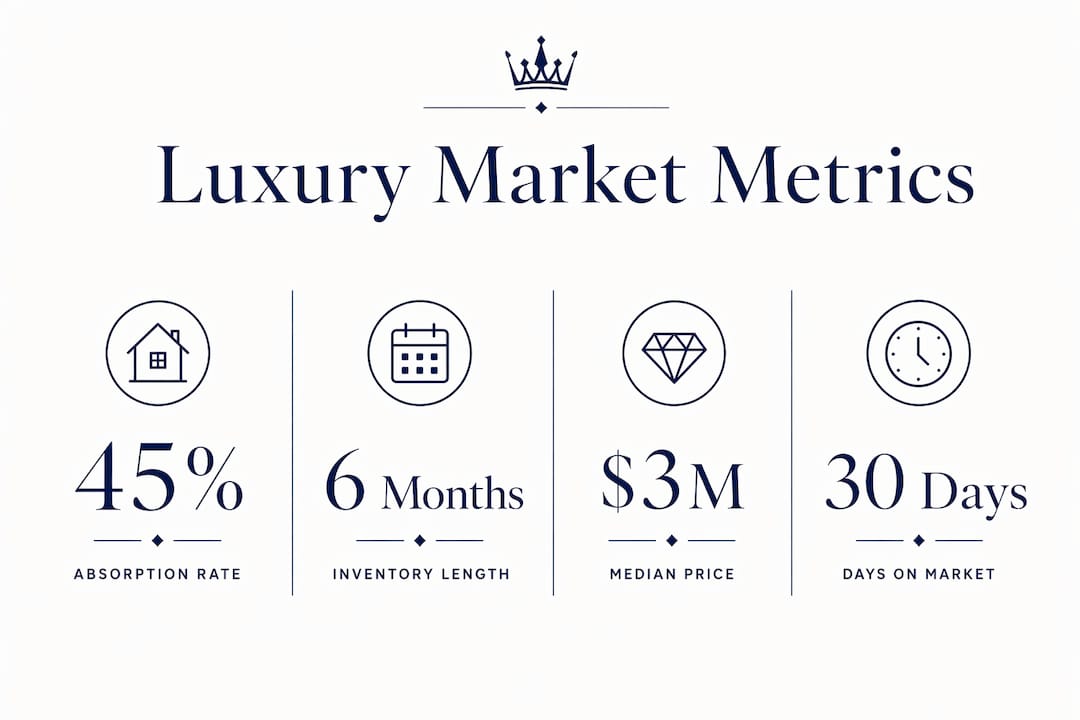
| Metric | What it measures | Why it matters in luxury | Threshold to watch |
|---|---|---|---|
| Months of inventory | Active listings divided by monthly sales pace | Primary signal of buyer vs. seller leverage | Below 5: seller's market; above 7: buyer's market |
| Absorption rate | Percentage of listings sold per month | Speed at which supply is clearing | Falling rate signals softening demand |
| Days on market | Average time from list to contract | Reflects buyer urgency and pricing accuracy | Rising DOM signals inventory pressure |
| New listings (weekly) | Fresh supply entering the market | Early warning of supply build | Sustained weekly increases precede price softening |
| Price-reduction frequency | Share of active listings with at least one reduction | Reveals seller capitulation | Above 20% in a submarket signals meaningful pressure |
| Off-market activity | Private transactions not on MLS | Indicates true demand at full price | Declining off-market volume is an early warning |
Pro Tip: Combining rising new listings with rising days on market is a stronger signal than either metric alone. When both trend upward simultaneously over four to six weeks, sellers should reassess pricing before the first price reduction becomes necessary.
Data cadence matters: active luxury markets warrant weekly monitoring of new listings and days on market, while slower enclaves can be reviewed monthly without losing meaningful lead time.
What should sellers do when luxury inventory rises?
Prioritize exclusivity, narrative, and targeted distribution over blunt price reductions or mass-market exposure. The goal is to preserve the scarcity signal even as the broader market softens.
- Precision pricing from day one. Overpricing in a rising-inventory market accelerates days on market and forces a public reduction, which resets comps unfavorably. A well-calibrated luxury listing price attracts qualified buyers before the market absorbs comparable supply.
- Staged showings and off-market previews. Selective access preserves the perception of rarity. A private preview to a curated buyer list tests demand without creating a visible days-on-market clock.
- Buyer qualification before showings. Limiting access to financially verified, motivated buyers reduces the risk of low-ball offers that could anchor future negotiations.
- Enhanced storytelling and provenance documentation. Architecture, designer provenance, and lifestyle narrative differentiate a property from inventory that looks similar on paper.
- Phased listing strategy. Smaller-batch or phased approaches reduce visible supply and protect comps, a principle luxury goods brands apply to protect brand equity.
Pro Tip: An off-market preview of 14–21 days, offered exclusively through a qualified broker network, can generate a private bid at or above list price before a property ever appears on the MLS. This approach, central to Yhluxrealestate's distribution strategy, keeps comps clean and negotiating leverage intact.
At the 30-day mark with no offer, reassess narrative and buyer targeting before adjusting price. At 60–90 days, a strategic relist with updated positioning often outperforms a visible price reduction.
How should buyers act when luxury inventory rises?
Rising inventory creates genuine windows for disciplined buyers, but patience and selectivity determine whether those windows yield real value or merely the appearance of it. The buyers who extract the most favorable terms are those who arrive prepared, not those who arrive aggressive.
Building a priority short list of five to eight properties allows a buyer to move decisively when the right opportunity surfaces, rather than making reactive offers under pressure. Appraisal-sensitive offer structures, where the purchase price is anchored to a defensible valuation, protect buyers in markets where comps are actively resetting downward. Inspection and closing flexibility, offered strategically, can secure price concessions from sellers who have already absorbed the psychological cost of a reduction.
Off-market access changes the calculus entirely. Private inventory, reached through broker relationships and networks like Sotheby's International Realty, often carries sellers who are motivated but unwilling to accept the reputational cost of a public price reduction. East Coast buyers evaluating Las Vegas, for example, frequently discover that the most compelling opportunities never appear on the MLS at all.
The caution worth heeding: aggressive lowballing on a well-positioned property can stall negotiations entirely, particularly when a seller's identity is bound to the asset. A staged offer strategy, opening at a credible figure with clearly communicated flexibility on terms, tends to produce better outcomes than a single dramatic opening bid.
Why do off-market listings preserve pricing power?
Controlled distribution reduces visible supply and preserves negotiating leverage, which is why the most sophisticated sellers in trophy markets default to private channels before considering public exposure. When a property does not appear on the MLS, it does not contribute to the days-on-market statistics that buyers and their agents use to calibrate offers. It does not become a comparable sale at a reduced price. It simply does not exist in the public inventory count.
The private real estate transaction model offers several structural advantages that compound over time.
- Protects brand and perception by keeping the property out of public inventory tallies.
- Reduces the risk of setting unfavorable comps that suppress neighborhood valuations.
- Enables buyer qualification before any price discussion, preserving leverage.
- Maintains the scarcity signal that underpins luxury pricing psychology.
The parallel in luxury goods is instructive: the Fashion Transparency Index found high rates of non-disclosure among major brands, a deliberate opacity that supports pricing power by preventing external inventory signals from reaching the market. Selective distribution in real estate operates on the same principle. Full-market exposure remains appropriate when a property's unique attributes are best showcased to the widest possible audience, or when a seller's timeline demands maximum reach, but it should be a considered choice rather than a default.
Scarcity in high-demand property markets across multiple geographies confirms that controlled supply, whether geographic, regulatory, or strategic, consistently commands premium pricing. The mechanism is universal; the application is local.
Key Takeaways
Luxury market inventory affects pricing through behavioral mechanisms, not just supply-and-demand arithmetic, and the sellers and buyers who understand that distinction hold a decisive advantage.
| Point | Details |
|---|---|
| Inventory drives leverage | Rising supply shifts bargaining power to buyers and erodes scarcity signaling within weeks. |
| Trophy vs. non-trophy sensitivity | Non-trophy luxury responds to inventory shifts faster; trophy assets with irreplaceable provenance hold value longer. |
| Lead indicators to monitor | Track absorption rate and new listings weekly; median sold price lags and often masks the shift already underway. |
| Off-market distribution | Keeping listings out of public inventory preserves comps, scarcity perception, and negotiating leverage. |
| Yhluxrealestate advantage | Off-market access and precision pricing through Sotheby's International Realty network protect value for both buyers and sellers in Las Vegas. |
The inventory signal most sellers misread
The conventional wisdom holds that a rising market forgives pricing errors and a softening market demands price cuts. Neither is quite right at the luxury tier, and the gap between those two assumptions is where most sellers lose money.
What the data from Los Angeles, Miami, and Aspen through 2024–2025 actually shows is that the first casualty of rising inventory is not the sale price; it is the scarcity signal. Once buyers perceive that comparable properties are available, the urgency that drives full-price offers evaporates. A seller who responds with a public price reduction has now confirmed the buyer's perception and handed them a comp to use in every subsequent negotiation. The price cut that was meant to attract offers often produces the opposite: it signals distress and invites further negotiation.
The more effective response, and the one that the most sophisticated sellers in Las Vegas's trophy tier have employed, is distribution discipline before price adjustment. An off-market preview, a curated broker outreach, a private showing to three qualified buyers rather than thirty curious ones: these preserve the psychological architecture of exclusivity even when the broader market is softening. Kearney's observation that aspirational buyers are increasingly sensitive to price-quality gaps is a reminder that the luxury premium is earned continuously, not granted permanently.
Protect your position in a shifting luxury market

Yhluxrealestate offers buyers and sellers in Las Vegas a concrete advantage when inventory shifts alter the pricing equation: exclusive access to off-market properties that never enter the public supply count, precision pricing calibrated to absorption-rate data, and negotiation strategies built around buyer positioning rather than reactive discounting. Backed by the Sotheby's International Realty global network and a dedicated relocation concierge for out-of-state buyers, Yhluxrealestate brings the distribution discipline and market intelligence that preserve value on both sides of a transaction. Whether the market is tightening or softening, the right representation determines whether inventory works for you or against you. Connect with Yhluxrealestate to discuss your position in the current Las Vegas luxury market.
Useful sources
| Source | Relevance | Best for |
|---|---|---|
| Kearney 2026 Global Luxury Outlook | Links equity-market volatility to luxury transaction velocity and inventory absorption | Market data and wealth-effect transmission |
| The Luxury Playbook: U.S. Price Flatline | Documents 2024–2025 U.S. inventory build and January 2026 price flatline; cash-sale prevalence data | U.S. market metrics and timeline expectations |
| Agility Research: Price-Value Equation | Analyst commentary on the price ceiling and supply-control response | Behavioral pricing and strategic shifts |
| SubtleLuxuryLife: How Luxury Pricing Is Decided | Explains scarcity, identity signaling, and consistency bias as pricing drivers | Behavioral insights and off-market rationale |
| Forbes: Luxury Overstock and Discounting Risk | Cross-industry evidence that discounting erodes luxury brand equity | Seller strategy and reputational risk |
| Lexology: Luxury Fashion Inventory Balance | Covers smaller-batch production, transparency gaps, and distribution control | Off-market distribution and phased listing strategy |
| Reuters: Tariffs and Luxury Pricing Power | Frames macro/policy events as tests of luxury pricing resilience | Macroeconomic factors and buyer strategy |
| Yhluxrealestate: Private Transactions | Explains off-market mechanics in Las Vegas luxury context | Practitioner guidance on distribution control |
| Yhluxrealestate: Seller Exit Strategies | Covers seller timeline and negotiation outcomes | Seller tactics and pricing discipline |