
Luxury amenities are defined as property features that elevate a home's lifestyle appeal beyond standard expectations, and they directly influence resale value by expanding the buyer pool and supporting premium pricing. Understanding why luxury amenities affect resale value is no longer a matter of intuition. Zillow's 2026 research confirms that lifestyle-driven amenities can push a home's final sale price as much as 5.4% above expectations. For homebuyers and real estate investors, that figure represents both a purchase decision and a long-term financial strategy. The distinction between features that merely impress and those that genuinely hold value at resale is where informed decisions are made.
Why luxury amenities affect resale value: the core mechanism
Luxury amenities increase resale value because they shift a property from a commodity into a curated lifestyle offering. Buyers in the upper price tiers are not simply purchasing square footage. They are purchasing a way of living, and amenities are the clearest expression of that promise. When a property delivers on that promise in a measurable, move-in-ready way, it commands a premium that appraisers, lenders, and buyers all recognize.
The Appraisal Institute confirms that amenity premiums reflect market demand, meaning their value is not fixed. It rises and falls with buyer preferences and comparable sales in the local market. This is why the same outdoor kitchen that adds 4.4% to a sale price in one market may add less in another where that feature is already standard. Context governs value, and understanding that context is the foundation of sound investment.

Buyers also favor move-in-ready homes with luxury amenities because they can roll improvement costs into mortgages, avoiding expensive upfront projects. That financial convenience translates directly into willingness to pay more at closing.
What types of luxury amenities deliver the greatest resale uplift?
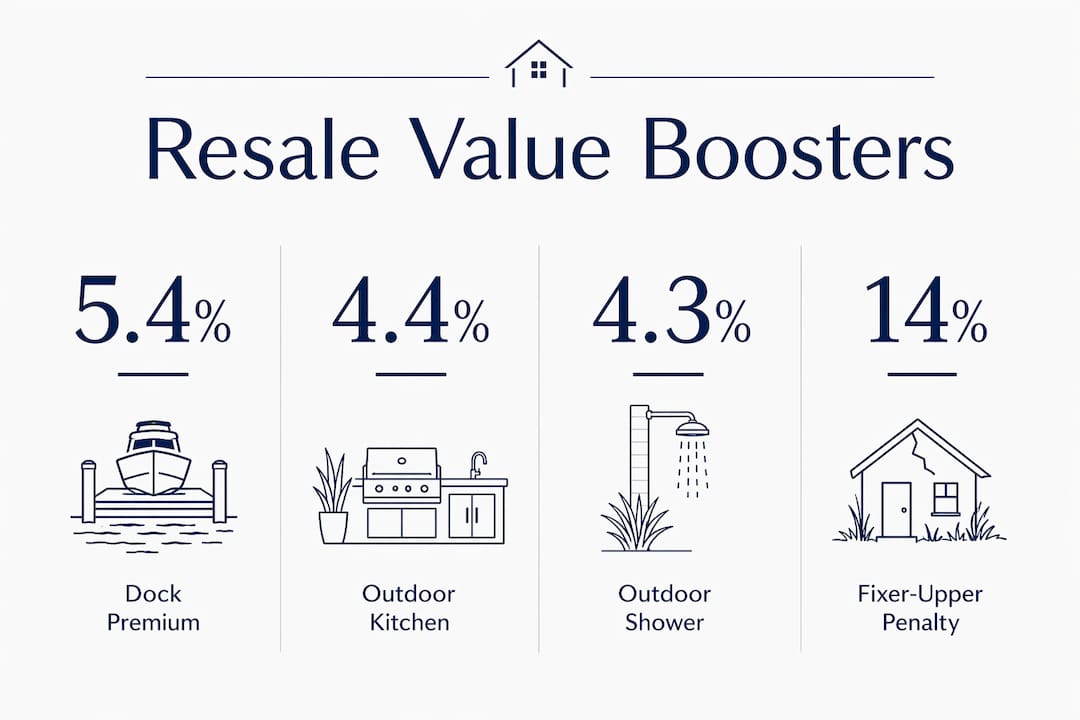
The impact of luxury features on resale is not uniform across all upgrades. Zillow's 2026 data identifies specific amenities that consistently outperform expectations at the point of sale.
| Amenity | Average Resale Premium |
|---|---|
| Dock | +5.4% |
| Outdoor kitchen | +4.4% |
| Outdoor shower | +4.3% |
| Bespoke finishes | +3.0% |
| Customized features | +3.2% |
| Turnkey condition | +2.9% |
| Remodeled interiors | +2.2% |
| Fixer-upper condition | -14.0% |
Docks lead the table because they represent a scarce, location-dependent feature that cannot be replicated without significant capital and permitting. Outdoor kitchens and showers follow closely, reflecting the sustained demand for al fresco living that has defined the post-pandemic luxury market. Bespoke finishes and customized features add premiums of 3.0% and 3.2% respectively, demonstrating that personalization tied to buyer preferences adds measurable value beyond raw square footage.
The contrast with fixer-uppers is instructive. A home that sells 14% below expected price illustrates the cost of deferred investment. Luxury buyers price in the inconvenience of renovation, and they price it harshly. A property that arrives complete, refined, and appointment-ready commands a fundamentally different conversation at the negotiating table.
Pro Tip: When evaluating a luxury purchase for resale potential, prioritize amenities that are difficult or expensive to add later, such as docks, outdoor kitchens, and custom millwork. These features carry scarcity value that standard upgrades cannot replicate.
How do shared community amenities compare to private features?
Shared community amenities and private property features serve different buyer motivations, and both influence resale value in distinct ways. Private amenities signal exclusivity and personal investment. Shared amenities signal community quality and reduce individual maintenance burden.
GOBankingRates reports that 60% of prospective buyers would pay a premium for shared community amenities, with 76% of those buyers willing to pay 5% or more. That willingness reflects a practical calculation: shared pools, fitness centers, and tennis courts deliver lifestyle value without the cost of private ownership and upkeep.
A critical insight that most buyers overlook is that even unused amenities add resale value because future buyers may regard them as necessary. A resident who never uses the community spa still benefits from its presence at resale, because the next buyer may consider it non-negotiable. Amenities expand the addressable buyer pool, and a wider pool produces stronger offers.
The tradeoffs between shared and private amenities deserve clear consideration:
Shared community amenities:
Advantages include lower individual cost, broader lifestyle appeal, and the ability to attract buyers who could not afford equivalent private features. The presence of a well-maintained community gym or resort-style pool positions a building or development as a complete lifestyle destination.
Disadvantages include dependence on HOA management quality, potential for fee increases, and the reality that a poorly maintained shared facility can actively harm resale value rather than support it.
Private amenities:
Advantages include exclusivity, full control over condition and use, and the ability to tailor features precisely to buyer preferences. A private dock or chef's kitchen signals a level of investment that resonates with the most discerning buyers.
Disadvantages include higher upfront cost, ongoing maintenance responsibility, and the risk that highly personalized features may not align with future buyer tastes.
Pro Tip: Request the HOA's most recent reserve study before purchasing any amenity-rich property. A well-funded reserve signals that shared amenities will remain in excellent condition, protecting your resale premium for years ahead.
What are the hidden costs that can offset amenity-driven resale premiums?
The benefits of high-end amenities are real, but they carry operational costs that can erode the premium if left unexamined. Luxury condo amenities affect resale value indirectly through HOA budget and reserve funding viability. A building with a stunning rooftop pool and an underfunded reserve account is a liability dressed as an asset.
Buyers must scrutinize four specific cost factors before attributing full resale value to any amenity-rich property:
-
HOA fee trajectory. Rising fees reduce net buyer affordability and compress the pool of qualified purchasers. A $2,000 monthly HOA fee in a market where comparable buildings charge $800 will suppress demand regardless of amenity quality.
-
Reserve fund adequacy. Amenity-rich buildings function like complex enterprises. A reserve study that reveals deferred maintenance on elevators, pools, or fitness centers signals future special assessments that buyers will discount from their offers.
-
Amenity condition and management. A neglected outdoor kitchen or a closed community pool does not add value. It signals mismanagement and raises questions about the entire property's upkeep. Condition is the multiplier that either amplifies or destroys the amenity premium.
-
Market saturation. When every new development in a submarket offers the same amenity package, the premium for any individual feature compresses. Appraisers connect market evidence to buyer demand when valuing luxury amenities, so a feature that was rare three years ago may now be standard, and its premium may have followed suit.
The most sophisticated investors treat amenity costs as a line item in their underwriting, not an afterthought. Sustainable fees preserve resale premiums. Unsustainable fees destroy them.
How does location and proximity to recreational amenities affect resale?
The effect of upscale features on market value extends beyond the property boundary. Neighborhood amenities, particularly parks, greenways, and recreational trails, exert a measurable influence on resale pricing that operates independently of what sits inside the home.
A hedonic pricing study of the Waterford Greenway and Great Western Greenway in Ireland quantified this effect with precision. Each kilometer farther from these greenways correlates with a 1.35% and 1.22% lower mean sale price respectively. The methodology used spatial regression to isolate the greenway effect from other variables, making the finding statistically credible and transferable to other markets.
| Distance from Greenway | Price Effect |
|---|---|
| At greenway proximity | Baseline premium |
| 1 km farther | -1.22% to -1.35% |
| 2 km farther | -2.44% to -2.70% |
| 3 km farther | -3.66% to -4.05% |
The implication for luxury buyers and investors is direct. A property positioned near parks, trails, or waterfront access carries a locational premium that compounds the value of its private amenities. The two categories of amenity, private and locational, are not substitutes. They are multipliers. A home with a private outdoor kitchen that also sits adjacent to a well-maintained greenway or marina captures value from both directions.
In markets like Las Vegas, where luxury real estate commands attention from both domestic and international buyers, proximity to golf courses, resort corridors, and recreational infrastructure functions as a permanent, location-anchored amenity that no renovation can replicate. Buyers who understand this dynamic position themselves to acquire properties whose resale premiums are structurally supported, not merely aspirational.
Key takeaways
Luxury amenities increase resale value by expanding buyer demand, supporting premium pricing, and delivering lifestyle certainty that buyers are willing to pay for at closing.
| Point | Details |
|---|---|
| Top amenities by premium | Docks, outdoor kitchens, and outdoor showers add 4.3%–5.4% to sale price per Zillow 2026. |
| Shared amenities drive demand | 60% of buyers pay premiums for community features; 76% of those pay 5% or more. |
| HOA health determines value | Underfunded reserves and rising fees can erase amenity premiums entirely. |
| Location compounds value | Each kilometer from a greenway or recreational corridor reduces mean sale price by over 1%. |
| Move-in-ready commands more | Turnkey homes sell 2.9% above expected; fixer-uppers sell 14% below. |
What I have learned about amenities and resale after years in Las Vegas luxury real estate
The conversation about amenities and resale value is one I have with buyers and investors almost every week, and the same misunderstanding surfaces repeatedly. Buyers focus on the amenity itself. The more experienced investors focus on the amenity's operational context. Both matter, but the second one is where fortunes are protected or lost.
I have seen properties with extraordinary private amenities, chef's kitchens, resort pools, home theaters, sell below their potential because the HOA was carrying deferred maintenance and a reserve fund that could not sustain the building's lifestyle promise. The amenity looked magnificent. The financial structure behind it was fragile. Buyers who did their due diligence walked away. Those who did not paid a premium for a problem.
The amenities I consistently see hold their value in the Las Vegas luxury market are those tied to outdoor living and personalization. Outdoor kitchens, covered loggias, and water features perform reliably because the climate supports year-round use. That sustained utility is what appraisers and buyers both recognize. A feature used twelve months a year commands more than one used three.
My advice to any serious buyer or investor is this: read the HOA documents before you fall in love with the amenities. Verify the reserve study. Understand what the monthly fees fund and what they do not. Then evaluate the private features against the locational context. A property that scores well on both dimensions, strong private amenities in a location with genuine recreational infrastructure, is the one that will hold its premium through market cycles.
— Yelena
Yhluxrealestate: finding properties where amenities work for you
Selecting a luxury property where amenities genuinely support long-term resale value requires more than a beautiful listing. It requires market intelligence, access to properties before they reach the open market, and the ability to evaluate both lifestyle appeal and financial structure with equal rigor.

Yhluxrealestate, led by Yelena Horton and backed by Sotheby's International Realty, provides exactly that depth of service to buyers and investors in the Las Vegas luxury market. From off-market properties with premium outdoor living features to condominiums with well-managed community amenities, the focus is always on acquisitions that protect and grow your investment. Buyers relocating from out of state benefit from a dedicated concierge service that addresses every detail of the transition. Explore Las Vegas luxury listings and connect with a team that treats your resale outcome as seriously as your purchase decision.
FAQ
What amenities add the most resale value to a luxury home?
Docks, outdoor kitchens, and outdoor showers consistently deliver the highest resale premiums, ranging from 4.3% to 5.4% above expected sale price according to Zillow's 2026 research. These features combine scarcity, lifestyle appeal, and high replacement cost.
Do luxury amenities increase home value even if buyers don't use them?
Unused amenities still add resale value because they expand the future buyer pool. A buyer who never uses a community spa benefits at resale from buyers who consider it a requirement.
How do HOA fees affect the resale premium from luxury amenities?
High or rising HOA fees reduce buyer affordability and compress the pool of qualified purchasers, which can offset the premium that amenities would otherwise generate. A well-funded reserve and stable fees are prerequisites for sustaining amenity-driven resale value.
Does proximity to parks and trails affect luxury property resale prices?
Research using hedonic pricing models shows that each kilometer farther from a greenway or recreational trail reduces mean sale price by 1.22% to 1.35%. Locational amenities compound the value of private features rather than substitute for them.
Are move-in-ready luxury homes worth more than fixer-uppers?
Turnkey homes with luxury amenities sell approximately 2.9% above expected price, while fixer-uppers sell roughly 14% below. Buyers price in the cost and inconvenience of renovation, making move-in-ready condition a significant value driver at resale.