
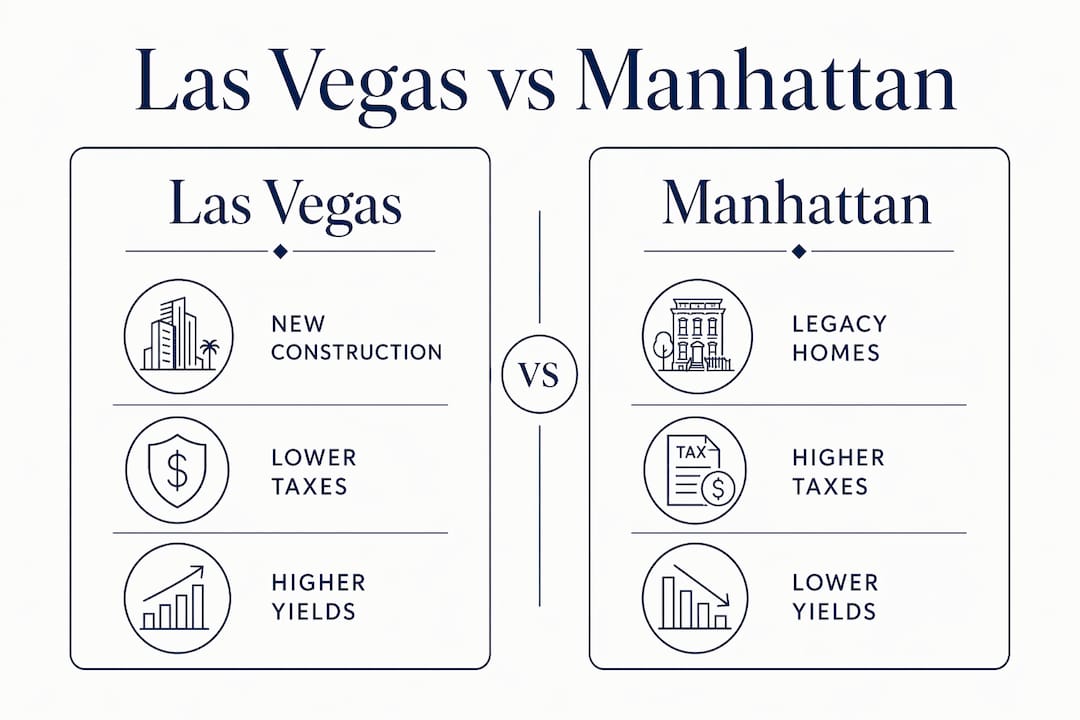
Las Vegas luxury real estate is defined by a structural cost advantage over Manhattan, rooted in land availability, a zero-income-tax environment, and the prevalence of new construction that eliminates the renovation burden endemic to legacy coastal properties. The median home price in Las Vegas sits near $440,000, compared to Manhattan's $1.32 million, a disparity that widens considerably at the top of the market. Nevada's 0% state income tax, contrasted with New York City's combined 14.7% rate, compounds the savings year after year. For wealthy buyers and investors who understand why Las Vegas luxury costs less than Manhattan, the financial case is not merely compelling. It is, by any rigorous measure, decisive.
Why Las Vegas luxury costs less than Manhattan: land and new construction
The single most underappreciated driver of Las Vegas luxury affordability is the sheer availability of developable land. In Manhattan, scarcity is absolute. Every square foot of buildable space has been spoken for, often for generations, which means luxury buyers are almost always purchasing legacy properties built decades ago with floor plans and mechanical systems that no longer reflect contemporary standards of living.
Las Vegas operates under an entirely different calculus. High-net-worth buyers are drawn to the Nevada desert precisely because they can commission or purchase estates built from the ground up, integrating current architectural sensibilities, smart-home technology, and energy-efficient systems from the first pour of concrete. The result is a product that is not only newer but functionally superior for modern living.

The cost implications for Manhattan buyers are severe. Legacy NYC luxury homes built decades ago routinely require seven-figure renovations before they meet the expectations of a discerning buyer. Rewiring, replumbing, HVAC replacement, and structural updates can add $1 million to $3 million to the true cost of acquisition. Las Vegas buyers, by contrast, receive turn-key modern estates where the purchase price is the actual price.
New construction also attracts a different caliber of talent to the Las Vegas market. Better architects, designers, and builders follow the demand for ground-up luxury development, which in turn raises the quality of the overall inventory. This dynamic distinguishes Las Vegas from coastal resale markets where buyers compete for the same aging stock.
Pro Tip: When comparing luxury properties across markets, always calculate the "true acquisition cost" by adding estimated renovation expenses to the purchase price. A $4 million Manhattan co-op requiring $2 million in updates competes very differently with a $4 million new build in Summerlin or Henderson.
How does Nevada's tax environment affect luxury real estate costs?
Nevada's tax structure is not merely favorable. It is, for high earners, transformative. The state levies no income tax whatsoever, placing it in direct contrast to New York, where the combined state and local income tax rate reaches 14.7% for top earners in New York City.
The annual savings are quantifiable and substantial. At an income of $250,000, a Nevada resident retains approximately $26,500 more per year than a comparable New York City resident. Over a decade, cumulative savings exceed $500,000 at that income level, a figure that represents a meaningful portion of a luxury property's purchase price. That is capital that can be redeployed into the property itself, into additional investments, or simply preserved.
Property tax rates in Nevada are also lower than those in New York. Nevada's effective property tax rate is among the lowest in the nation, which reduces the annual carrying cost of holding a luxury asset. Carrying costs matter enormously at the top of the market, where a Manhattan penthouse can generate six-figure annual property tax bills that compound the already elevated purchase price.
| Income Level | Annual Tax Savings (NV vs. NYC) | 10-Year Cumulative Savings |
|---|---|---|
| $100,000 | $9,500 | $95,000 |
| $250,000 | $26,500 | $265,000 |
| $500,000 | $53,000+ | $530,000+ |
The cost-of-living advantage for affluent households moving from coastal metros to Las Vegas is concentrated almost entirely in housing, state taxes, and energy costs. Groceries and healthcare costs are broadly comparable. The real savings are structural, not incidental.
Pro Tip: Before committing to a Las Vegas purchase, consult a tax attorney who specializes in interstate domicile changes. Establishing Nevada residency correctly is the mechanism through which the tax savings are realized. The property purchase alone does not confer the benefit.
Manhattan vs Las Vegas costs: what do the market numbers say?
Las Vegas luxury home prices rose 16.1% year-over-year by April 2026, a rate that places it among the fastest-appreciating luxury markets in the United States. That rate of appreciation signals genuine demand from high-net-worth buyers who have evaluated both markets and chosen Las Vegas.
Yet the same data reveals a nuance that sophisticated investors should register. The number of luxury homes sold in Las Vegas decreased by 14.3% over the same period, and the median days on market rose to 97 days, up 31 days year-over-year. Price growth and sales velocity are moving in opposite directions. This pattern suggests a market where sellers have raised expectations faster than buyers have followed, creating a window of negotiating leverage for well-positioned purchasers.
Manhattan's luxury segment tells a different story. Entry prices are dramatically higher, the inventory is older, and the carrying costs are compounded by New York City's tax burden. The median home price in Manhattan stands at $1.32 million across all segments, while Las Vegas sits near $440,000. At the true luxury tier, the gap narrows in percentage terms but widens in absolute dollars.
For investors, the yield differential is equally instructive. Las Vegas rental yields range from 5.1% to 6.2%, compared to Manhattan's approximately 3.29%. That spread represents a fundamentally different income profile for the same capital deployed.
How do lifestyle and infrastructure factors shape Las Vegas luxury prices?
The conventional objection to Las Vegas as a world-class luxury address has always been cultural. Manhattan offers the Metropolitan Museum of Art, Lincoln Center, and a density of cultural institutions that Las Vegas historically could not match. That objection carries less weight today than it did a decade ago.
The Smith Center for the Performing Arts brought a genuine performing arts anchor to the city. The arrival of the Vegas Golden Knights and the Las Vegas Raiders introduced major professional sports franchises that have reshaped the city's identity and its appeal to affluent residents who prioritize live sports as a lifestyle component. The dining scene has matured considerably, with Michelin-recognized restaurants now operating alongside the established resort properties.
These infrastructure investments matter to luxury real estate pricing because they expand the pool of buyers who consider Las Vegas a credible primary residence rather than a secondary market. A larger, more committed buyer pool supports price appreciation and market depth. The city is no longer competing solely on price. It is competing on quality of life, and it is winning that argument with an increasingly broad demographic of high-net-worth individuals.
The comparison with Beverly Hills is also instructive when examining why Las Vegas luxury costs less than Beverly Hills. Land scarcity in Los Angeles mirrors Manhattan's constraints, and California's income tax rate of 13.3% at the top bracket creates a tax burden nearly as severe as New York's. Las Vegas offers the lifestyle infrastructure of a major American city without either constraint.
Practical considerations for investors evaluating Las Vegas vs Manhattan
Wealthy buyers and investors who approach this comparison with rigor will find that the financial case for Las Vegas strengthens at every level of analysis. The following considerations deserve careful attention before committing capital to either market.
First, evaluate the total cost of ownership rather than the purchase price alone. In Manhattan, property taxes, income taxes, common charges in co-op and condominium buildings, and renovation costs routinely add 30% to 50% to the effective cost of a luxury acquisition. In Las Vegas, the purchase price of a new build is a far more accurate representation of the true investment.
Second, assess market liquidity with clear eyes. The 97-day median time on market in Las Vegas signals that the luxury segment is not a rapid-turnover environment. Buyers who require short holding periods should factor that into their underwriting. Manhattan's luxury market, despite its higher prices, benefits from a deeper global buyer pool that can support faster exits.
Third, consider the high-net-worth real estate investment thesis holistically. Rental yield, tax efficiency, appreciation potential, and lifestyle value all contribute to total return. Las Vegas scores well on yield and tax efficiency. Manhattan scores well on liquidity and global brand recognition. The optimal choice depends on the buyer's primary objective.
Fourth, recognize that the migration of high-net-worth individuals to Nevada is a self-reinforcing trend. Each new affluent resident strengthens the case for the next. The social and professional networks that form around concentrated wealth create their own gravitational pull, and Las Vegas is building that critical mass with notable speed.
| Factor | Las Vegas | Manhattan |
|---|---|---|
| Median luxury price | ~$440,000 | ~$1.32 million |
| State income tax | 0% | Up to 14.7% (combined) |
| Rental yield | 5.1%–6.2% | ~3.29% |
| Construction type | Predominantly new builds | Predominantly legacy resale |
| Days on market (luxury) | 97 days | Varies; generally lower |
Key takeaways
Las Vegas luxury real estate costs less than Manhattan because of new construction availability, Nevada's zero income tax, and lower carrying costs that compound into six-figure savings over a decade.
| Point | Details |
|---|---|
| Land drives the price gap | Las Vegas's open land enables new luxury builds; Manhattan's scarcity forces buyers into costly legacy properties. |
| Tax savings are quantifiable | Nevada's 0% income tax saves a $250,000-income earner over $265,000 across a decade versus New York City. |
| Yields favor Las Vegas | Las Vegas rental yields of 5.1%–6.2% outperform Manhattan's 3.29%, improving the investment return profile. |
| Luxury prices are rising fast | Las Vegas luxury home prices rose 16.1% year-over-year in 2026, signaling strong demand despite slower sales volume. |
| Infrastructure is maturing | The Smith Center, Golden Knights, and Raiders have strengthened Las Vegas's case as a primary luxury residence market. |
My perspective on the Las Vegas luxury market shift
I have watched this market transform with a clarity that only comes from working within it daily. When I began advising clients on Las Vegas luxury real estate, the conversation was almost always framed around price. Buyers came here because it was less expensive than Manhattan or Beverly Hills, and that was the beginning and end of the analysis.
That framing is now incomplete. The buyers I work with today are not choosing Las Vegas because it is cheaper. They are choosing it because it is better, on the specific terms that matter most to them. A newly constructed estate in Summerlin with a Lutron lighting system, a Crestron home automation platform, and a design by a nationally recognized architect is not a consolation prize for someone who could not afford Manhattan. It is a deliberate, informed choice by someone who has evaluated both options and recognized that the Las Vegas product is, in material ways, superior.
The tax argument accelerates that conclusion. When I show a client the ten-year cumulative savings from Nevada residency alongside the purchase price comparison, the conversation shifts from "why is Vegas cheaper" to "why would I pay more for less." That is the question that now defines this market, and it is one that Manhattan cannot answer satisfactorily.
What I find most compelling is that Las Vegas is still early in this evolution. The luxury real estate values that define established coastal markets took generations to build. Las Vegas is building them in years. For investors with a five-to-ten-year horizon, that trajectory represents an opportunity that the mature markets simply cannot replicate.
— Yelena
Discover Las Vegas luxury with Yhluxrealestate

Yhluxrealestate brings uncompromising expertise to every facet of the Las Vegas luxury market, from off-market estates in Summerlin and Henderson to new construction in the most coveted guard-gated communities. Yelena Horton's relocation concierge service is designed specifically for out-of-state buyers who require a trusted guide through the nuances of Nevada tax residency, neighborhood selection, and property evaluation. Backed by Sotheby's International Realty's global network, Yhluxrealestate offers access to properties and intelligence that the open market does not provide. If the analysis in this article has clarified your thinking, the next step is a conversation. Explore current Las Vegas luxury listings and request a personalized consultation with Yelena today.
FAQ
Why is Las Vegas luxury real estate cheaper than Manhattan?
Las Vegas luxury costs less than Manhattan primarily because of abundant land for new construction, Nevada's 0% state income tax, and lower property tax rates that reduce annual carrying costs. Manhattan's scarcity of land forces buyers into legacy properties that often require seven-figure renovations, adding substantially to the true acquisition cost.
How much can a luxury buyer save on taxes by choosing Las Vegas over New York?
A buyer earning $250,000 annually saves approximately $26,500 per year by establishing Nevada residency instead of maintaining a New York City address, with cumulative savings exceeding $265,000 over a decade. At higher income levels, the savings scale proportionally and can represent a significant share of the property's purchase price.
Are Las Vegas luxury home prices still rising in 2026?
Las Vegas luxury home prices rose 16.1% year-over-year by April 2026, placing the city among the fastest-appreciating luxury markets in the country. Sales volume declined 14.3% over the same period, and median days on market reached 97 days, indicating that price growth has outpaced buyer absorption in the near term.
How do rental yields compare between Las Vegas and Manhattan?
Las Vegas luxury properties generate rental yields of approximately 5.1% to 6.2%, compared to Manhattan's roughly 3.29%. That yield differential makes Las Vegas a materially stronger income-producing asset for investors who intend to lease their properties.
Is Las Vegas a credible primary residence for high-net-worth individuals?
Las Vegas has established the infrastructure of a world-class city, including the Smith Center for the Performing Arts, the Vegas Golden Knights, and the Las Vegas Raiders, alongside a maturing fine dining scene. These developments have expanded the city's appeal well beyond its resort identity, making it a legitimate primary residence choice for affluent buyers who previously considered only coastal markets.