
Land scarcity is the single most reliable driver of luxury property value because prime land is finite, non-reproducible, and irreplaceable by definition. Unlike structures, which can be rebuilt, demolished, or redesigned, the ground beneath a trophy estate cannot be manufactured or relocated. This is the foundational principle behind why land scarcity drives luxury property value across every high-end market, from Las Vegas to coastal California to Manhattan. Investors and affluent buyers who understand this distinction gain a structural advantage over those who chase amenities alone.
Why does land scarcity drive luxury property value?
Land scarcity drives luxury property value through a mechanism economists call supply constraint. When the supply of buildable, desirable land shrinks, prices for what remains rise, often sharply and permanently. Markets with scarce large buildable parcels experience faster house price growth than markets with abundant land supply. That finding is not a market anomaly. It is the predictable result of basic economics applied to an asset that cannot be replicated.
The distinction between land and the structures on it matters enormously in luxury real estate. A penthouse can be renovated. A beachfront lot in Malibu, a ridgeline parcel above Las Vegas, or a protected-view estate in Paradise Valley cannot be recreated. The building depreciates; the land appreciates. This is why sophisticated investors have long treated prime land as a store of value rather than a consumable asset.
True scarcity in luxury real estate is binary. Either a property occupies a non-repeatable context or it does not. Buildings can be rebuilt, but the unique land and location cannot. That binary quality defines both the resilience and the price floor of any genuinely scarce luxury asset.
How does limited land supply accelerate price appreciation?
The data from Florida illustrates the impact of land scarcity effects on housing with striking clarity. Between 1995 and 2025, Florida farmland values increased from $2,500 to $8,000 per acre, driven by the conversion of 1.5 million acres to residential and commercial use. That is a more than threefold increase over three decades, fueled not by inflation alone but by the progressive depletion of buildable parcels.
As parcels are consumed, the remaining land commands a scarcity premium. Development pressure compounds this effect. When builders compete for the last available lots in a desirable corridor, prices reflect not just current demand but anticipated future scarcity. Luxury buyers in markets like Scottsdale, Miami Beach, and the San Francisco Bay Area have witnessed this cycle repeatedly.
The ultra-luxury segment confirms the trend at the highest price points. Ultra-luxury segment prices rose from $5.4M in september 2025 to $5.6M in january 2026, a trajectory that reflects sustained demand meeting constrained supply. That price movement occurred even as broader real estate markets normalized, which underscores how scarcity insulates the top tier from cyclical corrections.

| Market factor | Effect on luxury land value |
|---|---|
| Parcel depletion | Remaining lots command accelerating premiums |
| Development pressure | Competition among builders inflates raw land prices |
| Farmland conversion | Reduces future supply, raising prices on existing parcels |
| Ultra-luxury demand | Sustains appreciation even during broader market softening |
Permanent scarcity vs. temporary low inventory: what luxury buyers actually respond to
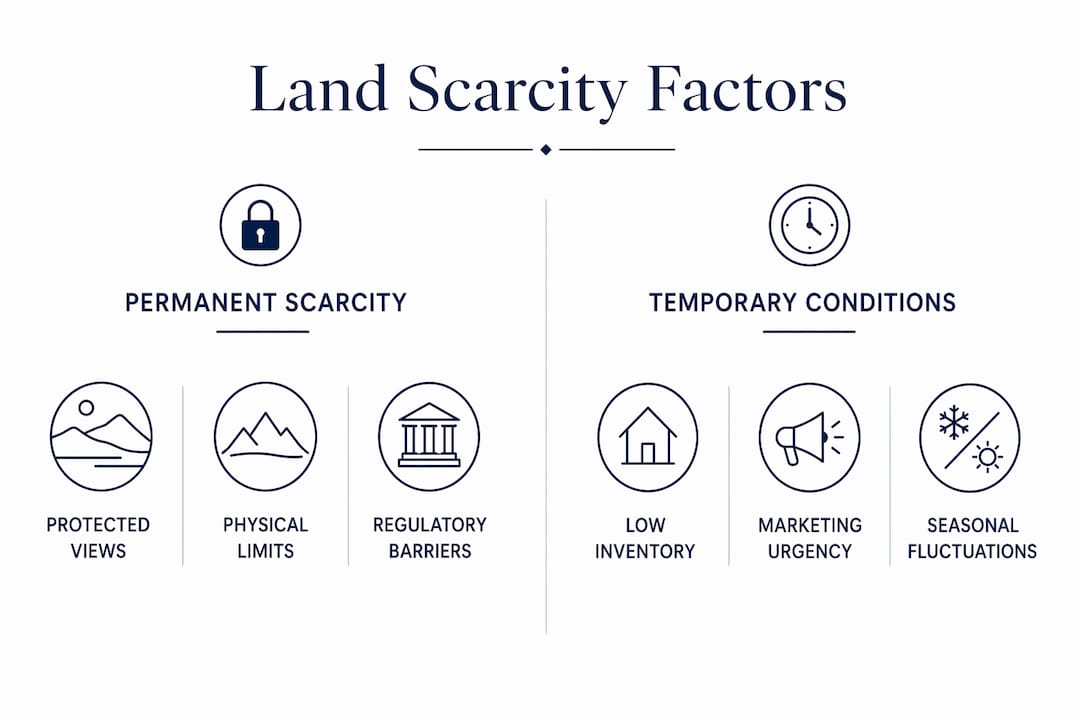
Luxury buyers respond to structural scarcity, not manufactured urgency. Marketing-induced urgency is ineffective compared to permanent scarcity in creating buyer decisiveness. A listing agent who claims "only two units remain" in a new development triggers skepticism in sophisticated buyers. A property with a protected canyon view, a single-owner oceanfront lot, or a parcel within a fully built-out gated community triggers genuine urgency.
The distinction matters because it changes buyer behavior in measurable ways. Luxury buyers respond decisively when encountering true scarcity such as irreplaceable views, full build-out, and restrictive zoning. They negotiate less and move faster. In markets like Scottsdale and Paradise Valley, verified scarcity leads to fewer price reductions and faster sales. That is not sentiment. It is a documented pattern in high-end property market transactions.
Permanent scarcity manifests in several distinct forms that discerning buyers and investors should recognize.
Protected view corridors that cannot be obstructed by future development represent one of the most durable forms of scarcity. Zoning designations that prohibit subdivision or high-density construction create another layer. Geographic uniqueness, such as a peninsula, a lakefront, or a mountain ridgeline, provides a third. Each of these attributes is either present or absent. They cannot be engineered after the fact.
Pro Tip: When evaluating a luxury property, ask specifically whether the scarcity attribute is legally protected or merely circumstantial. A view that depends on a neighboring vacant lot remaining undeveloped is not true scarcity. A view protected by a conservation easement or a public park is.
How do regulations and entitlements amplify luxury property scarcity?
Regulatory barriers function as scarcity multipliers in luxury real estate. Environmental regulations and permit difficulties create artificial scarcity that drives trophy property values in a manner similar to rare art or fine vineyards. A coastal parcel subject to California Coastal Commission review, a historic district property in Charleston, or a wetlands-adjacent estate in the Florida Keys all carry entitlement barriers that restrict supply far beyond what physical land limits alone would impose.
This regulatory layer transforms luxury real estate into a collectible asset class. Entitlement and environmental regulations function as critical scarcity multipliers by limiting supply through non-physical barriers, making trophy properties behave like unique collectibles. The comparison to fine wine or museum-quality art is apt. Scarcity of origin, combined with barriers to replication, creates a value floor that persists across economic cycles.
| Scarcity type | Source | Example markets |
|---|---|---|
| Physical land limits | Geography, coastline, mountain terrain | Malibu, Lake Tahoe, Hawaii |
| Regulatory barriers | Zoning, environmental review, historic designation | Charleston, Florida Keys, San Francisco |
| Full build-out | No remaining lots in a defined community | Paradise Valley, Scottsdale guard-gated enclaves |
| View protection | Conservation easements, public land adjacency | Las Vegas ridgelines, Colorado mountain estates |
Markets where multiple scarcity types overlap produce the most durable appreciation. A coastal parcel that is also subject to environmental review and sits within a fully built-out community represents a convergence of physical, regulatory, and contextual scarcity. These properties rarely trade at a discount, regardless of broader market conditions.
How does location utility multiply the impact of land scarcity?
Land scarcity alone does not guarantee value. Location utility, meaning the practical and cultural benefits a parcel delivers, determines how powerfully scarcity translates into price. Land utility, including density and infrastructure accessibility, significantly affects land value. A scarce parcel in an isolated area with poor access commands far less than an equally scarce parcel adjacent to world-class dining, private aviation, and elite schools.
Fragmentation compounds this effect in the opposite direction. When large contiguous parcels are subdivided into smaller lots, each fragment loses the economies of scale that made the original parcel valuable. Investors benefit from owning well-located contiguous parcels zoned for premium demand uses. Fragmented land in a high-demand corridor often trades at a discount to its theoretical value precisely because no single buyer can capture the full utility of the original parcel.
The high-end property market in cities like New York, Miami, and San Francisco demonstrates the utility premium in action. Prime luxury cities like NYC, Miami, and San Francisco continue to attract strong interest despite market normalization in 2026. The scarcity of land in these cities is inseparable from their cultural density, employment concentration, and infrastructure quality. Remove the utility, and the scarcity premium shrinks. The two forces are interdependent.
Buyers evaluating property investment in scarce areas should assess the following utility factors alongside the scarcity attributes themselves.
Proximity to private aviation facilities, which reduces the friction of travel for high-net-worth owners with multiple residences. Access to medical facilities specializing in longevity and wellness care, a factor that longevity-focused living has made central to affluent buyer decisions. Adjacency to cultural institutions, private clubs, and curated retail that sustains the lifestyle premium a luxury property commands.
Practical strategies for investors and luxury buyers in scarce markets
Investors who understand the factors increasing property values in scarce markets follow a disciplined framework. The goal is to identify properties where scarcity is permanent, utility is high, and regulatory barriers protect against future supply increases.
The first principle is to prioritize irreplaceable locations above all other attributes. A property with an average interior in an irreplaceable location will outperform a property with a spectacular interior in a replicable location over any meaningful time horizon. Land appreciates; structures depreciate. This is not a preference. It is an accounting reality.
The second principle involves the growing importance of aging-in-place considerations. 38% of luxury real estate professionals cite aging in place as a growing factor influencing purchase decisions in the $10M and above segment. Buyers in this cohort are not purchasing for a five-year horizon. They are acquiring legacy assets intended to serve multiple generations. Scarcity-driven properties in markets that support long-term habitation, with strong medical infrastructure and low crime, align precisely with this demand profile.
The third principle is to evaluate the regulatory environment as a feature, not a burden. Permit difficulty in coastal or historic markets is not an obstacle to value. It is the mechanism that protects value by preventing new supply from eroding the scarcity premium.
Pro Tip: Before acquiring a luxury property in a scarce market, commission a title and entitlement review that maps every regulatory restriction on the parcel. Restrictions that limit future development by neighbors are assets. Restrictions that limit your own use require careful analysis.
The fourth principle is to monitor market momentum indicators specific to the luxury tier. In the Bay Area, for example, cash requirements for down payments have increased by 6.6 percentage points compared to pre-pandemic levels, translating to roughly $198,000 in additional upfront cash for a $3M entry-level luxury home. That liquidity concentration signals the depth of demand in scarcity-constrained markets and the caliber of buyer competing for available inventory.
Key Takeaways
Land scarcity drives luxury property value by creating a permanent, non-reproducible asset that commands rising prices, faster sales, and resilience across market cycles.
| Point | Details |
|---|---|
| Scarcity is binary | A property either occupies a non-repeatable context or it does not. There is no middle ground. |
| Regulatory barriers add value | Environmental and zoning restrictions limit supply, functioning as scarcity multipliers that protect trophy property prices. |
| Utility amplifies scarcity | Proximity to infrastructure, culture, and services multiplies the price premium that scarcity alone creates. |
| Buyer behavior confirms the thesis | Luxury buyers negotiate less and move faster when true scarcity is verified, not when urgency is manufactured. |
| Legacy demand sustains appreciation | Aging-in-place and intergenerational wealth goals drive demand for irreplaceable locations across long time horizons. |
What I have learned about scarcity that most buyers miss
Working in the Las Vegas luxury market, I have watched buyers spend months evaluating finishes, fixtures, and floor plans while giving almost no attention to the one attribute that will determine their property's value in twenty years: whether the land beneath it is genuinely irreplaceable.
The most common mistake I see is confusing low inventory with true scarcity. A market with few listings is not the same as a market with non-reproducible land. Low inventory is temporary. True scarcity is permanent. When a buyer pays a premium for a property because "there's nothing else available right now," they are paying for a condition that will change. When they pay a premium for a ridgeline parcel with protected views inside a fully built-out community, they are paying for a condition that cannot change.
I also find that buyers underestimate how powerfully regulatory barriers protect value. A property that is difficult to permit, difficult to subdivide, and surrounded by conservation land is not a liability. It is a bastion of preserved value. The same restrictions that frustrated the original developer are the reason the asset holds its price floor across cycles.
The Singapore freehold land market offers a useful parallel. In that market, freehold land commands a permanent premium over leasehold precisely because buyers understand the binary nature of ownership permanence. American luxury buyers would do well to apply the same clarity of thinking to their own acquisitions.
My counsel to every investor and buyer I work with is the same: find the land that cannot be replaced, confirm that its scarcity is legally protected, and let the market do the rest.
— Yelena
Discover truly scarce luxury properties with Yhluxrealestate

Yhluxrealestate, led by Yelena Horton and backed by Sotheby's International Realty, specializes in identifying Las Vegas luxury properties where scarcity is genuine, legally protected, and positioned for long-term appreciation. The firm's access to off-market inventory means clients encounter properties that never reach the public market, precisely the kind of irreplaceable parcels this article describes. From ridgeline estates with protected views to guard-gated enclaves at full build-out, Yhluxrealestate evaluates every listing through the lens of permanent scarcity and location utility. Explore exclusive Las Vegas listings and connect with Yelena's team to begin your search with the competitive advantage that genuine scarcity intelligence provides.
FAQ
What is the main reason land scarcity increases luxury property value?
Land scarcity increases luxury property value because prime land is finite and non-reproducible. When supply cannot expand to meet demand, prices rise and hold across market cycles.
How is permanent scarcity different from low inventory?
Permanent scarcity means a location's defining attributes, such as protected views or geographic uniqueness, cannot be replicated by future development. Low inventory is a temporary market condition that resolves as new supply enters.
Do regulations actually make luxury properties more valuable?
Yes. Environmental regulations, zoning restrictions, and permit barriers limit new supply, which functions as an artificial scarcity multiplier. Trophy properties in regulated coastal or historic markets behave like collectibles, holding value independent of broader market trends.
Which luxury markets best demonstrate scarcity-driven appreciation?
Markets like Paradise Valley, Malibu, Miami Beach, and San Francisco combine physical land limits with regulatory barriers and high location utility. That convergence produces the most durable appreciation in the high-end property market.
How should investors identify genuine scarcity before purchasing?
Investors should commission a title and entitlement review to confirm that scarcity attributes are legally protected, not circumstantial. Verified restrictions on neighboring development, conservation easements, and full build-out status are the most reliable indicators of permanent scarcity.