
Las Vegas is defined, beyond its celebrated Strip, as a collection of thriving residential communities where families find affordable housing, expanding school choices, and a cost of living that rewards relocation. The reasons families relocate to Las Vegas converge on three pillars: Nevada's no state income tax, a growing network of public and charter schools now shaped by the landmark AB 533 open enrollment law, and suburban neighborhoods like Summerlin that offer safety, parks, and genuine community life. This guide addresses every dimension a relocating family needs to evaluate, from classroom seats to property taxes to weekend recreation.
Why families are moving to Las Vegas: lifestyle benefits
Las Vegas family living advantages begin well outside the casino corridor, in suburbs that read more like Scottsdale or Plano than anything associated with the Strip. The city maintains 68 parks and 123 playgrounds across Clark County, giving children consistent access to outdoor space regardless of which neighborhood a family chooses. Mild winters extend the outdoor season considerably, and proximity to Red Rock Canyon, Lake Mead, and Mount Charleston means weekend recreation is genuinely diverse.
Safety is a legitimate draw. Las Vegas suburbs maintain relatively low crime rates compared to other large American cities, with neighborhoods outside the Strip offering measurably safer living environments. That distinction matters enormously for families who hear "Las Vegas" and picture the tourist corridor rather than the quiet cul-de-sacs of Henderson or the master-planned boulevards of Summerlin.

Community programming reinforces the residential character. Libraries, recreation centers, and youth sports leagues operate across the valley, and family-oriented events fill the calendar year-round. The infrastructure of daily family life, grocery stores, pediatric clinics, youth theaters, is fully developed in the suburbs, which surprises many families arriving from coastal cities who expected a thinner civic fabric.
Pro Tip: Visit the Las Vegas Valley during january or february before committing to a neighborhood. Mild winter temperatures reveal the outdoor lifestyle at its most appealing, and you will see school drop-off traffic, park usage, and community activity at a realistic pace.
How does the 2026 open enrollment policy affect school choices?
Nevada's AB 533 open enrollment law, active for Fall 2026, is the most significant shift in Clark County school access in a generation. The law allows families to apply to public schools outside their assigned zone through a transparent, capacity-based process with a clear timeline. Applications open in january, decisions arrive by march, and the system operates a lottery when a school is oversubscribed.
The practical mechanics work as follows:
- Families submit applications to up to three public schools through a centralized portal before the january 13 deadline.
- Schools publish their available capacity and vacancy data publicly, so families can assess realistic odds before applying.
- Oversubscribed schools run a lottery; students in low-performing zones receive priority placement under AB 533's equity provisions.
- Families who do not receive their preferred placement may file a formal appeal through the district.
- Transportation support for open enrollment attendees is planned to begin in the 2027–28 school year, so families should budget for independent transport in the interim.
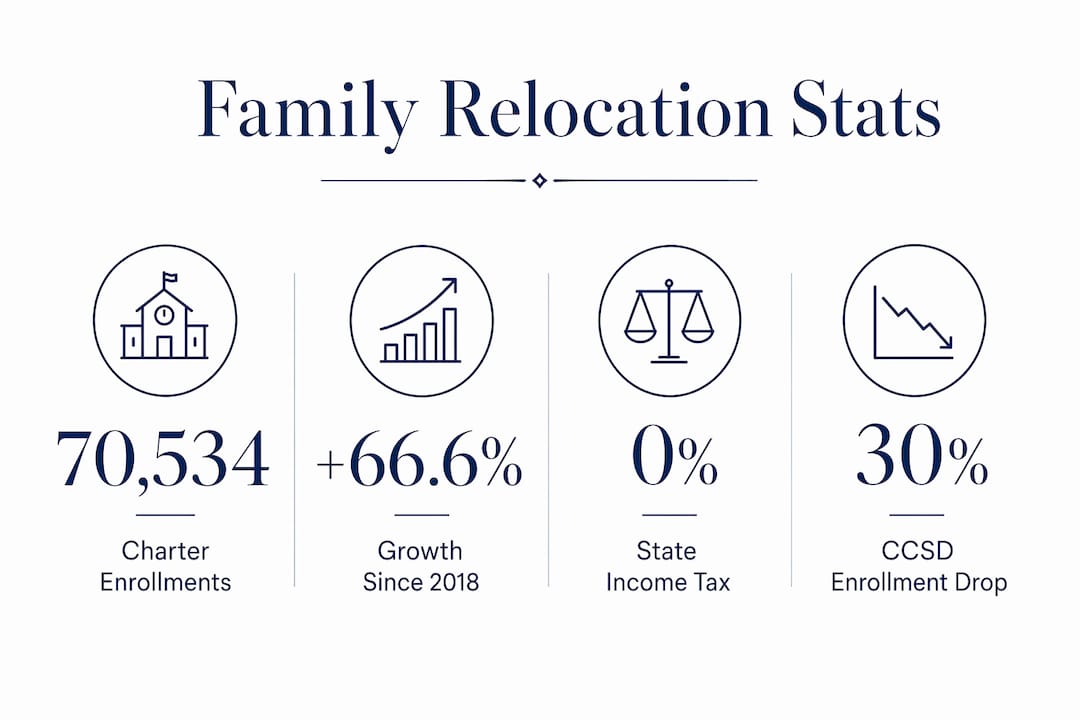
The charter school sector amplifies these choices further. Charter enrollment reached 70,534 students in 2025–26, representing 14.9% of statewide enrollment, and Nevada's charter sector has grown 66.6% since 2018–19. That growth reflects genuine family demand, not administrative reshuffling.
One counterintuitive data point: CCSD kindergarten enrollment fell nearly 30% relative to senior class levels, even as Clark County's overall population grew by roughly 44,000 in the past year. The explanation is demographic, not a signal of declining family appeal. Nevada's birth rate declined 17.2% from 2011 to 2023, meaning the population growth is driven largely by adults without school-age children. Families with children are actually a more concentrated and well-served segment of the community than raw enrollment numbers suggest.
Pro Tip: Check individual school capacity listings on the CCSD open enrollment portal before january, not just district-wide averages. Neighborhood-level vacancy data reveals which schools have genuine open seats and which are likely to lottery out.
What are the financial considerations for families relocating to Las Vegas?
Nevada's no state income tax status is the headline financial advantage, and it is real. Nevada ranks among the nine states with no personal income tax for 2025–26, which delivers immediate, compounding savings for families with two working adults. A household earning $150,000 annually in California, for example, would pay thousands in state income tax that simply does not exist in Nevada.
The full picture requires a more careful accounting, however. Nevada funds its public services through sales and property taxes, and the combined sales tax averages 8.24% when state and local additions are included. Families with high consumption spending, particularly those with multiple children buying clothing, school supplies, and sporting equipment regularly, will feel that rate.
| Cost factor | Las Vegas (Clark County) | California (Los Angeles) |
|---|---|---|
| State income tax | None | Up to 13.3% |
| Combined sales tax | ~8.24% | ~10.25% |
| Median home price (suburbs) | Lower than LA metro | Significantly higher |
| HOA fees (Summerlin) | Varies; common in master-planned areas | Common in comparable communities |
Property taxes in Nevada are moderate by national standards, though HOA fees in master-planned communities like Summerlin add a meaningful monthly line item. Effective relocation budgeting requires modeling total tax exposure and ancillary costs, not just the income tax headline. A family that spends heavily on goods and services may find the sales tax partially offsets income tax savings, while a family with a high income and modest consumption will come out clearly ahead.
The net financial case for Las Vegas remains strong for most relocating families. Housing costs in Summerlin and Henderson run well below comparable suburban markets in the San Francisco Bay Area, Seattle, or Denver, and the absence of state income tax accelerates wealth accumulation over time.
How do housing options and neighborhood choices support families?
Summerlin stands as the most recognized family destination within the Las Vegas valley, offering a master-planned environment with top-tier schools, extensive trail systems, and a community character that prioritizes residential quality. The neighborhood's cooler temperatures, a product of its higher elevation on the western edge of the valley, make outdoor life more comfortable through the summer months. Summerlin's combination of parks, safety, and school access makes it a consistent first choice for relocating families.
Henderson, southeast of the Strip, offers a similar residential character with strong school ratings and a well-developed commercial infrastructure. North Las Vegas provides more affordable entry points for families prioritizing budget over prestige address. Each of these communities sits entirely outside the tourist corridor and functions as a self-contained suburban city.
Housing variety across the valley accommodates a wide range of family budgets and preferences. Single-family homes, townhomes, and gated communities with shared amenities all exist within a 30-minute drive of the city center. The real estate market has grown steadily, and families relocating from high-cost coastal markets often find they can purchase significantly more square footage for the same dollar.
Healthcare access is strong across the suburban communities, with major hospital systems including Sunrise Health and Valley Health System operating facilities throughout Henderson, Summerlin, and North Las Vegas. Pediatric specialists, urgent care centers, and family medicine practices are distributed across the valley rather than concentrated downtown.
What educational and community resources support family life?
The educational ecosystem in Las Vegas extends well beyond the Clark County School District. Charter schools now serve nearly 15% of Nevada's students, and the diversity of models, including STEM-focused, arts-integrated, and college-preparatory programs, gives families genuine alternatives to their zoned district school.
| School type | 2025–26 enrollment | Growth since 2018–19 |
|---|---|---|
| Charter schools (statewide) | 70,534 | +66.6% |
| CCSD (district) | Declining toward ~455,000 by 2026 | Negative trend |
| Private schools | Not publicly tracked statewide | Steady |
Community resources complement the school options. Clark County operates branch libraries with robust youth programming, and recreation centers throughout the valley offer after-school activities, summer camps, and youth sports leagues. Arts programs, including youth theater and music instruction, are available through both public institutions and private studios concentrated in Summerlin and Henderson.
Neighborhood-level enrollment data reveals important variation within the district. Some communities show stable or growing enrollment while others decline, and that pattern influences program stability, extracurricular offerings, and resource allocation at individual schools. Families should analyze school-level trends, not just district-wide averages, when evaluating their options.
The open enrollment implementation under AB 533 requires districts to publish capacity data annually, operate fair lotteries, and communicate clearly with applicant families. That transparency is new and meaningful. Families who engage the process early, checking vacancy listings in december before the january deadline, position themselves for the widest range of placements.
Key takeaways
Las Vegas offers relocating families a rare combination: no state income tax, expanding school choice through AB 533, and suburban communities with genuine residential character well removed from the tourist corridor.
| Point | Details |
|---|---|
| No state income tax | Nevada is among nine states with no personal income tax, delivering compounding savings for working families. |
| AB 533 open enrollment | Families can apply to up to three public schools outside their zone; decisions arrive by march each year. |
| Charter school growth | Nevada charter enrollment grew 66.6% since 2018–19, now serving 14.9% of statewide students. |
| Suburban safety and amenities | Neighborhoods like Summerlin and Henderson offer low crime rates, 68 parks, and strong healthcare access. |
| Budget the full tax picture | Sales tax averages 8.24% combined; families should model total costs, not just the income tax headline. |
What I have learned advising families on Las Vegas relocation
The families I work with most often arrive with two misconceptions. The first is that Las Vegas is not a real city for raising children. The second is that the no income tax benefit is so large it renders every other financial consideration irrelevant. Both assumptions require correction before a family can make a genuinely informed decision.
Las Vegas is a real city. Summerlin has Little League fields, school fundraisers, and neighborhood watch programs. Henderson has pediatric dentists and Saturday morning farmers markets. The residential fabric is fully formed, and it has been for decades. What has changed recently is the school choice architecture. AB 533 gives families a level of educational agency that did not exist before 2026, and the charter sector's growth means the options are substantive, not just theoretical.
On the financial side, I always tell families to build a full model before celebrating the income tax savings. A family spending heavily on goods and services will see the 8.24% sales tax erode a meaningful portion of that advantage. The families who benefit most are those with high incomes, moderate consumption, and the discipline to direct tax savings into housing equity or investment accounts.
My honest recommendation: visit two or three neighborhoods in person, attend an open house in Summerlin and one in Henderson, and sit with the school capacity data for your children's grade levels before signing anything. Las Vegas rewards families who do the work upfront. The ones who arrive prepared find a city that genuinely delivers on its promise.
— Yelena
Finding the right Las Vegas home for your family
Relocating a family requires more than a property search. It requires understanding which neighborhoods align with your children's school options, your commute, and the lifestyle you are building.

Yhluxrealestate, led by Yelena Horton and backed by Sotheby's International Realty's global network, specializes in exactly this kind of relocation. Yelena's relocation concierge service is built for out-of-state families who need more than a list of listings. It includes off-market property access, neighborhood-level guidance on schools and community fit, and negotiation expertise that protects your position in a competitive market. Families who work with Yhluxrealestate arrive at closing with clarity, not compromise.
FAQ
Why are families choosing Las Vegas over other Sun Belt cities?
Las Vegas combines no state income tax, lower housing costs than Phoenix or Austin's premium suburbs, and a newly reformed school choice system under AB 533. The suburban communities of Summerlin and Henderson offer safety and amenities that rival any Sun Belt market.
What is the AB 533 open enrollment law?
AB 533 is Nevada's 2026 law allowing families to apply to public schools outside their assigned zone. Families submit applications by january 13, receive decisions by march, and oversubscribed schools use a lottery system with priority for students in low-performing zones.
Is Las Vegas actually affordable for families?
Housing costs in Las Vegas suburbs run well below comparable markets in California, Seattle, or Denver. Nevada's no income tax status adds to the advantage, though families should account for the 8.24% combined sales tax when modeling their full budget.
Are Las Vegas suburbs safe for families?
Suburban neighborhoods outside the Strip, particularly Summerlin, Henderson, and parts of North Las Vegas, maintain comparatively low crime rates relative to other large American cities. Safety profiles vary by specific neighborhood, so reviewing block-level data before purchasing is advisable.
How fast is the Las Vegas charter school sector growing?
Nevada's charter school enrollment reached 70,534 students in 2025–26, a 66.6% increase since 2018–19. Charter schools now serve 14.9% of statewide enrollment, offering families STEM, arts, and college-preparatory alternatives to district schools.