
A private real estate transaction is defined as the direct sale of property between a buyer and seller without a public MLS listing, open-house marketing, or agent mediation. Known formally as an off-market or private treaty sale, this structure prizes confidentiality, speed, and negotiating control above all else. Earnest money deposits typically range from 1% to 3% of the purchase price, held in escrow until closing. High-profile sellers, privacy-sensitive investors, and buyers seeking a competitive edge all gravitate toward this model. Yhluxrealestate specializes in exactly this arena, connecting discerning clients with off-market properties that never appear in public searches.
What is a private real estate transaction and how is it defined?
A private real estate transaction, also called a private treaty sale or off-market deal, is any property transfer negotiated directly between parties outside the public marketplace. No MLS listing is filed, no public advertising runs, and no open houses are staged. The property changes hands through a confidential, bilateral agreement governed by the same legal framework that applies to any real estate closing.
Privacy-sensitive sellers prefer this structure for discretion and speed, particularly when financial circumstances, celebrity status, or estate matters make public exposure undesirable. That preference translates into a distinct market segment where access depends on relationships and professional networks rather than public search portals. Yhluxrealestate operates within this segment daily, drawing on a global network backed by Sotheby's International Realty to surface properties that never reach the open market.

The term "off-market" is the recognized industry standard for this category. Both phrases describe the same core concept: a private real estate deal conducted away from public view, with all standard legal obligations fully intact.
How does a private real estate transaction work?
The process follows a clear sequence, though it unfolds without the public-facing choreography of a traditional listing.
-
Initial contact and price discussion. Buyer and seller connect directly, often through a shared professional network, attorney referral, or a specialist like Yhluxrealestate. They exchange price expectations and basic property details in confidence.
-
Letter of intent or offer. The buyer submits a written offer outlining price, proposed closing date, and key contingencies. Private treaty negotiations proceed without competitive bidding, so both parties negotiate directly until terms are mutually acceptable.
-
Purchase agreement. A formal purchase contract is drafted, covering purchase price, earnest money deposit, inspection contingencies, financing conditions, and closing timeline. This document carries the same legal weight as any publicly listed sale contract.
-
Due diligence period. The buyer arranges a professional property inspection, orders an independent appraisal, and confirms financing approval. All standard closing requirements apply: title search, transfer taxes, and closing cost calculations proceed exactly as they would in a public sale.
-
Escrow and closing. A neutral escrow agent holds the earnest money deposit and all transaction documents. Title is transferred, funds are disbursed, and the deed is recorded.
Pro Tip: Engage a real estate attorney before drafting any purchase agreement. A skilled attorney can draft contingency language that protects both parties and prevents costly disputes during due diligence.
One critical point: finding a buyer is only the first step. Closing requires rigorous coordination of documents, title work, and financing validation. The absence of a listing agent does not reduce the transactional complexity; it simply shifts the coordination responsibility to the parties and their legal counsel.
What are the benefits and challenges of private real estate transactions?
Private property sales offer genuine advantages, but they carry real risks that buyers and sellers must weigh honestly.
Benefits worth noting:
- Confidentiality. The property address, sale price, and seller identity remain out of public databases during the transaction. This matters enormously for estate sales, divorce proceedings, and high-net-worth individuals.
- Speed. Without marketing delays, open-house schedules, or MLS processing times, private deals can close significantly faster than public listings.
- Negotiating control. Both parties set the terms of engagement. There is no auction dynamic, no competing offers driving price beyond fair value, and no public pressure to accept or reject quickly.
- Reduced carrying costs. Sellers avoid staging fees, professional photography, and prolonged holding costs associated with extended public listings.
Challenges that demand attention:
- Pricing risk. Without competitive bidding, sellers lose the price discovery mechanism that public markets provide. Sellers may save commission fees but often accept lower final prices because buyers expect concessions in exchange for their flexibility.
- Absence of neutral intermediaries. The lack of a neutral agent increases the risk of emotional conflict and deal failure, particularly in transactions between acquaintances or family members.
- Legal exposure. Every state-mandated disclosure still applies. Skipping professional oversight does not eliminate legal liability; it concentrates it.
- Stigma risk. Improper pricing in a private sale can create long-term market stigma if the property must be publicly re-listed after a failed private attempt.
Pro Tip: Sellers should commission an independent appraisal before entering private negotiations. A credible valuation anchors the asking price and prevents the deal from collapsing over a disputed number.
Buyers in private sales often expect price concessions in exchange for reduced competition and greater flexibility. Sellers who understand this dynamic can price strategically from the outset, rather than being caught off guard mid-negotiation.
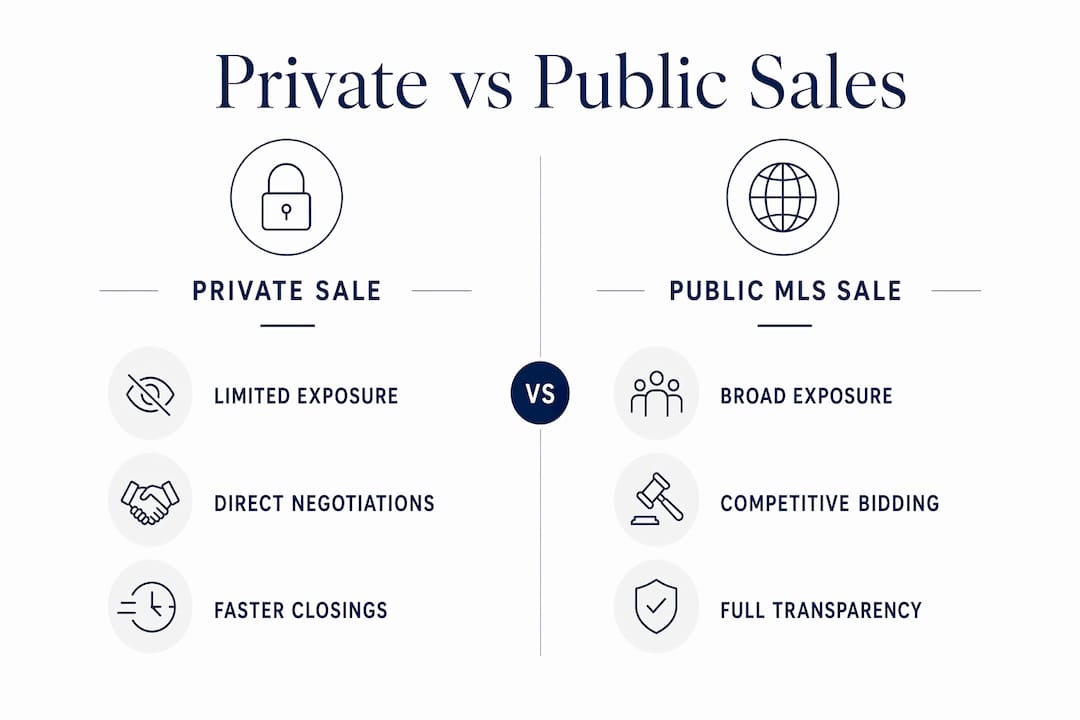
Private real estate transactions compared to public MLS sales
Understanding when a private sale is better requires a clear-eyed comparison of both paths.
Public MLS sales expose a property to the broadest possible buyer pool. That exposure creates competitive bidding, which typically drives prices toward or above asking. The trade-off is time, transparency, and loss of control. Listing history becomes public record, and price reductions are visible to every future buyer.
Private sales invert that equation. The seller controls who knows about the property, when they know, and under what terms they may make an offer. Speed is a genuine advantage: large-scale private acquisitions have closed in as few as 93 days even at significant premiums to public market prices. Individual transactions can move even faster when both parties are motivated and well-prepared.
| Factor | Private sale | Public MLS sale |
|---|---|---|
| Market exposure | Limited, by invitation | Broad, publicly searchable |
| Price discovery | Negotiated bilaterally | Driven by competitive bidding |
| Timeline | Typically faster | Dependent on market activity |
| Confidentiality | High | Low |
| Commission costs | Potentially reduced | Standard agent commissions apply |
| Legal requirements | Identical to public sales | Identical to private sales |
| Pricing risk | Higher without competition | Lower with multiple offers |
The right choice depends on the seller's goals. A luxury homeowner who values discretion above maximum price extraction will favor a private real estate deal. A seller who needs to test market value and attract the widest buyer pool will benefit from a public listing. Neither path is universally superior; the property type, timeline, and personal priorities determine the answer.
How to successfully navigate and close a private real estate deal
Closing a private transaction without professional guidance is possible, but the margin for error is narrow. These steps reduce that margin considerably.
-
Engage a real estate attorney early. An attorney drafts the purchase agreement, reviews title, and manages state-mandated disclosures. Early attorney involvement buffers negotiations and ensures legal compliance from the first offer forward.
-
Commission an independent appraisal. Both parties benefit from an objective valuation. It anchors price negotiations and satisfies lender requirements if the buyer is financing the purchase.
-
Use a neutral escrow agent. A licensed escrow officer holds the earnest money deposit and all transaction documents impartially. This protects both parties if the deal falls through during due diligence.
-
Conduct thorough due diligence. Buyers should order a professional inspection, review all seller disclosures, confirm zoning and title status, and validate HOA obligations before removing contingencies.
-
Confirm financing before removing contingencies. A financing contingency protects the buyer's deposit if the loan falls through. Removing it prematurely is one of the most costly mistakes in private real estate agreements.
Pro Tip: Draft a clear communication protocol at the start of negotiations. Agree on who contacts whom, through which channel, and within what timeframe. Ambiguity in communication is the most common cause of deal collapse in private sales.
Private real estate requires active management and legal structuring that public market transactions rarely demand. Sophisticated investors sometimes use special purpose vehicles to hold private real estate assets, separating ownership from personal liability. For individual buyers and sellers, the equivalent protection comes from thorough contracts, clear contingencies, and qualified legal counsel.
Key takeaways
A private real estate transaction is a direct, off-market sale that preserves confidentiality and speed, but demands the same legal rigor as any public closing.
| Point | Details |
|---|---|
| Core definition | A private sale bypasses public MLS listing while keeping all legal closing requirements intact. |
| Earnest money standard | Deposits of 1%–3% of purchase price are held in escrow to secure buyer commitment. |
| Pricing trade-off | Sellers gain privacy but often accept lower prices without competitive bidding to anchor value. |
| Attorney involvement | Engaging a real estate attorney early is the single most effective way to prevent deal failure. |
| Due diligence is non-negotiable | Inspections, title searches, and financing validation apply equally in private and public sales. |
Why I believe private transactions reward the prepared, not the private
Private sales attract people who believe that keeping a transaction quiet is the same as keeping it simple. That belief is the most expensive misconception in real estate.
I have worked with buyers and sellers who entered private negotiations convinced that fewer parties meant fewer complications. What they discovered is that the absence of a listing agent does not remove complexity. It removes the person who usually manages it. Every disclosure requirement, every title issue, every financing contingency still exists. The difference is that without professional oversight, those issues surface at the worst possible moment, typically days before closing.
The sellers who succeed in private transactions are the ones who treat confidentiality as a feature of the deal, not a substitute for preparation. They commission appraisals before negotiating. They retain attorneys before signing anything. They use escrow agents as neutral anchors. The privacy benefit is real and valuable, but it only pays off when the underlying transaction is as disciplined as any public sale.
What I find most compelling about this market is the access it creates for buyers. A well-connected buyer who understands private real estate agreements can acquire properties that never appear in any public search. That is a genuine competitive advantage, and it is one that Yhluxrealestate is built to deliver.
— Yelena
Private real estate services at Yhluxrealestate
Yhluxrealestate brings uncompromising standards to every private property sale, offering clients in Las Vegas and beyond exclusive access to off-market opportunities that the public market never sees.

Yelena Horton's practice is built on the kind of discretion and depth that private transactions demand. From relocation concierge services for out-of-state buyers to expert negotiation strategies backed by Sotheby's International Realty's global network, every engagement is handled with the precision that sophisticated buyers and sellers deserve. Whether you are entering your first private real estate deal or managing a portfolio of off-market acquisitions, Yhluxrealestate provides the professional guidance that turns a private sale into a flawless closing.
FAQ
What is a private real estate transaction in simple terms?
A private real estate transaction is a property sale conducted directly between buyer and seller without a public MLS listing or open-house marketing. All standard legal requirements, including contracts, title searches, and disclosures, still apply.
Is a private sale better than listing on the MLS?
A private sale is better when the seller prioritizes confidentiality, speed, or control over negotiations. It is less advantageous when maximum price through competitive bidding is the primary goal.
How does earnest money work in a private real estate deal?
Earnest money deposits in private sales typically range from 1% to 3% of the purchase price, held by a neutral escrow agent until closing or deal termination.
Do I need an attorney for a private property sale?
An attorney is not legally required in every state, but early attorney involvement is strongly recommended. A real estate attorney drafts the purchase agreement, manages disclosures, and reduces the risk of costly disputes.
Can buyers get a better price through private real estate agreements?
Buyers in private sales often receive price concessions because sellers value the speed and discretion of a direct deal. However, buyers should still commission an independent appraisal to confirm fair market value before finalizing terms.