
A luxury smart home system — more precisely termed an intelligent home — is a professionally engineered, architecturally embedded automation platform that learns occupant behavior, runs coordinated scenes through local processing, and manages every environmental system as a single, coherent whole. Unlike a collection of consumer devices tethered to cloud servers, a Tier 3 intelligent home is designed, commissioned, and maintained by CEDIA-certified integrators, making it as permanent and purposeful as the structure itself. For high-net-worth buyers and sellers navigating the Las Vegas luxury market, Yhluxrealestate treats these systems not as amenities but as investment-grade infrastructure — features that shape valuation, negotiation, and long-term desirability.
Table of Contents
- What is a luxury smart home system, and how does it differ from a standard one?
- Core components that define a truly luxury system
- Which luxury platforms should you know in the U.S.?
- What does design, installation, and ongoing maintenance actually look like?
- What does a luxury system cost, and how long does it take?
- Questions to ask an integrator — and red flags to watch for
- How does a luxury system affect buying, selling, and marketability in Las Vegas?
- Key Takeaways
- A Las Vegas agent's perspective on intelligent homes
- Yhluxrealestate: your concierge for Las Vegas intelligent homes
- Useful sources and further reading
- FAQ
What is a luxury smart home system, and how does it differ from a standard one?
The distinction is architectural, not cosmetic. A standard smart home offers remote controllability: a thermostat you adjust from your phone, lights that respond to a voice command, a doorbell camera that sends an alert. Each device operates largely in isolation, dependent on a cloud server, and replaceable on a weekend. An intelligent home learns occupant patterns, anticipates preferences, and proactively manages environmental factors — temperature, lighting, security, shading, and audio — as a single, coordinated organism.
The technical differences are equally pronounced. Consumer devices rely on Wi-Fi and third-party cloud infrastructure; professional systems use local processing and dedicated communications protocols so that automations run flawlessly even during an internet outage. Lighting in a luxury system operates at the circuit level, not the fixture level, meaning scenes are calibrated with precision that a plug-in smart bulb cannot replicate. The backbone is hardwired, provisioned during construction or a major renovation, and embedded in the building fabric itself.
- Consumer smart devices: cloud-dependent, fixture-level control, easily swapped, no integrator required
- Luxury intelligent systems: local processing, circuit-level lighting, hardwired backbone, CEDIA-certified commissioning, architectural permanence
Pro Tip: If you are commissioning a new build or undertaking a major renovation, specify Tier 3 infrastructure — conduit, structured cabling, and rack space — before walls close. Retrofitting these elements afterward carries costs that can rival the original system budget.
Core components that define a truly luxury system
A genuine intelligent home is defined by integration depth and reliability engineering, not by the price of individual devices. The components below must be architecturally specified; consumer-grade alternatives may fill secondary roles but cannot anchor the system.
| Component | Role | Reliability Marker |
|---|---|---|
| Control platform | Central brain; orchestrates all subsystems | Local processing, on-premises controller |
| Backbone network | Structured cabling, managed switches, dedicated VLANs | Hardwired with redundant wireless mesh |
| Lighting control | Circuit-level dimming, scene programming | Dedicated keypads, hardwired dimmers |
| HVAC integration | Zoned climate, occupancy-based scheduling | Direct integration with building controls |
| AV / home theater | Multi-room audio, 4K video distribution | Dedicated AV matrix, acoustic engineering |
| Motorized shading | Circadian and glare management | Hardwired motors, scene-linked |
| Security | Access control, cameras, intrusion detection | Local recording, encrypted comms |
| Energy management | Submetering, demand-response, solar integration | Real-time analytics dashboard |
| Sensors / wellness | Air quality, occupancy, circadian lighting | Calibrated, integrated with HVAC and lighting |
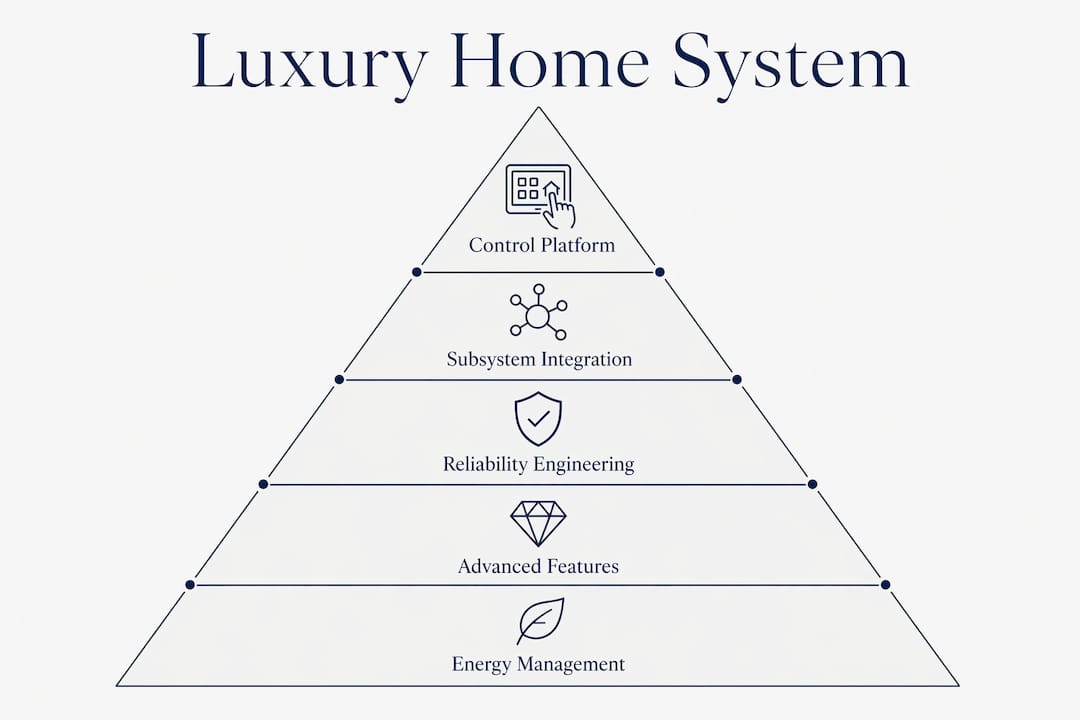
Advanced features that distinguish estate-scale installations include predictive maintenance alerts, occupancy pattern learning, circadian lighting tuned to human biology, and energy demand-shifting that can reduce costs for large properties in Time of Use markets.
Pro Tip: Request submetering as a standard specification, not an upgrade. In Nevada's Time of Use rate environment, granular energy analytics pay for themselves and become a compelling data point in listing materials.
Which luxury platforms should you know in the U.S.?
The control platform selection determines what the system can do, how reliably it performs over a decade, and how gracefully it grows with the property. Six platforms dominate the U.S. luxury market, each with a distinct profile.
- Control4: Broad integration flexibility and a mature dealer ecosystem; well-suited to projects where interoperability across many subsystems is the priority, often at a more accessible price point within the luxury tier.
- Savant: Design-forward interface and a reputation for the most refined user experience; the preferred choice when aesthetic cohesion between hardware and interior design is non-negotiable.
- Crestron: The de rigueur standard for large commercial and estate-scale residential projects; unmatched in scalability and custom programming depth, though it demands highly experienced integrators.
- Lutron: The uncontested authority in lighting and motorized shading; frequently specified alongside a primary control platform rather than as a standalone whole-home solution.
- Josh.ai: A voice-first platform built for privacy, with on-device processing and natural language understanding calibrated for luxury residential environments — no data sent to third-party servers.
- Kaleidescape: The gold standard for premium home cinema; a dedicated movie server and player ecosystem that delivers studio-master picture and audio quality, often integrated with Savant or Crestron for scene control.
Pro Tip: Platform longevity matters as much as current features. Verify that your chosen manufacturer has a documented upgrade path and an active certified integrator network in the Las Vegas metro before committing.
What does design, installation, and ongoing maintenance actually look like?
Early inclusion in the design process is not optional for Tier 3 performance. Hardwired distribution, dedicated communications protocols, and rack space must be specified before structural elements are finalized — a principle that applies equally to new construction in Summerlin and major renovations in Henderson's guard-gated communities.
The lifecycle unfolds in five stages:
- Planning and specification: Integrator joins the architect and interior designer; system scope, platform selection, and infrastructure requirements are documented.
- Rough-in and prewiring: Conduit, structured cabling, and smart-home prewiring are installed before drywall; rack locations and equipment rooms are framed.
- Equipment rack and network build: Managed switches, controllers, and AV matrices are installed and configured; network segmentation and cybersecurity architecture are established.
- Programming and commissioning: Scenes, automations, and user interfaces are programmed, tested, and refined; the integrator documents every configuration.
- Handover and documentation: The owner receives a full commissioning report, as-built drawings, and training; a service contract is established.
Ongoing maintenance is a structured commitment. Operational continuity depends on documentation, annual service contracts, and training — the most common failure mode is loss of institutional knowledge when service contacts change. Trust signals to verify: CEDIA certification, a written commissioning report, a maintenance SLA with defined response times, and remote-diagnosis capability.
- Confirm CEDIA certification or manufacturer-level credentials
- Request sample commissioning documents before signing a contract
- Verify remote-diagnosis capability and local service availability
- Confirm the integrator's documented upgrade path for the chosen platform
What does a luxury system cost, and how long does it take?
Cost varies by an order of magnitude between consumer-grade setups and a fully engineered Tier 3 installation. The factors that most influence budget are the degree of hardwiring, AV and theater scope, energy analytics depth, and the number of controlled zones.
| Project Scale | Typical System Investment | Design-Through-Commissioning Timeline |
|---|---|---|
| High-end condominium | — | 3 months |
| Estate / compound | — | 12–24 months |
Recurring costs are a de rigueur ownership consideration. Annual integrator service contracts for large properties typically range from $12,000 to $24,000, covering software updates, component replacements, and emergency support. These figures belong in a buyer's total cost of ownership model and in a seller's disclosure package.
Pro Tip: When evaluating a property with an existing system, request the current service contract and the last two commissioning or maintenance reports. A lapsed contract is a negotiation point; an active one with a reputable integrator is a genuine asset.
Questions to ask an integrator — and red flags to watch for
Prioritize integrator experience, service model, and documentation over the spectacle of a single polished demo. The questions below are the ones that separate a capable professional from a vendor whose system will frustrate you within eighteen months.
- Does the firm hold CEDIA certification or manufacturer-level credentials for the proposed platform?
- Can they provide sample commissioning documents and as-built drawings from a comparable project?
- What are the defined service response times, and is remote diagnosis included?
- How is the system's cybersecurity architecture designed — network segmentation, encrypted protocols, firmware update cadence?
- What is the documented upgrade path if the platform releases a major new version?
- Can they provide references from projects of similar scale in the Las Vegas area?
Red flags that warrant serious caution:
- No written commissioning documentation or as-built drawings offered
- Automations that rely entirely on cloud connectivity with no local fallback
- No local service contract option or vague response-time commitments
- Inability to provide references from comparable residential projects
How does a luxury system affect buying, selling, and marketability in Las Vegas?
A professionally documented intelligent home is a differentiator that can increase buyer interest and reduce time on market — provided it is presented with the same rigor as any other architectural feature. Las Vegas buyers at the $3M+ tier increasingly expect well-documented systems, demonstrable service contracts, and hardware that integrates tastefully with the interior design rather than announcing itself. Yhluxrealestate positions these features as part of a property's investment narrative, connecting luxury amenities and resale value in a way that resonates with both local buyers and the out-of-state clientele relocating from California, New York, and the Pacific Northwest.
For sellers preparing a listing:
- Compile the full commissioning report, as-built drawings, and current service contract
- Prepare a brief scene walkthrough that demonstrates the system's capabilities during showings
- Confirm service contract transferability and document the integrator's contact and response terms
- Include system specifications in listing materials distributed through global syndication channels, including luxury property marketing platforms that reach qualified international buyers
For buyers inspecting a property:
- Request the commissioning report and verify the service contract is active
- Ask for a live demonstration of primary scenes — arrival, evening, security, and climate
- Confirm the integrator is still in business and offers local service in Nevada
- Factor annual service contract costs ($12,000–$24,000 for estate-scale properties) into your total ownership model
Pro Tip: Out-of-state buyers relocating to Las Vegas often underestimate the importance of a transferable service contract. Yelena Horton's relocation concierge includes integrator-vetting assistance precisely because this detail is routinely overlooked until after closing.
Key Takeaways
A luxury smart home system is an engineered infrastructure asset — not a feature — and buyers, sellers, and investors should evaluate it with the same discipline applied to any other capital component of a high-value property.
| Point | Details |
|---|---|
| Intelligent vs. standard | Luxury systems use local processing, circuit-level control, and coordinated scenes; consumer devices rely on cloud connectivity and operate in isolation. |
| Energy savings potential | Advanced energy demand-shifting can reduce costs for large properties in Time of Use markets. |
| Recurring ownership costs | Annual integrator service contracts for estate-scale properties typically range from $12,000 to $24,000. |
| Integrator vetting | Prioritize CEDIA certification, written commissioning documents, local service availability, and a documented upgrade path. |
| Yhluxrealestate advantage | Yelena Horton evaluates smart-home documentation as part of every Las Vegas luxury transaction, advising buyers and sellers on system value, service transferability, and negotiation positioning. |
A Las Vegas agent's perspective on intelligent homes
The most consequential gap in how luxury smart homes are bought and sold is not the technology itself — it is the documentation. A $400,000 Crestron installation with a lapsed service contract and no commissioning report is, from a transactional standpoint, a liability dressed as an amenity. Buyers cannot verify what they cannot document, and sellers who cannot demonstrate a system's provenance leave value on the table.
What genuinely moves the needle in a Las Vegas negotiation is a transferable service contract with a named, locally present integrator, paired with a commissioning report that a buyer's technical advisor can review. That combination transforms an intelligent home from a marketing claim into a verifiable asset. The system's sophistication matters; its paper trail matters more.
Yhluxrealestate: your concierge for Las Vegas intelligent homes
Buyers who arrive in Las Vegas with a clear vision of the intelligent home they want — and sellers who understand how to present one compellingly — consistently achieve better outcomes than those who treat automation as an afterthought. Yhluxrealestate offers exclusive access to off-market properties where intelligent home systems are already commissioned and documented, alongside a relocation concierge that includes integrator-vetting assistance for out-of-state clients who need a trusted technical perspective before committing.

Whether you are acquiring a guard-gated estate in MacDonald Highlands or preparing a Summerlin residence for the global market, Yelena Horton brings the negotiation expertise and network depth — backed by Sotheby's International Realty — to position every detail of the property, including its technology infrastructure, to its fullest advantage. Connect with Yhluxrealestate to arrange a private consultation.
Useful sources and further reading
The following authoritative resources support the claims in this article and provide practical next steps for buyers, sellers, and their advisors.
- CEDIA: What Is a Smart Home? — The industry body's definition and certified integrator directory; use the CEDIA locator to verify integrator credentials in Nevada.
- LuxuryEstate Journal: Smart Home Technology in Luxury Real Estate — Covers intelligent home distinctions, AI applications, energy savings data, and service contract cost ranges.
- Expert Tech USA: Luxury Smart Home Buyer's Guide — Detailed guidance on local processing, platform longevity, and service-contract expectations.
- Smart Freedom Todays: How to Choose Luxury Smart Home Systems — Platform selection criteria, architectural permanence, and infrastructure specifications.
When verifying claims about an existing system in a property you are considering, always request the commissioning report, as-built drawings, and current service-contract terms directly from the seller or their integrator — marketing materials alone are insufficient due diligence.
FAQ
What exactly is a luxury smart home system?
A luxury smart home system is a professionally engineered, architecturally embedded automation platform that uses local processing to run coordinated scenes across all home systems — lighting, climate, security, AV, and shading — through a single interface, commissioned by CEDIA-certified integrators.
How much does a luxury smart home system cost to maintain annually?
Annual integrator service contracts for estate-scale properties typically cover software updates, component replacements, and emergency support and are an important part of ownership costs.
Which platforms are considered the best luxury smart devices in the U.S.?
Control4, Savant, and Crestron are the primary whole-home platforms; Lutron leads in lighting and shading; Josh.ai specializes in privacy-first voice control; and Kaleidescape sets the standard for premium home cinema.
Does a luxury smart home system increase resale value in Las Vegas?
A professionally documented system with an active, transferable service contract is a verifiable asset that can increase buyer interest and support pricing; an undocumented or poorly maintained system can become a negotiation liability.
How does Yhluxrealestate help buyers evaluate a home's automation system?
Yelena Horton reviews commissioning documentation, service contract transferability, and integrator credentials as part of every luxury transaction, and her relocation concierge includes integrator-vetting assistance for out-of-state buyers.