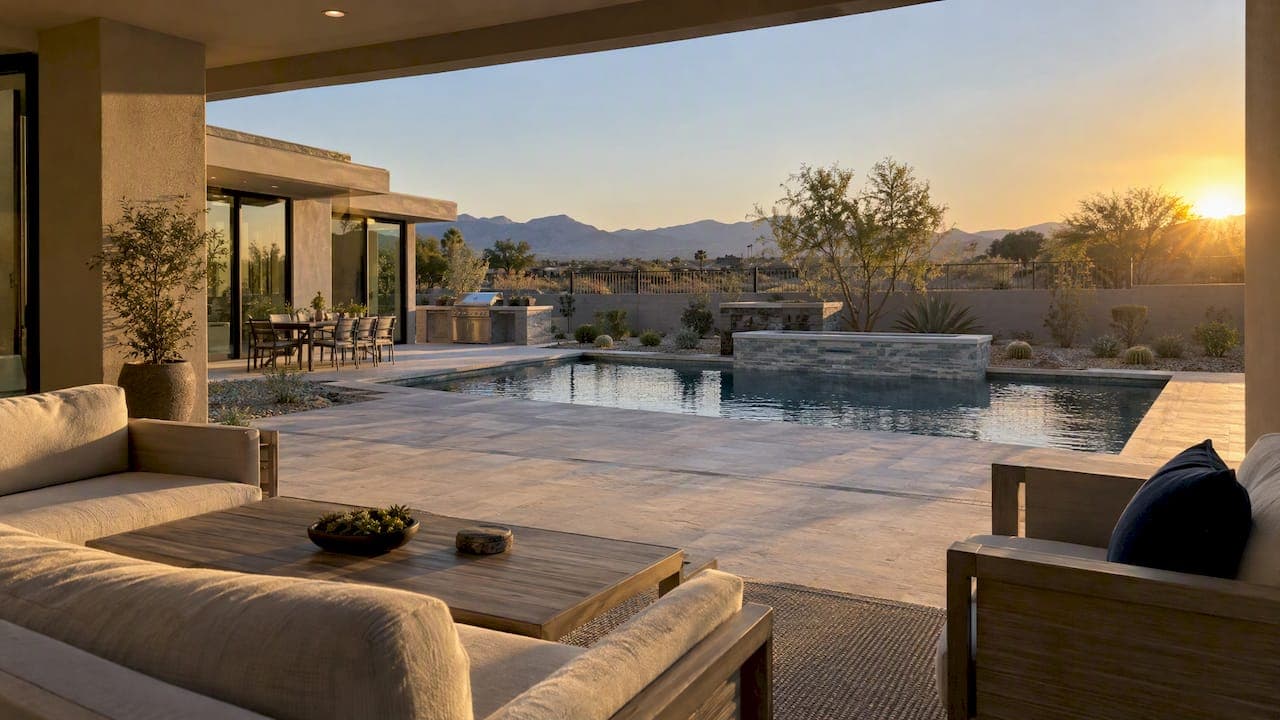
A west-facing backyard in Las Vegas receives the full force of the afternoon and evening sun, which makes it the warmest exposure on the lot and, with the right shade, one of the most rewarding. The sunsets are extraordinary, the evening light gilds the desert, and the terrace comes alive just as the day relents. The trade-off is heat: western exposure demands deliberate planning for shade, materials, plantings and mechanical equipment. Understood properly, it is a matter of design rather than a deficiency, and a well-conceived west-facing yard can be among the most memorable outdoor settings in the valley.
TL;DR
- A west-facing yard gets direct sun through the afternoon and into the evening, and western and southern exposures are the hottest in Nevada, according to University of Nevada, Reno Extension.
- Walls, rock mulch and paving store heat and release it after sunset, so materials and shade structures matter as much as the compass direction.
- Overhead shade, low-branching trees on the west side, and true desert plantings are the proven remedies.
- Check where the air conditioning condenser sits, how the pool is shaded, and what the lot's own microclimate does at 4 p.m. before you make an offer.
- Visit the property in the late afternoon in warm months; it tells you more than any listing photograph.
Table of Contents
- What a west-facing backyard actually means
- The desert context: how hot is it, really
- How afternoon sun shapes patio, pool and outdoor living
- Shade strategies that transform the space
- Planting a west-facing yard with desert intelligence
- Cooling costs and the placement of mechanical equipment
- What to assess when you tour a west-facing property
- Our perspective
- Finding the right home with the right exposure
- Frequently asked questions
- Sources
What a west-facing backyard actually means
The term describes the orientation of the rear of the house: the back elevation faces west, so the yard extends in that direction from the home. The house itself therefore stands between the yard and the morning sun, leaving the garden in shade early in the day, while the afternoon sun arrives directly, low and intense, over the rear wall and across the terrace.
The reverse is equally common in Las Vegas, where an east-facing backyard enjoys a shaded afternoon and a cooler evening. Neither is inherently superior; the choice is one of lifestyle. Those who rise early and take their coffee on the patio may prefer a yard sheltered from the sun after noon, whereas those who entertain at dusk and prize a view of the Spring Mountains or the sunset often accept the heat for the light it affords.
It helps to understand the timing. One sun-position tool for Las Vegas shows west-facing glass receiving direct sun for more than five hours on the day displayed, beginning shortly after midday and continuing until nearly sunset, and it notes that buildings across the street can interrupt that exposure. The precise window shifts with the seasons, lengthening in summer and contracting in winter, which is why the same yard can feel delightful in February and punishing in July.
The desert context: how hot is it, really
Las Vegas is, by the account of the National Weather Service, the driest major metropolitan area in the continental United States, with abundant sunshine, summer temperatures that reach the triple digits, and monsoon moisture in July and August that brings higher humidity. In such a climate, every hour of direct exposure carries weight.
University of Nevada, Reno Extension, in its landscape guidance for the state, observes that southern and western exposures are the hottest in Nevada, while northern exposures are the coolest, and that patterns of sun and shade change through the seasons. That guidance was written with northern Nevada in mind, yet the principle holds across the state: a west-facing yard is a heat-management question as much as a question of direction.
Surface temperatures illustrate the point. A Las Vegas cooling contractor reports that on a 115°F July afternoon, ground temperatures on the west side of a typical home measure 145 to 160°F, against 100 to 110°F on the north side. These are one company's field observations rather than a standard, but they match what any resident knows: bare ground and masonry facing the afternoon sun can be too hot to touch.

Location within the valley also matters. Urbanization has produced an urban heat island in the center of the Las Vegas Valley, most pronounced near downtown and the Strip in the warmer months. A west-facing lot in a central neighborhood may therefore hold heat later into the night than a similar lot on the valley's edge, where open desert cools more readily after dark.
How afternoon sun shapes patio, pool and outdoor living
The most consequential effect of western exposure is not the sun itself but what the yard does with it. The same contractor notes that a west-facing stucco wall, block wall or field of rock mulch can re-radiate heat into the evening, leaving the area beside the wall 10 to 15°F hotter than the open yard. A beautifully finished terrace that is pleasant at 10 a.m. may be unusable at 5 p.m. for want of one thoughtful shade structure.
The pool deserves particular attention. The Centers for Disease Control and Prevention advises that ultraviolet rays are strongest from 10 a.m. to 4 p.m. daylight-saving time, that they reflect off water and cement, and that shade and sun protection are essential. A west-facing pool therefore receives its strongest light during the hours when guests are most likely to gather, and the deck surface becomes the principal concern. Lighter, cooler pavers or textured finishes designed to stay comfortable underfoot are worth the premium, and a shaded lounge area near the water extends the pool's useful hours considerably. For a clear view of the long-term carrying cost, our note on pool maintenance costs in Las Vegas is a sensible companion.
The evening is the reward. As the sun descends, the heat eases, the sky turns to copper and rose, and the mountains take on a theatrical glow. Owners of west-facing homes frequently describe the hour after sunset as the true living hour of the yard, when a fire feature, a gathering table and soft lighting come into their own.
Shade strategies that transform the space
Shade is the single most effective instrument for a west-facing yard, and it works best in layers.
The U.S. Department of Energy's landscaping guide recommends that trees with leaves and branches lower to the ground be planted on the west side of a house where shade from the afternoon sun is needed. Trees take time to mature, so a buyer assessing a recently built property should consider what the canopy will look like in five years rather than today. UNR Extension's review of gardening in arid climates likewise identifies shading as a useful strategy for moderating environmental stress in a climate of extreme temperatures and strong solar radiation.
Structures act faster than trees. A Las Vegas screen-room specialist suggests that for west-facing exposures, the considered answer is overhead mesh combined with a drop shade on the western side: the mesh softens high-angle midday sun, while the drop shade intercepts the low, penetrating light of late afternoon. A pergola with an adjustable shade cloth, a motorized louvered roof, or a covered loggia with a western screen each achieves a similar effect, and each belongs in the budget when you evaluate a home that lacks one.

Misters merit a caution. The same source notes that they add humidity to dry air, and without strong cross-ventilation that humidity lingers and the patio can feel worse. In a covered, enclosed space, a ceiling fan is often the wiser companion.
The roof and the house envelope belong in the conversation too. West-facing windows and walls transmit heat to the interior, and the Department of Energy advises low solar heat gain coefficient glazing or shading for west-facing windows in warmer climates; the coefficient measures how much of the sun's heat passes through the glass. Homeowners considering a replacement roof may also find this overview of cool roof colors and how they handle heat instructive when weighing shingle choices for a sun-exposed elevation.
Planting a west-facing yard with desert intelligence
A west-facing bed is no place for sentiment. One regional landscaping firm advises that these exposures are among the harshest and best reserved for true desert species. The valley's soil compounds the challenge: alkaline conditions with a pH near 8 and layers of caliche, a cement-like mineral crust, can restrict root growth and drainage, which affects both plant selection and where each is placed.
The prudent palette favors drought-tolerant and native species, the subject of UNR Extension's guidance on sustainable gardening in arid climates. In practice that means desert-adapted trees that cast filtered shade, structural succulents, and low-water shrubs arranged so that taller specimens shield more tender ones. Rock mulch, so common in Las Vegas landscapes, holds heat on the western side; many designers use it sparingly near the house and favor shaded planting beds, decomposed granite paths or turf alternatives closer to seating areas.

It is also worth remembering that every lot has its own character. UNR Extension points out that each property contains microclimates that may be hotter, cooler, windier or shadier than other parts of the same yard. A neighbor's two-story house, a block wall, or a mature tree can alter the afternoon dramatically, and a thoughtful buyer observes these effects rather than assuming them.
Cooling costs and the placement of mechanical equipment
Orientation influences the house as well as the garden. A west-facing rear elevation takes direct afternoon heat through its glazing, which is precisely when electricity demand and air-conditioning load peak. The Department of Energy notes that blinds or curtains on west-facing windows can block strong summer rays and reduce the need for indoor cooling, so window coverings and exterior shade are among the easiest improvements.
The outdoor condenser is a subtler matter. The Las Vegas contractor cited above reports that a west-side unit can be 8 to 12% less efficient than one on the north side, and that north-side placement may extend a system's life by five to eight years; on a 115°F day, a west-side condenser may be rejecting heat into air 20 to 30°F hotter than the ambient reading. These are the company's own field figures, and individual results vary with equipment and installation, but they justify a simple question during a showing: where does the condenser sit, and is it shaded?
What to assess when you tour a west-facing property
A listing photograph taken at noon reveals little about a west-facing yard. The discerning buyer visits in the late afternoon, ideally during warmer months, and observes how the light falls on the terrace, the pool deck and the rear windows. Note whether the patio is covered and which direction the cover protects; whether the pool receives any shade; and whether the rear wall radiates heat as you stand beside it.
Consider next the elements that can be improved and those that cannot. Shade structures, plantings, window treatments and paving can be refined over time, whereas the lot's orientation, its relationship to neighboring homes and its views are fixed. A west-facing lot with an unobstructed mountain or city view and ample room for a generous covered loggia often outperforms an east-facing lot with an ordinary outlook, particularly for owners who entertain in the evening.
There is a financial dimension as well. Pool care, shade installation and landscape renovation all carry costs, and a property that requires them should be priced accordingly. Sellers of west-facing homes, for their part, are well served by presenting the yard at its best hour, with shade installed, lighting arranged and the sunset itself becoming part of the story; our perspective on luxury home marketing in Las Vegas explains how that presentation reaches the right audience. Buyers weighing a custom approach will also find it useful to read about design-build options in Las Vegas, since a well-designed outdoor room can transform a western lot.
For those contemplating a larger renovation, an example of pool and backyard redesign work shows how a reconsidered layout can reshape the way a yard is used, even when climate and conditions differ from those in Nevada.
Our perspective
We approach a west-facing backyard as one of the valley's most characterful settings, provided it is read with care. The orientation that delivers a blazing afternoon also delivers the evening light that many of our clients remember longest, and the question is never whether the exposure is good or bad but whether the property has been shaped to honor it.
Our work begins with that reading. For buyers, particularly those arriving from California and New York, the Las Vegas sun is a different proposition from the one they know, and we walk each property with them at the hour that matters, assessing shade, the pool, the placement of equipment and the way the house meets its terrace. Because we also offer access to off-market residences backed by the reach of Sotheby's International Realty, we are often able to place clients in homes whose outdoor spaces have already been conceived with the climate in mind.
For sellers, we present a west-facing yard in its finest hour, so that its sunsets and its architecture are seen as the assets they are. And for those relocating from afar, our relocation concierge makes it possible to evaluate such details with confidence before committing.
Yelena
Finding the right home with the right exposure
Whether you are drawn to the sunset terrace of a west-facing estate or prefer the gentler afternoons of an east-facing yard, the decision is best made with a guide who knows the valley street by street. Yelena Horton represents buyers and sellers of luxury homes in Las Vegas, with access to off-market properties, expert negotiation, and a relocation concierge for out-of-state clients.

To discuss the exposure, shade and outdoor living you envision, visit Yelena Horton's Las Vegas luxury real estate site and begin the conversation.
Frequently asked questions
Is a west-facing backyard bad in Las Vegas?
Not inherently. It is the hottest exposure, since western and southern exposures are the hottest in Nevada, but shade structures, low-branching trees, suitable paving and desert plantings can make it very comfortable. Many owners consider the evening light worth the effort.
What is the best way to shade a west-facing patio?
Layering works best: overhead cover such as a pergola or mesh canopy for the high sun, plus a western drop shade or screen for the low afternoon sun. Trees with low branches on the west side add natural shade over time.
Does a west-facing yard raise cooling costs?
It can, because west-facing glass and walls absorb afternoon heat. Exterior shade, window treatments and low solar heat gain glazing help, and the position of the outdoor air-conditioning unit is worth checking. A licensed HVAC contractor can assess a specific home.
When should I view a west-facing property?
In the late afternoon, ideally in the warmer months, so you can feel the heat on the terrace and pool deck, and see how shade falls. Returning near sunset shows the yard at its best.
Sources
- Climate of Las Vegas, National Weather Service
- Designing Landscapes for Northern Nevada's Arid Climate, University of Nevada, Reno Extension
- Sustainable Gardening in Arid Climates, University of Nevada, Reno Extension
- Sun position in Las Vegas
- Outdoor AC Unit Placement in Las Vegas
- Reading a Mojave Backyard
- Sun Safety Facts, CDC
- Consumer Guide to Home Landscaping, U.S. Department of Energy
- Guide to Energy-Efficient Windows, U.S. Department of Energy
- Energy-Saving Hacks to Beat the Summer Heat, U.S. Department of Energy
- Las Vegas Climate and Growing Zones