
Exclusivity in luxury real estate is defined as the deliberate control of access, availability, and market exposure to preserve a property's perceived value and attract buyers who prize privacy, rarity, and social distinction above all else. The role of exclusivity in luxury real estate extends far beyond simple scarcity. It operates through structured private channels, psychological triggers, and brokerage networks that keep the most coveted properties invisible to the general public. As of may 2026, roughly 5,500 active listings exist within Compass's Private Exclusives program alone, representing a substantial off-market inventory segment hidden from portals like Zillow. Understanding how this system works gives buyers and sellers a decisive advantage in a market where the finest properties rarely appear on public platforms.
What channels define the role of exclusivity in luxury real estate?
The architecture of luxury real estate exclusivity rests on several distinct, layered channels that operate well below the public market's surface. Each channel serves a specific purpose, from price discovery to absolute privacy, and brokers who command access to all of them hold a rare and consequential advantage.
Private Exclusive listings, such as those managed within brokerage-internal programs, represent the most controlled tier. These properties are shared only within a brokerage's own agent network, never appearing on the MLS or public portals. The MLS Clear Cooperation Policy requires brokers to submit listings to the MLS within one business day of public marketing, but office-exclusive listings that are not publicly marketed remain fully compliant and entirely private.

Beyond brokerage-internal pools, elite agent networks like Top Agent Networks provide a curated pre-MLS layer where vetted brokers share listings among trusted peers before any broader exposure. Personal broker relationships, cultivated over years of high-value transactions, form the third and most opaque channel. The most desirable properties at the highest price tiers often trade entirely through these personal networks, never touching any formal system.
The scale of this private market is significant. Off-market activity rises sharply with price: approximately 25% of transactions in the $5M–$10M range occur off-market, while that figure climbs to 80% at $20M and above. That concentration at the top of the market reflects how deeply exclusivity and price are intertwined.
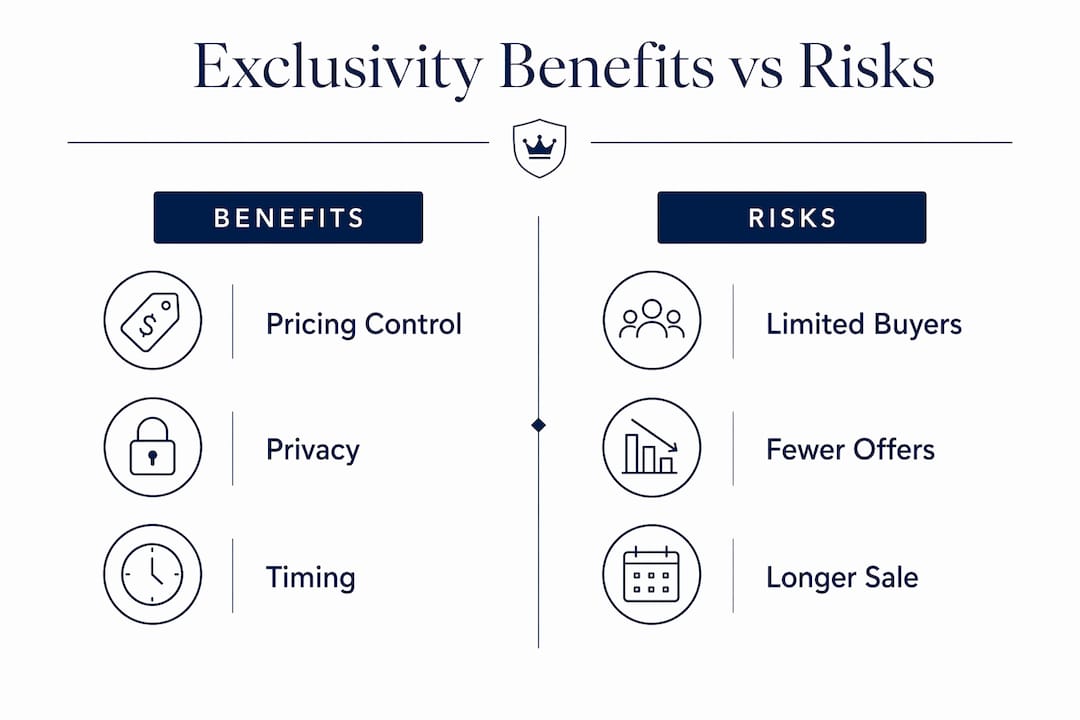
Sellers choose private channels for three primary reasons: pricing control, privacy, and timing. A private sale allows a seller to test valuation, gather buyer feedback, and refine their approach without accumulating days on market, which can signal weakness to future buyers.
Pro Tip: If you are a buyer seeking access to off-market inventory, retain a broker with documented relationships inside brokerage-internal pools and elite agent networks. Public portal searches will not surface the properties that matter most at the top of the market.
How does exclusivity shape buyer psychology in the luxury market?
Exclusivity functions as a complex social signaling mechanism in luxury real estate, transforming a property purchase into an act of identity performance. Psychological research confirms that luxury exclusivity triggers loss aversion, social distinction, and deep emotional engagement among high-net-worth buyers. These are not irrational responses. They are predictable, well-documented behavioral patterns that sophisticated sellers and brokers understand and design for.
The distinction between genuine scarcity and manufactured urgency matters enormously in this market. Affluent buyers are acutely sensitive to the difference. True luxury scarcity signals irreproducibility, fostering buyer confidence and decisive action rather than the skepticism that artificial urgency tends to produce. A property with a protected ridgeline view, a single-family zoning designation in a dense urban core, or a waterfront position that cannot be replicated carries a fundamentally different psychological weight than a property simply withheld from the MLS for tactical reasons.
"Exclusivity in luxury real estate is both an emotional and social performance, transforming a property purchase into a status-signaling event that extends well beyond the financial transaction itself."
Several behavioral forces converge when a qualified buyer encounters a genuinely exclusive property. Loss aversion, the well-established tendency to weight potential losses more heavily than equivalent gains, intensifies when a buyer believes a property may be acquired by a competing buyer within a narrow window. Social distinction, the desire to own what others cannot access, reinforces commitment. And the simple fact of private access, of being among the few invited to view a property, elevates the buyer's sense of their own standing. These forces do not manufacture desire. They amplify desire that already exists.
Cross-cultural research on luxury buyer behavior confirms that these psychological dynamics operate across markets, from Las Vegas to London to Singapore, with consistent intensity at the top of the wealth spectrum. Buyers who understand how East Coast buyers evaluate new markets often bring these same psychological frameworks with them, expecting exclusivity as a baseline condition of serious luxury transactions.
What are the real benefits and risks of exclusivity for sellers and buyers?
Exclusivity delivers concrete, measurable advantages for sellers who use it correctly. Private sales give sellers strategic control over narrative, valuation, and timing, insulating them from the public scrutiny that can erode a property's perceived value during extended market exposure. A seller who tests pricing privately, adjusts based on qualified buyer feedback, and then launches publicly with a refined strategy avoids the stigma of a price reduction on a visible listing.
Multi-phase launch strategies begin with a private or office-exclusive phase, then expand to broader MLS exposure if needed. This approach preserves the property's freshness in the market while gathering real buyer intelligence. Understanding luxury listing pricing strategies is central to executing this kind of phased campaign effectively.
The risks of exclusivity are real and deserve equal attention. A limited buyer pool means fewer competing offers, which can suppress the final sale price if the private phase does not surface sufficient demand. Properties that remain in private channels too long can develop a quiet stigma among the broker community, where word travels fast about listings that have not moved. Recent industry developments, including agreements that expand listing visibility across platforms, reflect a growing recognition that pure exclusivity can work against sellers in certain market conditions.
| Consideration | Seller benefit | Buyer benefit |
|---|---|---|
| Pricing control | Test valuation without public risk | Negotiate without competing public offers |
| Privacy | No public record of marketing activity | Discreet acquisition process |
| Market exposure | Phased launch preserves listing freshness | Access to inventory unavailable publicly |
| Risk | Smaller buyer pool may limit competition | Requires broker relationships to gain access |
Pro Tip: Sellers should set a clear private-phase timeline before launch, typically 2–4 weeks, and define the minimum acceptable offer threshold before moving to broader MLS exposure. Discipline in this phase protects both price and positioning.
How do scarcity and exclusivity interact to create lasting value?
Scarcity and exclusivity are related but distinct forces in the luxury property market, and conflating them is a costly mistake. Scarcity is a permanent, verifiable condition rooted in irreproducible physical attributes. Exclusivity is a controlled market condition created by brokers, sellers, and brokerage systems. The two reinforce each other most powerfully when genuine scarcity provides the foundation for exclusivity's appeal.
True luxury scarcity derives from irreproducible attributes such as land position, protected views, and zoning restrictions that cannot be replicated regardless of capital or ambition. A property positioned on the last developable acre within a protected desert preserve in Arizona, or a Las Vegas hillside estate with unobstructed Strip views protected by deed restriction, possesses scarcity that no amount of marketing can manufacture or replicate.
Exclusivity, by contrast, is the mechanism that translates that scarcity into market behavior. When a broker controls access to a scarce property, limiting viewings to pre-qualified buyers and keeping the listing out of public channels, the combination of real scarcity and controlled access creates the conditions for exceptional pricing outcomes. Neither force achieves its full effect without the other.
| Value driver | Definition | Example |
|---|---|---|
| Natural scarcity | Irreproducible physical attribute | Protected ridgeline, single waterfront lot |
| Zoning restriction | Legal limit on development or use | Single-family designation in dense urban area |
| Controlled access | Broker-managed private listing | Office-exclusive, pre-MLS brokerage pool |
| Combined effect | Scarcity amplified by exclusivity | Trophy property with private brokerage launch |
Markets where zoning is strict and land is genuinely constrained, such as coastal California, parts of Arizona, and select Las Vegas hillside corridors, consistently produce the strongest examples of this combined effect. Buyers in these markets pay a premium not just for the property but for the certainty that what they are acquiring cannot be reproduced.
What practical steps help buyers and sellers navigate exclusive luxury markets?
Accessing the exclusive properties market requires deliberate preparation on both sides of a transaction. The steps below reflect how serious participants in the $5M and above segment actually operate.
-
Select a broker with documented internal network access. The most effective way to access top-tier off-market inventory involves brokers who input client preferences into private pre-MLS databases checked before public listing. Ask any prospective broker directly which internal pools and agent networks they participate in.
-
Complete financial verification before requesting exclusive access. At luxury tiers of $5M and above, brokers require proof of funds or financial verification before granting access to private listings. This protects seller privacy and confirms transaction seriousness. Prepare documentation in advance.
-
Understand what a private real estate transaction entails. Buyers new to off-market acquisitions benefit from reviewing what a private transaction involves before entering negotiations, as the process differs materially from a standard MLS purchase.
-
For sellers, structure a phased listing campaign. Begin with a private or office-exclusive phase to test pricing and gather qualified buyer feedback. Set a defined timeline for each phase and establish clear criteria for moving to broader exposure.
-
Invest in trusted broker relationships before you need them. The most consequential off-market transactions are completed by buyers and sellers who have cultivated broker relationships over time, not those who approach the market transactionally when a need arises.
Key Takeaways
Exclusivity in luxury real estate creates durable value when controlled market access is built on a foundation of genuine, irreproducible scarcity rather than artificial withholding.
| Point | Details |
|---|---|
| Exclusivity operates through layered channels | Private brokerage pools, elite agent networks, and personal relationships keep top listings off public platforms. |
| Off-market activity dominates at the top | Up to 80% of transactions above $20M occur through private channels, not the MLS. |
| Buyer psychology amplifies value | Loss aversion and social distinction motivate high-net-worth buyers to act decisively on genuinely exclusive properties. |
| Scarcity and exclusivity are distinct forces | Natural scarcity provides the foundation; controlled access translates it into pricing strength. |
| Phased launches protect seller positioning | Testing pricing privately before MLS exposure preserves listing freshness and avoids public price reductions. |
What I have learned about exclusivity after years in the Las Vegas luxury market
The conversation around exclusivity in luxury real estate has shifted considerably since MLS policy reforms began reshaping how brokers manage private listings. I have watched sellers and buyers navigate these changes with varying degrees of sophistication, and the pattern is consistent: those who treat exclusivity as a strategic tool rather than a reflexive instinct toward secrecy achieve far better outcomes.
The most common misunderstanding I encounter is the belief that keeping a property off-market is inherently advantageous. It is not. Exclusivity earns its value only when the private phase is disciplined, time-bound, and targeted at genuinely qualified buyers. A property that lingers in private channels without a clear strategy does not benefit from exclusivity. It simply accumulates quiet stigma within the broker community, which is a far more damaging outcome than a well-managed public listing.
What I find genuinely underappreciated is how much the buyer experience matters in exclusive transactions. When a buyer is granted access to a private listing, the manner of that access, the quality of the presentation, and the professionalism of the broker relationship all signal the property's caliber before a single room is viewed. Exclusivity is not just about what is withheld. It is about the entire experience of access, and that experience either confirms or undermines the property's positioning. The brokers who understand this distinction consistently produce the strongest outcomes for their clients, on both sides of the transaction.
— Yelena
How Yhluxrealestate positions clients within the exclusive properties market
Yhluxrealestate, led by Yelena Horton and backed by Sotheby's International Realty's global network, operates at the intersection of private access and uncompromising client service in the Las Vegas luxury market. The practice maintains active relationships within off-market and brokerage-internal channels, giving buyers access to properties that never reach public portals and giving sellers the discretion and positioning that the highest-tier transactions demand.
For buyers relocating from out of state, Yhluxrealestate offers a dedicated relocation concierge alongside expert negotiation strategies calibrated to the Las Vegas market's distinct dynamics. For sellers, the practice structures phased listing campaigns that protect pricing integrity while reaching the most qualified buyers through private channels first. Clients seeking a trusted guide through the exclusive properties market are welcome to connect with Yhluxrealestate directly for a confidential consultation.
FAQ
What is an exclusive listing in luxury real estate?
An exclusive listing is a property marketed only through private channels, such as brokerage-internal pools or elite agent networks, without appearing on the MLS or public portals. This controlled access preserves seller privacy and supports stronger pricing outcomes.
How do luxury brokers access exclusive listings?
Luxury brokers access exclusive listings through brokerage-internal pre-MLS databases, elite agent networks like Top Agent Networks, and personal relationships cultivated through years of high-value transactions. Buyers gain access only through brokers who participate in these private channels.
Why does exclusivity matter in luxury property transactions?
Exclusivity matters because it triggers loss aversion and social distinction among high-net-worth buyers, creating the psychological conditions for decisive action and stronger pricing. Psychological research confirms that exclusivity transforms a property purchase into a status-signaling event that extends beyond the financial transaction.
What is the difference between scarcity and exclusivity in real estate?
Scarcity is a permanent, physical condition rooted in irreproducible attributes like land position or protected views. Exclusivity is a controlled market condition created by brokers and sellers. The two reinforce each other most powerfully when genuine scarcity provides the foundation for exclusive access.
How can buyers secure access to exclusive luxury listings?
Buyers secure access by retaining a broker with documented participation in private brokerage pools, completing financial verification in advance, and building trusted broker relationships before a specific property need arises. Financial verification at the $5M and above tier is a standard prerequisite for accessing private listings.