
The most consequential seller concession mistakes are requesting the wrong concession type, exceeding loan-program caps, and neglecting the appraisal and net-proceeds math. Each of these errors can stall a closing, trigger a loan denial, or quietly cost thousands in forfeited equity. The single most protective action you can take: run lender-modeled scenarios and confirm program caps with the buyer's lender before the offer is written.
Do this now:
- Confirm the buyer's loan program and its allowable seller-contribution cap with the lender.
- Model the seller's net proceeds after the proposed concession, using actual estimated closing costs.
- Verify that the concession type requested is eligible under the specific loan program.
Pro Tip: Unused concession money is typically forfeited at closing — it cannot be paid out as cash to the buyer. Size every credit to actual, documented eligible costs, or the excess simply disappears.
Key Takeaways
Exceeding loan-program contribution caps, inflating the contract price without appraisal support, and using vague contract language are the three errors most likely to delay or derail a transaction involving seller concessions.
| Point | Details |
|---|---|
| Confirm program caps first | FHA caps at 6%; conventional varies from 3%–9% by down payment; VA and USDA have separate rules. |
| Appraisal risk is real | Raising the price to absorb a credit only works when comparable sales support the higher number. |
| Size credits to actual costs | Excess concession funds are forfeited at closing and cannot be paid out as cash to the buyer. |
| Use specific contract language | Dollar-denominated language referencing lender-allowable limits prevents Closing Disclosure mismatches. |
| Yhluxrealestate | Yelena Horton provides net-sheet analysis, lender coordination, and precise contract drafting for every transaction. |
Table of Contents
- What are seller concessions, and why do buyers and sellers use them?
- What types of seller concessions are most commonly used?
- What loan-program limits apply to seller concessions?
- How do concessions affect the sale price, appraisal, and loan approval?
- What are the most common seller concession mistakes to avoid?
- How do you negotiate concessions without losing leverage?
- A practical checklist and sample negotiation language
- What tax and closing-cost consequences should you check before accepting?
- When does a price reduction make more sense than a concession?
- What to check and who to call before you close
- A perspective on concession pitfalls from the field
- Yhluxrealestate guides you through every concession decision
- Sources
- FAQ
What are seller concessions, and why do buyers and sellers use them?
A seller concession is a contribution from the seller toward the buyer's transaction costs, distinct from a price reduction in that it does not lower the loan amount or the appraised value baseline. Whereas a price cut reduces what the buyer finances, a concession redirects a portion of the seller's proceeds to cover specific costs the buyer would otherwise pay out of pocket at closing.
Three concrete examples illustrate the distinction clearly. A seller might credit $8,000 toward the buyer's closing costs, reducing the cash the buyer must bring to the table without altering the contract price. Alternatively, a seller might fund a 2-1 buydown, paying discount points that temporarily lower the buyer's interest rate for the first two years. A third common form is a repair credit, where instead of completing work before closing, the seller grants a dollar allowance the buyer applies toward repairs after possession.
Seller concessions lower the buyer's cash-to-close or monthly payment without changing the sale price on paper — but lenders, appraisers, and the IRS all see the full picture, which is why structuring them correctly matters as much as negotiating them.
The purpose varies by situation. A cash-strapped buyer may need closing-cost relief more than a lower purchase price. A buyer stretched by today's rates may benefit more from a funded buydown than from a $10,000 price reduction. Understanding which problem a concession actually solves is the foundation of every sound concession agreement.
What types of seller concessions are most commonly used?
The range of concession types is broader than most buyers and sellers realize, and each carries a different impact on monthly payment versus cash-to-close.
- Closing-cost credit: The seller credits a fixed dollar amount toward the buyer's lender fees, title charges, and prepaid items. This is the most direct cash-to-close relief and the most frequently requested form.
- Repair allowance: Rather than completing repairs before closing, the seller grants a credit the buyer uses post-closing. Useful when the seller wants a clean break; the tradeoff is that lenders scrutinize large repair credits carefully.
- Rate buydown (2-1 or permanent): The seller funds discount points that reduce the buyer's interest rate, either temporarily (a 2-1 buydown lowers the rate by 2% in year one and 1% in year two) or permanently. Rate buydowns often deliver larger monthly-payment relief than equivalent price cuts in high-rate environments.
- Home warranty: A one-year warranty policy paid by the seller, typically $400–$700, providing the buyer with repair coverage on major systems. Low cost to the seller, high perceived value to the buyer.
- Seller-paid discount points: Distinct from a buydown in that points are paid upfront to permanently reduce the rate. These count toward program contribution caps and must be disclosed to the lender.
For buyers prioritizing monthly payment, a buydown or discount points deliver the most durable benefit. For buyers short on cash at closing, a direct closing-cost credit is the more precise instrument.
What loan-program limits apply to seller concessions?
Every major loan program imposes limits on how much a seller may contribute, and exceeding those limits is one of the most common seller concession errors agents encounter. The CFPB's loan-options guidance underscores that buyers and sellers must coordinate with lenders because rules differ by program and can affect both eligibility and closing timelines.
Program caps at a glance:
| Loan Program | Seller Contribution Cap | Key Gotcha |
|---|---|---|
| FHA | 6% of sales price | Discount points and upfront MIP count toward the cap |
| VA | No fixed % cap on customary closing costs | Non-customary concessions (e.g., paying buyer debts) capped separately |
| USDA | 6% of eligible loan costs | Cannot be used to pay off buyer's personal debts |
| Conventional | 3%, 6%, or 9% depending on down payment | Investor properties have stricter limits |
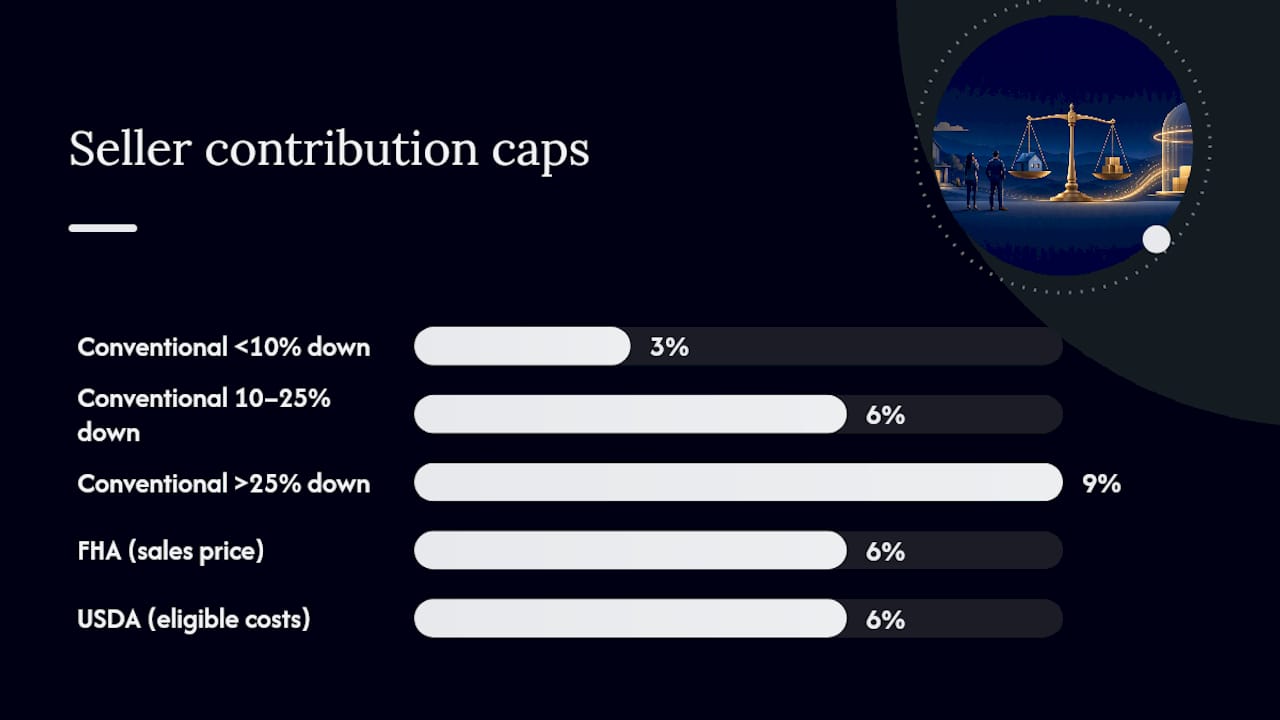
FHA caps seller concessions at 6% of the sales price and applies that cap broadly, counting discount points and the upfront mortgage insurance premium toward the total.
VA home loans take a different approach. Sellers may pay many customary closing costs without a fixed percentage ceiling, but non-customary concessions, such as paying down a buyer's personal debts or vehicle loans, are treated separately and subject to their own limits. The distinction between "customary closing costs" and "concessions" under VA rules trips up even experienced agents.
USDA's single-family guaranteed loan program allows seller contributions up to 6% toward eligible loan costs, with a clear prohibition on using those funds to retire the buyer's personal debts. Conventional loan limits vary with down payment: contributions are commonly capped at 3% for down payments below 10%, 6% for down payments of 10%–25%, and 9% for down payments above 25%, with investor-property rules applying a tighter standard.
Appraisers are required to note seller concessions in their reports, and underwriters flag contributions that approach or exceed program limits. A concession that looks clean in the contract can still trigger a condition or a counter-request from the underwriter if it was not modeled against the actual loan type.
Pro Tip: Before submitting any offer with a concession, ask the buyer's lender to confirm the allowable contribution amount, the eligible uses, and whether the specific items requested count toward the cap. A five-minute call can prevent a two-week delay.
How do concessions affect the sale price, appraisal, and loan approval?
The relationship between a seller concession and the appraised value is where many well-intentioned deals quietly unravel. When a seller raises the contract price to absorb a credit, the loan amount rises accordingly, but the appraiser works from comparable sales that may not support the inflated figure. Lenders use the lower of the contract price or the appraised value, so an appraisal that comes in below the adjusted price leaves the buyer short, often by exactly the amount of the concession.
Consider a straightforward example. A home is worth $450,000 based on recent comps. The buyer asks for $12,000 in closing-cost credits, and the seller agrees to raise the price to $462,000 to preserve net proceeds. If the appraiser values the property at $450,000, the lender bases the loan on $450,000. The buyer must now cover the $12,000 gap in addition to their down payment, which is precisely the cash problem the concession was meant to solve.

Seller net proceeds: a simplified illustration
The table illustrates a critical point: raising the price to absorb a concession only works when the appraised value supports the higher number. When it does not, the seller's net is effectively the same as the "price held" scenario, but the buyer is now in a worse position than if the price had never been inflated.
Credits also cannot exceed actual eligible closing costs. Excess concession funds are forfeited at closing and cannot be paid out as cash to the buyer. Requesting a $15,000 credit when the buyer's documented closing costs total $9,000 wastes $6,000 of the seller's negotiating capital.
What are the most common seller concession mistakes to avoid?
These are the errors that appear most frequently in real transactions, ranked by the severity of their consequences.
-
Requesting more than the loan program allows. Asking for a 7% credit on an FHA loan, or a 10% credit on a conventional loan with a 15% down payment, forces the lender to reduce the concession at closing. The contract must then be amended, which costs time and occasionally goodwill.
Mistake: Buyer agent writes "Seller to credit $20,000 toward buyer's closing costs" on a $280,000 FHA purchase. The $3,200 overage must be renegotiated. Fix: Calculate the cap first. On a $280,000 FHA purchase, the ceiling is $16,800. Request $16,500 and document actual costs to match.
-
Choosing a price cut when a buydown solves the real problem. A buyer who is payment-sensitive but not cash-strapped benefits far more from a funded rate buydown than from a $10,000 price reduction. On a 30-year loan at 7%, a $10,000 price cut reduces the monthly payment by roughly $67. A $10,000 2-1 buydown can reduce the first-year payment by several hundred dollars per month.
-
Advertising concessions prematurely or too broadly. Marketing a listing with "seller will pay closing costs" before receiving offers signals desperation and invites lowball bids. Specific incentives, such as "seller to fund a 2-1 buydown," communicate value without surrendering leverage.
-
Using vague contract language. Phrases like "seller to assist with buyer's costs" are ambiguous and can be interpreted differently by the title company, lender, and underwriter. Vague language delays closing.
Fix: Use specific, lender-aligned language: "Seller to credit $X toward buyer's allowable closing costs and/or prepaid items, not to exceed lender-allowable limits, to be applied per lender instructions."
-
Failing to calculate seller net proceeds before accepting. A seller who agrees to a $15,000 concession without modeling net proceeds may be surprised at the closing table. Run the net sheet before signing.
-
Confusing a repair credit with a price reduction. A repair credit is a concession and counts toward program caps. A price reduction does not. Treating them as interchangeable can push total contributions over the allowable limit.
-
Not coordinating with the lender and agent before writing the offer. The lender knows which costs are eligible, what the cap is, and how the credit will appear on the Closing Disclosure. Skipping this step is the root cause of most concession-related delays.
How do you negotiate concessions without losing leverage?
Timing and specificity are the two variables that separate a well-executed concession request from a buyer concession pitfall.
In a seller's market or on a new listing, leading with a concession request weakens the offer. Sellers with multiple bids have no incentive to absorb costs. In these conditions, buyers who need closing-cost relief are better served by offering a slightly higher price with a specific credit built in, provided the appraisal math supports it.
In a buyer's market or on a stale listing (typically 30-plus days on market), concessions are a legitimate and expected negotiating tool. A seller who has already reduced the price once is often more receptive to a structured credit than to another price cut, because a credit preserves the sale price on paper.
Negotiation dos and don'ts:
- Do frame concession requests around a specific buyer need: "We'd like to request a seller-funded 2-1 buydown to address the payment gap at current rates" reads as a reasoned ask, not a demand.
- Do offer something in return: a shorter inspection period, flexible closing date, or higher earnest money deposit signals a serious buyer and softens the concession request.
- Don't advertise the seller's willingness to concede before the offer is submitted. Once it is in the listing remarks, every buyer knows the floor.
- Don't stack multiple concession types without confirming the combined total stays within the program cap.
- Do use specific credit language in the offer rather than generic "seller assistance" phrasing.
Pro Tip: In a balanced market, a 2-1 buydown offered proactively by the seller can attract more qualified buyers than an equivalent price reduction, because it directly addresses the payment anxiety most buyers feel at today's rates.
A practical checklist and sample negotiation language
Before requesting or accepting any concession, work through this sequence.
Pre-offer checklist:
- Confirm the buyer's loan program (FHA, VA, USDA, or conventional) and the applicable seller-contribution cap.
- Obtain an estimated closing-cost worksheet from the lender, itemized by eligible category.
- Verify that the requested concession type is eligible under the program (e.g., USDA prohibits using credits to retire personal debts).
- Model the seller's net proceeds with and without the concession, at the current contract price and at a price adjusted upward to absorb the credit.
- Check recent comparable sales to assess whether an adjusted price would survive appraisal.
- Confirm the inspection priorities: is a repair credit preferable to a price reduction, and does it stay within the cap?
- Draft contract language that is specific, dollar-denominated, and references lender-allowable limits.
Sample contract clause templates (examples only, not legal advice; confirm with your agent and attorney):
- "Seller to credit Buyer $[X] toward Buyer's allowable closing costs, prepaid items, and/or discount points, not to exceed lender-allowable limits; funds to be applied at closing per lender instructions."
- "Seller to fund a 2-1 temporary rate buydown in the amount of $[X], to be deposited into a buydown escrow account at closing per lender requirements."
- "Seller to provide a repair credit of $[X] toward Buyer's post-closing repairs; credit to be applied as a reduction in Buyer's closing costs per lender guidelines."
Negotiation scripts:
- Buyer agent requesting a buydown: "Given current rates, our buyer would benefit most from a seller-funded 2-1 buydown of approximately $[X]. This keeps the contract price intact while addressing the payment gap that is their primary concern."
- Buyer requesting a repair credit: "The inspection identified $[X] in deferred maintenance. Rather than asking for a price reduction, we'd prefer a closing-cost credit of $[X] so the buyer can address repairs on their own timeline."
- Seller framing a concession as problem-solving: "We're prepared to offer a $[X] credit toward the buyer's closing costs to keep the transaction moving. This preserves the agreed price and gets both parties to the table."
Pro Tip: Always coordinate the final concession language with the buyer's lender before the contract is executed. The lender's processor will need to match the credit line on the Closing Disclosure exactly to what the contract states — a one-word discrepancy can trigger a correction and delay.
What tax and closing-cost consequences should you check before accepting?
Seller concessions do not change the taxable sale price for federal capital gains purposes; the IRS treats the net proceeds (after concessions) as the amount realized from the sale. However, the interaction between concessions and the seller's adjusted cost basis, depreciation recapture on investment properties, and state-level transfer taxes warrants a conversation with a tax advisor before closing.
For buyers, certain concession-funded items carry different tax treatment. Prepaid property taxes paid by the seller on the buyer's behalf may be deductible by the buyer in the year of purchase, while a generic closing-cost credit applied to lender fees is not. Seller-paid discount points may be deductible by the buyer under IRS Publication 936 rules, subject to conditions.
At the settlement statement level, both parties should verify:
- That the concession appears on the Closing Disclosure exactly as written in the contract.
- That the credit does not exceed actual eligible costs (excess is forfeited, not refunded).
- That seller-paid items are correctly categorized as either closing costs or prepaid items, since lenders treat these differently when calculating the contribution cap.
- That any repair credit is structured as a closing-cost credit rather than a post-closing payment, which most lenders will not permit.
Consult a qualified tax professional for guidance specific to your situation; this article provides general information only.
When does a price reduction make more sense than a concession?
The choice between a price cut and a seller concession turns on which problem the buyer is actually trying to solve.
A price reduction is the stronger choice when:
- The buyer's primary concern is long-term loan cost. A lower principal reduces total interest paid over the life of the loan.
- The property has appraisal risk. A price reduction eliminates the gap risk that a concession-inflated price creates.
- The buyer has sufficient cash to close and does not need upfront relief.
- The buyer is an investor whose loan program imposes strict concession limits.
A concession or buydown is the stronger choice when:
- The buyer is cash-constrained and needs closing-cost relief now.
- The buyer is payment-sensitive and a buydown delivers more monthly relief than an equivalent price cut.
- The seller wants to preserve the sale price on paper (relevant for neighborhood comps and seller psychology).
- The market is soft and the seller needs a differentiating incentive without formally reducing the list price.
Price reduction vs. concession: key trade-offs
| Factor | Price Reduction | Concession / Buydown |
|---|---|---|
| Monthly payment impact | Modest (lower principal) | Higher (buydown directly reduces rate) |
| Cash-to-close impact | None | Reduces buyer's out-of-pocket costs |
| Appraisal risk | Lower | Higher if price is inflated to absorb credit |
| Seller net proceeds | Reduced by full amount | Reduced by concession amount only |
| Loan-program cap exposure | None | Must stay within program limits |
The cleanest guidance: if the buyer's lender confirms the appraisal will support the adjusted price, a concession often solves the buyer's actual problem more precisely than a price cut. When appraisal support is uncertain, a price reduction is the safer instrument.
What to check and who to call before you close
The most consequential checks, distilled to their essentials:
- Confirm the loan-program cap with the lender before the offer is written.
- Run the seller net-proceeds calculation at both the current price and any adjusted price.
- Verify that the appraised value will support the contract price if it has been raised to absorb a credit.
- Use specific, dollar-denominated contract language that references lender-allowable limits.
- Confirm that the concession type is eligible under the buyer's program.
Before writing or accepting any offer with a concession, call the buyer's lender and the listing or buyer's agent. Ask the lender: "What is the maximum allowable seller contribution for this loan type and down payment, and which cost categories are eligible?" Ask the agent: "Does the proposed concession language match what the lender's processor will need on the Closing Disclosure?"
Bookmark the checklist in the section above and return to it at every offer.
A perspective on concession pitfalls from the field
What strikes me most, having guided clients through transactions at every price point, is how often concession mistakes originate not from bad intentions but from a simple failure to sequence the conversation correctly. A buyer's agent submits an offer with a $20,000 credit on an FHA loan before anyone has confirmed the program cap. A seller agrees to a repair credit without modeling what it does to net proceeds. A listing markets "seller pays all closing costs" before a single offer arrives, and the negotiating position evaporates before it was ever established.
The pattern is consistent: the concession is treated as a negotiating afterthought rather than a structural decision that requires lender input, appraisal awareness, and precise contract language. In the luxury segment, where transaction values amplify every error, the cost of imprecision is proportionally higher.
Yhluxrealestate guides you through every concession decision

Negotiating a seller concession correctly requires three things working in concert: a lender who has modeled the program caps, an agent who can draft precise contract language, and a net-sheet analysis that shows exactly what the seller walks away with. At Yhluxrealestate, Yelena Horton provides all three as a standard part of every transaction, whether you are a buyer seeking closing-cost relief or a seller evaluating whether a concession, a price reduction, or a funded buydown best serves your position. Backed by Sotheby's International Realty's global network and a relocation concierge for out-of-state clients, the practice is built around the kind of uncompromising precision that prevents the errors outlined in this article from reaching the closing table. To discuss your specific situation and run the numbers before your next offer, schedule a consultation at Yhluxrealestate.
Sources
The following primary and authoritative sources underpin the program caps, disclosure rules, and guidance cited throughout this article.
- Loan options | Consumer Financial Protection Bureau
- VA Home Loans | U.S. Department of Veterans Affairs
- Single Family Housing Guaranteed Loan Program | USDA RD
- What Are Seller Concessions? How Buyers Use Them to Lower Cash to Close • 719 Lending
This article is general information, not a substitute for advice from a qualified financial advisor. Consult a qualified financial professional about your own circumstances before acting on anything here.
FAQ
What is a fair amount to ask for in seller concessions?
A fair concession request is one sized to the buyer's actual, documented closing costs and within the loan program's contribution cap.
What does $5,000 in seller concessions mean?
A seller concession means the seller agrees to credit an amount toward the buyer's eligible closing costs, prepaid items, or discount points at closing. The funds reduce the buyer's cash-to-close by up to the credited amount, provided actual eligible costs meet or exceed that amount; any unused portion is forfeited.
Do seller concessions hurt the seller?
Seller concessions reduce net proceeds by the concession amount, so yes, they represent a real cost to the seller. However, a well-structured concession can attract a stronger offer or prevent a deal from falling apart over a buyer's cash-to-close shortfall, making the tradeoff worthwhile in many markets.
What can seller concessions not be used to pay?
Seller concessions cannot be used to pay off the buyer's personal debts (prohibited under USDA and VA rules for non-customary concessions), and they cannot exceed the loan program's contribution cap. Excess funds above actual eligible closing costs are forfeited at closing rather than returned as cash to the buyer.
How do seller concessions affect the appraisal?
Appraisers are required to note seller concessions in their reports, and lenders use the lower of the contract price or the appraised value when calculating the loan amount. If the contract price was raised to absorb a concession and the appraiser's value does not support that higher number, the buyer faces an appraisal gap that the concession was meant to prevent.