
Real estate wire fraud happens when criminals compromise email accounts or impersonate trusted parties to redirect closing funds into their own accounts, often within a single business day of the scheduled transfer. The single most effective defense is out-of-band verification: never trust wiring instructions received solely by email, and always confirm the account number and routing details by calling a phone number you sourced independently, not one supplied in the same message that gave you the new instructions.
Before you go further, adopt these three behaviors today:
- Call your title or escrow company using a number from their official website or a prior contract, never a number pasted into a new email.
- Treat any last-minute change to wiring instructions as a red flag requiring a live phone conversation, not a reply email.
- Confirm a small test transfer or verbal reference number with your bank before releasing six or seven figures into a title company's account.
Table of Contents
- What Is Real Estate Wire Fraud and Why It Happens
- Common Schemes and Real-World Examples
- Red Flags: A Quick Checklist for Wiring Instructions
- Prevention: Practices for Buyers, Sellers, Agents, and Title Companies
- If Funds Were Wired to a Scammer: Recovery and Reporting Steps
- Liability, Contracts, and Title Insurance: Who Is Responsible?
- What the Data Shows About the Rising Risk
- A Practitioner's View on Verification-First Closings
- How Yhluxrealestate Protects Your Closing
- Key Takeaways: What to Do Today
- Sources
- FAQ
What Is Real Estate Wire Fraud and Why It Happens
Real estate wire fraud is a form of Business Email Compromise, or BEC, in which a criminal infiltrates or spoofs a legitimate email thread involved in a home purchase and then sends the buyer, seller, or their agent altered wiring instructions. The money looks like it's going to the title company or escrow agent. It's actually going to an account the fraudster controls, often at a bank several states away, and typically drained within hours.
Closings attract this kind of crime for reasons that have nothing to do with sloppy security and everything to do with structure. A residential purchase moves a down payment or full purchase price, sometimes hundreds of thousands of dollars, through a chain of people who rarely meet in person: a buyer, a listing agent, a buyer's agent, a lender, a title officer, and an escrow processor. Each handoff is a chance for a criminal to insert a fraudulent message, and the FBI's guidance on Business Email Compromise identifies exactly this kind of multi-party financial handoff as the mechanism attackers exploit most successfully.
Picture two typical scenarios. In the first, a fraudster monitors a title company's inbox for weeks after breaching one employee's credentials, waits until the week of closing, then emails the buyer from a nearly identical domain with "updated" wire instructions. In the second, a criminal spoofs the seller's email and tells the closing agent to redirect the seller's proceeds to a "new" account, banking on the fact that nobody double checks a request that sounds routine. Neither scheme requires sophisticated hacking. Both rely on one person skipping a phone call.
Common Schemes and Real-World Examples
Several common patterns account for most reported incidents, and each one has a distinct signature once you know to look for it.
Compromised title or agent email. A criminal gains access to a real inbox at a title company or brokerage, often through a phishing link clicked weeks earlier, and then quietly watches active transaction threads until the moment is right to insert fraudulent wire instructions into a real conversation.

Domain spoofing. Instead of hacking an account, the fraudster registers a domain that looks nearly identical to the title company's real one (a swapped letter, an inserted hyphen) and sends convincing emails from that lookalike address.
Seller impersonation. In cash-out or investment deals, criminals impersonate the seller directly, often targeting vacant or inherited properties where the real owner is harder to reach for verification.
Fake escrow accounts. Some schemes skip email compromise entirely and instead present buyers with an entirely fabricated escrow company, complete with a professional-looking website and a phone number that rings straight to the criminal.
A wire fraud investigator working title claims once summarized the pattern this way to industry researchers:
Criminals don't need to be inside your systems for months. Most real estate compromises follow a recon-to-strike window of just 24 to 72 hours: they watch a transaction thread quietly, then move the instant they see a closing date and dollar amount worth acting on.
That compressed timeline is why waiting even a day to double check unusual instructions can mean the difference between a recoverable wire and a permanent loss.
Red Flags: A Quick Checklist for Wiring Instructions
Every wiring instruction you receive during a closing deserves the same scrutiny, whether it arrives from a longtime title partner or a company you've never worked with. Look for these signs before you authorize anything:
- Wiring instructions that change in the final 24 to 48 hours before closing, especially with an urgent tone pushing you to act immediately.
- A sender domain that's subtly different from the one used earlier in the transaction (an extra letter, a ".net" instead of ".com").
- A request to route funds to a personal account, a business name that doesn't match the title company, or an out-of-state or international bank.
- Contact information that only routes to voicemail, with no live person answering during business hours.
On the email itself, watch for a generic greeting where your name should be, a signature block that doesn't match previous correspondence, and PDF attachments with slightly blurred logos or mismatched fonts, all common signs of a spoofed template.
Pro Tip: Never call the phone number listed in the email containing the wiring instructions. Instead, pull the title company's number from your original engagement letter, the county recorder's public listing, or a prior invoice, and ask specifically to speak with the escrow officer assigned to your file by name.
Prevention: Practices for Buyers, Sellers, Agents, and Title Companies
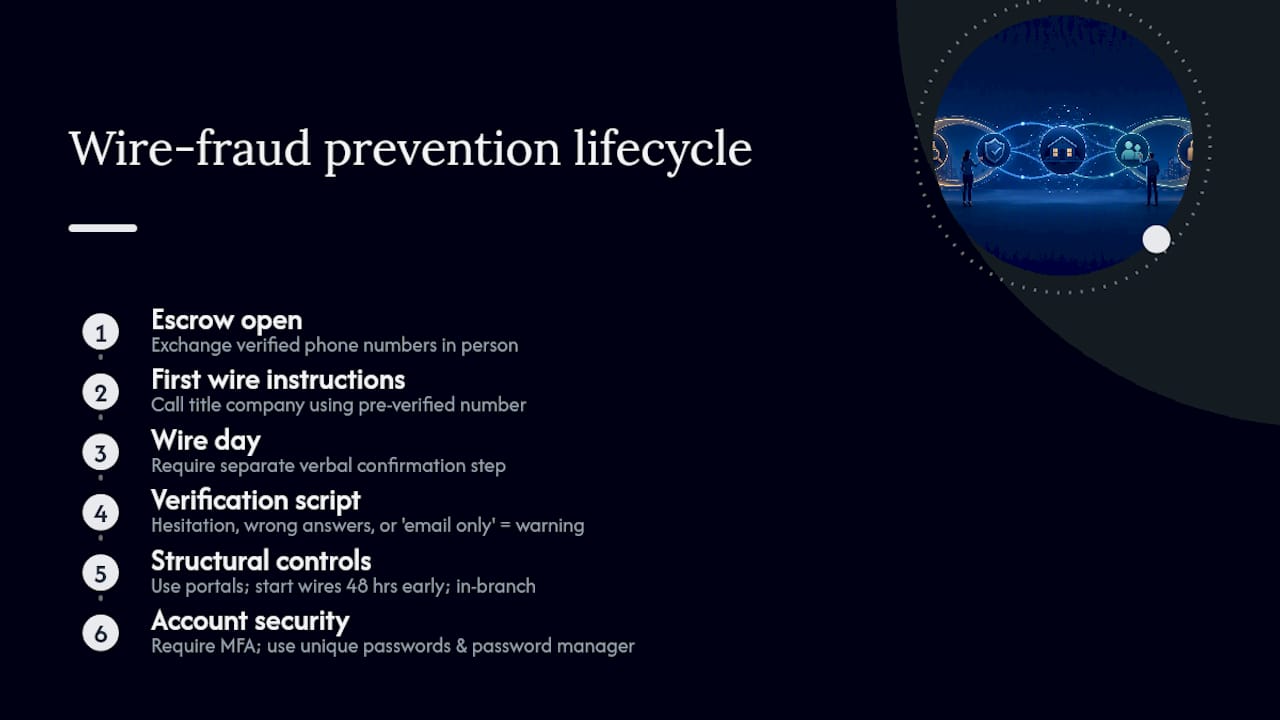
Wire fraud prevention works best as a lifecycle discipline rather than a one-time check. At escrow open, every party should exchange verified phone numbers in person or via a signed document, not just email, so that later verification has a trustworthy baseline. When the first wire instructions arrive, whoever receives them should independently call the title company using that pre-verified number before doing anything else. On wire day itself, treat the transfer like a formal transaction requiring its own confirmation step, not a routine errand.
A simple verbal script protects everyone involved:
If the person on the other end hesitates, can't answer basic details, or asks you to email instead of talk, treat that as a serious warning sign.
Practical structural choices reduce risk further. Use authenticated client portals when your title company offers them, since portal-based instructions can't be intercepted or altered in transit the way email can, as explained in How rental platforms detect fraud: what you need to know. Initiate transfers 48 hours before the scheduled closing rather than the morning of, giving your bank more room to catch anomalies. Where feasible, complete wires in person at a bank branch for large transactions. And every party in a transaction, from agents to buyers, should require multi-factor authentication on their email accounts.
Pro Tip: Turn on MFA for every account tied to your transaction email, use a unique password manager rather than reused passwords, and keep your phone and laptop updated. Most BEC compromises start with a single reused password from an unrelated data breach months earlier.
If Funds Were Wired to a Scammer: Recovery and Reporting Steps
Speed determines nearly everything in a wire fraud recovery. Take these steps in order, within the first hour if at all possible:
- Call your bank's fraud department immediately, not the general customer service line, and request a wire recall. Get a case or reference number for the call itself.
- Ask your bank to contact the receiving bank's fraud desk directly. Banks can sometimes freeze or reverse a domestic wire if the request lands before funds are withdrawn.
- Notify your title or escrow company so they can flag the transaction and alert their own fraud and legal teams.
- File a report with local police to create an official record, which banks and insurers will likely require.
- File a complaint with the FBI's Internet Crime Complaint Center, which routes real estate fraud cases to the agents best positioned to trace the money.
- Submit a report through Reportfraud and, if personal information was compromised alongside the funds, through Identitytheft for a personalized recovery plan.
- Contact your title insurance provider or homeowner's insurance agent to ask whether a cyber-fraud endorsement applies.
Domestic wires reported within hours have a real, though not guaranteed, chance of recall or freeze before the criminal withdraws the funds. Moving your closing funds 48 hours ahead of schedule, as AdvisorGuide's wire fraud protocols recommend, gives your bank a wider window to catch problems and gives you documentation, including a wire reference number, that both insurers and investigators will ask for. International wires are considerably harder to recover once funds clear, since they often move through multiple intermediary banks and jurisdictions within minutes.
Liability, Contracts, and Title Insurance: Who Is Responsible?
Liability in a wire fraud case typically hinges on three questions: whose systems were compromised, what the purchase or listing contract says about wiring responsibility, and whether any party ignored an obvious red flag. Courts and title insurers generally look at whether the loss traces to negligence, such as a title company using an unsecured email system, or to a buyer who wired funds despite an unverified last-minute change.
Contracts increasingly address this directly. A sample clause worth proposing in any escrow or title agreement reads something like this:
Language like that shifts the incentive structure toward verification before the wire, not litigation after it.
Title insurance policies vary widely in whether they cover wire fraud losses. Some title companies carry specific cyber-fraud endorsements that reimburse buyers when the company's own systems were breached; the Old Republic Title network is one example of a title insurer offering wire fraud protection guidance to agents and consumers. Coverage typically excludes losses where the buyer or seller wired funds to an account they never independently verified, which is precisely why the verification step matters more than any insurance backstop. Wire fraud itself, when prosecuted, falls under 18 U.S.C. § 1343, which the Justice Department's own criminal resource manual defines as a scheme to defraud carried out using interstate wire communications, a felony that can carry decades in federal prison depending on the amount involved and whether the scheme targeted a financial institution.
What the Data Shows About the Rising Risk
The scale of this problem has grown consistently for nearly a decade. Reported Business Email Compromise losses climbed from $676 million in 2017 to more than $2.7 billion by 2022, a jump of more than 300%, with real estate transactions consistently named among the costliest categories because of the size of individual wires involved.
| Reporting period | What the data shows |
|---|---|
| 2017 | BEC losses reported at $676 million nationally |
| 2020 | FBI's IC3 report flags real estate wire fraud as a top-tier complaint category alongside COVID-19 scams |
| 2022 | Reported BEC losses exceed $2.7 billion |
| 2024 | IC3's annual report continues documenting real estate fraud as a recurring high-loss category |
The IC3's 2025 annual report shows the trend has not reversed, and industry researchers point to a specific reason: attackers are getting better tools, not just more of them. Security analysts writing for HousingWire note that AI-generated voice cloning and deepfake video are starting to defeat the informal verification methods agents have relied on for years, like recognizing a client's voice on a callback. That shift is pushing serious fraud-prevention frameworks toward verification-first controls, such as authenticated portals and multi-factor identity checks, rather than casual recognition cues, a point echoed in DeepIDV's fraud prevention playbook.
Pro Tip: Set up email or text alerts through your bank for any outbound wire over a threshold you choose, so you get real-time notification the moment funds move, not a monthly statement that arrives too late to act.
A Practitioner's View on Verification-First Closings
In luxury transactions, where wires often carry seven figures and out-of-state buyers may never set foot in the property before closing, verification stops being a formality and becomes the backbone of the entire process. Every escrow file I open starts with independently verified phone numbers exchanged directly with the title officer, confirmed before a single wiring document is ever emailed. Funds move 48 hours ahead of the scheduled closing whenever the timeline allows, giving banks a real window to flag anything unusual rather than a few rushed hours on closing morning.
For relocating buyers coordinating a purchase from another state or country, that discipline matters even more, since they're relying entirely on trust in people they've never met face to face. Building that verification habit into the process from day one is what lets a buyer wire hundreds of thousands of dollars with confidence instead of anxiety.
How Yhluxrealestate Protects Your Closing
Yhluxrealestate is the alternative to a rushed, email-only closing process for luxury transactions in Las Vegas: every wire instruction gets verified through pre-confirmed phone contacts and coordinated directly with your title and escrow team before funds ever move. That verification-first workflow integrates directly into the relocation concierge process for out-of-state buyers, so clients coordinating a purchase from across the country get the same independently confirmed wiring instructions and closing timeline as someone sitting in the room.

If you're preparing to buy or sell a luxury property in Las Vegas and want a transaction team that treats wire security as a standard part of closing rather than an afterthought, reach out to Yhluxrealestate to discuss your timeline and get connected with a verified, concierge-supported closing process.
Key Takeaways: What to Do Today
Verifying wiring instructions through an independently sourced phone number, before every transfer, is the single most reliable defense against real estate wire fraud.
| Point | Details |
|---|---|
| Verify out-of-band | Call a phone number you sourced independently, never one from the same email with new instructions. |
| Get numbers early | Exchange verified title and escrow phone contacts on day one of escrow, not the week of closing. |
| Move funds early | Initiate wires 48 hours before closing to give your bank time to catch anomalies. |
| Secure your accounts | Enable multi-factor authentication and unique passwords on every email tied to the transaction. |
| Choose a verification-first partner | Yhluxrealestate builds phone-verified wiring confirmation into every luxury closing, including for out-of-state and relocating buyers. |
Sources
- Business Email Compromise (FBI consumer guidance)
- DOJ Criminal Resource Manual — elements of wire fraud (18 U.S.C. § 1343)
This article is general information, not a substitute for advice from a qualified financial advisor. Consult a qualified financial professional about your own circumstances before acting on anything here.
FAQ
Can You Get a Wire Transfer Back If You Were Scammed?
Sometimes, if you act within hours: banks can occasionally recall or freeze a domestic wire before the criminal withdraws the funds, but recovery odds drop sharply after the first day, and international wires are much harder to reverse once cleared.
What Are Common Examples of Real Estate Wire Fraud?
The most common patterns include a compromised title or agent email inbox, a spoofed lookalike domain sending fake instructions, direct impersonation of a seller, and entirely fabricated escrow companies designed to look legitimate.
What Qualifies as Wire Fraud Under Federal Law?
Under 18 U.S.C. § 1343, wire fraud requires a scheme to defraud someone of money or property carried out using interstate wire communications like email, phone, or electronic funds transfer; this is general information, not legal advice, so consult an attorney for guidance on a specific case.
What Is the Most Common Type of Real Estate Fraud?
Business Email Compromise targeting closing wire instructions is consistently ranked among the costliest real estate fraud types by the FBI's Internet Crime Complaint Center, largely because of how large a single closing wire tends to be compared to other scam categories.
How Can I Verify Wiring Instructions Are Legitimate?
Call the title or escrow company using a phone number sourced independently, such as from your original engagement paperwork, and ask the named escrow officer to confirm the receiving bank and account details verbally before authorizing any transfer.