
A real estate NDA is a signed contract that lets sellers, landlords, and brokers share non-public property or financial details with prospective buyers or tenants while legally limiting how that information travels. Sign one before you hand over rent rolls, financials, or off-market listing details. Skip that step, and there is no legal leash on where sensitive numbers end up next.
TL;DR:
- An NDA is essential before revealing sensitive property details to prevent unauthorized disclosure or misuse, especially for off-market listings and confidential reports.
- Clauses must clearly define confidential information, permitted disclosures, use restrictions, and include specific deadlines for returning or destroying materials to ensure enforceability.
- A unilateral NDA suits cases where only one party discloses information, while a mutual NDA is necessary for joint disclosures in commercial or partnership deals.
- NDAs are most valuable when disclosing financials, environmental reports, or pre-launch marketing strategies that could weaken negotiating leverage if leaked.
- Proper NDA drafting, including precise definitions and clear governing law, is crucial, and involving a lawyer is recommended for high-value transactions or complex agreements.
Table of Contents
- What Does a Real Estate NDA Protect, and When Do You Use One?
- What Clauses Belong in Every Real Estate NDA?
- Unilateral or Mutual, Commercial or Residential: Which Form Fits?
- When Should You Actually Require an NDA?
- How Do You Write a Real Estate NDA Step by Step?
- How Does Governing Law Affect Enforceability and Remedies?
- How Brokers Use NDAs to Protect Their Commissions
- Where Do Most Real Estate NDAs Go Wrong?
- How Yelena Horton Supports Confidential Off-Market Transactions
- Sources
- FAQ
What Does a Real Estate NDA Protect, and When Do You Use One?
A real estate non-disclosure agreement, also called a real estate confidentiality agreement, exists to keep sensitive transaction details from wandering past the people who genuinely need them. Sellers use it before opening their books to a buyer. Landlords use it before releasing tenant rosters. Brokers use it to keep their introductions from being quietly routed around them once a buyer has the seller's contact information.
The scenarios where this matters most tend to repeat across the Las Vegas luxury market and beyond:
- Off-market listings, where the seller's identity or asking price is meant to stay out of public databases
- Commercial lease packages that include rent rolls, tenant identities, and vendor contracts
- Environmental or inspection reports that could affect negotiating leverage if leaked
- Marketing strategies for a pre-launch development or new construction release
- Financing terms a seller shares to prove a deal's feasibility before a buyer commits
Each of these situations shares a common thread: someone is disclosing information that has commercial value only as long as it stays confidential.
What Clauses Belong in Every Real Estate NDA?
A property non-disclosure agreement earns its weight only when its clauses are specific. Vague language is the fastest way to end up with an agreement no court will enforce. The FDIC's own sample confidentiality agreement for owned real estate offers a useful blueprint, built around a handful of essential provisions.
Work through these in order when drafting or reviewing:
- Parties and property identification. Name every signing party and attach an Exhibit A describing the property or portfolio in question.
- Definition of confidential information. State plainly what counts, and pair it with explicit exclusions for public information, prior knowledge, or anything legally compelled through a subpoena.
- Permitted disclosures. Allow sharing with "Representatives" such as lenders, attorneys, or appraisers, but require them to be bound by the same terms.
- Limitation on use. Restrict the information to evaluating the transaction, nothing else.
- Return or destroy obligations, term, governing law, and remedies. Set a deadline for returning materials, a defined expiration, the state whose law governs, and what happens if someone breaches the agreement.
A checklist worth keeping nearby covers the essentials: parties, property exhibit, definitions with exclusions, permitted recipients, use restrictions, return deadline, term, governing law, and signature blocks. Miss any one of these and the agreement has a real gap.
Unilateral or Mutual, Commercial or Residential: Which Form Fits?
A unilateral NDA fits when only one side discloses sensitive information, which is the norm when a seller hands financials to a buyer. A mutual NDA fits joint ventures or partnership deals where both sides are exposing something.
Commercial transactions tend to demand more detail: rent rolls, lease abstracts, and vendor contracts, closer to the C.A.R. Commercial Confidentiality and Non-Disclosure Agreement. Residential deals more often protect pricing strategy and disclosure sensitivity. A narrow scope is easier to enforce; a broad one covers more ground but invites a court to question its reasonableness.
When Should You Actually Require an NDA?
Not every showing needs paperwork. An NDA earns its place when the information at stake would hurt someone's negotiating position if it leaked. Watch for these triggers:
- The listing is off-market or hasn't hit public databases yet
- You're sharing a pre-listing financial package or appraisal
- Rent rolls, vendor contracts, or environmental reports are changing hands
- Publicity around the deal, or premature disclosure of terms, would weaken your leverage at the table
If none of those apply, a standard purchase agreement's confidentiality clause is often enough.
How Do You Write a Real Estate NDA Step by Step?
Drafting one from scratch is less intimidating than it sounds, especially when you follow the structure institutional sellers already use. Here's the sequence that produces a clean, enforceable document.
- Identify the parties and the property. Use legal names, not just first names or company shorthand, and attach an Exhibit A with a property description or address.
- Define confidential information precisely. List categories: financial statements, tenant data, inspection reports, marketing plans. Then carve out exclusions for information that's already public, was independently known beforehand, or must be disclosed under court order. LegalTemplates and other fillable real estate NDA templates build this structure directly into their forms.
- Permit limited disclosure to Representatives. Allow sharing with lenders, accountants, or attorneys, but require each Representative to sign a written acknowledgment or be otherwise bound by the same restrictions.
- Set the term, governing law, and return obligations. Decide whether the NDA expires on a fixed date or terminates once the sale closes. Require signed confirmation that materials were returned or destroyed by a specific deadline.
Before signing anything, run through this redline checklist:
- Does the confidential information definition list specific categories rather than "any and all information"?
- Are the exclusions for public knowledge and legal compulsion present?
- Is there a named recipient list or a requirement to log who received what?
- Does the governing law clause match the state where the property sits?
- Is there a clear return or destruction deadline, not just a vague "upon request"?
If you're unsure about any answer, that's the moment to loop in a real estate attorney rather than guess.
How Does Governing Law Affect Enforceability and Remedies?
Governing law should track the state where the property is located, since that state's courts will most likely hear any dispute and its precedent on confidentiality agreements will govern how a judge reads the contract.
Duration matters just as much. An indefinite term invites a court to question whether the restriction is reasonable, especially once the underlying information has lost its commercial value. FDIC's confidentiality agreement for ORE purchasers ties termination to consummation of the sale or sets a specific return deadline, such as the fifth business day after notice, which is a cleaner approach than leaving the term open-ended.
Remedies typically include:
- Injunctive relief to stop further disclosure
- Monetary damages tied to demonstrable harm
- Attorneys' fees, where the contract specifically authorizes them
Enforceability and available remedies vary by state, and proving damages from a breach of confidentiality can be its own uphill climb. Treat any high-value transaction's NDA as a document worth a lawyer's eyes before signing.
How Brokers Use NDAs to Protect Their Commissions
Brokers face a specific risk that sellers rarely think about: making an introduction, then watching the buyer and seller finish the deal without them. Attorneys at Maddox, Segerblom & Canepa note that a well-drafted NDA can define the broker's role explicitly, which reduces disputes over who is owed a commission and why.
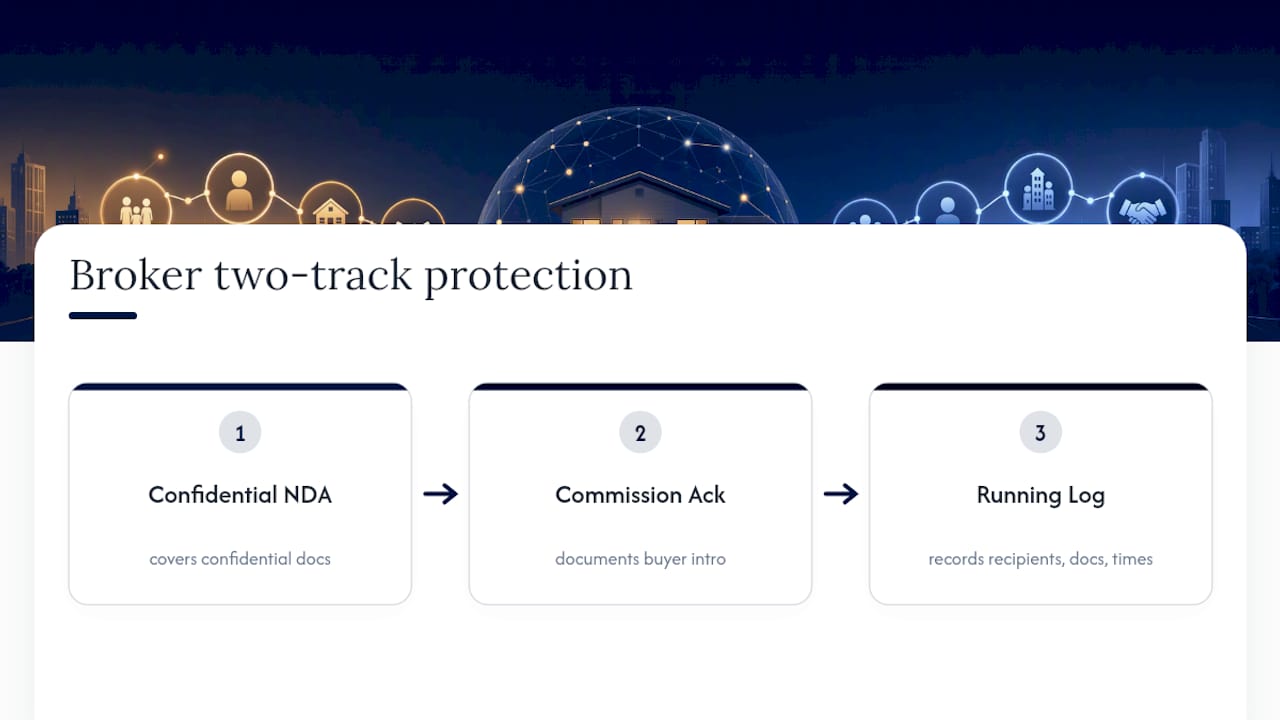
The practical version of this looks like a two-track approach: an NDA covering confidential materials, paired with a short introduction or commission acknowledgment that documents exactly when and how the buyer was introduced. Smart brokers keep a running log of who received which documents and when each signature came in.
Pro Tip: Never rely on a verbal introduction alone. A one-paragraph commission acknowledgment signed alongside the NDA has saved more deals from dispute than any amount of goodwill.
This documentation habit is key for brokers coordinating confidential disclosures and relocation logistics for out-of-state buyers without losing the deal to a bypassed introduction.
Where Do Most Real Estate NDAs Go Wrong?
The mistakes I see most often trace back to laziness in the drafting, not bad intentions. A definition of "confidential information" that says "any and all information" is nearly impossible to enforce; an exhibit listing specific documents holds up far better. An NDA cannot be used to bury an illegal fact, like a known structural defect, no matter how the clause is worded. State the governing law clearly, make the return or destroy obligation date specific, and if the deal involves seven figures or more, hire a real estate attorney before you sign anything.
— Yelena
How Yelena Horton Supports Confidential Off-Market Transactions
Sharing financial documents, rent rolls, or off-market listing details always carries some exposure, and that risk drops considerably with a broker who treats documentation as part of the job, not an afterthought. A broker coordinating NDA execution alongside off-market access helps buyers and sellers in the luxury market know who has seen their information and when.

For out-of-state buyers, such coordination can extend into relocation logistics, so confidential disclosures, financing terms, and property evaluations move through one consistent point of contact instead of scattering across multiple parties. If you're preparing to disclose sensitive property information, or you want a second set of eyes on an NDA before you sign, reach out through YH Luxury Homes to start that conversation.
This article is general information, not a substitute for advice from a qualified lawyer. Consult a qualified legal professional about your own circumstances before acting on anything here.
Sources
- Maddox, Segerblom & Canepa — What Is a Real Estate Non-Disclosure Agreement?
- FDIC — Non-Disclosure Agreement for Owned Real Estate
- California Association of REALTORS® — Commercial Confidentiality and Non-Disclosure Agreement (CML-CNDA)
FAQ
What Is an NDA in Real Estate?
A real estate NDA is a signed agreement that lets a seller, landlord, or broker share non-public property or financial information with a prospective buyer or tenant while restricting how that information can be used or shared further.
What States Are NDAs Not Enforceable In?
No U.S. state bans real estate NDAs outright, but enforceability depends on how reasonably the agreement is drafted. Some states commonly cited online pertain to seller property-disclosure exemption laws rather than NDA enforceability, so confirm your state's specific confidentiality precedent with an attorney rather than relying on such lists.
Can You Sue a Realtor for Non-Disclosure?
Yes, a seller or broker who breaches a signed confidentiality agreement can face a lawsuit seeking injunctive relief, monetary damages, or attorneys' fees where the contract authorizes them, though proving damages can be difficult.
Do real estate brokers help with NDA coordination?
Some brokers coordinate NDA execution and document review as part of managing off-market transactions and relocation logistics for luxury buyers and sellers.