
A proof of funds letter is a bank-issued document confirming a buyer has liquid money available to close, and sellers ask for one whenever an offer relies on cash rather than a loan. If you're making a cash offer or competing against several bidders, attach a current bank letter or verification of deposit with your offer, not after. If you don't have one yet, call your bank today and ask for a "verification of deposit."
TL;DR:
- A proof of funds letter should be current, contain specific details about liquid assets, and be issued on official bank letterhead to satisfy sellers' verification standards.
- Only liquid, accessible funds such as checking, savings, money market, or liquid certificates qualify; retirement accounts or cryptocurrencies are generally not accepted unless converted to cash.
- For cash offers, a proof of funds letter usually suffices without a preapproval, but for financed offers, both documents are recommended to demonstrate payment ability.
- If funds are distributed across multiple accounts, separate proof of funds documentation for each source enhances credibility and prevents questions from sellers or title companies.
Table of Contents
- What Is Proof of Funds in Real Estate?
- Which Funds Actually Qualify?
- Is Proof of Funds the Same as a Mortgage Preapproval?
- What Should a Proof of Funds Letter Include?
- What Does a Sample Proof of Funds Letter Look Like?
- How Do You Get a Proof of Funds Letter From Your Bank?
- What If You Don't Have Cash Sitting in an Account?
- How Long Is a Proof of Funds Letter Valid?
- How Do Sellers Verify a Proof of Funds Letter?
- When Does Proof of Funds Actually Change an Offer's Odds?
- Preparing a Competitive Offer Package With Professional Guidance
- Sources
- FAQ
What Is Proof of Funds in Real Estate?
A proof of funds letter proves you have enough liquid, accessible money to cover a down payment, closing costs, or the entire purchase price. Sellers request one because it de-risks the transaction: they want assurance the deal won't collapse over financing three weeks into escrow. In competitive markets, a documented POF also signals credibility and often speeds up the timeline, since title and escrow teams don't need to wait on financing contingencies to clear.
The most commonly accepted formats include:
- A recent bank statement showing the balance
- A bank-issued verification of deposit letter
- A formal proof of funds letter on institution letterhead, which demonstrates liquid funds available to cover a purchase and is the version most listing agents prefer
Which Funds Actually Qualify?
Liquidity is the deciding factor. Sellers want to see money that's already spendable, not assets that would need to be sold or borrowed against.
Funds that typically qualify:
- Checking and savings account balances
- Money market account balances
- Brokerage cash balances not tied up in pending trades
- Certificates of deposit, if they can be liquidated without excessive penalty
Funds that typically don't:
- Retirement accounts (401(k), IRA) unless already withdrawn and deposited
- Home equity that hasn't been converted through a loan or line of credit
- Illiquid securities or restricted stock
- Most cryptocurrency, unless converted to cash and seasoned in a bank account
If your funds are split across accounts, or you're combining money with a spouse or business partner, get a separate letter or statement for each source. A single letter that lumps unrelated accounts together tends to raise more questions than it answers.
Is Proof of Funds the Same as a Mortgage Preapproval?
No, and confusing the two is one of the more common mistakes buyers make. A preapproval is a lender's conditional promise to loan you a specific amount, based on credit, income, and debt review. A proof of funds letter shows cash you already have, right now, sitting in an account. Loan officers note that a POF often supplements a preapproval by confirming the buyer actually has cash for the down payment and closing costs, since preapproval alone doesn't prove that.
- Financed offer: preapproval plus a POF covering the down payment and closing costs
- Cash offer: a POF alone, usually sufficient without any lender involvement
- Investment or auction purchase: sellers frequently want both, especially when the closing window is tight
What Should a Proof of Funds Letter Include?
A proof of funds letter needs to satisfy a fairly specific checklist, and missing even one item can get it rejected by a cautious listing agent. According to the six essential elements banks include when issuing these letters, a compliant letter should have:
- The issuing institution's name and official letterhead
- The buyer's or entity's name, matching exactly what's on the purchase contract
- The available amount, stated clearly
- A liquidity statement confirming the funds are accessible, not restricted
- The date of issuance
- An authorized signature with a direct phone number or email for verification
Helpful extras include the account type and the last four digits of the account number, plus a recent statement attached as backup. Keep the letter to one page on real letterhead, not a screenshot or a generic template.
Pro Tip: Request your POF letter with the exact name that appears on the purchase agreement. A mismatch between "John Smith" and "John Smith Living Trust" is one of the fastest ways to get a letter bounced back by a title company.
What Does a Sample Proof of Funds Letter Look Like?
Banks vary in formatting, but the substance stays consistent. A typical letter reads something close to this:
First National Bank, 123 Main Street, Anytown, USA
This letter confirms that John A. Smith maintains a checking account with First National Bank with a verified available balance of $450,000.00 as of March 3, 2026. These funds are liquid and immediately accessible. For verification, contact Jane Doe, Branch Manager, at (555) 123-4567.
Signed, Jane Doe, Branch Manager
Before sending your letter, compare it against what the seller's side typically expects:
- Institution name and contact info clearly visible
- Buyer name matching the contract
- Dollar amount and liquidity language present
- Signature from someone the bank will confirm holds that authority
Redact the full account number before sharing. Bankrate notes that most sellers prefer this formal letter format over a raw bank statement precisely because it's cleaner to verify and doesn't expose unnecessary account detail.
How Do You Get a Proof of Funds Letter From Your Bank?
Getting the letter itself is usually the easy part, assuming you know what to ask for.
- Call your bank or credit union and ask specifically for a "proof of funds letter" or "verification of deposit," since some institutions use that second term internally.
- Bring or confirm your identification and account details, either in a branch visit, through an online banking portal, or via a request routed through your lender.
- Ask the bank to include the six core elements: institution name, your name, the amount, a liquidity statement, the date, and a verification contact.
- Confirm the turnaround time up front. Simple requests are often same day; more complex ones, especially for trusts or LLCs, can take up to 10 business days.
- Ask about fees. Many banks issue these letters free for existing customers, though some charge a small processing fee.
If you're buying through a corporate entity, expect extra steps. Banks apply Customer Due Diligence rules that can require formation documents and identification for any beneficial owner holding 25% or more of the entity before they'll issue the letter.
What If You Don't Have Cash Sitting in an Account?
Not every credible buyer has hundreds of thousands of dollars parked in checking. Transactional and hard-money lenders fill that gap, and they're widely accepted in investor circles.
- Transactional or hard-money lenders can issue a POF letter quickly, sometimes within a day, because the letter helps them win the borrower's follow-on loan business
- Gifted funds require a signed donor gift letter plus verification directly from the donor's bank, not just a screenshot of their balance
- Watch for red flags: third-party "funding verification" services that charge a fee to fabricate a letter are a fraud risk sellers and title companies actively screen for
Pro Tip: If you're using an investor or hard-money lender's POF, ask them to name the specific property address in the letter. Generic, undated templates get flagged faster than almost anything else in a competitive offer package.
How Long Is a Proof of Funds Letter Valid?
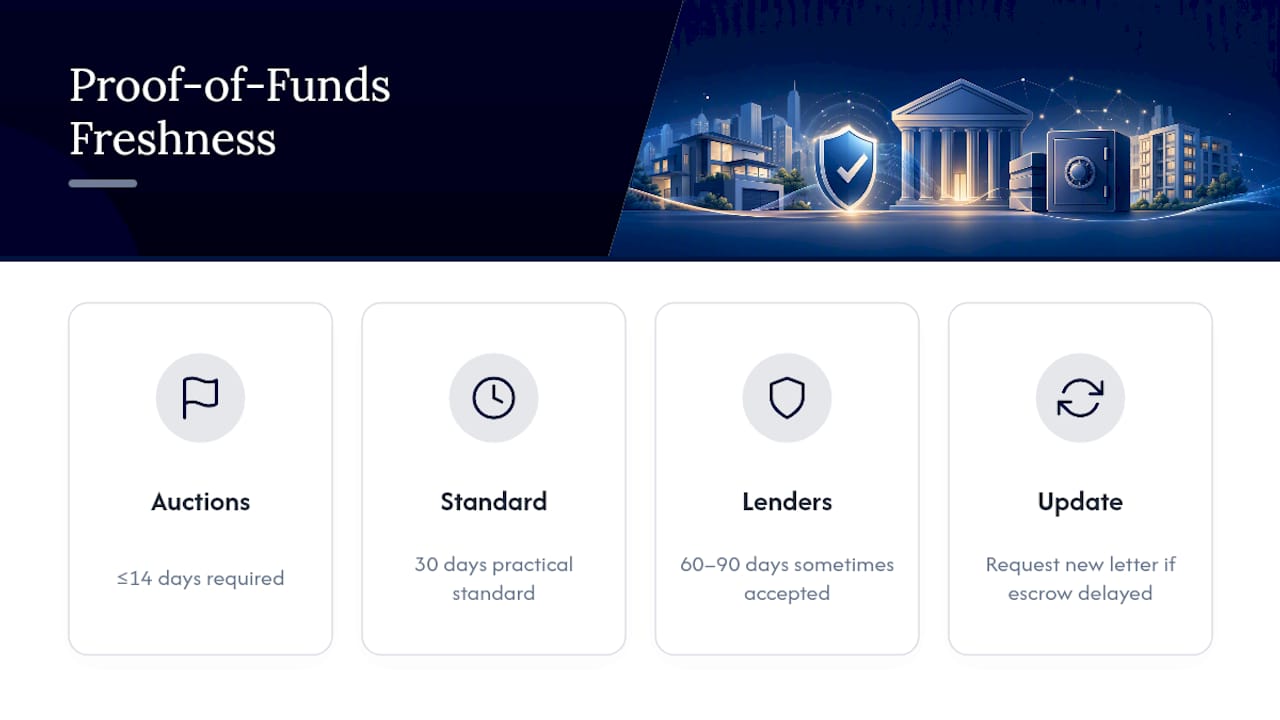
Thirty days is the practical standard most sellers and title companies expect, though some lenders will accept documentation up to 60 or 90 days old. Auction purchases often demand something fresher, sometimes 14 days or less. If your escrow drags on longer than expected, or your closing date slips, request an updated letter proactively rather than waiting for the seller's side to ask. Keep a digital copy ready to resend the moment your agent requests it.
How Do Sellers Verify a Proof of Funds Letter?
Redact your account number before sharing anything, but leave the bank's contact information fully visible. That's the whole point of the letter: it gives the seller's agent or title company a real person to call.
- A verification call typically confirms the letter is authentic, the signer has proper authority, and the date and amount match
- Banks generally confirm only what's printed on the letter itself, without disclosing extra account details
- Forged or altered letters carry real legal exposure and are one of the fastest ways to torpedo a buyer's credibility mid-negotiation
When Does Proof of Funds Actually Change an Offer's Odds?
A POF becomes decisive in a narrow set of situations: all-cash listings, auction properties, and off-market or luxury transactions where sellers have little patience for financing uncertainty. In those settings, a clean, verifiable letter delivered with the initial offer, not after a counter, often separates serious buyers from browsers. Investors frequently lean on lender-issued POFs rather than personal statements, and that approach is broadly accepted as long as the verification path and lender identity are clear.
Part of what an experienced agent brings to this process is knowing how to package the letter, redacted, current, and paired with a preapproval if financing is involved, so it reads as airtight the first time a listing agent opens the file. Timing matters too: submitting the POF alongside the offer, rather than waiting to be asked, often signals seriousness that a counter offer alone can't.
— Yelena
Preparing a Competitive Offer Package With Professional Guidance
Assembling a proof of funds letter is straightforward once you know what a bank needs to include. Assembling an entire offer package that reads as bulletproof to a seller representing a $4 million off-market listing is a different exercise entirely, and that's where a buyer's agent earns their fee.

An experienced buyer's agent can assist out-of-state buyers by handling logistics such as coordinating bank verification calls, formatting documentation to protect sensitive account details, and timing POF submissions appropriately for off-market and luxury transactions. Relocation concierge services may also help buyers touring homes remotely and coordinating closing. If you're preparing to compete for a high-value or off-market property and want someone to manage the paperwork end of the offer, reach out through YH Luxury Homes to start that conversation.
Sources
- What Is a Proof of Funds Letter in Real Estate? — Freedom Mortgage
- Proof of funds letter — Bankrate
- How to Get a Proof of Funds Letter From Your Bank — LegalClarity
- What's a Proof of Funds Letter in Real Estate? — BiggerPockets
This article is general information, not a substitute for advice from a qualified financial advisor. Consult a qualified financial professional about your own circumstances before acting on anything here.
FAQ
Is it normal for a realtor to ask for proof of funds?
Yes. Listing agents routinely request a POF before presenting a cash offer to a seller, and it's standard practice in competitive or off-market situations where sellers want assurance the buyer can actually close.
What is acceptable as proof of funds?
A recent bank statement, a bank-issued verification of deposit, or a formal proof of funds letter on institution letterhead are all commonly accepted, though most sellers prefer the formal letter format.
How do you show proof of funds for real estate?
Request a letter or verification of deposit from your bank or credit union that includes the institution's name, your name, the available amount, a liquidity statement, the date, and a signed contact for verification.
How do I show proof of funds for a property purchase if my money is spread across accounts?
Get a separate letter or statement for each account and, if a spouse or partner is contributing funds, include their documentation separately rather than combining figures into one letter.