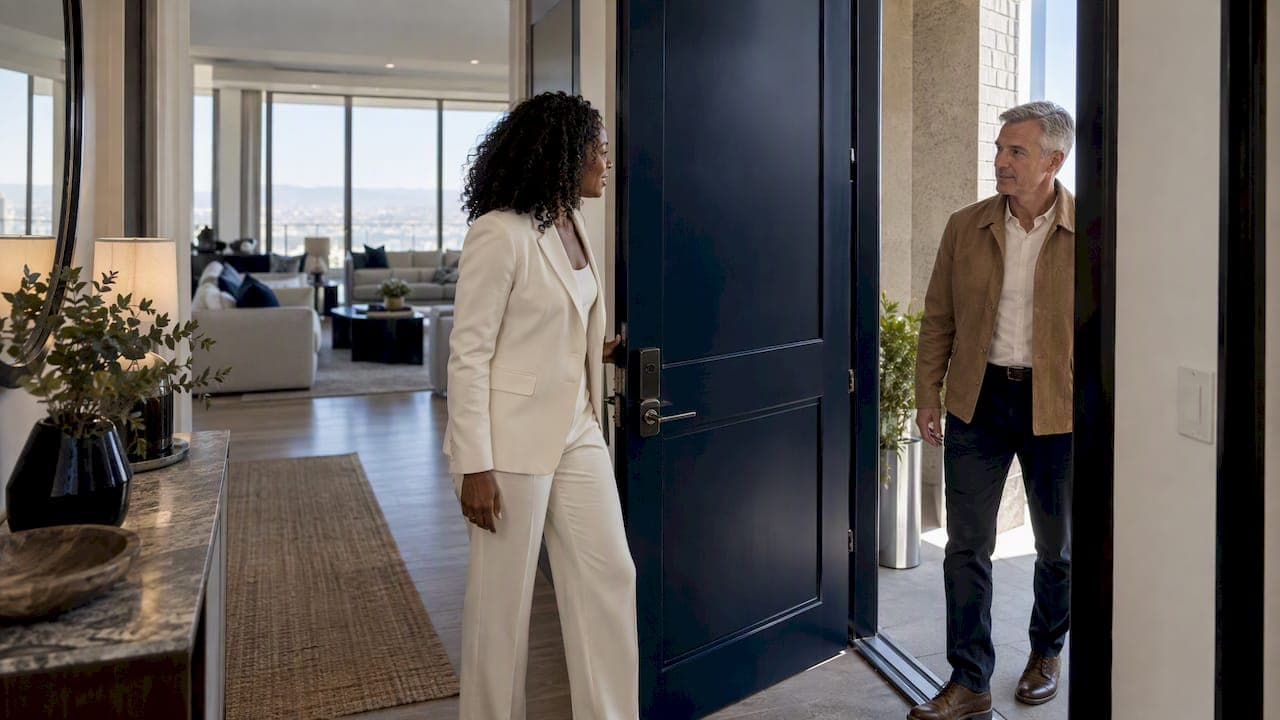
A private showing is a scheduled viewing of a home that is closed to the public, arranged between the listing side and a buyer or the buyer's agent. At the luxury level it is governed by a quiet but exacting etiquette: confirmed appointments, a qualified buyer, supervised access, discretion about photographs and personal belongings, and a prompt, candid response afterward. What follows sets out that protocol for both sides of the door, with the Nevada particulars a Las Vegas buyer or seller should know.
TL;DR
- A private showing is by appointment only, usually attended by the buyer and their agent, and suited to serious or pre-approved buyers who want a slower, more detailed look than an open house allows.
- Many agents now ask buyers for a written agreement before touring, so expect that conversation before the first door opens.
- Sellers should secure valuables, personal information, firearms and medications, and may ask for a "No Photography" note on the MLS.
- In Nevada, licensees owe their clients confidentiality and honest dealing under the state's published duties form, which shapes what may be said during and after a tour.
- After the visit, prompt and honest feedback through the listing agent keeps negotiations clean and useful.
Table of Contents
- What a private showing is, and how it differs from an open house
- Requesting and scheduling the visit
- Buyer qualification and the written agreement
- Conduct during the tour
- Preparing a luxury home for private showings
- Security, privacy and valuables
- Confidentiality and duties under Nevada law
- After the showing
- Our perspective
- How we arrange private showings
- Frequently asked questions
- Sources
What a private showing is, and how it differs from an open house
An open house invites anyone who walks past; a private showing admits only those who have asked and been confirmed. Showable describes private showings as typically scheduled among the buyer, the seller and their agents, suited to serious or pre-approved buyers, and conducive to a slower, more detailed evaluation. The buyer usually tours with their own agent, who coordinates timing with the listing side.
For a luxury residence the distinction matters more than it does for a starter home. A estate in the Summerlin hills, a high-rise residence on the Strip corridor or a waterfront property on Lake Las Vegas carries a seller who values discretion, furnishings and art worth protecting, and a buyer who often wishes not to be seen shopping. The private showing serves both temperaments: the seller controls who enters, and the buyer examines the property without a crowd at the shoulder.
For properties that never reach the public market at all, the private showing is the only form of viewing. Off-market homes are shown by introduction, and the protocol below is exactly what makes a seller comfortable allowing it.
Requesting and scheduling the visit
The sequence is simple, and its simplicity is the point. The buyer's agent contacts the listing agent, proposes a window, and receives confirmation. Where the seller has set a call-before-showing requirement, that confirmation is not a courtesy but a condition. NAR's guidance on call-before-showing codes explains that such codes prevent an agent from entering without a confirmed appointment, give the seller advance notice, and can be changed whenever access should be tightened.
Four habits distinguish a well-run request from a careless one:
- Propose a specific time and an honest estimate of duration, and be punctual once confirmed.
- Say how many people will attend, and who they are.
- Ask in advance whether photography is permitted.
- Notify the listing firm promptly if the plans change; the professional courtesies published by the Kansas City Regional Association of Realtors specify that a buyer's agent who will not enter, or must cancel, should say so at once.
These courtesies originate with one regional association, but they restate norms that agents follow broadly, and they translate directly to a Las Vegas appointment.
Buyer qualification and the written agreement
Sellers of luxury property rarely admit the merely curious. Expect to be asked for evidence of financial capacity, whether a lender's pre-approval letter for a financed purchase or proof of funds for a cash acquisition. The aim is not suspicion; it is respect for the owner's privacy and time.
A second expectation has become common nationwide. According to the National Association of Realtors' consumer guide on open houses and written agreements, as of August 17, 2024 many real estate professionals will ask buyers for a written agreement before touring a home, while buyers attending an open house on their own do not need one, and practices may vary by state and local law. A buyer should therefore read such an agreement carefully, ask what services it covers and how the agent is compensated, and request clarification before signing.
Out-of-state buyers, particularly those arriving from California or New York, often tour several properties in a compressed visit. Qualification documents prepared before the flight, and a scheduled sequence of showings arranged in advance, prevent a wasted day. Buyers weighing the tax dimension of a move may also wish to read our note on Nevada's lack of a state income tax before they arrive.

Conduct during the tour
On the day, the agent's role is that of a host and a guide, and the buyer's is that of a considered guest. Several principles hold.
First, the tour is accompanied. Luxury sellers expect supervised access, and for good reason. Inman's 2025 guidance on luxury showings recommends that the agent be present rather than relying on a lockbox unless the seller specifically requests otherwise, and that a trusted, fully briefed team member attend if the agent cannot.
Second, photography follows permission. A buyer who wishes to photograph a room for a spouse or designer asks first; the answer depends on the seller's instructions. Where a seller has asked for a note on the listing, the answer is already given.
Third, the buyer examines with attention and speaks with discretion. Offer strategy and price opinions belong in the car or the agent's office, never within earshot of a camera or a family member of the seller. The courtesies referenced above add that offer details are discussed through the listing agent rather than directly with the owner.
Fourth, a gated community introduces its own layer. Builders and communities often offer guided in-person or virtual tours within secure gated access, as Lennar describes at its Lake Las Vegas community; a buyer should arrange gate clearance with the agent in advance rather than at the guardhouse. Those drawn to the water may find our guide to waterfront living at Lake Las Vegas a useful companion before touring.

Preparing a luxury home for private showings
A seller's preparation is the quiet half of the protocol. Inman recommends addressing repairs and deferred maintenance, securing pets, and setting temperature and lighting before a luxury showing, noting that subtle scents can help create an elevated mood. In the Las Vegas climate, temperature is not a trifle: a residence that is comfortably cool on a July afternoon speaks of care before a word is said.
The lighting deserves its own consideration. A great room with expansive glass tells a different story at noon than at dusk, and a showing scheduled for the hour when the light across the valley or the fairway is most flattering will do more than any staging.
A seller who wishes to present the home as a finished composition might attend to the following, in roughly this order: the exterior and entry, the principal living spaces, the kitchen, the primary suite, then outdoor spaces, pool and any guest accommodation. Every room should be unhurried, uncluttered and consistent in temperature and light.
For a deeper look at how presentation and reach work together once a property is on the market, see our overview of luxury home marketing in Las Vegas.
Security, privacy and valuables
A luxury residence holds objects and information that deserve protection, and a private showing, however carefully controlled, still brings strangers inside. The National Association of Realtors' privacy and safety guidance for home sellers advises stowing personal information, and securing jewelry, sensitive documents, firearms and prescription medications. It also advises putting away family photographs, calendars, mail, computer logins and Wi-Fi passwords.
Access control completes the picture. The same guidance notes that electronic lockboxes limit entry to licensed real estate professionals and record who enters and when. Sellers can ask their agent to add a "No Photography" note to the MLS and to place polite signage to discourage photos or videos.
The agent's own safety is part of the protocol too. NAR's personal protection resources recommend that agents arrive early to identify exits, keep phones charged, share itineraries with colleagues, use check-in or emergency-alert tools, maintain visibility, and leave if circumstances feel unsafe. Its open house guidance adds asking for identification, withholding garage or door codes, and limiting the number of people inside. The philosophy is preventive: identify risks before the appointment, keep communication open, and preserve the ability to end an uncomfortable interaction.
A short table summarizes who is responsible for what.
| Concern | Seller | Agent |
|---|---|---|
| Valuables and medications | Remove or lock away before the visit | Remind the seller during preparation |
| Personal information | Stow mail, photos, logins, Wi-Fi details | Check the home before guests arrive |
| Photography | Request an MLS note and signage | Confirm the rule with the buyer's agent |
| Access | Choose lockbox or accompanied entry | Verify identity, limit attendees, record entry |
| Personal safety | Be absent during the tour | Arrive early, note exits, share the itinerary |
Confidentiality and duties under Nevada law
Las Vegas buyers and sellers are protected by obligations that exist regardless of how grand the property is. The Nevada Real Estate Division's Form 525, Duties Owed by a Nevada Real Estate Licensee, states that a licensee must not disclose confidential client information, except to the broker, for one year after termination or revocation of the brokerage agreement, unless a court orders disclosure or the client gives written permission.
The same form requires licensees to deal honestly, to exercise reasonable skill and care toward all parties, to disclose known or reasonably knowable material facts about the property, and to advise clients to obtain expert advice on matters beyond the licensee's expertise. For a private showing, this means an agent may not casually repeat a seller's motivation or a buyer's budget to the other side, and must speak truthfully about the property's condition.
For questions on a specific contract or disclosure, a Nevada real estate attorney is the right professional; this article is a guide to etiquette and general duties, not legal advice.
After the showing
The protocol does not end at the front door. The professional courtesies cited earlier ask that the visiting party leave the home as found: reset heating and cooling, turn off lights, shut windows and lock doors. Anything that appears wrong, or any listing information that proves inaccurate, should be reported.
Then comes feedback. ShowingTime+ calls feedback the key post-showing process: honest answers help the buyer's agent understand preferences, while seller-side feedback can reveal concerns worth addressing. A buyer who found the floor plan appealing but the airport flight path audible has given useful information; our note on the airport noise map for Las Vegas helps buyers weigh that factor before the second visit.
When a buyer is ready to proceed, the conversation moves through the listing agent. In a competitive situation, preparation matters again, and our discussion of multiple offer strategies explains how a buyer's position is built.
Our perspective
We regard the private showing as the place where trust is either established or lost. A seller who entrusts a home, its art and its privacy to a stranger is extending a courtesy, and the protocol is how that courtesy is honored. For that reason we ask the same questions of every buyer, in the same unhurried way, and we brief every seller on what will happen in their home, who will be present and what has been put away.
For buyers, the discipline pays dividends. Our access to off-market luxury homes depends on sellers who are confident that a showing will be handled with discretion, and that confidence is earned one visit at a time. Backed by the global network of Sotheby's International Realty, we can introduce a property to the right audience without exposing it to the wrong one, and we bring the same care to evaluating its lifestyle and investment potential once the door has closed behind us.
For families relocating from out of state, we treat the showing itinerary as part of the move itself: sequenced, confirmed and arranged so that a limited visit yields a considered decision.
— Yelena
How we arrange private showings
Whether you are buying or selling, we handle the protocol on your behalf: buyer and seller representation, a relocation concierge for out-of-state clients, expert negotiation, and luxury marketing for sellers. If you would like a private showing arranged, or a plan for showing your own home with discretion, begin at Yelena Horton's Las Vegas luxury real estate page.

We do not publish fees for these services; the conversation begins with your objectives.
Frequently asked questions
What is the difference between a private showing and an open house?
An open house is open to anyone who walks in, with no appointment. A private showing is scheduled in advance, usually between the buyer, their agent and the listing side, and suits serious or pre-approved buyers who want a slower evaluation.
Do I need to sign anything before a private showing?
Often, yes. As of August 17, 2024, many agents nationwide ask buyers for a written agreement before touring a home, though practices vary by state and local law. Ask what it covers and how the agent is paid before you sign.
Can I take photographs during a private showing?
Only with permission. Sellers can ask for a "No Photography" note on the MLS and post polite signage, so ask the listing agent before you arrive and again at the door.
Who can enter a home that has a lockbox?
Electronic lockboxes limit access to licensed real estate professionals and record who enters and when. For luxury homes, many sellers prefer that the agent attend in person rather than leave the home to a lockbox.
Is what I say during a showing confidential?
Nevada licensees must keep confidential client information private, with limited exceptions, for one year after the brokerage agreement ends. Even so, keep price opinions and offer plans out of the owner's hearing and discuss them with your agent privately.
Sources
- Open House vs Private Showing: Pros, Cons, and When to Use (Showable)
- Private showings, broker tours, and showing software (LeanProp)
- Professional Courtesies (Kansas City Regional Association of Realtors)
- Call Before Showing Codes Enhance Customer Service (NAR)
- Luxury Home Showing Tips (Inman)
- Vita at Piazza Paradiso at Lake Las Vegas (Lennar)
- Consumer Guide: Home Selling Tips for Privacy and Safety (NAR)
- Safety Resources for Personal Protection (NAR)
- Open Houses (NAR)
- Form 525, Duties Owed by a Nevada Real Estate Licensee (Nevada Real Estate Division)
- The Most Important Thing to Do After a Real Estate Showing (ShowingTime+)