
A pre-listing inspection is worth the expense for most sellers, particularly on older homes or in balanced markets, because it hands you control over the narrative before a buyer's inspector finds it first. The report typically costs a moderate amount in the low hundreds, and yes, you generally must disclose what it reveals, but that tradeoff usually beats losing a deal at the closing table.
TL;DR:
- Most common pre-listing inspections cost between $300 and $700, with additional testing like radon or sewer scope adding $100 to $200 each.
- Inspectors evaluate major systems such as foundation, roof, and electrical wiring, with critical issues like active leaks or structural damage requiring immediate fixing.
- Sellers must disclose inspection findings as material defects, making repair receipts and full reports essential for legal and negotiation purposes.
- Running repairs based on the inspection often saves money and avoids larger negotiations or deal cancellations during escrow.
- In high-end markets, sellers coordinate inspections early, including permits and warranties for systems like pools or elevators, to simplify negotiations and reduce friction.
Table of Contents
- What Is a Pre-Inspection for Sellers?
- What Are the Benefits of a Pre-Inspection?
- How Much Does a Pre-Sale Home Inspection Cost?
- What Do Home Inspectors Check For?
- What Are Sellers' Legal Disclosure Obligations After an Inspection?
- How Should Sellers Decide What to Fix, Disclose, or Price-Adjust?
- How Do You Choose a Qualified Home Inspector?
- Does a Pre-Inspection Affect Home Insurance or Warranties?
- A Luxury Market Perspective on Pre-Inspections
- Ready to List? Get Inspection Strategy Built Into Your Listing Plan
- Sources
- FAQ
What Is a Pre-Inspection for Sellers?
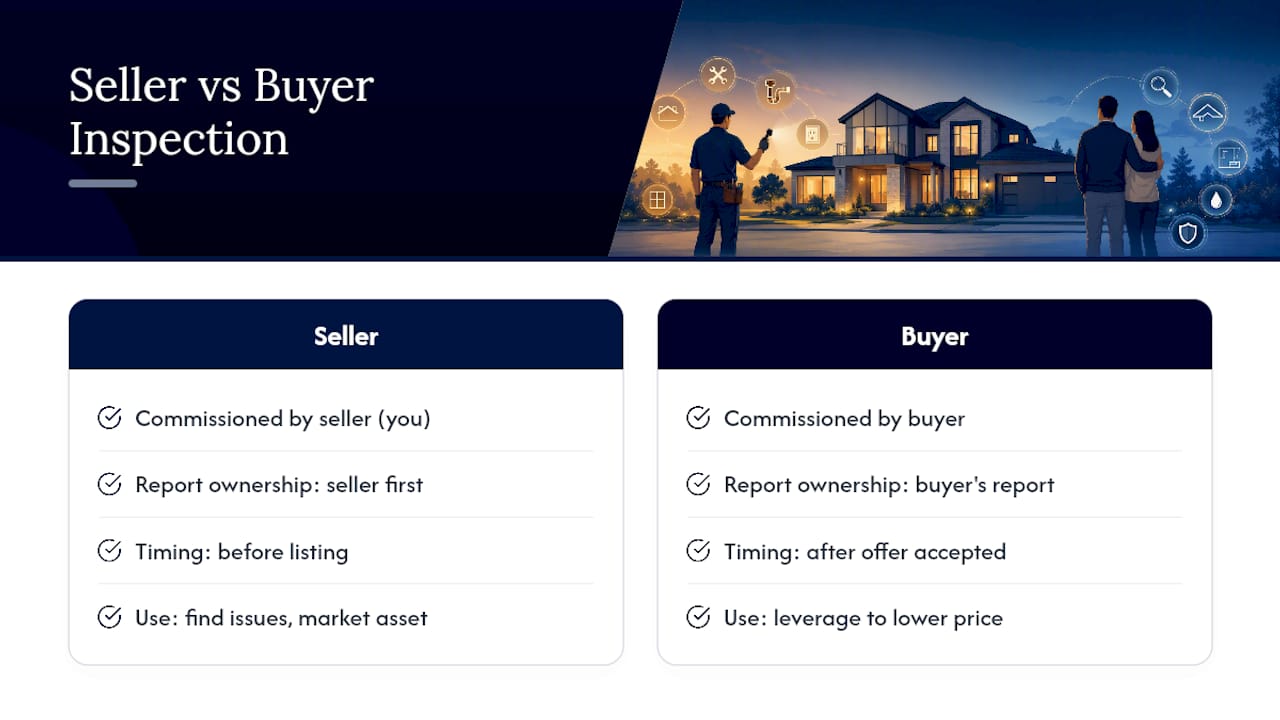
A pre-listing inspection, sometimes called a seller pre-listing inspection or seller home inspection, is a professional walkthrough of the property that you, the seller, commission and pay for before the home ever hits the market. The report belongs to you first. You decide who sees it, when, and in what form, which is the fundamental difference from a buyer's inspection, where a purchaser hires the inspector after an offer is accepted and uses the findings as leverage against your price.
InterNACHI recommends this approach precisely because it lets sellers identify issues on their own timeline rather than during a tense contingency period, and it turns the report into a marketing asset rather than a liability.
Most seller inspections cover the same core systems a buyer's inspector would examine, but sellers frequently add specialized tests that buyers might otherwise request later anyway. Radon testing, sewer scope inspections, and wood-destroying insect (WDI or termite) inspections are the three most common add-ons. If your home sits on an older septic line, has a basement in a radon-prone region, or shows any history of moisture intrusion, ordering these upfront removes a common source of last-minute renegotiation. A real estate inspection for sellers that includes these extras costs more, but it also closes off the exact avenues buyers use to reopen price talks weeks into escrow.
What Are the Benefits of a Pre-Inspection?
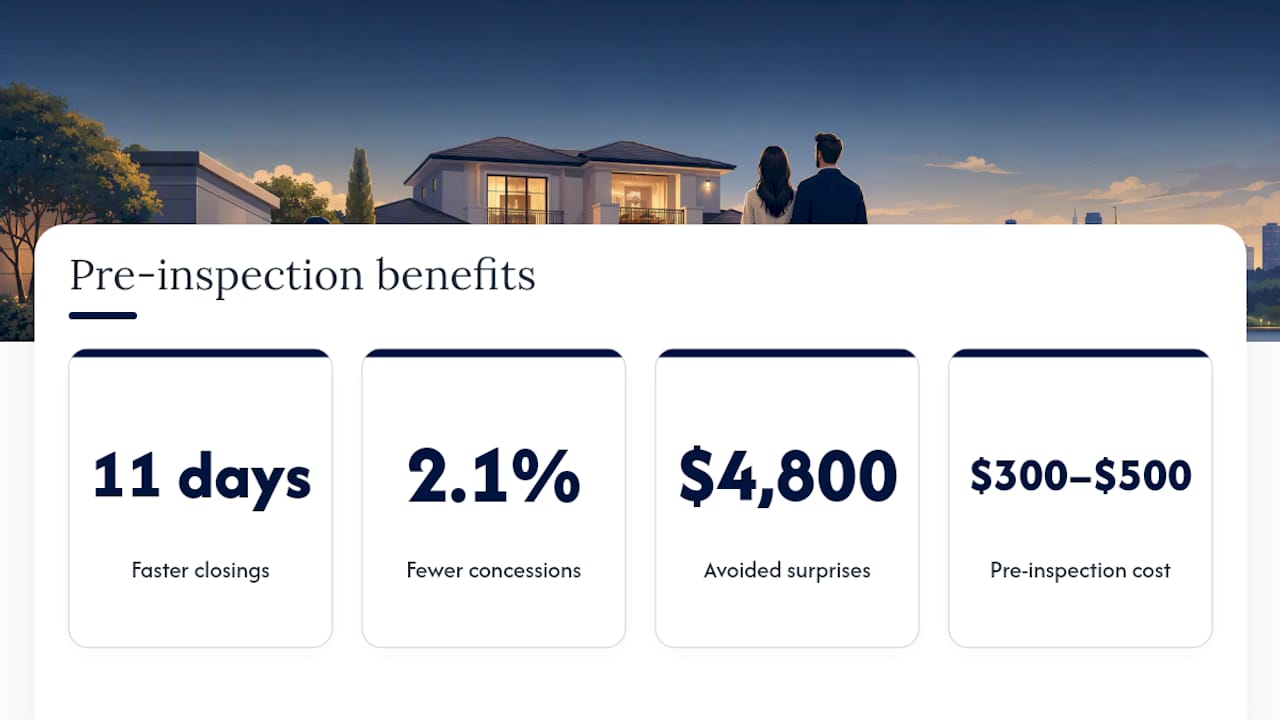
Control over documentation is the single biggest advantage. When you walk into negotiations already holding a clean, professionally documented report, or one paired with paid repair receipts, buyers have far less room to manufacture concessions based on unknowns. HomeScore's 2026 seller data found that sellers who completed a pre-inspection closed roughly 11 days faster and faced about 2.1% fewer concessions on average, with typical avoided surprises worth close to $4,800 per transaction.
The marketing upside matters just as much as the negotiation math, and sellers can use seller tips for making the property marketable to prepare the home and highlight inspection-ready selling points effectively. A pristine inspection report, or a clear before-and-after showing completed repairs, gives your listing agent something tangible to hand nervous buyers early. It signals a seller who has nothing to hide, which shortens the psychological distance between "interested" and "ready to write an offer." EffectiveAgents frames the cost of a pre-inspection, typically $300 to $500, against the far larger cost of a canceled contract, and the comparison holds up in most markets.
The benefit scales with property complexity and age. A 1970s home with original mechanical systems, a house with a finished basement of unknown vintage, or anything in a buyer's market where purchasers have leverage to walk away, all stand to gain the most. In a red hot, all cash seller's market with newer construction, the case weakens considerably, since buyers there are often waiving inspections outright.
How Much Does a Pre-Sale Home Inspection Cost?
Budget $300 to $700 for a standard inspection on an average single-family home, with the number climbing toward the top of that range for larger square footage or older properties with more systems to evaluate, according to guidance from the American Society of Home Inspectors. Add-ons push the total higher: radon testing typically runs another $100 to $200, sewer scopes fall in a similar range, and a WDI inspection often adds $75 to $150 depending on your region.
Time on site usually runs two to four hours for a typical home, with larger or older properties taking longer. Expect the written report within 24 to 48 hours after the inspection wraps.
The return on investment framing is straightforward. A $500 inspection that surfaces a $150 plumbing fix you can handle quietly is a bargain next to a buyer's inspector finding that same leak during a 10 day option period and using it to demand a $3,000 credit plus a closing extension. Schedule the inspection at least two to three weeks before your target listing date, which gives you enough runway to get repair quotes, complete the work, and still hit your market window.
What Do Home Inspectors Check For?
A standard inspection covers the roof, foundation, HVAC system, electrical panel and wiring, plumbing, drainage and grading, and core safety items like smoke detectors, handrails, and garage door auto-reverse mechanisms. Inspectors also check attic insulation, window seals, and the condition of major appliances included in the sale.
Findings generally fall into three tiers, and knowing which tier you're dealing with changes your entire strategy.
Tier 1, deal-killers: structural foundation cracks, active roof leaks, knob-and-tube or aluminum wiring, failing septic systems, or significant mold. These items can cause a buyer to walk or a lender to deny financing outright, and they typically need remediation before you list, not after an accepted offer.
Tier 2, price-adjusters: an aging water heater nearing end of life, a roof with 5 to 7 years of remaining service life, minor foundation settling, or an HVAC system that runs but is clearly dated. These rarely kill a deal, but they hand buyers a concrete number to negotiate against, often in the $500 to $5,000 range depending on the fix.
Tier 3, minor items: a loose cabinet hinge, a cracked outlet cover, a dripping faucet aerator, or missing caulk around a tub surround. These cost almost nothing to fix and should simply get handled before your first showing.
What Are Sellers' Legal Disclosure Obligations After an Inspection?
Once you read the report, you generally can't unknow what it tells you. Most states operate under some version of a rule requiring sellers to disclose known material defects, meaning the inspection report converts previously unknown issues into facts you're legally obligated to reveal to buyers. LegalClarity notes that this is one of the most misunderstood parts of the process: ordering an inspection doesn't create new risk, it simply documents risk that already existed in your home.
One federal rule applies regardless of state: homes built before 1978 require lead-based paint disclosure under EPA regulations.
Beyond that federal floor, disclosure law varies meaningfully by state, and what counts as "material" or how "constructive knowledge" gets defined differs from Nevada to New York to Florida. Talk to your listing agent or a real estate attorney about your specific state's requirements before you decide how much of the report to share verbatim.
In practice, most sellers handle this by fixing what's fixable, documenting every repair with dated contractor receipts, and providing either the full report or a clear written summary of remaining items alongside those receipts. That combination, repaired items with proof plus honest disclosure of what remains, tends to satisfy both legal obligations and buyer psychology at the same time.
How Should Sellers Decide What to Fix, Disclose, or Price-Adjust?
Run every finding through three filters, in this exact order.
Filter one: safety and financing risk. Anything that could injure someone or block a loan, active gas leaks, exposed wiring, structural movement, gets fixed immediately regardless of cost. These items also tend to spook buyers disproportionately relative to their actual repair price, so leaving them unaddressed almost always costs you more in lost showings than the repair itself.
Filter two: price impact. For everything else, compare the repair cost to your list price as a percentage. If it lands between 0.5% and 2%, get two or three contractor quotes and decide based on how competitive your local market is.
Filter three: cosmetic and routine maintenance. Caulk, paint touch-ups, a squeaky door hinge. Fix these regardless because they cost little and their presence in a report makes buyers wonder what else you overlooked.
For mid-ticket items in that 0.5% to 2% zone, gathering multiple contractor bids does double duty: it gives you a realistic repair budget, and it gives you paper you can hand a buyer's agent later if they try to inflate the cost of the same fix during negotiation. Keep every quote, invoice, and warranty document in one folder tied to the listing. That file becomes your strongest asset the moment a buyer's inspector raises an issue you already addressed.
How Do You Choose a Qualified Home Inspector?
Look for inspectors certified through InterNACHI or the American Society of Home Inspectors, both of which require ongoing education and adherence to a standardized inspection process. Ask to see a sample report before you book. A strong report includes clear photos tied to specific findings, a severity rating system, and plain-language explanations rather than dense code citations that mean nothing to a buyer skimming the document.
Ask directly about turnaround time, whether they offer radon, sewer scope, or WDI testing as add-ons, and whether they've done seller-side pre-listing inspections before, since the reporting emphasis differs slightly from a buyer-focused inspection. A red flag worth avoiding: any inspector unwilling to provide a sample report, or one who rushes through a large home in under 90 minutes. Thoroughness here protects you later.
Does a Pre-Inspection Affect Home Insurance or Warranties?
A pre-listing inspection itself doesn't touch your existing homeowners insurance policy, but the findings inside it often do. If the report flags an aging roof, outdated electrical panel, or plumbing material insurers consider high risk, like polybutylene piping, that information can affect what a buyer's future insurer is willing to underwrite, sometimes at a higher premium or with specific exclusions.
Home warranty companies also pay attention to inspection reports. Many warranty providers exclude pre-existing conditions that a documented inspection would have caught, so a seller-ordered report can actually clarify what a future one-year home warranty will and won't cover once the buyer takes possession. This works in your favor at the negotiating table: offering a home warranty alongside a clean pre-inspection report is a common way to reassure buyers without cutting your price.
Fixing flagged issues before listing can also help on the buyer's side of the transaction. A newer roof or upgraded panel, verified in writing, often qualifies a buyer for better homeowners insurance rates once they close, which is a detail savvy agents highlight during showings.
A Luxury Market Perspective on Pre-Inspections
On high-end Las Vegas properties, inspection strategy looks different because the stakes and the systems are bigger. Yelena Horton coordinates inspectors, specialty contractors, and permit documentation together, rather than treating the inspection as a single isolated event before listing.
Luxury buyers scrutinize service history on pool equipment, elevator maintenance records, and climate-controlled wine storage far more than they scrutinize paint color. Sellers who arrive with permits pulled and warranties intact for these systems close with noticeably less friction, because the report becomes proof of stewardship rather than a list of unknowns for a buyer's attorney to pick apart.
— Yelena
Ready to List? Get Inspection Strategy Built Into Your Listing Plan
Most agents hand you a list of local inspectors and wish you luck. Inspection coordination can be built directly into the listing preparation process, so repair documentation, contractor quotes, and disclosure timing work together instead of getting handled separately by three different people who never talk to each other.

Services can include coordination with a relocation concierge for out-of-state sellers and buyers, negotiation strategy focused on client positioning, and access to a global buyer network through a luxury real estate affiliation. Whether your home needs a straightforward pre-inspection or a full documentation package for a high-end mechanical system, the goal is the same: walk into negotiations holding the paperwork instead of chasing it. If you're preparing to list in the Las Vegas market, reach out to Yelena Horton to talk through an inspection and listing timeline before you set a date.
Sources
- Seller's Pre-Listing Inspection - InterNACHI®
- Before You Sell: 6 Reasons to Get a Pre-Listing Inspection
- What is a pre-listing inspection? | Rocket Mortgage
- Pre-Listing Home Inspection: Worth It in 2026? Seller Guide
- Pre-listing inspection: what to expect and how to prepare | LegalClarity
FAQ
Is a Pre-Listing Inspection a Good Idea?
Yes, for most sellers, particularly on older homes or in balanced and buyer-leaning markets, since it typically shortens time in escrow and reduces the odds of a large buyer concession
Can You Do Your Own Pre-Purchase Inspection?
You can walk through your own home informally, but a self-inspection carries no professional weight with buyers or lenders. Hiring a certified inspector through InterNACHI or ASHI is what gives the report credibility during negotiations.
What Is the Biggest Red Flag in a Home Inspection?
Structural foundation movement, active roof leaks, and outdated wiring systems like knob-and-tube are the findings most likely to scare off a buyer or trigger a financing denial, making them the top priority to address before listing.
What's Good About Having a Pre-Sale Home Inspection?
It gives you control over timing and documentation, turns a clean report into a marketing tool, and, according to HomeScore's 2026 data, correlates with faster closings and fewer concessions compared to skipping it.