
The fastest, lowest-risk way to plan a cross-country move into a luxury home is to hire a concierge-capable buyer's agent who can prove genuine off-market access before you ever board a plane. A meaningful share of high-end inventory never touches a public listing. Roughly [15% to 20% of U.S. luxury homes above $3 million trade privately](https://www.ownluxuryhomes.com/markets/off-market-luxury/guide/how-to-find-off-market-luxury-homes), and in the top tiers, an even larger fraction closes quietly, out of view of any portal search.
Yelena Horton of YH Luxury Homes works this exact lane for out-of-state buyers targeting Las Vegas. Within the next 24 to 72 hours, do this:
- Draft a one-page buying brief (budget, must-haves, timeline).
- Assemble proof of funds or a lender's commitment letter.
- Ask any prospective agent for their last three off-market closings, with addresses and dates.
Key Takeaways
A concierge-capable buyer's agent with verifiable off-market access and a coordinated relocation team is the single most reliable way to acquire and settle into a luxury home across state lines.
| Point | Details |
|---|---|
| Verify before you trust | Request the agent's last three off-market closings with addresses, dates, and listing-agent contacts. |
| Prepare financing first | Proof of funds or lender preapproval must be ready before you make any private offer. |
| Expect a 30 to 60 day close | Deals move this fast only when your team, financing, and title work are aligned in advance. |
| Budget beyond the price tag | Include taxes, concierge fees, and relocation costs, not just the purchase price. |
| Engage a concierge for both sides | Yelena Horton's YH Luxury Homes coordinates off-market access and relocation onboarding as one project. |
Table of Contents
- How Do You Plan a Cross-Country Move to a Luxury Home?
- Who Should Be on Your Buyer Team?
- Where Does Off-Market Las Vegas Inventory Actually Come From?
- What Financing Do You Need Before Making an Offer?
- How Do You Evaluate Neighborhood and Lifestyle Fit Remotely?
- How Should You Negotiate and Handle Due Diligence on a Private Deal?
- What Does a Luxury Relocation Concierge Actually Handle?
- How Do Concierge Services Coordinate Relocation and Onboarding?
- What Should Your Full Relocation Budget Actually Include?
- How Do You Keep Property Acquisition and Physical Relocation in Sync?
- How Do You Vet a Relocation Concierge or Broker?
- What Happens After You Close on Your New Home?
- Ready to Start Your Los Vegas Off-Market Search?
- Sources
- FAQ
How Do You Plan a Cross-Country Move to a Luxury Home?
Planning a cross-country move into a luxury home breaks into five phases, and knowing where travel and money decisions land in that sequence saves both.
- Week 1, assemble your team. Buyer's agent, private banker or family office contact, real estate attorney, and inspection specialists all get looped in before you view a single property.
- Weeks 2 to 4, source inventory and schedule viewings. This is when off-market introductions surface and your first scouting trip usually happens.
- Parallel track, ready your financing. Proof of funds and preapproval need to be locked before you make any offer, not after.
- Inspect and negotiate. Structural review, title work, and price negotiation typically run concurrently to protect the closing window.
- Close and onboard, 30 to 60 days from accepted offer when every party above is already mobilized, per Chase's relocation planning guidance.
Book travel only after financing is confirmed and a short list of properties is verified. Anything earlier risks a wasted trip.
Who Should Be on Your Buyer Team?
Five roles need to be filled before you take a single showing seriously, and each one has a specific job that overlaps very little with the others.
- Buyer's agent. Demand their last three off-market closings, addresses and dates included, plus confirmation there's no dual-agency conflict where they also represent the seller.
- Private banker or family office contact. This person opens developer desks, issues proof-of-funds letters, and makes introductions that a standard mortgage broker cannot.
- Real estate attorney. Handles entity structuring (trusts, LLCs) and title review, and needs enough lead time to move fast when a 30 to 60 day window opens.
- Inspection and closing specialists. Structural, environmental, and escrow professionals who can mobilize on short notice, since private deals rarely wait.
- Relocation concierge. Coordinates everything outside the transaction itself, from temporary housing to household staffing.
Pro Tip: Ask any agent claiming off-market access for the listing agent's name and phone number on each of their last three private deals. If they hesitate, that access is likely secondhand or stale.
Where Does Off-Market Las Vegas Inventory Actually Come From?
Private inventory surfaces through a small number of real channels, and distinguishing genuine access from a sales pitch takes three pointed questions.
The main pathways are private broker introductions built on years of trust, developer and portfolio contacts for new construction or estate liquidations, private buyer registries maintained by top brokerages, and targeted outreach to owners in thin-inventory submarkets. That last channel is a long game. Direct owner outreach converts at roughly 1% to 3%, so it works best as a background effort rather than a primary strategy.
Before trusting anyone's claim of off-market access, ask three things: Which specific off-market properties have you closed in the last 12 months? Can you name the listing agent on each of those deals? Will you introduce me directly to that agent for verification? Vague answers to any of these are a red flag.
Sellers and their agents gate access deliberately, typically requiring a signed buyer representation agreement, proof of funds, and a tight, specific brief before sharing anything private. A buyer who shows up with a vague budget range and no financing documentation simply doesn't get considered. Reviewing how private real estate transactions actually work before your first call helps you sound like a serious buyer instead of a tourist.
What Financing Do You Need Before Making an Offer?
Proof of funds or a lender's preapproval letter is not a courtesy in the off-market world. It's the price of admission, and most serious agents won't share private listings without it.
Expect a 30 to 60 day close when your financing, escrow, and title work are already aligned before you make an offer, according to Laxary's off-market buying guide. Deals stretch well past that window when a buyer scrambles to produce documentation after an offer is already accepted, and sellers in this tier notice the difference.
Before you ever write an offer, have these in place:
- A current proof-of-funds letter or lender preapproval, dated within the last 30 days.
- Escrow and title contacts already identified and briefed on your timeline.
- Entity structure decided (personal name, trust, or LLC) with your attorney.
- A clear number for how fast you can move earnest money if a seller wants speed.
The busy relocation season can also add cost pressure if your calendar isn't planned ahead, since interstate moving logistics tend to compress during peak months.
How Do You Evaluate Neighborhood and Lifestyle Fit Remotely?
You don't need five scouting trips to know whether a neighborhood fits your family. You need the right checklist and a specialist willing to answer the questions Google can't.
Before booking a flight, have your agent or a local specialist confirm: HOA rules and any restrictions on renovation or short-term rental, noise patterns from nearby roads or flight paths, proximity to private clubs or amenities that matter to your household, typical commute times to the areas where you'll actually spend time, and the property's view corridor and elevation, both of which shift dramatically across Las Vegas submarkets.
Schools and membership clubs deserve their own verification pass. A guide to top schools near Las Vegas luxury homes is useful groundwork, but a local specialist can confirm current enrollment policies and wait lists that change year to year. The same goes for country clubs and private social memberships, where availability and initiation terms shift often.
Pro Tip: If you've spent fewer than two full weeks in Las Vegas across all seasons, book a short scouting visit or a month-long rental before committing to a purchase. Micro-location regret, the wrong side of a highway, an HOA you didn't fully read, is one of the most common and preventable mistakes among out-of-state buyers.
Reviewing how east coast buyers evaluate the Las Vegas market before your trip sharpens the questions you'll ask once you're on the ground.
How Should You Negotiate and Handle Due Diligence on a Private Deal?
Off-market deals reward buyers who move fast without skipping the steps that protect them. Getting that balance right comes down to a specific sequence.
- Set negotiation terms early. Confidentiality clauses, timing leverage (sellers often value certainty over top dollar), and staged earnest-money deposits all give you room to move without appearing desperate.
- Lock in non-negotiable due diligence. A full structural inspection, a complete title chain review, entity ownership verification, and zoning or environmental checks are never items to waive, no matter how fast the seller wants to move.
- Coordinate remotely, in parallel. Inspectors, title companies, and escrow officers can work simultaneously rather than sequentially, which is how experienced teams hit a 30 to 60 day close without cutting corners.
Pro Tip: Schedule your structural inspection and title search the same week you sign a purchase agreement, not after. Running them in parallel, rather than waiting on one to finish before starting the other, is what keeps a private deal inside a 60-day window.
What Does a Luxury Relocation Concierge Actually Handle?
A concierge's job starts where the purchase agreement ends, and the scope is broader than most first-time relocating buyers expect.
Deliverables typically include: private property viewings scheduled around your travel calendar, secure and discreet transportation, temporary housing arrangements while you're between homes, introductions to vetted local vendors, full household setup, and direct coordination with schools during enrollment. Concierge-led acquisition models are increasingly the standard among ultra-high-net-worth buyers precisely because they fold relocation, residency logistics, and onboarding into a single coordinated effort rather than a dozen disconnected vendors.

On your end, come prepared with signed authorization forms, a list of local contacts you already have (if any), and a clear sense of your key scheduling windows, school start dates, lease expirations, job start dates. Most concierge services engage at or just before the offer stage, once financing is confirmed, and fee structures vary by scope rather than following a single flat rate.
How Do Concierge Services Coordinate Relocation and Onboarding?
A concierge's real value shows up in the sequencing, not just the task list. Once your offer is accepted, a well-run concierge shifts into a parallel-track mode, running relocation logistics alongside the closing process instead of waiting until after keys change hands.
That typically means booking private travel around your inspection and walkthrough dates, so you're not making separate trips for each milestone. It means securing temporary housing that bridges the gap between your old home's departure date and your new home's close date, which matters enormously when school calendars or job start dates don't line up neatly with a closing timeline. It means pre-scheduling vendor walkthroughs, security system installers, landscaping crews, smart-home technicians, so the property is livable the day you arrive rather than weeks later.
The concierge model built around confidentiality and coordination treats these as one continuous project rather than separate handoffs between a real estate transaction and a household move. That distinction is what separates buyers who arrive to a functioning home from buyers who spend their first month in Las Vegas managing a dozen uncoordinated vendors themselves.
For families relocating with school-age children, onboarding coordination often starts weeks before closing. Concierge teams typically initiate school enrollment conversations, membership applications for clubs or associations, and utility transfers well ahead of the move date, so none of it becomes a scramble in the final week.
What Should Your Full Relocation Budget Actually Include?
The purchase price is the number buyers fixate on, but it's rarely the number that determines whether a relocation budget holds up. A complete budget accounts for five categories, and skipping any one of them is how buyers end up surprised.
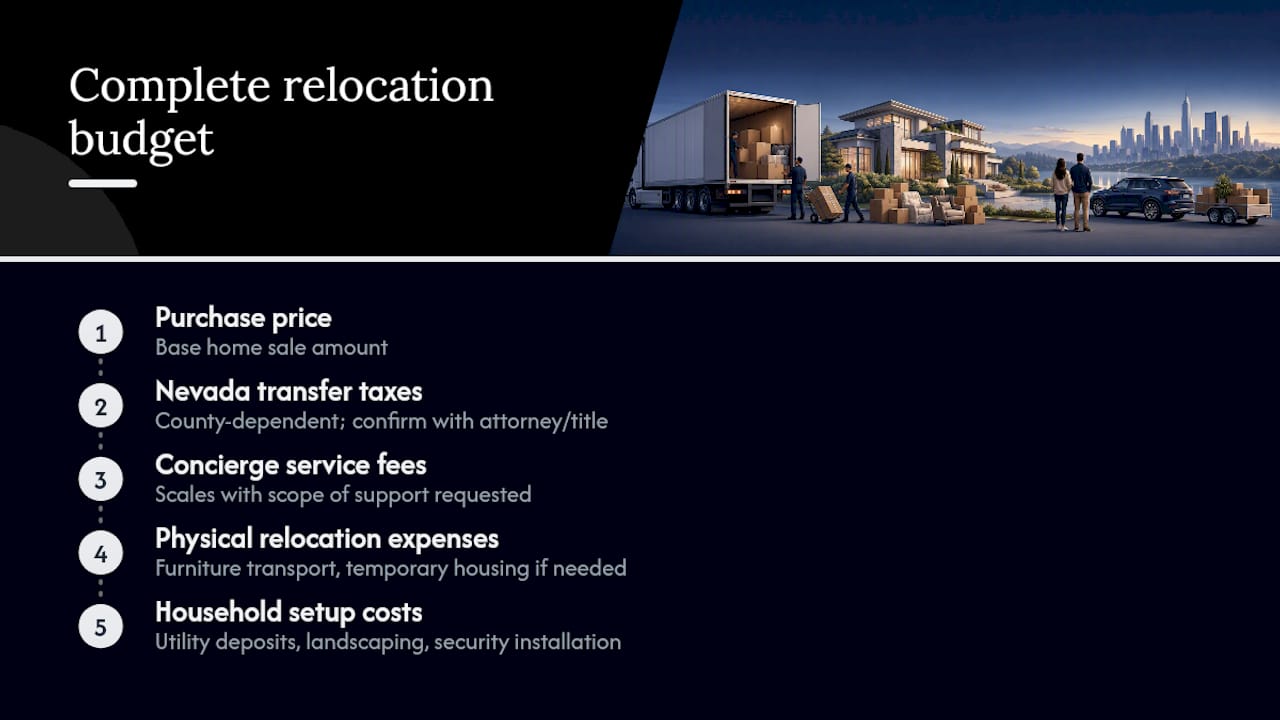
Start with the purchase price itself, then layer in Nevada's transfer taxes and closing costs, which vary by county and sale structure and should be confirmed with your attorney or title company for your exact transaction. Add any concierge service fees, which typically scale with the scope of relocation support requested rather than following a flat industry rate. Then factor in the physical relocation itself: transporting furniture and personal property across state lines, temporary housing if your closing date and move-out date don't align, and the incidental costs of setting up a new household, from utility deposits to initial landscaping and security system installation.
A budget built only around the sale price consistently underestimates total cash outlay by a wide margin once concierge fees, temporary housing, and household setup costs are added. Building the full number early, before you make an offer, is what lets you negotiate from a position of certainty rather than discovering a gap mid-transaction. Working with a private banker or family office contact who has handled interstate luxury purchases before helps surface these line items before they become last-minute surprises.
How Do You Keep Property Acquisition and Physical Relocation in Sync?
The single biggest planning failure among cross-country luxury buyers isn't the property search. It's letting the purchase timeline and the physical move timeline drift apart, so you close on a home you can't yet live in, or vacate your old home before the new one is ready.
The fix is treating both timelines as one project from day one, not two separate efforts run by different people. That means your buyer's agent, attorney, and concierge should all be working from the same closing date estimate, updated in real time as due diligence progresses. If your inspection reveals an issue that pushes closing back two weeks, your temporary housing arrangement and any scheduled furniture transport need to shift with it, not stay locked to the original date.
Practically, this means confirming your moving logistics, whatever company or method you use to transport furniture and household goods across state lines, only after your financing contingency has been satisfied and your closing date has firm confirmation from escrow. Booking too early risks paying for flexibility you don't need or, worse, locking into a date that slips. A concierge who's coordinating both sides of this equation catches the drift before it becomes a costly gap between two empty months of temporary housing.
How Do You Vet a Relocation Concierge or Broker?
Not every agent who claims concierge services actually delivers them, and the difference shows up fast once you start asking specific questions rather than accepting a polished pitch.
Vetting experience means asking for verifiable transaction history, not just years in the business. How many out-of-state relocations has this person or team handled in the last two years? Can they name specific closings, with enough detail that you could independently confirm them? Service scope matters just as much: does "concierge" mean a few vendor introductions, or does it extend to school enrollment coordination, household staffing, and ongoing local support after you've moved in?
Red flags are usually easy to spot once you know what to look for. An agent who can't name specific off-market closings when asked directly. Vague answers about fee structure that never resolve into an actual number. Reluctance to connect you with a listing agent from a past private deal for verification. Pressure to move fast on a property before your financing and legal team are actually ready.
Client references, where an agent can point to actual past buyers willing to speak about their experience, carry more weight than any marketing material. A broker's affiliation with a globally recognized network, Sotheby's International Realty among them, also signals access to a wider referral pool for buyers relocating from unfamiliar markets, though affiliation alone never substitutes for the verification questions above.
What Happens After You Close on Your New Home?
Closing day is the midpoint of a relocation, not the finish line, and the weeks that follow determine how quickly a house becomes a home.
Post-purchase integration typically covers three areas. The first is physical setup: coordinating movers, unpacking, and getting furniture, art, and any specialty items placed correctly, which matters more in luxury homes with specific architectural or climate considerations than in a standard move. The second is local service connections, introductions to a trusted physician, a reliable contractor, a landscaping service that understands desert climate maintenance, and household staff if the property requires it. The third, and often the most overlooked, is community assimilation: connecting new residents to neighborhood associations, local clubs, and social circles that make a new city feel less foreign within the first few months.
Buyers who skip this phase, treating the closing as the end of the process, often spend six months to a year rebuilding a support network that a coordinated concierge could have assembled in weeks. The gap isn't usually about money. It's about not knowing who to call for what, in a city where you have no existing network. A concierge who stays engaged past the closing table, rather than disappearing once commission clears, is the difference between moving into a house and actually settling into a life there.
A Broker's View on What Buyers Get Wrong
Buyers move too fast without verifying access, or too slow once financing is ready, and both mistakes cost real money. I've watched a Los Angeles family close on an off-market Las Vegas estate in under six weeks entirely through video walkthroughs and a trusted local inspection team, because they had proof of funds and a precise brief ready on day one. Speed rewards preparation, not urgency.
Ready to Start Your Los Vegas Off-Market Search?
Yhluxrealestate gives out-of-state buyers something most agencies can't: verified private inventory, backed by a track record you can actually check before you commit to anything. Yelena Horton's Las Vegas luxury real estate practice combines direct developer and owner relationships with a global referral network through Sotheby's International Realty, meaning your search isn't limited to whatever happens to be publicly listed the week you start looking.

At your first conversation, ask for exactly what this article recommends: the last three off-market closings, a clear outline of concierge scope (viewings, temporary housing, vendor introductions, household setup), and straightforward terms on engagement and fees. If you're relocating from out of state and want a buyer's agent who treats verification as standard practice rather than an inconvenience, request an introduction through YH Luxury Homes and bring your one-page brief and proof of funds to that first call.
Sources
- The Complete Guide to Off-Market Luxury Real Estate — Laxary
- Ultra-Luxury Concierge Coordination - Dubai Buyers Club
- Moving across the country — Chase
FAQ
How much luxury real estate sells off-market?
Between 15% and 20% of U.S. luxury homes above $3 million trade privately, with an even higher share in the top price tiers.
How long does an off-market luxury purchase take to close?
A prepared buyer with financing, an attorney, and inspectors ready to mobilize can typically close in 30 to 60 days.
Do I need proof of funds to see off-market listings?
Yes. Agents and sellers generally require proof of funds or a lender preapproval, plus a signed buyer representation agreement, before sharing private inventory.
Should I rent before buying in a new city?
A short rental or scouting visit is worth considering if you've spent limited time in the market, since it helps prevent regret over micro-location choices that are hard to reverse after purchase.
What does a relocation concierge charge?
Concierge fees vary by the scope of service requested, from private viewings and vendor introductions to full household setup, so terms should be confirmed directly during your initial consultation with a broker like Yelena Horton.