
Owner financing is a legal, workable path to homeownership in Las Vegas, provided the promissory note and deed of trust are properly drafted and recorded with Clark County. The single most important next step is contacting a Nevada real estate attorney or a local broker experienced in seller carrybacks before you sign anything, since the structure of the deal determines whether you are protected if something goes wrong.
TL;DR:
- Many owner-financed homes in Las Vegas are hidden off-market or only appear in pocket listings, necessitating local agent connections for full access.
- Nevada law requires proper documentation, including a promissory note and recorded deed of trust, to ensure protection against default and enforceability.
- Sellers often prefer larger down payments, shorter terms with balloon payments, and interest rates above bank norms to offset their own risks.
- Risks include mortgage due-on-sale clauses that could force full repayment if the seller’s existing mortgage includes such provisions, especially with wrap-around financing.
- Buyers with diverse credit profiles have flexibility, but should prepare documented income, larger down payments, and legal reviews to improve negotiation and ensure compliance.
Table of Contents
- Where Owner Financing Las Vegas Buyers Can Find Listings
- How Owner Financing Works: Notes, Deeds, and Payment Structures
- Nevada Legal Rules and Risk Checklist for Seller-Financed Deals
- How to Evaluate and Negotiate an Owner-Finance Offer
- Finding the Right Attorney, Title Company, and Local Agent
- Credit and Qualification Standards for Owner-Financed Buyers
- Tax Consequences for Buyers and Sellers in Nevada
- Why Owner Financing Is Gaining Ground in the Las Vegas Market
- Why Las Vegas Sellers Choose to Carry the Note
- Author Perspective: How Yelena Horton Approaches Seller-Financed Deals
- Search, Negotiate, and Close With YH Luxury Homes
- Sources
- FAQ
Where Owner Financing Las Vegas Buyers Can Find Listings
Owner financing Las Vegas opportunities rarely announce themselves with a banner ad, but there are reliable places to look, and knowing the limits of each one saves weeks of wasted searching.
Zillow and Redfin both let you filter or search for "owner financing" or "seller financing" in listing remarks, and sellers who are open to carrying a note often say so directly in the description. The catch is coverage. These portals only show what agents choose to flag publicly, and plenty of sellers willing to negotiate seller-financed terms never mention it until a buyer asks.
That is where full MLS access through a local agent changes the math. An agent working the Las Vegas MLS can see pocket listings and off-market inventory that never reaches consumer sites, and can call listing agents directly to ask whether a seller would consider carrying paper, even when the listing says nothing about it.
Beyond MLS, several channels consistently surface seller-financed opportunities:
- Local broker networks and relocation concierge services that track sellers looking for steady income rather than a lump sum
- Driving targeted neighborhoods and calling on "for sale by owner" signs, which skew heavily toward flexible terms
- Classifieds and investor forums where sellers who own property free and clear post directly
- Condo and high-rise specialist teams who track building-specific inventory, including retirees ready to carry a note on a paid-off unit
How Owner Financing Works: Notes, Deeds, and Payment Structures
A seller-financed deal replaces the bank with the seller, but the paperwork still has to function like a real loan. Two documents anchor every legitimate transaction: the promissory note, which spells out the amount owed, the interest rate, and the repayment schedule, and the deed of trust (Nevada's version of a mortgage), which gives the seller a recorded lien against the property until the debt is paid off. Recording the deed of trust with the county protects both sides, since it establishes lien priority and gives the seller a legal remedy if the buyer defaults.
Payment structures vary more than most buyers expect:
- Fully amortized loans that pay down principal and interest over the full term, just like a bank mortgage
- Interest-only payments with a lump-sum balloon due at the end of a shorter term, often 5 to 10 years
- Escrowed monthly amounts that fold in property taxes and homeowners insurance so nothing gets missed
Deal types differ too. A full seller carryback means the seller owns the property outright and finances the entire purchase. A partial carry supplements a smaller bank loan. A wrap-around mortgage layers new financing on top of the seller's existing mortgage, which introduces real risk covered in the next section. Lease-options and rent-to-own arrangements are a different animal entirely. They delay the transfer of title, and the FTC warns buyers to read these contracts closely before signing.
Pro Tip: Ask for an amortization schedule before you agree to anything. If a seller can't produce one, that alone tells you how organized the rest of the transaction is likely to be.
Nevada Legal Rules and Risk Checklist for Seller-Financed Deals
Nevada permits owner financing without restriction, as long as the agreement follows state and federal disclosure requirements and gets properly documented. That is the good news. The risk sits in what happens when a seller still owes money on their own mortgage.
Most residential mortgages contain a due-on-sale clause, which lets the lender demand full repayment the moment the property changes hands, even informally through a carryback arrangement. Wrap-around mortgages are especially exposed here, because the seller keeps their existing loan in place and layers your payments on top of it. If that underlying lender ever enforces the clause, the seller could be forced to pay off their mortgage in full, and your deal could unravel through no fault of your own.
One clause, one phone call, and years of payments can be at stake. Before agreeing to any carryback that involves an existing mortgage, insist that your attorney or title company confirm whether that mortgage has a due-on-sale clause and how the seller plans to address it.
A few non-negotiable safeguards apply to every deal:
- A full title search to confirm the seller actually owns the property free of undisclosed liens
- A recorded deed of trust, filed with Clark County, protecting your equitable interest from the start
- Escrowed payments administered by a title company rather than a private arrangement between buyer and seller, since third-party escrow sharply reduces the risk that funds get misapplied or disputed later
- A written, itemized payment schedule that both parties sign and keep
Tax reporting matters too. Owner-financed sales are typically treated as installment sales under IRS Publication 537, which means the seller reports principal and interest separately each year rather than claiming the full gain up front. A Nevada real estate attorney and a CPA should both review the contract before you close, not after.
How to Evaluate and Negotiate an Owner-Finance Offer
Every seller-financed deal has moving parts that a conventional mortgage handles automatically. Negotiate each one explicitly rather than assuming standard terms apply.
- Down payment. Sellers carrying the note often want more skin in the game upfront, often a substantial initial payment, since they are taking on the credit risk a bank would normally absorb.
- Interest rate and term. Rates on owner-financed deals generally run higher than conventional mortgage rates to compensate the seller for that risk, and terms are often shorter, commonly several years with a balloon payment at the end.
- Amortization and balloon structure. Clarify whether the loan fully amortizes or ends in a lump-sum balloon payment you will need to refinance.
- Prepayment rights. Confirm you can pay the loan off early without a penalty if your financial situation improves.
- Escrow responsibilities. Decide upfront whether taxes, insurance, and HOA dues get folded into your monthly payment or paid separately.
Before signing anything, verify the seller's own mortgage payoff amount, run a title and lien search, and insist on a recorded security instrument with escrowed payments through a title company rather than a private arrangement.
Pro Tip: If a seller resists a title search or pushes for payments outside of escrow, treat that as a red flag, not a negotiating quirk. Legitimate sellers rarely object to the protections that also protect them.
Finding the Right Attorney, Title Company, and Local Agent
A Nevada real estate attorney should review the promissory note and deed of trust before you sign, confirm the deal complies with state law, and check whether the seller's existing mortgage carries a due-on-sale clause. When you interview one, ask directly how many seller-carry transactions they have handled and whether they will personally review the recorded documents at closing.
Title companies and escrow officers handle the mechanical side: recording the deed of trust with Clark County, confirming clean title, managing the flow of funds, and often administering ongoing escrowed payments for taxes and insurance. This is also where wire fraud protections matter most, since scammers specifically target real estate closings by intercepting wire instructions.
A local broker adds a different kind of value. Off-market and pocket listings rarely surface without an agent who has relationships across the Las Vegas market, and complex carryback structures benefit from someone who has negotiated them before. You can verify any agent or broker's license directly through the Nevada Real Estate Division.
Before you hire anyone, confirm:
- Their specific experience with seller-financed or carryback transactions, not just conventional sales
- Whether they coordinate directly with title companies they trust
- Their fee structure and what happens if the deal falls through mid-negotiation
Credit and Qualification Standards for Owner-Financed Buyers
Owner financing exists largely because conventional mortgage qualification leaves people out, and sellers set their own bar rather than following bank underwriting rules. There is no fixed minimum credit score required to buy a house in Nevada through owner financing, because the seller, not a lender, decides who qualifies.
That flexibility cuts both ways. A seller might accept a buyer with a 580 credit score and a spotty credit history if the down payment is large enough to offset their risk. Another seller might demand proof of steady income, bank statements, or a co-signer even with decent credit, simply because they have no interest in chasing a defaulted buyer through Nevada's foreclosure process.
Expect most sellers to ask for some combination of the following: recent pay stubs or tax returns, bank statements showing reserves, a larger down payment than a conventional lender would require, and sometimes a personal reference or rental history. Self-employed buyers, recent immigrants building credit, and people recovering from bankruptcy or foreclosure often find owner financing more accessible than a bank loan, since the seller can weigh the whole picture rather than running a rigid algorithm.
Buyers should still come prepared as if applying for a real loan. A clean file, documented income, and a reasonable down payment strengthen your negotiating position and often translate directly into a better interest rate or a longer amortization term.
Tax Consequences for Buyers and Sellers in Nevada
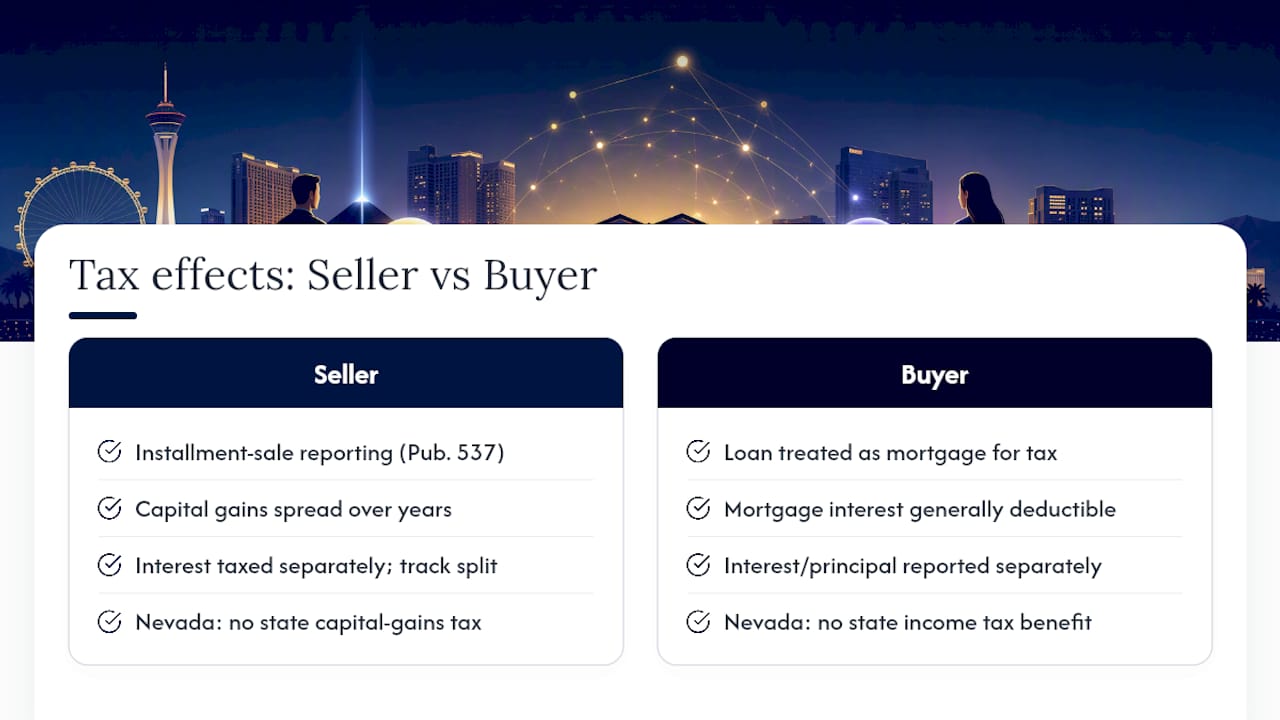
Owner-financed transactions carry tax obligations for both sides that a conventional sale simply routes through a lender instead. Sellers typically report the sale as an installment sale under IRS Publication 537, spreading capital gains recognition across the years they receive payments rather than owing tax on the full gain in the year of sale. That can be a meaningful advantage for sellers sitting on significant appreciation, since it smooths out their tax liability instead of concentrating it into a single year.
Interest income is taxed separately from principal, and sellers need to track that split carefully on every payment received. A CPA familiar with installment sale reporting should set up the amortization schedule in a way that makes annual tax filing straightforward rather than a scramble each spring.
For buyers, mortgage interest paid to a seller is generally deductible under the same rules that apply to bank-financed interest, provided the loan is properly secured by a recorded deed of trust. Nevada has no state income tax, which simplifies things somewhat compared to states where sellers would also owe state-level capital gains tax on the installment income. Property taxes continue to apply regardless of financing structure, and whoever holds title is responsible for them unless the contract states otherwise.
Neither party should treat this as boilerplate. Every seller-financed deal has slightly different terms, and a tax professional should review the specific note before it's signed.
Why Owner Financing Is Gaining Ground in the Las Vegas Market
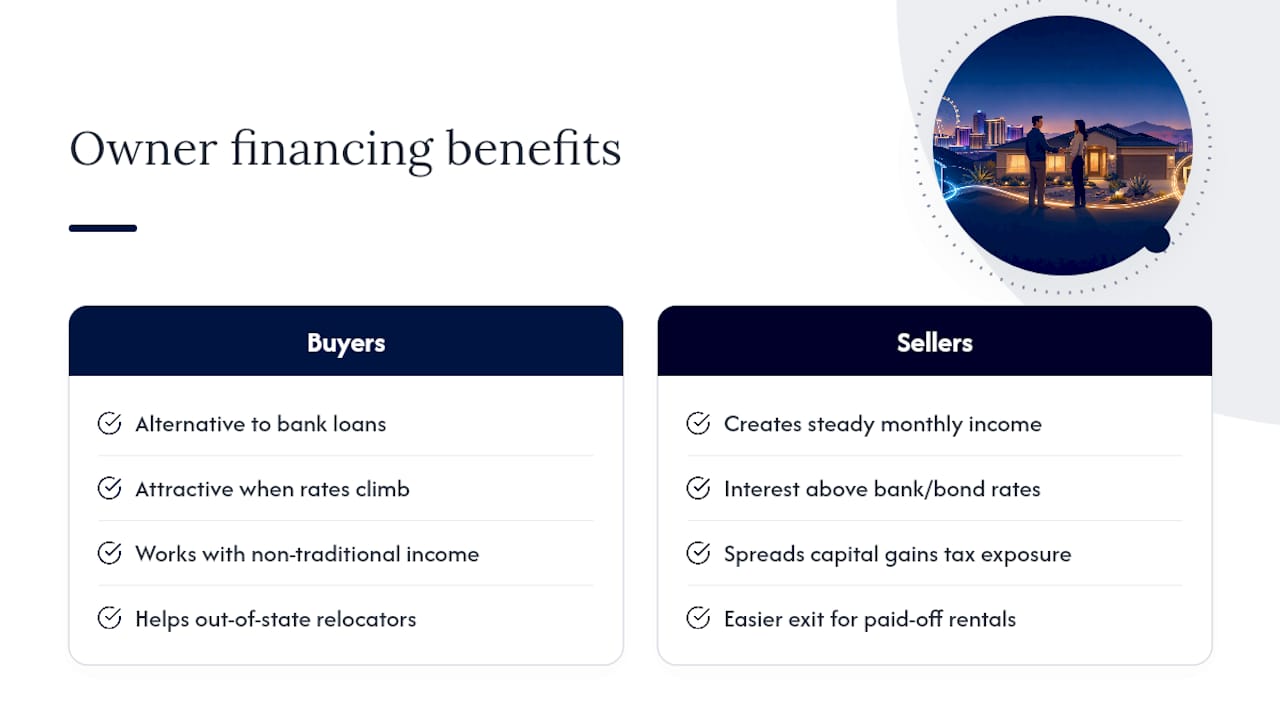
Owner financing has moved from a niche workaround to a genuine strategy in the current Las Vegas market, largely because affordability pressure and elevated mortgage rates have pushed a wider range of buyers toward alternatives to conventional lending. When bank rates climb, seller-financed deals often become comparatively attractive, since sellers can set terms that split the difference between what a buyer can afford and what a bank would otherwise charge.
Las Vegas draws a steady stream of out-of-state buyers relocating for tax advantages, retirement, or lifestyle reasons, and many of them are self-employed or hold non-traditional income that does not fit neatly into conventional underwriting. Owner financing gives that population a route into the market that a rigid bank approval process simply will not accommodate.
On the seller side, the advantage runs in the opposite direction. A retiree who owns a property free and clear can turn it into a source of monthly income, often at an interest rate well above what a bank savings account or bond would pay, while spreading out their capital gains tax exposure over time. Investors holding paid-off rental property sometimes find seller financing an easier exit than listing conventionally, since it opens the buyer pool to people a bank would reject outright.
None of this makes owner financing the default choice, and it still represents a smaller slice of transactions than conventional sales. But in a market where luxury and off-market inventory move on relationships as much as listings, sellers and buyers who understand seller carrybacks have real leverage that most conventional transactions never offer.
Why Las Vegas Sellers Choose to Carry the Note
Sellers rarely choose owner financing out of generosity. They choose it because it solves a specific problem a conventional sale cannot.
The most common motivation is monthly income. A seller who does not need the full sale price in a lump sum can generate a steady interest-bearing stream that often outperforms what they would earn parking the same cash elsewhere. This appeals especially to retirees and long-term owners who have paid off their mortgage and are not in a hurry.
Tax timing is another major driver. Spreading gains across an installment sale under IRS rules, rather than recognizing them all in one year, can keep a seller in a lower tax bracket and reduce their overall liability. For sellers sitting on decades of appreciation, that difference is substantial.
Some sellers turn to owner financing simply because the property is difficult to finance conventionally, whether due to condition issues, unusual construction, or a location that gives bank appraisers trouble. Others are motivated by a faster sale in a slower market, since offering flexible terms widens the buyer pool considerably and can shorten time on market. And a smaller group simply prefers the control: setting their own terms, vetting buyers directly, and avoiding a drawn-out bank underwriting process on either end of the transaction.
Author Perspective: How Yelena Horton Approaches Seller-Financed Deals
Owner-financed transactions reward buyers who move slowly and sellers who document everything. In practice, the deals that go smoothly tend to have one thing in common: a broker willing to coordinate the attorney, the title company, and the escrow officer as a team rather than leaving each party to work in isolation. Off-market access matters here too, because sellers open to carrying a note rarely advertise the fact, and finding them usually comes down to relationships built over years in the local market, not a listing search. For out-of-state buyers, a relocation concierge that handles logistics alongside the financing negotiation removes a layer of stress that has nothing to do with the deal itself but derails plenty of them anyway.
— Yelena
Search, Negotiate, and Close With YH Luxury Homes
Owner financing rewards buyers and sellers who move with the right people beside them, and having strong local market connections is a key advantage in Las Vegas. Rather than relying on public listings alone, experienced brokers draw on exclusive off-market access and extensive networks to surface seller-carry opportunities that never reach Zillow or Redfin, then coordinate the attorney and title work needed to close them safely.

Some brokers offer relocation concierge services that fold logistics into the same conversation as financing terms, helping buyers manage movers and mortgage details seamlessly. Whether you are searching for owner-financed inventory, negotiating terms on a home you have already found, or preparing to sell and carry a note yourself, start with a consultation through Yhluxrealestate to map out the right approach for your situation before you commit to anything.
This article is general information, not a substitute for advice from a qualified financial advisor. Consult a qualified financial professional about your own circumstances before acting on anything here.
Sources
- Owner financing and seller carryback in Nevada
- IRS Publication 537, Installment Sales
- CFPB regulation overview (Truth in Lending Act rules)
FAQ
Can You Get a Loan for Owner Financing?
You don't need a bank loan for owner financing since the seller acts as the lender directly, but some buyers use a smaller conventional loan alongside a partial seller carry to cover the gap between what they can afford and the purchase price.
How Do You Find Owner-Financed Homes in Las Vegas?
Search Zillow and Redfin for listings that flag seller financing, but work with a local agent who has full MLS access, since many owner-finance opportunities exist as pocket listings or emerge only when an agent asks a seller directly.
What Credit Score Do You Need to Buy a House in Nevada With Owner Financing?
There's no fixed minimum credit score required, since the seller sets their own qualification standards rather than following bank underwriting rules, though a stronger credit file typically earns better terms.
What Are Typical Interest Rates for Owner Financing?
Owner-financed interest rates generally run higher than conventional mortgage rates to compensate the seller for taking on lending risk, and terms are often shorter, commonly several years with a balloon payment at the end.