
In Las Vegas real estate, "opportunity zones" refers not to the federal Qualified Opportunity Zone tax program, but to something far more relevant for discerning buyers: the private, off-market luxury properties that never appear on public listing platforms. Success here means gaining access to homes that exist outside the visible market, arriving prepared with proof of funds and entity documentation, and understanding that Nevada's disclosure laws still govern every transaction, seen or unseen. What follows is the preparation checklist, legal groundwork, and negotiation reality that separates a serious buyer from a curious one.
TL;DR:
- Access to private luxury listings in Las Vegas requires proof of funds, entity documentation, and a clear decision-maker, reflecting the exclusivity of off-market properties.
- Sellers of off-market homes often restrict exposure to protect privacy, test prices, and meet timing needs, making thorough buyer preparation essential.
- Nevada law mandates disclosure of known property conditions through the Seller’s Real Property Disclosure form, even for transactions run privately.
- Without public market pressure, negotiations are influenced more heavily by contingencies, escrow terms, and offer credibility, affecting final pricing and deal speed.
- Confusing opportunity zones with federal tax programs can mislead buyers; private listings are driven by market scarcity, not tax incentives, shaping the real estate landscape.
Table of Contents
- How Off-Market and Office-Exclusive Listings Work in Las Vegas
- What Buyers Need Ready to Access Private Luxury Listings
- What Nevada Disclosure Law Requires Before You Close
- Negotiating Price When the Market Never Saw the Listing
- Overview of Opportunity Zones for Tax Benefits vs. Off-Market Luxury Access Confusion
- Local Economic Incentives Shaping Las Vegas Development
- Risks Specific to Private Luxury Transactions
- How Private Access Shapes Las Vegas Market Trends
- The Real Effect on Luxury Property Values
- How Yhluxrealestate Opens the Door to Private Las Vegas Listings
- When to Choose Privacy and When to Choose Exposure
- Sources
- FAQ
How Off-Market and Office-Exclusive Listings Work in Las Vegas
A seller who wants privacy has options that never touch the public-facing internet. An office-exclusive listing, sometimes called pre-marketing, is entered into the local multiple listing service but flagged so it never syndicates to public search sites. The property exists in the system; it simply stays invisible to anyone outside a broker's direct network. NAR's guidance on office-exclusive and pre-marketing listings makes clear that this arrangement requires explicit seller authorization, and the broker must disclose to the seller exactly what exposure they are giving up by choosing it.
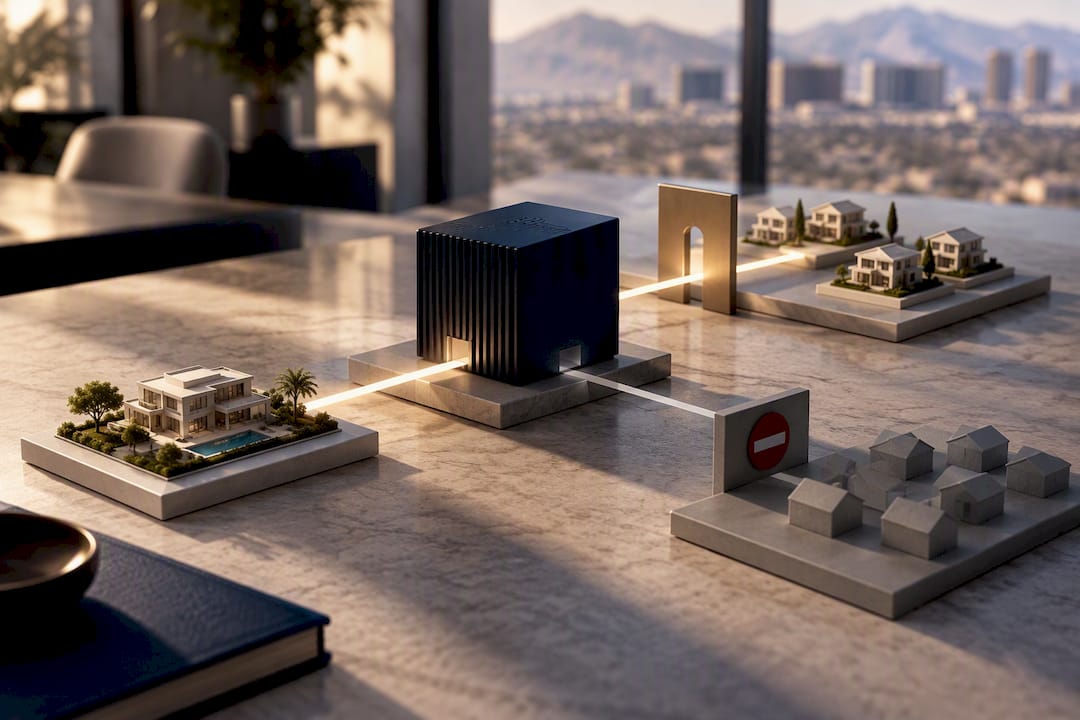
Las Vegas brokers exercise real discretion in how they classify and route these listings, and that discretion shapes what "off-market" actually means locally. A property might sit in a private network for weeks before a broker even considers wider release, tested quietly against a handful of qualified buyers.
Sellers choose this path for reasons that rarely show up in a listing description:
- Protecting the identity of a public figure, executive, or celebrity from unwanted attention
- Testing price sensitivity before committing to a public number that becomes a permanent record
- Avoiding foot traffic from unqualified lookers in a high-security or gated estate
- Timing a sale around a divorce, estate settlement, or relocation that demands discretion
Every one of these arrangements still operates under Nevada's compensation rules. The Nevada Real Estate Division confirms that commission is negotiable and that licensees must disclose material facts and the source of their compensation, regardless of whether a listing is public or private. A breakdown of Las Vegas MLS practices shows how these classifications play out on the ground, and the clear cooperation policy explains the broader framework brokers navigate when deciding how much exposure a listing gets.
What Buyers Need Ready to Access Private Luxury Listings
Sellers who choose privacy are also choosing scarcity, and scarcity means they can afford to be selective about who even sees the property. A serious inquiry from an unprepared buyer wastes everyone's time, and brokers representing these sellers know it within the first phone call.
Three categories of documentation separate a buyer who gets a private showing from one who gets a polite decline:
- Proof of funds or a lender verification letter. A bank statement or a signed letter from a private banker demonstrates the buyer can close without financing contingencies dragging out the timeline.
- Entity formation and trust documents. Many high-net-worth purchases close through an LLC, family trust, or holding company, and sellers want to see that structure before granting access, not after an offer lands.
- Identification and a clear decision-maker contact. Sellers want to know who they are actually negotiating with, especially when a buyer is represented by an advisor, family office, or attorney making decisions on their behalf.
These items exist because private transactions run on trust rather than public market pressure. A seller who has taken a home off the open market is betting that a quieter process will produce a better outcome, and every document a buyer supplies upfront reinforces that bet.
Pro Tip: Request the full property dossier the moment access opens, not after you've made an offer. Ask for the seller disclosure form, HOA documents, permit history, and title information in the same email where you request a showing. Sellers who are already inclined toward privacy respond well to buyers who move efficiently.
Out-of-state buyers face an additional layer of logistics that can be streamlined with trusted Las Vegas parking management software, ensuring smooth coordination of inspections, private showings, and closing timelines from another state or country. Coordinating inspections, private showings, and closing timelines from another state or country requires someone managing the calendar on the ground, which is precisely where a relocation concierge earns its keep, alongside practical considerations like private aviation access for buyers flying in for a narrow inspection window.
What Nevada Disclosure Law Requires Before You Close
Privacy does not exempt anyone from Nevada's statutory disclosure requirements. Every seller, whether marketing publicly or through a whisper network of one, must complete the Nevada Seller's Real Property Disclosure form under the requirements of NRS 113, disclosing known conditions that materially affect the property's value. The seller completes this form and serves it before the deal closes, and it becomes a foundational document for anything a buyer negotiates afterward.
For a limited-exposure luxury transaction, where price history and comparable data are thin by design, buyer diligence has to work harder than usual to fill the gaps. Prioritize verification of:
- Structural or moisture history, particularly in older estates or properties near water features
- Permit records for additions, pools, casitas, or renovated wings
- HOA obligations, club membership requirements, and any transfer fees tied to a gated community
- Special assessments pending against the property or the association
- Insurance constraints, especially flood or wildfire exposure that could affect future coverage
Nevada gives buyers a standard contingency period to inspect a property, and on a private luxury deal that window is not a formality. It is often the only structured opportunity a buyer has to verify claims a seller has made informally during a quiet, invite-only showing. The Nevada Real Estate Division's consumer disclosure guide recommends buyers and sellers alike consult legal counsel where questions arise, and on a seven or eight-figure purchase, that recommendation is not optional caution.
When public comps are sparse, Clark County assessor records become one of the few reliable tools for triangulating value against recent closed sales rather than asking prices, which on a private listing may never have been publicly tested at all.
Negotiating Price When the Market Never Saw the Listing
A property that never hits the open market never generates the competitive tension that drives price discovery. That absence cuts both ways: a buyer might get a fairer number away from bidding-war psychology, or a seller might hold firm on a price that was never stress-tested against real market feedback. Either way, both sides are negotiating with less information than a public sale would generate.
Several levers matter more in this environment than they do in a conventional sale:
- Clean, minimal contingencies signal seriousness to a seller who values discretion over maximum offers
- Deposit structure and escrow terms that show financial commitment beyond a standard earnest money check
- Escalation language that lets a buyer compete without a public auction dynamic ever forming
- Bespoke closing timelines that accommodate a seller's own relocation, estate, or tax planning needs
Because listing history is often thin or nonexistent, an offer grounded in recent closed sales and assessor data carries more credibility than one anchored to a seller's asking number alone, and a guide to Las Vegas cap rates walks through how investment-grade buyers build that case. Budget for the standard Clark County closing costs and timeline regardless of how the deal was sourced. A breakdown of typical closing costs helps buyers avoid surprises that have nothing to do with privacy and everything to do with ordinary transaction mechanics.
Overview of Opportunity Zones for Tax Benefits vs. Off-Market Luxury Access Confusion
Search results for "opportunity zones Las Vegas" often surface federal Qualified Opportunity Zone programs, a tax-advantaged investment vehicle tied to designated low-income census tracts under federal law. That program is a legitimate tool for certain investors, but it is a different subject entirely from what most high-net-worth buyers and sellers mean when they use the phrase in a Las Vegas real estate context.
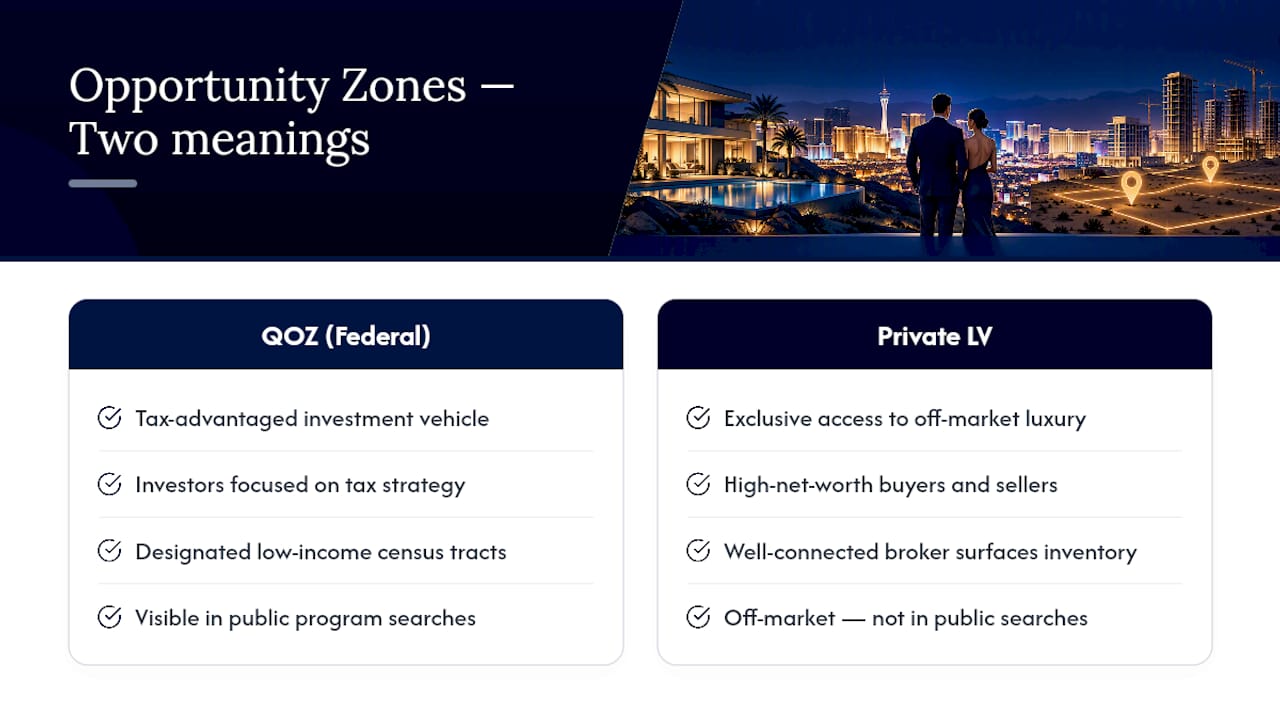
Here, "opportunity zones" describes exclusive access to off-market luxury homes and investment-grade residential properties, the private inventory that a well-connected broker can surface long before it reaches a public search. The confusion matters because someone researching federal QOZ tax mechanics is solving a completely different problem than someone trying to find a discreet estate in Summerlin or The Ridges.
If tax strategy is genuinely part of your motivation for a Las Vegas purchase, particularly around the sale of a prior primary residence, IRS Publication 523 outlines the main-home gain exclusion of $250,000 for single filers and $500,000 for married couples filing jointly. That exclusion does not automatically extend to investment or second properties, and sellers moving significant equity through a luxury transaction should bring in tax counsel well before closing rather than after. But that is a tax planning conversation, separate from the access and negotiation strategy that private luxury real estate actually requires.
Local Economic Incentives Shaping Las Vegas Development
Las Vegas has spent the last decade diversifying beyond gaming and hospitality, and that diversification shows up in how the luxury market behaves. Various economic factors have drawn high-net-worth households from higher-tax states into master-planned communities in the Las Vegas area.
This isn't a tax-credit program in the QOZ sense. It is a broader pattern of economic development that raises demand for this kind of luxury real estate inventory. Large-scale developments, entertainment venues, and business relocations create a steady pipeline of buyers who need housing quickly and quietly, often before a public search would reveal available properties.
Events tied to the region's growing profile as a business and entertainment hub, gatherings like the Las Vegas summit, reflect the same demand pattern. Executives visiting for business increasingly leave considering a second home or full relocation, and those buyers rarely want to start their search on a public portal. They want a broker who already knows what exists quietly, in their price range, before they've finished unpacking from the trip.
Risks Specific to Private Luxury Transactions
The scarcity that makes off-market listings appealing also introduces risks a public transaction rarely presents. Limited comparable data means a buyer can overpay without realizing it, since there's no public price history to sanity-check an asking number against. Assessor records and recent closed sales help, but they are a substitute for market feedback, not a replacement.
Privacy also compresses the diligence timeline in ways buyers underestimate. A seller who prizes discretion may push for a faster close than a public sale would allow, which puts real pressure on inspections, title review, and financing verification inside a shortened window. Rushing any of these steps on a multi-million dollar purchase is where costly surprises live.
The most expensive mistakes rarely involve the structure itself. They involve ongoing obligations that surface only after closing: HOA assessments, club membership requirements, or insurance limitations tied to flood zones or wildfire exposure that weren't fully disclosed upfront. Requesting these documents early and calculating their long-term cost during the contingency period is the difference between a smooth close and a bitter one.

There's also a security dimension unique to high-value private deals. Wire fraud targeting real estate closings has grown more sophisticated, and a guide to protecting against real estate wire fraud is worth reading before any funds move, particularly when a transaction is being coordinated remotely by an out-of-state buyer.
How Private Access Shapes Las Vegas Market Trends
The Las Vegas luxury market has moved meaningfully upward, with the entry point for luxury properties crossing $1.2 million by late 2025, according to Realtor.com research. A significant share of interest in that tier comes from out-of-state buyers, many from California metros, drawn by tax advantages, lifestyle, and relative value compared to their home markets.
That demand pattern has a direct effect on how much inventory moves privately rather than publicly. As more well-capitalized buyers enter the market already knowing what they want, sellers of the most distinctive properties have less incentive to expose them broadly. Why generate public interest and public scrutiny when a broker's existing network already contains a qualified match?
The result is a luxury segment where public listing counts undersell actual transaction volume. Homes trade, sometimes for record sums, without ever appearing in the data sets that track median days on market or list-to-sale ratios. For a buyer, this means the publicly visible luxury market is only part of the real inventory available at any given moment, and for a seller, it means the right buyer might already exist in a broker's contact list before a listing is even drafted.
The Real Effect on Luxury Property Values
Private, controlled access changes value in ways that don't always show up in a spreadsheet. When a property never faces public bidding pressure, its final sale price reflects a negotiation between two informed parties rather than a market-tested auction, and that can cut either direction depending on who holds more leverage at the table.
What off-market access reliably does is protect the seller's asking position. A public listing that sits too long develops a stigma, price reductions become visible, and buyers start negotiating from a position of perceived weakness. A private listing never accumulates that history. If it doesn't sell in the first round of quiet outreach, the seller simply waits, adjusts terms privately, and tries again, with no public record of the delay.
For buyers, this dynamic means the sharpest deals often come not from waiting for a public price cut, but from being the first qualified party a broker calls when a private listing quietly comes available. Being early, prepared, and credible carries more weight in this segment than patience ever will. That's precisely why buyer readiness, proof of funds, entity documents, and a clear decision-maker on record matters as much as the property itself.
How Yhluxrealestate Opens the Door to Private Las Vegas Listings
This approach offers an alternative to searching public portals and hoping a suitable estate surfaces before others find it, focusing on access to off-market properties that do not appear on public searches, paired with negotiation strategies tailored to privacy-minded sellers in this market.

Engaging the team starts with assembling your buyer dossier, proof of funds, entity documentation, and decision-maker contacts to be ready when a private showing opens. Following this, inspections, title review, and negotiation strategy are coordinated efficiently, which is important when access is limited. Out-of-state buyers may use relocation concierge services to manage logistics from afar, and clients benefit from connections to a global network associated with a prominent luxury real estate brand.
Whether you're selling a distinctive estate that deserves a discreet, well-matched buyer, or searching for a property that will never show up on a public search, the next step is a direct conversation. Reach out to Yhluxrealestate to start the process of accessing Las Vegas's private luxury inventory.
When to Choose Privacy and When to Choose Exposure
Privacy wins when safety, sensitive timing, or a genuinely unique buyer match matter more than testing the ceiling of the market. A public figure selling a compound, or a family navigating a divorce quietly, gains real value from controlled exposure that a public listing simply cannot offer.
Broader exposure wins when the goal is pure price discovery: multiple qualified offers competing openly tend to produce the highest number a market will bear. There is no universal right answer, only a question worth asking honestly. Is the goal to protect something, or to test something? Answer that first, and the marketing strategy follows. If you're unsure which side of that line you're on, a conversation with a relocation concierge or representation team grounded in both approaches is worth more than guessing alone.
— Yelena
Sources
- Nevada Real Estate Division — Frequently Asked Questions
- NAR — Office exclusive listings / pre‑marketing guidance
- IRS Publication 523, Selling Your Home
- Realtor
FAQ
What Does "Opportunity Zones Las Vegas" Mean for Buyers?
In the Las Vegas luxury market, the phrase refers to exclusive, off-market real estate opportunities rather than federal Qualified Opportunity Zone tax designations. It describes private listings, often office-exclusive or pre-marketed, that require broker relationships and buyer preparation to access.
Do Nevada Disclosure Laws Apply to Off-Market Sales?
Yes. Every seller must complete the Nevada Seller's Real Property Disclosure form under NRS 113 requirements, regardless of whether the property was marketed publicly or privately, and must serve it before closing.
What Documents Do I Need to Access Private Luxury Listings?
Prepared buyers typically need proof of funds or a lender verification letter, entity formation or trust documents, and clear identification of the decision-maker involved. These signal seriousness to sellers who have deliberately chosen limited exposure.
How Long Do I Have to Inspect a Property Before Closing?
Nevada buyers typically get a standard inspection contingency period, which becomes especially important on private listings where public price and condition history is limited or unavailable.
Does Yhluxrealestate Charge a Set Fee for Buyer Representation?
Yhluxrealestate's fees are not published, since commission structures on private, high-value transactions are negotiated per the Nevada Real Estate Division's guidance on negotiable compensation. Contact the team directly through Yhluxrealestate for details specific to your transaction.