
No, Nevada does not impose a personal state income tax in 2026. Wages, tips, retirement distributions, capital gains, interest, and dividends all pass to residents without a state-level deduction. Federal income tax and FICA withholding still apply, and the state makes up the difference through sales, gaming, and property taxes that shape the true cost of living in the Silver State.
TL;DR:
- Nevada’s absence of a personal income tax applies to wages, retirement income, capital gains, and investment earnings, resulting in no state return requirement.
- The state relies heavily on sales, gaming, and industry taxes, with an average combined sales tax rate around 8.24 percent, which can increase total living costs.
- Establishing Nevada residency requires specific steps like obtaining local driver's licenses, voter registration, and severing ties to previous states, especially for multi-state workers.
- Businesses pay taxes based on gross revenue exceeding four million dollars through the Commerce Tax and payroll taxes via the Modified Business Tax, not personal income tax.
- Retirees benefit from no taxation on Social Security, pensions, or retirement withdrawals, which makes Nevada attractive for fixed-income residents, despite higher consumption taxes.
Table of Contents
- Nevada No Income Tax: What It Covers for Individuals
- How Nevada Raises Revenue Instead of Taxing Income
- Establishing Nevada Residency When You Work Across State Lines
- Nevada Business Taxes: Commerce Tax and Payroll Obligations
- A Take-Home Pay Example: Nevada vs. a Taxed State
- Public Funding Without a State Income Tax
- The Real Tradeoffs Behind No State Income Tax
- Retirement Income and Social Security in Nevada
- Nevada vs. Neighboring States: The Bigger Tax Picture
- From the Field: Relocation and Luxury-Market Considerations
- How Yhluxrealestate Supports Your Move to Nevada
- Sources
- FAQ
Nevada No Income Tax: What It Covers for Individuals
The phrase "Nevada no income tax" describes a genuine structural feature of the state's tax code, not a temporary policy or a loophole that requires paperwork to claim. Nevada simply never adopted a personal income tax, and that omission touches nearly every form of individual earnings.
Here's what falls outside Nevada's tax reach:
- Wages and salaries from employment, whether paid by a Nevada employer or a company headquartered elsewhere.
- Retirement income, including pensions, 401(k) withdrawals, and IRA distributions.
- Capital gains from selling stocks, real estate, or other investments.
- Interest and dividend income from savings accounts, bonds, and brokerage holdings.
- Bonuses, tips, and commissions tied to employment.
Because the Nevada Department of Taxation does not administer a personal income tax, residents generally skip the state return altogether. There is no Nevada equivalent of a state 1040, no state withholding line to reconcile, and no state refund to wait on each spring.
That said, federal obligations do not disappear. Every paycheck still reflects federal income tax withholding along with Social Security and Medicare contributions under FICA. Anyone relocating to Nevada should still consult IRS resources for federal filing requirements, since those rules follow you regardless of which state you call home. The state-level relief is real, but it is one layer of the tax picture, not the whole picture.
How Nevada Raises Revenue Instead of Taxing Income
Nevada funds its government through consumption and industry taxes rather than a paycheck deduction, and that tradeoff shapes daily costs for anyone living there.
Nevada's state sales tax rate sits at 6.85%, with the average combined state and local rate reaching roughly 8.24% according to the Tax Foundation's 2026 state tax rankings. That combined rate ranks among the higher figures nationally, and it applies to most retail purchases, from furniture to electronics.
Gaming and tourism taxes fill a substantial share of the gap left by no income tax. Casino revenue taxes, hotel room taxes, and entertainment levies draw heavily on the roughly 40 million visitors who pass through Las Vegas and Reno each year, effectively exporting part of Nevada's tax burden to out-of-state tourists rather than residents.
Other notable state taxes include:
- A statewide gas tax of 23.81 cents per gallon.
- A cigarette excise tax of $1.80 per pack.
- An effective property tax rate on owner-occupied homes of roughly 0.50%, among the lower rates nationally.
The practical effect: housing costs benefit from that modest property tax rate, but everyday spending, from groceries taxed differently by category to big-ticket purchases, carries a heavier sales tax load than in many states with income taxes. Nevada currently ranks 20th overall on the Tax Foundation's State Tax Competitiveness Index, reflecting that mixed picture rather than a simple "lowest tax" story.
Establishing Nevada Residency When You Work Across State Lines
Moving to Nevada does not automatically shield every dollar you earn from other states' tax authorities. Domicile, the legal concept of your permanent home, determines which state can tax your income, and establishing it requires more than a change of mailing address.
States typically look for a cluster of evidence when someone claims Nevada domicile:
- A Nevada driver's license and vehicle registration, obtained promptly after the move.
- Voter registration in a Nevada county.
- A primary residence in Nevada, whether owned or leased, where you spend the majority of the year.
- Severed ties to the prior state, including canceling old registrations and updating financial accounts.
- Employer payroll updates reflecting your new address for withholding purposes.
Multi-state work complicates the picture further. If you physically perform work while sitting in another state, even remotely for a Nevada-based employer, that other state may still claim taxing rights over that income. Domicile alone does not override source-based rules that many states apply to work performed within their borders, according to guidance from the Nevada Department of Taxation.
Pro Tip: Keep a simple log of the days and locations where you perform work each year, especially if you split time between Nevada and a state with an income tax. That record becomes essential if another state's tax authority ever questions your residency claim.
New residents should also confirm their employer has updated withholding records and register any vehicles promptly, since delayed paperwork is one of the most common triggers for residency disputes.
Nevada Business Taxes: Commerce Tax and Payroll Obligations
No personal income tax does not mean no business tax. Nevada collects revenue from companies through a handful of mechanisms that owners need to understand before assuming the state is tax-free for their venture.
The Commerce Tax applies to businesses with gross revenue exceeding $4 million in a fiscal year, and it taxes gross receipts rather than net profit. That distinction matters for businesses with thin margins but high revenue volume, such as distributors or wholesalers, since the Nevada Department of Taxation calculates the tax before expenses are factored in. Returns are generally due 45 days after the close of the fiscal year.
The Modified Business Tax is a separate payroll tax employers pay based on total wages, distinct from any withholding taken from employee paychecks. It functions more like an employer excise tax than an income tax, and it applies regardless of whether the business ever approaches the Commerce Tax threshold.
Specific industries face additional levies:
- Gaming operators pay percentage-of-revenue taxes tied to gross gaming revenue.
- Mining companies face a net proceeds tax unique to Nevada's extraction industries.
Business owners setting up in Nevada should register through SilverFlume, the state's business portal, which handles entity formation and tax registration in one place. Many small service businesses never approach the Commerce Tax threshold, but they still owe Modified Business Tax on payroll from their first hire.
A Take-Home Pay Example: Nevada vs. a Taxed State
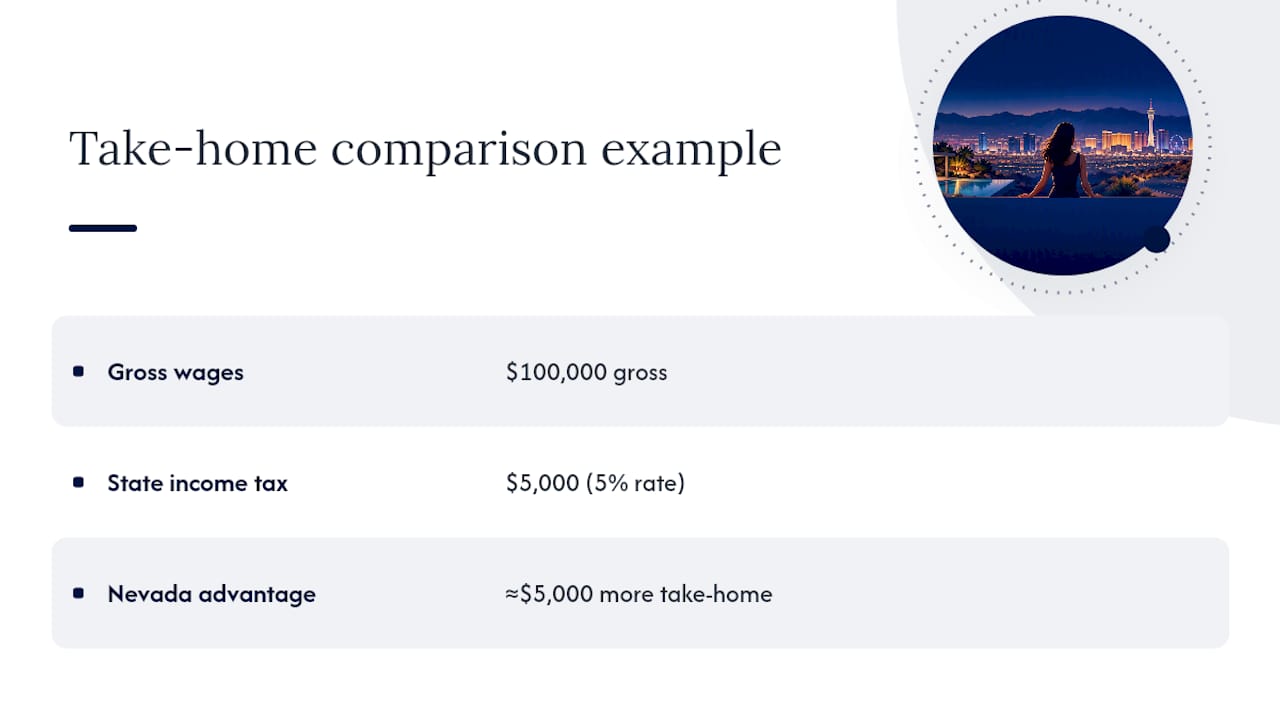
Numbers make the Nevada advantage concrete. Consider a single filer earning $100,000 in gross wages, comparing take-home pay in Nevada against a hypothetical state charging a flat 5% income tax, a rate representative of many mid-tier tax states.
That gap of roughly $5,000 a year stays in the pocket of the Nevada earner, though actual figures shift with filing status, deductions, retirement contributions, and local payroll quirks. GovCalcs and similar tools let you run your own numbers with current federal brackets, and the IRS withholding estimator remains the authoritative starting point for federal calculations. Treat any illustrative comparison like this one as a planning tool, not a substitute for a tax professional's review of your specific situation.
Public Funding Without a State Income Tax
Nevada funds schools, roads, and public safety without touching a paycheck, and that model produces real tradeoffs in how services get delivered. Because gaming, tourism, and sales taxes carry more of the load, state revenue tends to swing with visitor volume and consumer spending rather than staying steady year to year.
That volatility showed up sharply during downturns in tourism, when casino and hotel tax receipts fell and state budgets tightened faster than in states with more diversified revenue streams. School funding in particular draws frequent scrutiny, since Nevada has historically ranked among the lower states nationally for per-pupil spending, a pattern often linked back to the state's reliance on consumption taxes rather than a steady income tax base.
Property tax caps also limit how much local governments can raise for schools and municipal services without voter approval, which pushes many funding gaps toward sales tax increases or state-level appropriations instead. Residents weighing a move to Nevada should understand that lower personal tax bills come paired with a public funding system more sensitive to economic cycles, tourism trends, and gaming revenue than states relying primarily on income tax.
The Real Tradeoffs Behind No State Income Tax
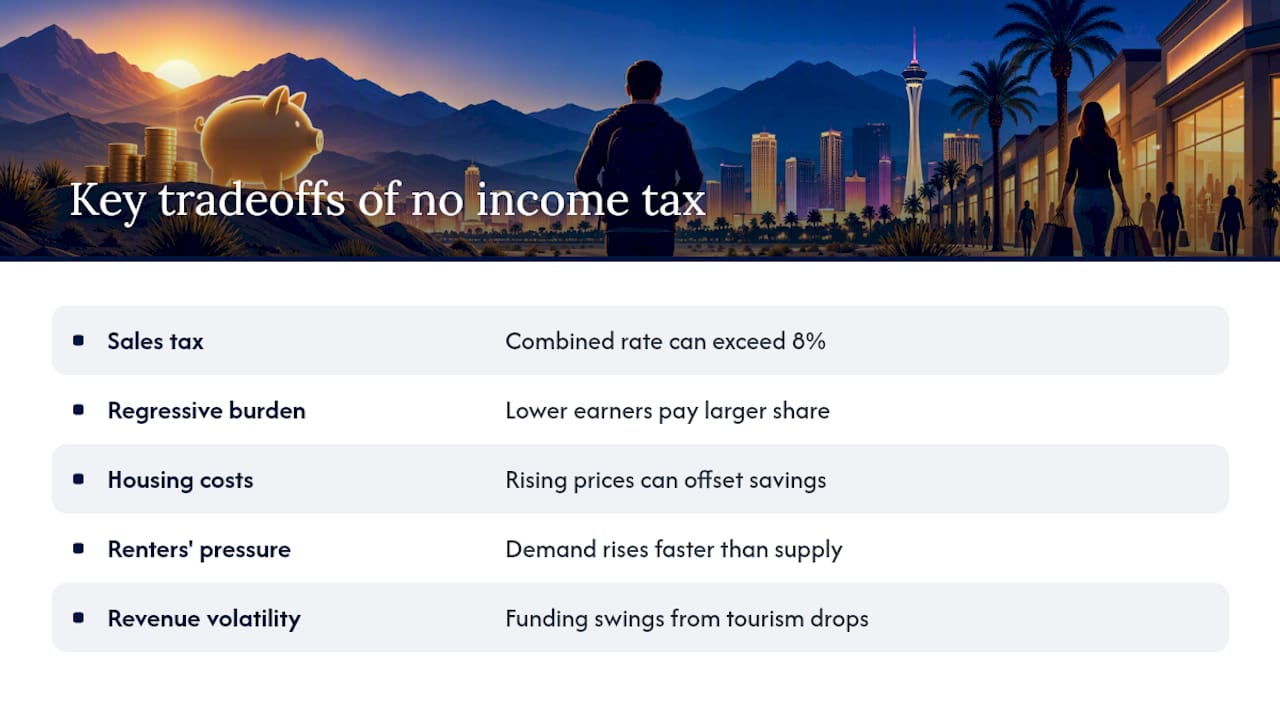
No income tax is not the same as no tax, and Nevada residents feel that distinction most sharply through consumption taxes. Sales tax applies to everyday purchases at a combined rate that can exceed 8% depending on the county, which means lower earners spend a larger share of their income on tax compared to high earners, a regressive effect that critics of consumption-heavy tax systems point to consistently.
Housing costs in fast-growing areas like Las Vegas and Reno have also climbed as more residents relocate specifically for tax reasons, which can offset some of the income tax savings for buyers entering the market at current prices. Renters face similar pressure as demand rises faster than new housing supply in certain submarkets.
Public services dependent on volatile gaming and tourism revenue can also see funding swings that steadier income-tax states avoid, particularly during economic downturns when visitor spending drops first. Experts studying state tax structures note that "no income tax" effectively shifts the tax burden toward consumption and industry-specific levies, which can raise living costs for renters, retail-heavy households, and residents who don't benefit as directly from Nevada's tourism economy. Anyone moving primarily for tax savings should weigh these tradeoffs against total cost of living, not just the absence of a line item on a paycheck.
Retirement Income and Social Security in Nevada
Retirees often see the clearest benefit from Nevada no income tax, since Social Security benefits, pension distributions, and retirement account withdrawals all arrive without a state tax deduction. That matters most for retirees drawing significant income from 401(k) or IRA accounts, where even a modest state tax rate elsewhere can add up to thousands of dollars annually.
Nevada's treatment contrasts with states that tax retirement distributions partially or fully, making it a frequent destination for retirees relocating specifically to preserve more of their fixed income. Combined with no state tax on investment income, retirees drawing from diversified portfolios, annuities, or rental property often find Nevada's overall tax exposure lighter than in their prior state, even accounting for higher sales tax on everyday purchases.
The tradeoff shows up in property tax planning and estate considerations rather than income itself. Nevada's relatively low effective property tax rate benefits retirees who own their homes outright, while the absence of a state estate or inheritance tax adds another layer of appeal for retirees managing wealth transfer to heirs. None of this replaces personalized retirement tax planning, but the baseline structure favors residents living primarily on retirement income over those still earning high active wages.
Nevada vs. Neighboring States: The Bigger Tax Picture
Comparing Nevada to its neighbors reveals that "no income tax" is only one variable in a larger tax equation. California imposes one of the nation's highest marginal income tax rates on top earners, making Nevada an obvious draw for high-income Californians, but California also offers different property tax protections under Proposition 13 that some longtime homeowners find hard to replicate elsewhere.
Arizona and Utah both levy state income tax, though at more moderate rates than California, and both pair that with lower combined sales tax rates than Nevada in many jurisdictions. Idaho similarly taxes income but tends to keep overall property tax burdens low. The pattern across the region is consistent: states without an income tax tend to lean harder on sales tax, property tax, or industry-specific levies to make up the difference, and Nevada's combined sales tax rate is a direct reflection of that shift.
Overall tax burden, meaning the total share of income residents pay across all state and local taxes combined, gives a fuller picture than any single tax type. Nevada's position reflects genuine savings for high earners and retirees, offset by higher consumption taxes that matter more to lower and middle-income households. The right comparison depends entirely on your income profile, spending habits, and whether you own property.
From the Field: Relocation and Luxury-Market Considerations
Tax savings rarely stand alone as the reason a high-net-worth buyer chooses Las Vegas. In practice, the decision weighs Nevada's tax structure against housing market timing, lifestyle fit, and how quickly a family can establish genuine roots.
Buyers moving primarily for tax reasons still need the same diligence as any relocation: verifying school districts, understanding HOA structures in master-planned communities, and confirming that a property supports the residency documentation state tax authorities expect. A relocation concierge service smooths exactly that friction, coordinating logistics, proof-of-residency steps, and off-market property searches so a move driven by tax strategy doesn't stall on paperwork or an incomplete home search.
The buyers who navigate this best treat Nevada's tax advantages as one input among several, not the entire thesis for a move.
— Yelena
How Yhluxrealestate Supports Your Move to Nevada
Relocating for Nevada's tax advantages means little if the home search drags on or the right property never surfaces publicly. A relocation concierge service exists to assist out-of-state buyers with proof-of-residency guidance, local registration steps, and access to off-market luxury properties, coordinated alongside expert negotiation focused on buyer positioning.

This approach fits high-net-worth buyers and families relocating from higher-tax states who value privacy, speed, and access over sorting through public listings alone. Supported by a global realty network, local Las Vegas market knowledge is combined with discreet service suited to significant relocations. If a move to Nevada is on your near-term horizon, start a conversation with Yhluxrealestate about your timeline, property criteria, and residency goals.
Sources
For direct answers straight from the source, a handful of official pages cover nearly everything a mover or business owner needs. The Nevada Department of Taxation's income tax page confirms the state's no-income-tax status and filing expectations, while its Commerce Tax page covers the $4 million gross revenue threshold for businesses.
The Tax Foundation's Nevada profile offers independent rankings and rate comparisons against other states. Business owners forming a new entity should start at SilverFlume for registration, and IRS.gov remains the definitive source for federal withholding and filing rules that apply regardless of state residency.
- Income Tax in Nevada – State of Nevada
- 2026 Nevada Tax Rates & Rankings | Tax Foundation
- Nevada Income Tax 2026: Rates, Brackets & Calculator - GovCalcs
FAQ
How does Nevada have no income tax?
Nevada never adopted a personal income tax as part of its state constitution and tax code, relying instead on sales tax, gaming revenue, and property tax to fund government operations. The Nevada Department of Taxation confirms this applies to wages, retirement income, and investment earnings alike.
How much will I earn after taxes if I earn $100,000 in Nevada?
A single filer earning $100,000 in Nevada would keep roughly $78,350 after federal income tax and FICA withholding, since no state income tax applies. Actual take-home pay varies with filing status, deductions, and retirement contributions, so tools like GovCalcs' Nevada calculator offer a more personalized estimate.
Which states have no income tax?
Nevada is one of several states with no personal income tax, a group that also includes Texas, Florida, Washington, Wyoming, South Dakota, Alaska, and New Hampshire (which taxes only certain investment income). Each state makes up the revenue differently, so overall tax burden still varies significantly between them.
Who pays the largest share of taxes in the US?
At the federal level, higher-income earners pay a disproportionate share of income tax collected nationally, since the federal system uses progressive brackets. Nevada's own tax structure works differently, leaning on sales and gaming taxes that spread the burden more evenly across income levels and even onto out-of-state visitors.
Do Nevada retirees pay tax on Social Security or pensions?
No. Nevada does not tax Social Security benefits, pension income, or retirement account withdrawals at the state level, since it has no personal income tax at all. Retirees still owe applicable federal taxes on that income under IRS rules.