
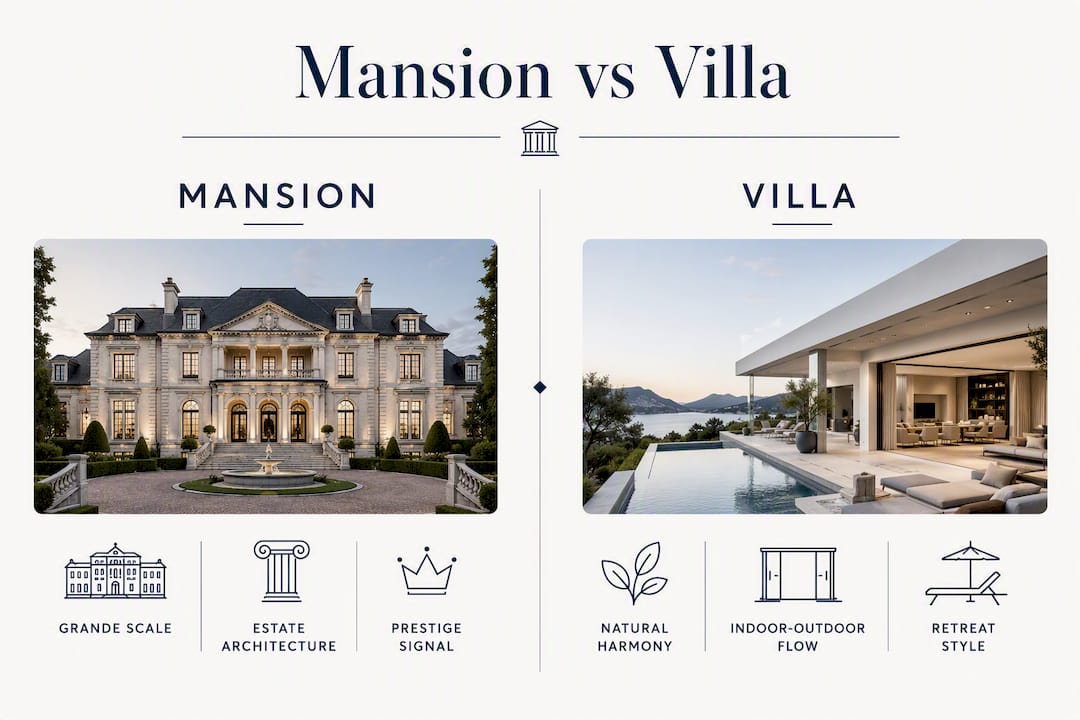
Mansions and villas are both expressions of luxury at its most deliberate — a mansion commands through scale, grandeur, and estate-level presence, while a villa seduces through architectural harmony with its landscape, serene indoor-outdoor flow, and the quiet authority of a private retreat. This guide delivers a practical roadmap for affluent buyers: where to find the finest inventory (public portals, luxury broker networks, and off-market channels), which U.S. markets reward discerning acquisition, and how to move from first inquiry to signed deed with confidence.
- Where to search: Curated portals such as JamesEdition and Luxury Portfolio International surface visible inventory; the most exclusive listings circulate through private broker networks and off-market access that only boutique specialists can unlock.
- Top U.S. markets to watch: Los Angeles, Miami, the Hamptons, Aspen, and Las Vegas each offer a distinct product profile and demand dynamic worth understanding before you commit capital.
- Core buying checklist: Verified recent comps, forensic title search, specialized inspections, financing pre-qualification, and a broker with demonstrated pocket-list access — these are the non-negotiable pillars of a sound acquisition.
Trusted resources including The Pinnacle List, Luxury Portfolio International, and YH Luxury Homes (Yelena Horton) serve as authoritative reference points throughout.
Table of Contents
- What actually separates a mansion from a villa?
- Where do you find mansions and villas in the United States?
- Which U.S. markets reward mansion and villa buyers most?
- What amenities and features drive desirability and price?
- What drives price, and what does the transaction timeline look like?
- How does the buying process work for ultra-high-end properties?
- How do you choose a luxury broker for mansions and villas?
- Working with YH Luxury Homes in Las Vegas
- Key Takeaways
- The label matters less than the brief
- YH Luxury Homes offers a direct path to Las Vegas's finest inventory
- Useful sources and specialist contacts
- FAQ
What actually separates a mansion from a villa?
The distinction matters in practice, not merely in nomenclature. A mansion is defined by expansive scale, grandeur, and wealth-signaling architecture — an estate-level property set apart by prestige, significant square footage, and a design vocabulary oriented toward formal entertaining, social display, and the projection of consequence. There is no rigid square-footage threshold universally applied, but the term implies a property that commands its setting rather than defers to it.

A villa, by contrast, emphasizes harmony with nature, privacy, and strong indoor-outdoor flow. Historically a retreat from urban life, the modern villa prioritizes scenic settings, landscape integration, and an architecture that dissolves the boundary between interior comfort and exterior splendor. Where a mansion announces itself, a villa withdraws into its surroundings with studied elegance.
Practical differentiators buyers encounter in listings:
- Site setting: Mansions typically occupy prominent urban or suburban lots; villas favor coastal bluffs, hillsides, vineyard estates, or waterfront parcels where the landscape is the primary amenity.
- Design priorities: Mansions feature formal entertaining wings, grand foyers, ballrooms, and gallery-scale reception rooms; villas emphasize covered terraces, courtyard gardens, infinity pools, and seamless transitions to outdoor living.
- Privacy and security: Both types prize seclusion, but villas tend to achieve it through natural topography and acreage, while mansions often rely on gated perimeters and architectural mass.
- Amenity emphasis: Mansion listings commonly highlight wine cellars, home cinemas, staff quarters, and formal dining suites; villa listings foreground outdoor kitchens, pool pavilions, guest cottages, and spa terraces.
When the label is marketing rather than meaningful, context reveals the truth. In Las Vegas, "villa" frequently describes a resort-adjacent compound with indoor-outdoor entertaining space; in the Hamptons, it may signal a European-inflected retreat with manicured grounds. Buyers who understand the underlying architectural intent — rather than the label alone — make better-informed decisions.
Where do you find mansions and villas in the United States?
The discovery process for high-end properties operates across three distinct tiers, each yielding a different quality and exclusivity of inventory.

Public portals and curated marketplaces represent the most accessible tier. Curated luxury marketplaces that aggregate villas, mansions, and estates worldwide are primary discovery tools for visible inventory, offering sophisticated search filters by lifestyle category, architecture, and price band. Luxury Portfolio International organizes its global listings by lifestyle category — golf, waterfront, ski, equestrian — allowing buyers to match property type with personal priorities from the outset. Mansion Global and LuxuryRealEstate.com provide additional breadth for buyers monitoring multiple markets simultaneously.
Luxury broker networks and affiliations constitute the second tier, where the quality of access rises sharply. Membership in networks such as Sotheby's International Realty unlocks curated listings, international syndication, and introductions to properties that never appear on public portals. A broker affiliated with a global luxury network can present a buyer's profile to counterpart agents across markets, generating opportunities that no algorithm surfaces.
Off-market and pocket listings represent the apex of the supply pyramid. The most exclusive assets circulate through private broker networks rather than public portals, and access requires a broker with genuine relationships in that private ecosystem. Concierge brokerage services — such as those offered by YH Luxury Homes — are specifically structured to grant this access to qualified buyers.
Auctions and estate sales occasionally surface architecturally significant properties, particularly when a historic estate changes hands for the first time in decades. These events reward buyers who have already completed their due diligence framework and can act decisively.
Pro Tip: Set real-time alerts on two or three curated portals for your target markets, then retain a boutique broker with pocket-list access for the inventory those alerts will never show you. The combination covers the full supply spectrum.
Which U.S. markets reward mansion and villa buyers most?
Each premier market offers a distinct product character, and understanding those distinctions protects capital as much as it refines taste.
- Los Angeles (Bel Air, Malibu, Beverly Hills): The quintessential mansion market, where architectural provenance, canyon privacy, and ocean views command extraordinary premiums. Malibu's coastal villas attract buyers who prize direct beach access and halcyon Pacific vistas; Bel Air rewards those seeking estate-scale compounds with city-light panoramas.
- Miami and Palm Beach: Waterfront premium is the defining value driver here. Deepwater dockage, Intracoastal frontage, and proximity to the Atlantic elevate otherwise comparable properties by a material margin. Palm Beach's historic estates carry provenance value that newer construction cannot replicate.
- The Hamptons: New York's preeminent retreat market, where oceanfront and bay-front estates command the highest per-acre values in the Northeast. The Hamptons rewards buyers who understand the distinction between ocean-side and bay-side positioning.
- Aspen: Mountain privacy and ski-in/ski-out access define value here. Aspen's luxury inventory skews toward compound-style properties with guest houses, wellness suites, and the kind of self-contained seclusion that urban markets cannot offer.
- Las Vegas: An increasingly sophisticated luxury market, where East Coast buyers are drawn by Nevada's favorable tax environment, no state income tax, and a growing inventory of custom-built estates in guard-gated communities. The product ranges from resort-adjacent villas to sprawling hillside mansions with Strip and mountain views.
- Lake Tahoe: A sanctuary market for buyers seeking alpine privacy, four-season recreation, and lakefront estates of genuine rarity. Supply is constrained by geography, which supports long-term value.
Emerging micro-markets — certain enclaves in the Texas Hill Country, coastal Carolina, and the Arizona high desert — attract buyers who prefer lower price-per-square-foot, reduced competition, and the privacy that comes before a market achieves mainstream recognition. For buyers with a longer investment horizon, these destinations can offer compelling entry points. Luxury Home Magazine provides ongoing editorial coverage of both established and emerging luxury destinations for buyers monitoring cross-market trends.
What amenities and features drive desirability and price?
The amenity profile of a luxury property is not merely a comfort consideration — it is a valuation input. Industry analysis shows a growing buyer preference for sanctuary-style properties that emphasize privacy and wellness amenities over pure architectural grandeur, a shift that has materially repriced certain feature categories.
The amenities that most consistently influence buyer demand and appraisal outcomes:
- Privacy and grounds: Acreage, mature landscaping, and natural topography that creates genuine seclusion command a premium that no interior renovation can replicate.
- Waterfront access: Direct frontage — ocean, lake, river, or bay — remains the single most defensible location premium in luxury real estate.
- Pools and wellness suites: Resort-caliber pool complexes, integrated spa facilities, and private fitness pavilions have moved from aspirational to de rigueur among buyers at the top of the market.
- Guest houses and staff quarters: Separate guest cottages or casitas add functional square footage while preserving the privacy of the main residence — a combination that broadens the property's appeal at resale.
- Wine cellars and home cinemas: Long-established prestige amenities that continue to signal estate-level quality, particularly when executed with architectural intention rather than as afterthoughts.
- Smart-home and security systems: Integrated automation, biometric access, and professional-grade surveillance are now baseline expectations for buyers in the ultra-high-end segment.
Architectural provenance adds a category of value that amenities alone cannot manufacture. A property designed by a recognized architect — Richard Neutra, Paul Williams, or a contemporary figure of comparable stature — carries a premium grounded in cultural significance and scarcity. Historic designation can both protect and constrain a property's future, so buyers should understand its implications before acquisition.
Maintenance complexity scales with amenity richness. A property with a seawall, a helipad, a commercial-grade kitchen, and a resort pool requires a dedicated facilities management budget that out-of-state buyers frequently underestimate. Understanding how amenities affect resale value is as important as appreciating them aesthetically.
Market insight: Demand is shifting decisively toward privacy and wellness. Features like private spas, integrated wellness suites, and secure, self-contained grounds are increasingly decisive in purchase decisions — and in appraisal outcomes.
What drives price, and what does the transaction timeline look like?
Price in the luxury segment is a function of location scarcity, land size, architectural rarity, and the depth of comparable sales in the immediate market. Advisors recommend analyzing recent comparable sales for similar high-end assets in the specific local market and focusing on location-specific liquidity metrics — a discipline that separates informed acquisition from aspirational overpayment.
There is no universal price hierarchy between mansions and villas; a Malibu villa with direct ocean frontage may command a higher price per square foot than a comparably sized inland mansion, while a historic Palm Beach estate may dwarf both. Location-specific demand is the governing variable.
| Transaction Phase | Typical Duration | Key Cost Categories |
|---|---|---|
| Property search and identification | 1–6 months | Broker retainer or commission agreement |
| Offer, negotiation, and acceptance | 1–4 weeks | Earnest money deposit (1–3% of purchase price) |
| Due diligence and inspections | 2–6 weeks | Specialized inspections, survey, environmental assessment |
| Title search and insurance | 2–4 weeks | Title insurance premium, attorney fees |
| Financing and appraisal | 3–8 weeks (if financed) | Appraisal fee, lender origination costs |
| Escrow and closing | 1–2 weeks | Escrow fees, transfer taxes, recording fees |
Transaction costs beyond the purchase price typically include agent commissions, title insurance, escrow fees, specialized inspection costs, and — in certain jurisdictions — transfer or mansion taxes levied on high-value sales. HOA fees and estate upkeep transfer costs apply in guard-gated communities and master-planned luxury enclaves. Buyers acquiring for investment purposes should also factor in the potential for a 1031 exchange when planning their exit strategy, as this mechanism can defer capital gains taxes on qualifying property exchanges.
How does the buying process work for ultra-high-end properties?
The due diligence protocol for a mansion or villa purchase is materially more complex than for a standard residential transaction, and the sequence in which steps are executed can determine whether a deal closes or collapses.
- Define lifestyle and investment priorities. Before engaging any broker, articulate whether the acquisition is primarily a primary residence, a seasonal retreat, an investment asset, or some combination. This clarity shapes every subsequent decision.
- Retain a luxury broker with verified off-market access. The broker relationship is the single most consequential early decision. A broker without pocket-list access limits your view of available supply to the public tier only.
- Conduct a forensic title search. Luxury properties — particularly historic estates — can carry encumbrances, easements, or title defects that standard searches miss. Engage a title attorney with experience in high-value transactions.
- Commission boundary and land surveys. Acreage claims in listing materials are frequently approximate; a certified survey establishes the legal boundaries and identifies any encroachments.
- Schedule specialized inspections. Beyond standard home inspection, luxury properties require mechanical systems review, structural engineering assessment, pool and spa inspection, septic or sewer evaluation, and — for coastal or lakefront properties — seawall and dock assessment.
- Complete environmental assessments. Coastal properties require flood zone analysis and potential wetlands review; mountain properties may require wildfire risk assessment and water rights verification.
- Arrange financing or confirm liquidity. Jumbo loans — those exceeding conforming loan limits — require more extensive documentation and longer underwriting timelines than conventional mortgages. All-cash buyers hold a decisive advantage in competitive off-market negotiations, as the absence of a financing contingency materially strengthens the offer.
- Negotiate with precision. Off-market transactions reward buyers who understand earnest money strategy, tailored contingencies, and timing levers. A broker with genuine negotiation experience in the ultra-high-end segment is indispensable here.
- Close through a vetted escrow and title company. Confirm that the escrow officer has handled transactions of comparable value and complexity.
Pro Tip: Engage a luxury asset appraiser and a conservation or environmental specialist before making an offer on any coastal, lakefront, or historically designated property. Their findings frequently alter both the offer price and the contingency structure.
How do you choose a luxury broker for mansions and villas?
The broker selection decision deserves the same rigor applied to the property itself. The following framework structures the vetting process.
Selection criteria to apply:
- Demonstrated off-market access, with named examples of pocket listings presented to qualified buyers in the past 12 months.
- Verified comparable sales experience at the price point and property type you are targeting — not merely adjacent price bands.
- A negotiation track record that includes off-market and competitive multi-offer scenarios.
- Concierge and relocation services for out-of-state or international buyers, including school district guidance, lifestyle advisory, and vendor introductions.
- Global syndication capability through an affiliated luxury network (Sotheby's International Realty, for example).
- Deep local market knowledge — a broker who specializes in Las Vegas luxury, for instance, understands the guard-gated community hierarchy, the tax advantages specific to Nevada, and the micro-market dynamics that a generalist cannot replicate.
Questions to ask a prospective broker:
- "Can you describe two or three off-market properties you presented to buyers in the past year, and what the outcome was?"
- "What comparable sales have you personally closed in this price range and property type?"
- "Who are your preferred escrow and title partners, and why?"
- "Will you sign a confidentiality agreement covering any off-market search conducted on my behalf?"
- "What post-close services do you offer, including property management introductions and lifestyle vendor referrals?"
Red flags that warrant caution:
- No verifiable recent high-end transactions at or near your target price point.
- Reluctance to provide private-network references from past clients.
- Unwillingness to execute a confidentiality agreement for off-market searches.
- A portfolio that emphasizes volume over specialization.
Trust signals worth verifying include active membership in a recognized luxury network, documented client testimonials, and a public record of market analysis that demonstrates genuine local expertise rather than generic commentary.
Working with YH Luxury Homes in Las Vegas
YH Luxury Homes, led by Yelena Horton, operates as a boutique luxury brokerage in Las Vegas with a service model built around the specific needs of high-net-worth buyers and sellers seeking exclusive estates and large private residences.
The core service offering encompasses off-market property search with access to pocket listings that never appear on public portals; expert negotiation strategy calibrated to the buyer's positioning and timeline; a relocation concierge for out-of-state clients that addresses everything from neighborhood orientation to lifestyle vendor introductions; and global syndication through Sotheby's International Realty for sellers seeking maximum international exposure.
What distinguishes a boutique specialist from a large portal or generalist brokerage is the quality of access and the depth of local intelligence. Yelena Horton's affiliation with Sotheby's International Realty provides the global network reach of an international brand while preserving the confidentiality, bespoke valuation insight, and white-glove attention that only a specialist practice can deliver. For buyers evaluating Las Vegas as a luxury market, that combination of local depth and global reach is a material advantage.
Key Takeaways
The most defensible luxury property acquisition combines a clear lifestyle brief, a boutique broker with verified off-market access, rigorous due diligence across title, inspections, and environmental factors, and a financing structure aligned with the competitive realities of the ultra-high-end segment.
| Point | Details |
|---|---|
| Mansion vs. villa distinction | Mansions signal scale and prestige; villas prioritize landscape integration and indoor-outdoor flow. |
| Off-market access is decisive | The most exclusive listings circulate privately; a broker without pocket-list access limits your view of available supply. |
| Price has no universal hierarchy | Location scarcity, land size, and architectural rarity govern value — a villa can command more than a mansion in the same market. |
| Due diligence must be specialized | Luxury transactions require forensic title work, specialized inspections, and environmental assessments beyond standard protocols. |
| Yhluxrealestate for Las Vegas | YH Luxury Homes offers off-market search, relocation concierge, and Sotheby's-backed global syndication for buyers and sellers in Las Vegas. |
The label matters less than the brief
The most persistent misconception in luxury real estate is that the property type — mansion or villa — determines the quality of the acquisition. It does not. What determines quality is the alignment between architectural intent and the buyer's actual lifestyle. A buyer who prizes formal entertaining and social presence will find a villa's courtyard serenity quietly frustrating; a buyer who craves sanctuary and landscape immersion will find a mansion's grand foyer an exercise in performative excess.
The Las Vegas market illustrates this tension with particular clarity. Buyers relocating from the Northeast or California often arrive with a fixed image of what luxury should look like, shaped by markets with entirely different supply profiles and cultural registers. Las Vegas offers something genuinely distinct: resort-caliber compounds in guard-gated communities, hillside estates with panoramic desert and Strip views, and a tax environment that makes the financial case as compelling as the lifestyle one. The buyers who thrive here are those who engage a specialist early, define their brief with precision, and resist the temptation to transpose another market's value hierarchy onto this one.
Off-market negotiation in this segment rewards patience and preparation in equal measure. A buyer who arrives with financing confirmed, a clear lifestyle brief, and a broker who has already cultivated the relevant seller relationships will consistently outperform one who begins that preparation after identifying a property. The sequence matters as much as the strategy.
YH Luxury Homes offers a direct path to Las Vegas's finest inventory
For buyers who have spent time researching the luxury market and understand what they want, the next constraint is almost always access — access to properties that are never listed publicly, to sellers who require discretion, and to a negotiation process that protects the buyer's position from first contact to closing.

Yhluxrealestate provides exactly that access. Through Yelena Horton's boutique practice, backed by Sotheby's International Realty's global network, qualified buyers receive a bespoke off-market search, a relocation concierge that handles every logistical dimension of an out-of-state move, and negotiation representation calibrated to Las Vegas's specific market dynamics. Every engagement begins with a confidential consultation to define the acquisition brief — price range, lifestyle priorities, investment horizon, and preferred communities. From that brief, Yelena builds a targeted search that reaches inventory the public portals will never show.
To begin your confidential search, schedule a consultation with Yhluxrealestate and request access to current off-market listings in Las Vegas's premier guard-gated communities.
Useful sources and specialist contacts
The following resources support deeper research across market data, legal and tax structure, and listing discovery.
- The Pinnacle List: Authoritative editorial on the definitional distinctions between villas, mansions, and houses — the clearest publicly available treatment of how these labels function in modern luxury real estate.
- JamesEdition: A curated international marketplace aggregating luxury villas, mansions, and estates; useful for cross-market price benchmarking and lifestyle-category search.
- Luxury Portfolio International: Organizes global luxury listings by lifestyle category; valuable for buyers who want to match property type to personal priorities before narrowing geography.
- Forbes Global Properties: Market analysis and luxury property insights with editorial rigor; consult for investment-grade commentary on comparable sales and market liquidity.
- Luxury Home Magazine: Regional and national editorial coverage of luxury listings and market trends; useful for tracking emerging micro-markets and design trends.
- LuxuryEstate: International luxury property portal with strong coverage of villa-style properties; useful for buyers considering European or Caribbean acquisitions alongside U.S. options.
- Living Italy: For buyers considering Italian villas as part of an international portfolio, this resource addresses the specific legal and ownership considerations for foreign purchasers.
- YH Luxury Homes: Primary contact for off-market search, relocation concierge, and bespoke acquisition advisory in Las Vegas.
- Local real estate counsel: Engage a Nevada-licensed real estate attorney for purchase structure decisions, LLC or trust formation, and title review on high-value transactions.
- Tax advisor: Consult a CPA or tax attorney familiar with Nevada property tax, federal capital gains treatment, and 1031 exchange eligibility before finalizing any acquisition structure.
FAQ
What makes a house qualify as a mansion?
A mansion is defined by estate-level scale, grandeur, and wealth-signaling architecture rather than a fixed square-footage threshold. The term implies a property set apart by prestige, significant square footage, and a design orientation toward formal entertaining and social presence.
When is a property called a villa instead of a mansion?
A villa emphasizes harmony with its natural setting, strong indoor-outdoor flow, and a retreat-style character. The label typically applies when landscape integration and scenic siting are the primary architectural priorities rather than scale or formal grandeur.
Which is more expensive, a villa or a mansion?
There is no universal price hierarchy between the two. Cost is governed primarily by location scarcity, land size, rarity, and exclusive amenities — a coastal villa with direct ocean frontage can command a higher price per square foot than a comparably sized inland mansion.
How do you find off-market mansions and villas in the U.S.?
The most exclusive listings circulate through private broker networks rather than public portals. Retaining a boutique broker with verified pocket-list access — such as Yhluxrealestate in Las Vegas — is the most reliable path to inventory that never appears on curated marketplaces.
What ownership structures are commonly used for luxury property purchases?
LLCs and revocable trusts are the most common structures for high-value acquisitions, offering liability protection, estate planning benefits, and, in some cases, privacy advantages. The appropriate structure depends on the buyer's tax situation, estate planning goals, and intended use of the property; a qualified real estate attorney and tax advisor should be consulted before closing.