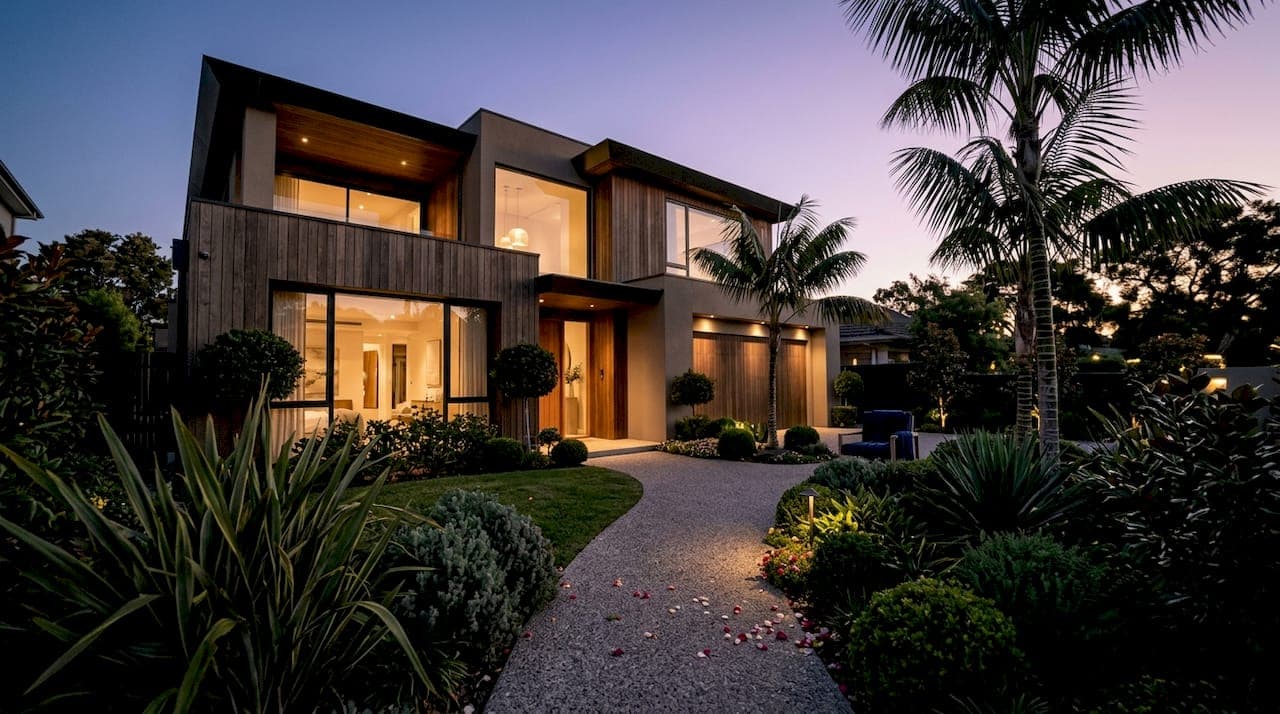
Luxury real estate is defined as residential property that occupies the top price percentiles of its regional or national market, distinguished further by exceptional location, architectural integrity, privacy, and amenities that transcend the ordinary. The definition of luxury real estate is not anchored to a single fixed price point. Instead, it reflects a percentile-based standard that shifts with local market conditions, buyer expectations, and the qualitative character of the property itself. Understanding this distinction is the first step toward navigating a market where million-dollar listings now represent a measurably larger share of American residential inventory than at any prior point in modern history.
What is luxury real estate defined by in the US market?
Luxury real estate in the United States is quantified primarily through price percentiles rather than arbitrary dollar thresholds. The national median home price stands at approximately $430,000. Against that baseline, entry-level luxury begins at the 90th percentile, which corresponds to roughly $1.28 million, placing it at nearly three times the national median.
This percentile methodology matters because it keeps the definition honest. A fixed threshold of, say, $1 million would have captured a very different slice of the market a decade ago than it does today. The entry-level luxury threshold rose over 60% from $796,922 in july 2016 to $1.3 million by september 2025. That rate of appreciation outpaced the broader housing market and signals how demand at the top of the market has compressed supply and driven prices upward with sustained force.
The table below summarizes the three primary national luxury tiers and their corresponding percentile benchmarks.
| Tier | Price Percentile | Approximate Threshold |
|---|---|---|
| Entry-level luxury | 90th percentile | ~$1.28 million |
| High-end luxury | 95th percentile | ~$2.0 million |
| Ultra-luxury | 99th percentile | ~$5.57 million |
Million-dollar listings now compose 13.8% of active US residential inventory, up from roughly 9% before the pandemic. That growth reflects both price appreciation and a structural shift in where wealth concentrates within the housing market.
Pro Tip: When evaluating a property's luxury status, always compare its price to the local median, not the national figure. A $1.5 million home in Manhattan occupies a very different percentile than the same price in a mid-sized Midwestern city.
What qualitative characteristics distinguish luxury properties beyond price?
Price percentiles establish the entry point, but they do not fully explain what makes real estate luxury in the eyes of a discerning buyer. The defining qualitative characteristics of luxury property are architectural excellence, prime location, privacy, and amenity depth, and these factors carry increasing weight as the market matures.

Luxury definitions are shifting from scale to architectural integrity, intentional design, and privacy. A sprawling home with generic finishes no longer qualifies as luxury simply because of its square footage. Buyers at this level expect materials and craftsmanship that reflect uncompromising standards: hand-laid stone, bespoke millwork, and structural design conceived by architects of recognized distinction.
Location remains the most durable luxury marker. Properties in prime neighborhoods, whether a guarded enclave in the Nevada desert or a waterfront parcel in coastal California, command premiums that no interior renovation can replicate. Proximity to cultural institutions, private schools, and exclusive social infrastructure amplifies this effect considerably.
The hallmark amenities of luxury properties in 2026 include the following:
- Integrated smart home systems that manage climate, security, and lighting through a single interface
- Private wellness facilities such as spa suites, cold plunge pools, and dedicated fitness pavilions
- Wine cellars, home theaters, and chef-caliber kitchens with professional-grade appliances
- Concierge-ready infrastructure, including staff quarters and service entrances designed for discretion
- Curated outdoor environments with resort-quality pools, fire features, and landscaped privacy screens
Privacy is now de rigueur at the upper tiers of the market. Buyers at the $2 million threshold and above routinely prioritize gated access, mature landscaping that shields sight lines, and floor plans that separate guest and owner quarters with deliberate intention.
Pro Tip: Buyers entering the luxury market for the first time often prioritize amenities over location. Experienced luxury buyers consistently reverse that priority. Location appreciates; amenities can be added or updated.
How do luxury real estate tiers differ and what defines ultra-luxury?
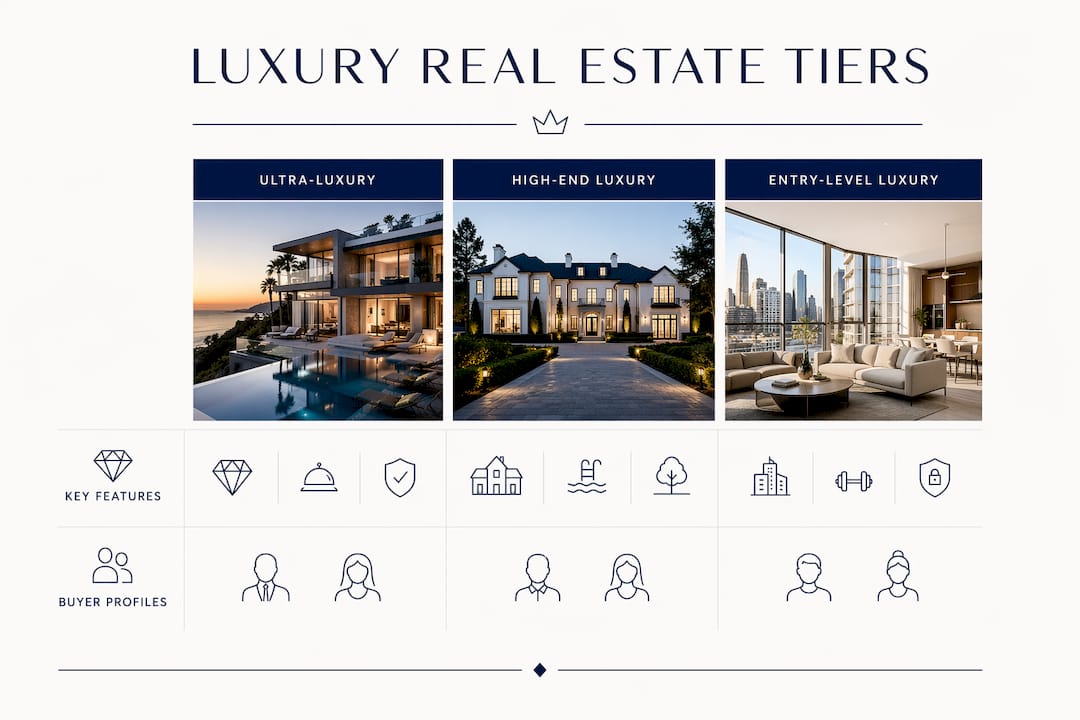
The luxury market is not a monolith. It operates across at least three distinct tiers, each with its own buyer profile, valuation logic, and cultural weight. Understanding the difference between entry-level luxury and ultra-luxury is as consequential as understanding the difference between luxury and the broader residential market.
Entry-level luxury, priced near the 90th percentile at approximately $1.28 million, attracts buyers who have achieved significant financial success and seek properties that reflect that achievement. These homes offer superior finishes and desirable locations, but they remain accessible through conventional financing and are priced within reach of a growing professional class.
High-end luxury, at the 95th percentile near $2.0 million, narrows the field considerably. These properties typically occupy premier addresses, feature architect-designed interiors, and include amenity packages that rival boutique hotel offerings. The buyer pool is smaller, and the holding periods tend to be longer.
Ultra-luxury real estate is defined by price, scarcity, global positioning, and project narrative rather than traditional valuation metrics. At the 99th percentile, beginning near $5.57 million, price per square foot becomes a secondary consideration. What matters is the irreplaceable quality of the asset: its provenance, its view, its cultural significance, and the story it tells about its owner.
| Tier | Price Range | Key Differentiators |
|---|---|---|
| Entry-level luxury | ~$1.28M–$2.0M | Superior finishes, desirable zip codes, conventional financing possible |
| High-end luxury | ~$2.0M–$5.57M | Architect-designed interiors, premier addresses, limited buyer pool |
| Ultra-luxury | $5.57M and above | Scarcity, global cachet, off-market sales, narrative-driven valuation |
Ultra-luxury properties often trade off-market within trusted brokerage networks to protect seller privacy and maintain exclusivity. Invitation-only private sales are not an anomaly at this tier. They are the expected standard. This practice means that the most significant properties in any given market rarely appear on public listing platforms, making access to the right professional network a genuine competitive advantage.
How do regional market differences affect the definition of luxury real estate?
Luxury is a relative concept, and its definition changes materially depending on where a property sits within its local market. Luxury thresholds can range from 2 to 17 times the local median home price depending on the market, a spread that illustrates just how misleading a national benchmark can be when applied to a specific geography.
Seven distinct levels of luxury exist across US markets, ranging from regional markets where luxury begins below $1 million to elite enclaves where the floor sits well above $5 million. This segmentation reflects the profound diversity of American real estate and the impossibility of applying a single national definition with precision.
The practical implications for buyers and investors are significant:
- A $900,000 property in a secondary Sunbelt market may occupy the 90th local percentile and qualify as entry-level luxury by every meaningful measure.
- The same $900,000 in Beverly Hills or Manhattan would not register as luxury at all, falling well below the local threshold.
- Markets with limited supply and high barriers to entry, such as exclusive resort communities or coastal enclaves, often operate outside typical data ranges entirely.
- Investors targeting appreciation should identify markets where the luxury floor is rising fastest relative to the local median, as that spread signals compressed supply and sustained demand.
- Buyers relocating across regions must recalibrate their expectations entirely, since luxury real estate meaning shifts with every market boundary.
Las Vegas presents a compelling case study in regional luxury dynamics. The market has attracted significant wealth migration from California and other high-tax states, compressing supply at the top of the market and pushing luxury thresholds upward at a rate that has surprised even seasoned observers. Properties that would have qualified as high-end luxury five years ago now represent entry-level positioning in the most desirable neighborhoods.
Key Takeaways
Luxury real estate is defined by price percentiles relative to local medians, not by a fixed national dollar figure, and qualitative factors such as design, privacy, and location carry equal weight at the upper tiers.
| Point | Details |
|---|---|
| Percentile-based definition | Entry-level luxury begins at the 90th percentile, approximately $1.28 million nationally. |
| Rising thresholds | The luxury entry price rose over 60% between 2016 and 2025, outpacing the broader market. |
| Qualitative factors matter | Architectural integrity, prime location, and privacy define luxury as much as price does. |
| Ultra-luxury trades privately | Properties above $5.57 million often sell off-market through exclusive brokerage networks. |
| Regional relativity | Luxury thresholds range from 2 to 17 times the local median, depending on the market. |
What I have learned about luxury real estate after years in this market
The most persistent misconception I encounter is that luxury is simply a price category. Buyers arrive with a budget and assume that spending enough money guarantees a luxury experience. It does not. I have toured properties priced well above the 95th percentile that felt neither exclusive nor refined, because the developer prioritized scale over intention. Square footage without design coherence is not luxury. It is just space.
What I have come to understand is that the buyers who navigate this market most successfully are the ones who treat qualitative criteria with the same rigor they apply to price. They ask about the architect. They evaluate the sight lines. They consider what the neighborhood will look like in ten years, not just today. These are the questions that separate a sound luxury acquisition from an expensive mistake.
The shift toward privacy as a primary luxury marker is real and accelerating. Buyers at every tier above $2 million are increasingly asking about off-market access, not because they distrust public listings, but because they understand that the most exceptional properties rarely appear on them. This is where professional relationships become the actual product. The right advisor does not just show you what is listed. The right advisor shows you what is not.
Las Vegas is a market I find genuinely underappreciated by buyers who have not spent time here. The combination of no state income tax, world-class infrastructure, and a rapidly maturing luxury residential sector creates conditions that are rare in American real estate. The buyers who recognized this five years ago are sitting on significant appreciation. The buyers who recognize it now are still early.
— Yelena
Yhluxrealestate and the Las Vegas luxury market
Yhluxrealestate, led by Yelena Horton and backed by Sotheby's International Realty's global network, specializes in the Las Vegas luxury market with a particular focus on off-market properties that never reach public platforms.
For buyers relocating from out of state, Yhluxrealestate offers a dedicated relocation concierge that handles the logistical and lifestyle dimensions of a move, not just the transaction. For investors, the combination of local market depth and global network access means exposure to opportunities that most buyers simply never see. Whether you are seeking Las Vegas luxury listings at the entry-level tier or pursuing an ultra-luxury acquisition that demands absolute discretion, Yhluxrealestate brings the expertise and access the market requires.
FAQ
What is the minimum price for luxury real estate in the US?
The national entry-level luxury threshold sits at approximately $1.28 million, representing the 90th price percentile. This figure varies significantly by local market and has risen over 60% since 2016.
What does ultra-luxury real estate mean?
Ultra-luxury real estate refers to properties at or above the 99th price percentile, currently near $5.57 million nationally. These properties are valued for scarcity, global positioning, and cultural significance rather than price per square foot alone.
What is a luxury property threshold in regional markets?
Luxury thresholds range from 2 to 17 times the local median home price depending on the market. In some secondary markets, luxury begins below $1 million; in elite coastal enclaves, the floor can exceed $5 million.
How is the definition of luxury real estate changing?
Luxury real estate meaning is shifting away from pure size and price toward architectural integrity, intentional design, and privacy. Expensive properties without these qualitative markers no longer qualify as luxury in the eyes of sophisticated buyers.
Why do ultra-luxury properties sell off-market?
Ultra-luxury homes bypass public listings to protect seller privacy and maintain exclusivity. Sales at this tier typically occur through invitation-only networks within trusted brokerages, ensuring discretion for both parties.