
Luxury property marketing is defined as a curated, multi-channel discipline that uses storytelling, cinematic visuals, AI personalization, and selective channel distribution to attract high-net-worth buyers to premium real estate. The types of luxury property marketing strategies available in 2026 span from immersive virtual reality tours to invitation-only private events, each engineered to signal exclusivity rather than volume. 73% of luxury properties remain unsold without a modern, strategic approach. That figure alone defines the stakes for every real estate professional working above the $3 million threshold.
1. What are the top 10 types of luxury property marketing strategies in 2026?
The ten strategies below represent the most effective approaches in luxury real estate marketing today. Each one serves a distinct function within a well-constructed marketing plan.
1. AI-driven hyper-personalization
AI hyper-personalization is the practice of using machine learning to match individual buyer preferences with property features, pricing signals, and lifestyle content in real time. Platforms now analyze browsing behavior, social media activity, and prior search patterns to serve tailored property recommendations before a buyer ever contacts an agent. This approach shortens the discovery phase and increases lead quality significantly. For luxury real estate professionals, it means fewer unqualified inquiries and more conversations with genuinely motivated buyers.
2. Short-form video and lifestyle storytelling
Short-form video on Instagram Reels and TikTok is now a primary channel for conveying luxury lifestyle to younger affluent buyers. The critical distinction is editorial quality: these videos must feel cinematic and aspirational, not promotional. A 60-second reel showing a sunrise over a Las Vegas mountain view, a chef's kitchen at golden hour, or a private pool at dusk communicates far more than a feature list ever could. Influencer collaborations amplify reach while preserving the refined tone that luxury buyers expect.
3. Immersive virtual reality and 3D tours
Virtual reality tours allow international and out-of-state buyers to experience a property's spatial qualities without traveling. This matters enormously in markets like Las Vegas, where relocation buyers from California, New York, and Texas make purchase decisions remotely. Matterport and similar platforms produce photorealistic 3D walkthroughs that replicate the physical experience of moving through a home. Properties with immersive virtual tours consistently attract more qualified remote inquiries than those with static photography alone.
4. Professional photography and cinematic video production
High-quality photography is the non-negotiable foundation of every effective luxury listing. Architectural photography shot by specialists, not generalists, captures the interplay of light, volume, and materiality that defines a premium property. Cinematic video production extends this further, using drone footage, stabilized interior movement, and color grading to produce content that functions as a short film. Buyers form emotional impressions within seconds of viewing a listing; the quality of that first image either opens or closes the conversation.
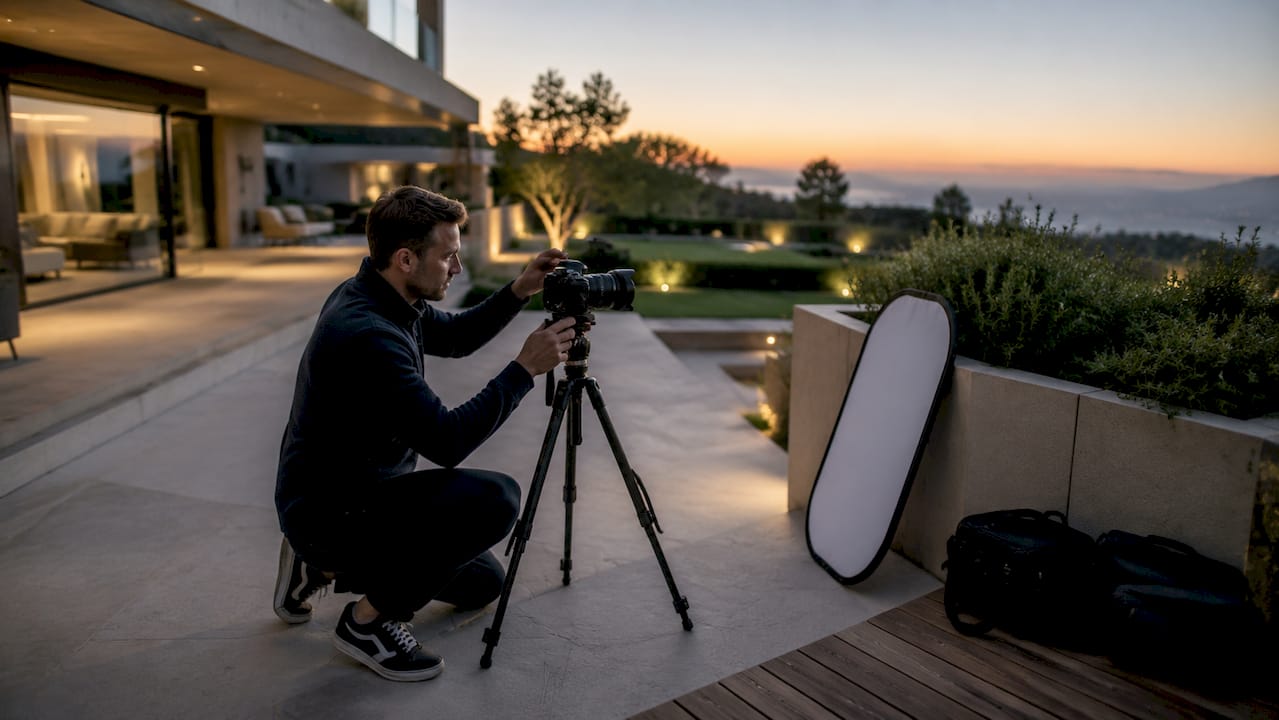
Pro Tip: Commission a dedicated twilight photography session for every luxury listing. The warm interior light against a darkening sky creates a sense of warmth and arrival that daytime photography rarely achieves.
5. Lifestyle storytelling and narrative positioning
Luxury marketing sells meaning and lifestyle, not square footage and appliance brands. The most effective luxury listing techniques build a narrative around the life a buyer will inhabit: the morning routine, the entertaining possibilities, the neighborhood culture, the investment legacy. This narrative must be constructed before any creative content is produced. Agents who understand their buyer's motivations first, and then commission photography and copy, consistently outperform those who lead with features.
6. Exclusive, invitation-only events
Private broker previews, curated open houses, and invitation-only evening events create a sense of privileged access that mass marketing cannot replicate. These events allow prospective buyers to experience a property's atmosphere, its acoustics, its light at a specific hour, and its social potential in a way no digital medium can fully convey. They also build trust: a buyer who has shared a glass of wine in a property's great room has already begun to imagine ownership. For ultra-high-net-worth buyers, the experience of exclusivity is itself a signal of the property's caliber.
7. Strategic social media channel selection
Instagram functions as a luxury magazine for property marketing, prioritizing exquisite architectural and atmospheric photography over listing catalogs. LinkedIn serves professional and institutional buyers through expert market analysis and investment-grade content rather than property listings. The principle underlying both is channel discipline: selective use of 3–5 platforms with impeccable quality signals exclusivity, while mass dissemination dilutes brand prestige. Choosing the wrong channel is as damaging as choosing no channel at all.
8. Targeted digital advertising with precision audience segmentation
Google Ads with geofencing and negative keywords increase precision in reaching high-net-worth leads at the moment of active search. Answer Engine Optimization, or AEO, is now equally critical as AI-powered search tools like Perplexity and ChatGPT become primary discovery channels for affluent buyers researching markets. Digital advertising in luxury real estate is not about volume; it is about placing the right property in front of the right buyer at the exact moment of intent. Budget efficiency follows naturally from that precision.
9. Strategic partnerships and influencer collaborations
Partnerships with luxury lifestyle brands, private aviation companies, yacht brokers, and high-end interior designers create cross-audience exposure that paid advertising cannot buy. A collaboration between a Las Vegas luxury listing and a recognized interior design firm, for example, reaches an audience that is already self-selected for affluence and aesthetic discernment. Influencer collaborations work on the same principle, provided the influencer's audience genuinely aligns with the property's buyer profile. Reach without relevance produces noise, not leads.
10. Luxury print media and curated offline experiences
Print media retains a specific authority in luxury marketing that digital channels have not displaced. Publications such as Robb Report, Architectural Digest, and Sotheby's International Realty's proprietary print catalog reach buyers who associate physical, tactile media with quality and permanence. Curated offline experiences, including private art exhibitions, wine tastings, and architectural tours hosted within a property, extend this principle into three dimensions. These tactics are most effective for properties above $10 million, where the buyer's decision timeline is longer and the emotional investment in the acquisition is correspondingly deeper.
How do these luxury marketing strategies compare in effectiveness?
The table below summarizes the core trade-offs across the primary high-end property promotion strategies. Real estate professionals should use this as a starting framework, not a fixed ranking, since effectiveness varies by property type, price point, and buyer geography.
| Strategy | Reach | Lead quality | Cost | Best for |
|---|---|---|---|---|
| AI hyper-personalization | High | Very high | Medium | All luxury tiers |
| Short-form video | Very high | Medium | Low to medium | Under-$5M, younger buyers |
| Virtual reality tours | Medium | High | Medium | Remote and international buyers |
| Professional photography | Medium | High | Medium | All listings, non-negotiable |
| Lifestyle storytelling | Medium | Very high | Low | Brand building, all tiers |
| Invitation-only events | Low | Very high | High | Ultra-high-net-worth buyers |
| Social media (Instagram, LinkedIn) | High | Medium to high | Low | Brand authority, ongoing presence |
| Targeted digital advertising | High | High | Medium to high | Active search buyers |
| Partnerships and influencers | Medium | High | Variable | Lifestyle-aligned properties |
| Luxury print media | Low | High | High | $10M+ properties, global buyers |
The clearest pattern in this comparison is that the highest lead quality consistently comes from strategies that prioritize selectivity and depth over volume. Invitation-only events and AI personalization both score at the top for lead quality despite their very different cost profiles. Digital advertising and social media offer the best balance of reach and targeting precision for most mid-tier luxury listings.
What situational factors should guide your luxury marketing mix?
The right premium property advertising strategy depends on three primary variables: the property's price point, the likely buyer's geography, and the available marketing timeline.
For properties priced between $3 million and $7 million, a combination of professional photography, Instagram-focused social media, targeted Google Ads, and short-form video typically produces the most efficient results. This tier attracts a broad range of affluent buyers, many of whom are active on digital platforms and responsive to lifestyle content. The Alys Beach Gulf-front home that sold for $28 million after six months on market, at 89.6% of its $31.25 million asking price, illustrates that even exceptional properties require patience and a sustained marketing effort. Six months is a realistic runway for ultra-luxury listings, and the marketing plan must be built to sustain engagement across that entire period.
For properties above $10 million, the marketing mix shifts toward private events, luxury print, strategic partnerships, and direct outreach through global broker networks. The Highland Park lakefront property that sold for $6.5 million against an $8.75 million asking price, representing 74% of original list price, demonstrates what happens when pricing and marketing alignment fail. The lesson is not that the property was unmarketable; it is that misaligned positioning erodes value over time.
Pro Tip: For niche or architecturally significant properties, commission a dedicated market report or buyer guide before launching the listing. True luxury authority is built through in-depth market intelligence, not advertising volume.
Luxury development marketing that begins before construction, using teaser campaigns and private waiting lists, consistently validates demand and builds anticipation more effectively than post-completion launches. This pre-launch discipline applies equally to resale properties: the marketing narrative should be fully developed before the first photograph is taken.
How storytelling and brand positioning define luxury property appeal
Successful luxury agents connect to affluent client motivations before producing any creative content. The narrative must answer a specific question: what does ownership of this property make possible in a buyer's life? That question is architectural, social, and aspirational all at once.
Brand positioning in luxury real estate is the cumulative impression an agent or brokerage creates across every touchpoint, from the quality of a listing photograph to the language of a market report to the caliber of an event invitation. Agents who publish in-depth market analyses, contribute to editorial publications, and maintain a consistent visual identity across Instagram and LinkedIn build the kind of authority that attracts high-net-worth buyers organically. The most common pitfall is inconsistency: a single poorly produced listing or an off-brand social media post can undermine months of careful positioning.
The discipline of selective channel use is inseparable from storytelling. A narrative that appears everywhere loses its sense of privilege. The most effective luxury marketing plans distribute their story through a small number of precisely chosen channels, each one reinforcing the property's identity rather than simply broadcasting its existence.
Key takeaways
The most effective luxury property marketing strategies combine selective channel discipline, cinematic visual content, and buyer-specific storytelling to attract high-net-worth buyers and protect asking price integrity.
| Point | Details |
|---|---|
| Channel discipline is non-negotiable | Use 3–5 curated platforms; mass dissemination dilutes luxury brand prestige. |
| Storytelling precedes creative production | Define buyer motivations and lifestyle narrative before commissioning photography or video. |
| Lead quality outranks reach | Invitation-only events and AI personalization produce the highest-quality buyer inquiries. |
| Timing requires a sustained plan | Ultra-luxury listings often require six months or more; marketing must sustain engagement throughout. |
| Pricing and marketing must align | Misaligned positioning erodes value, as demonstrated by properties selling well below asking price. |
What I've learned about luxury marketing that most guides won't tell you
The conversation about luxury property marketing tends to focus on tools and channels. After years of working with high-net-worth buyers and sellers in Las Vegas, I've come to believe that the real differentiator is restraint.
The agents who achieve the strongest results are not the ones using the most platforms or producing the most content. They are the ones who have the discipline to say no to channels that don't serve their property's specific narrative. A $15 million estate in Summerlin does not belong on every social media platform. It belongs in three or four places where its ideal buyer already lives, curated with the same care as the property itself.
The rise of AI personalization is genuinely significant, and I think it will reshape how buyers discover properties over the next several years. But AI is a delivery mechanism, not a story. The agents who will benefit most from these tools are those who have already done the harder work of understanding their buyer's psychology and constructing a narrative worth delivering.
The buyer psychology shift I observe most clearly in 2026 is a growing skepticism toward anything that feels mass-produced. Affluent buyers are more attuned than ever to the difference between a property that has been thoughtfully presented and one that has simply been advertised. That distinction is where the real work of luxury marketing lives.
— Yelena
How Yhluxrealestate approaches luxury property marketing in Las Vegas
Yhluxrealestate brings the full spectrum of these strategies to every listing and buyer engagement in the Las Vegas luxury market. Yelena Horton's approach integrates cinematic visual production, AI-informed buyer targeting, and exclusive off-market access through Sotheby's International Realty's global network, ensuring that each property reaches precisely the buyers most likely to recognize its value.

For sellers, Yhluxrealestate constructs a bespoke luxury marketing plan calibrated to the property's price point, architectural character, and target buyer profile. For buyers, the relocation concierge service and access to off-market inventory provide a competitive advantage that standard listing searches cannot replicate. If you are preparing to list a luxury property or searching for your next acquisition in Las Vegas, Yhluxrealestate delivers the strategic depth and market authority that premium real estate demands.
FAQ
What are the most effective luxury property marketing strategies?
AI hyper-personalization, cinematic video production, and invitation-only events consistently produce the highest-quality buyer leads for luxury properties. The most effective plans combine 3–5 precisely chosen channels rather than distributing content broadly.
How long does it typically take to sell a luxury home?
Ultra-luxury properties routinely require six months or more on market. The Alys Beach Gulf-front home sold after six months at 89.6% of its $31.25 million asking price, illustrating that patience and sustained marketing are both necessary at the highest price points.
Why is storytelling critical in luxury real estate marketing?
Luxury buyers purchase meaning and lifestyle, not features. Storytelling that connects a property to a buyer's aspirations and values creates the emotional resonance that motivates a decision at the highest price points.
How does social media fit into a luxury property marketing plan?
Instagram functions as a luxury editorial channel, best suited to architectural and atmospheric photography. LinkedIn serves professional and institutional buyers through market analysis content. Each platform requires a distinct content strategy aligned with its audience's expectations.
What is the role of digital advertising in luxury real estate?
Targeted Google Ads with geofencing and negative keywords place luxury listings in front of high-net-worth buyers at the moment of active search. As AI-powered search tools become primary discovery channels, Answer Engine Optimization is becoming equally important for luxury property visibility.