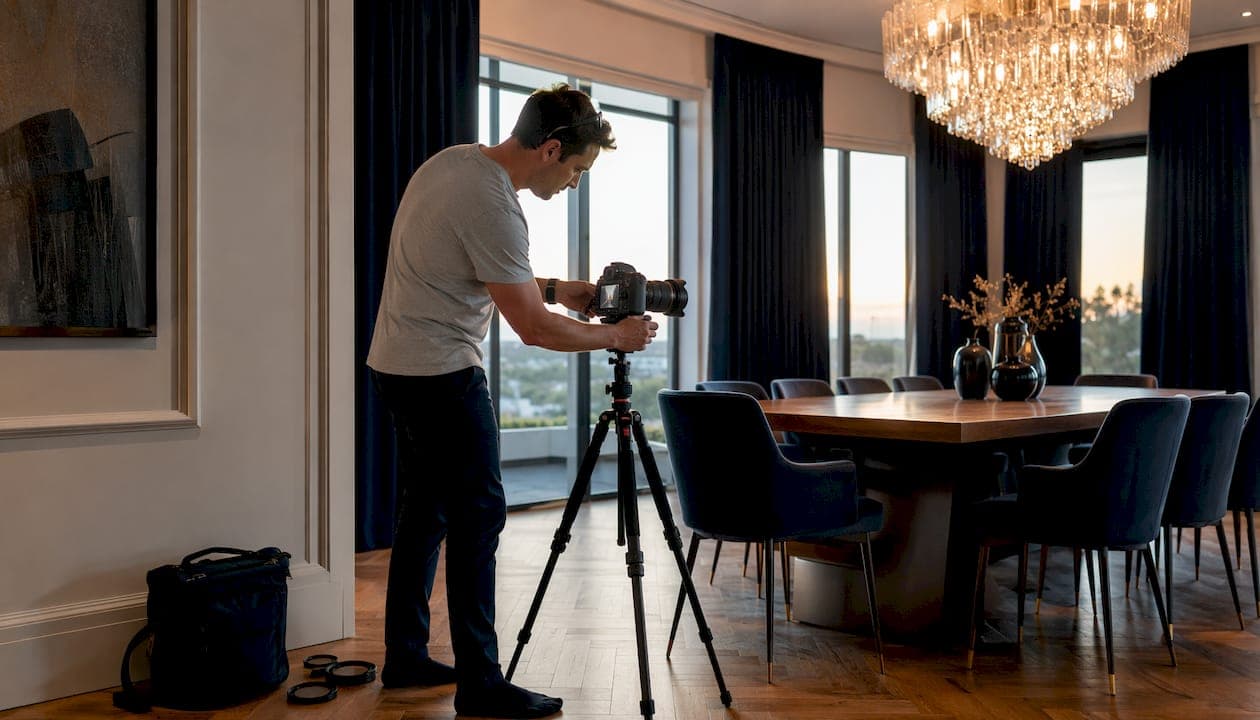
Book a specialist luxury photographer, confirm your shot list and lighting plan, and secure both a twilight window and a daylight backup before any other preparation begins. These three actions determine whether your gallery commands the attention a premium listing deserves. NAR reports that nearly all recent buyers used the internet in their home search and rated listing photos as the single most useful feature on every site they visited — meaning the camera is, in every practical sense, the first showing. A complete luxury listing photography checklist addresses not only what to shoot, but how to prepare the property, coordinate light sources, brief the photographer, and govern post-production so every image enhances truth rather than fabricating it.
Table of Contents
- Your luxury listing photography checklist: the day-before sweep
- What does a complete shot list for luxury homes look like?
- How do you coordinate lighting for a flawless luxury shoot?
- What gear and settings define a professional luxury shoot?
- Staging and styling that resonates with high-net-worth buyers
- What post-production rules protect buyer trust?
- What does a luxury shoot cost, and how should you schedule it?
- How do you vet and brief a luxury listing photographer?
- Drone and aerial photography: legal requirements you must know
- Key Takeaways
- Why premium photography is the first negotiation a seller wins
- Yhluxrealestate coordinates your entire shoot from staging to delivery
- Useful sources
Your luxury listing photography checklist: the day-before sweep
The day before a shoot, one focused hour of preparation eliminates the most common visual liabilities that erode perceived value in high-resolution imagery. Walk the property the way the camera will see it — not the way a homeowner moves through it — because rust stains, glass streaks, and oxidation on metalwork that pass unnoticed in daily life become conspicuous in a 50-megapixel frame.
- Declutter and depersonalize: Remove personal photographs, daily-use items (soap dispensers, phone chargers, mail), and any object that anchors the space to a specific resident rather than an aspirational lifestyle.
- Match all bulbs to 3000–4000K: Replace mismatched incandescent or cool-daylight bulbs so every room reads with consistent warmth; mismatched color temperatures are among the leading causes of unusable images on arrival.
- Exterior discipline: Mow and edge, pressure-wash driveways and pool decks, remove vehicles and refuse bins, and polish all glass surfaces including windows and pool fencing.
- Confirm staging placement: Verify that furniture, art, and accent pieces are positioned as agreed with the stager; move small rugs that read as busy at wide angles.
- Drone flight permission: Confirm FAA airspace authorization and any HOA overflight restrictions at least 24 hours before the shoot.
- Schedule twilight and backup: Lock the blue-hour window (roughly 15–30 minutes after sunset) and reserve a backup date with landscaping and pool crews.
Pro Tip: Polish every reflective surface — mirrors, cooktops, polished stone countertops — immediately before the photographer arrives, not the night before. Fingerprints reappear overnight and register sharply under studio strobes.
What does a complete shot list for luxury homes look like?
Luxury listings typically require a high number of delivered images, supplemented by drone aerials, a video walkthrough, and a Matterport 3D tour. The gallery must tell an intentional story, opening with the hero and moving through the property with the deliberate pacing of an architectural editorial. Sequence matters as much as coverage; top agents order the MLS gallery deliberately to guide buyer attention from aspiration to confirmation.
- Twilight hero exterior — the blue-hour facade with all landscape and interior lights illuminated; this single image drives clicks and saves above any other asset.
- Main living area — two wide angles (doorway and corner) plus one lifestyle vignette showing flow toward the kitchen or outdoor space.
- Kitchen — four to six frames covering the full layout, island, appliances, and one detail of custom hardware or stone.
- Primary suite and bath — two wides with symmetrical composition; one vertical detail of fixtures, millwork, or custom tile.
- Standout amenities — pool and spa, wine room, home theater, gym, and outdoor kitchen each receive two to four dedicated frames; amenity photography directly influences resale value perceptions among discerning buyers.
- Aerial and drone perspectives — property footprint, site context, and any water or mountain views; the role of aerial photography in conveying scale and setting is irreplaceable at this price tier.
- Secondary daylight exteriors — rear elevation, motor court, formal gardens, and guest structures.
- Detail and lifestyle vignettes — custom tile, designer hardware, art installations, and smart-home panels; these are hero shots, not afterthoughts.
- Neighborhood and amenities context — golf course, waterfront access, or city skyline where relevant.
If MLS photo limits apply, prioritize in this order: twilight hero, main living, kitchen, primary suite, top amenity, one aerial.
How do you coordinate lighting for a flawless luxury shoot?
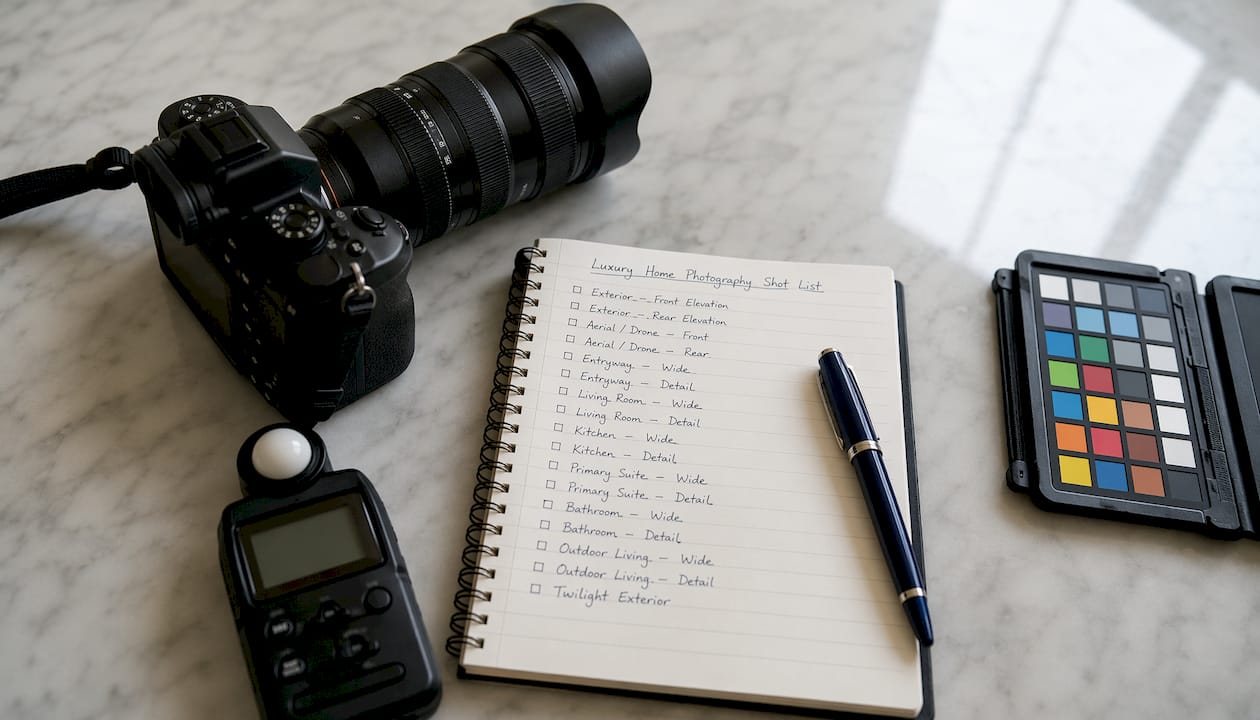
Lighting coordination is frequently overlooked by agents, yet it is one of the single greatest determinants of whether images are usable when the photographer arrives. The governing principle is simple: every light source in the frame must share a compatible color temperature, or the camera's sensor cannot reconcile the difference without sacrificing either shadow detail or highlight accuracy.
Set all interior fixtures to the 3000–4000K range and label any lamp that must remain off during the shoot (a single cool-daylight recessed can in a warm-toned kitchen will cast a visible green-blue shift). Program smart-home lighting scenes in advance so the photographer can recall them with one command rather than adjusting individual fixtures mid-shoot. Test landscape lighting, pool lighting, and pathway timers the evening before to confirm they activate at the correct time relative to the twilight window.
Pro Tip: Schedule any bulb swaps or electrician visits 48–72 hours before the shoot, not the morning of. Newly installed bulbs sometimes flicker under camera strobes until they stabilize, and a rushed swap the day of the shoot leaves no margin for correction.
What gear and settings define a professional luxury shoot?
Full-frame camera bodies, a sturdy tripod, and tilt-shift or perspective-correction lenses are the baseline for architectural work that reads as authoritative at the $2M+ tier. Tripod use for every interior shot prevents the inconsistent framing and softened detail that hand-held bracketed exposures produce — and that no amount of post-production reliably corrects.
- Bodies: Full-frame primary plus a backup body; no exceptions on a multi-hour luxury shoot.
- Lenses: 16–35mm and 24–70mm for interiors; 24mm tilt-shift for architectural correction; 35–50mm for detail vignettes.
- Stabilization: Gitzo-class carbon tripod with a leveling ball head; bubble level on every wide interior frame.
- Lighting: Two to four Profoto or Godox-class strobes for interior fill; continuous LEDs for video and detail work.
- Drone: FAA Part 107-certified hardware for aerials; backup batteries for extended estate shoots.
- Camera settings: f/8–f/11 for interiors, ISO 100–400, bracket five to seven exposures for high-contrast scenes; shoot at approximately 4–5 feet height for wide rooms; capture three to five detail frames per key space.
| Metric | Standard listing | Luxury listing ($2M+) |
|---|---|---|
| Delivered photo count | 20–30 | 40–60 |
| Time on site | 1–3 hours | 6–9 hours |
| Editing turnaround | 1–2 days | several days required |
| Typical photography budget | $300–$600 | a premium budget range+ |
Staging and styling that resonates with high-net-worth buyers
The governing principle of luxury home photo staging is this: remove every trace of daily function and compose each room as a lifestyle aspiration, not a cleaned house. Buyers at this tier are purchasing an identity as much as a structure, and the camera must reflect that.
- Remove: Personal photographs, small appliances, toiletries, pet items, and any object that reads as domestic routine rather than curated living.
- Keep: One or two high-quality accessories per surface; fresh neutral linens; purposeful art or sculptural objects that create focal points without competing with architecture.
- Bathrooms: Fresh towels folded with precision, all bottles removed, toilet lids down, fixtures polished to a mirror finish.
- Built-ins: Simplify shelving to a sparse, editorial arrangement; remove paperbacks and mismatched objects.
- Market-specific nuance: For desert-modern properties, emphasize tonal restraint and textural contrast; for indoor-outdoor flow spaces, stage the transition zone between living areas and the pool or terrace as a single composition.
Physical staging for hero spaces can run $5,000–$15,000 per month, but it remains the preferred approach for primary living areas when budget allows. AI virtual staging serves vacant secondary rooms well and offers a lower-cost path to showing multiple design directions.
Pro Tip: Remove distracting items physically before the shoot whenever possible. Reserve AI-assisted digital decluttering for objects that cannot be moved — a built-in appliance, a structural column — rather than as a substitute for proper preparation.
What post-production rules protect buyer trust?
The 2026 consensus among luxury-market photographers is clear: AI accelerates routine corrections, but human photographers retain control of mood, composition, and the ethical boundaries of editing. Over-editing remains a persistent pitfall; aggressive HDR processing and dramatic color shifts signal fabrication to sophisticated buyers and erode the trust that premium listings require.
Permitted edits: Exposure blending, color grading, minor dust and spot removal, sky replacement with natural equivalents, and day-to-dusk conversion with MLS disclosure.
Forbidden edits: Adding rooms or square footage, altering views, changing fixture finishes, removing structural elements, or concealing material defects.
Before the photographer wraps on-site, require a raw-to-final test frame to confirm the editing direction and avoid costly reshoots. When virtual staging or significant digital renovation is used, include a caption or MLS disclosure noting the enhancement — many markets require it, and transparency reinforces rather than undermines buyer confidence.
What does a luxury shoot cost, and how should you schedule it?
Luxury shoots demand more time and higher budgets than standard listings; planning for a multi-hour shoot day and multi-day post-production is not a luxury, it is a prerequisite for a credible marketing launch.
| Stage | Timing |
|---|---|
| Pre-shoot inspection and staging confirmation | 48–72 hours before shoot |
| Bulb swaps and lighting programming | 48 hours before shoot |
| Drone airspace authorization | 24–48 hours before shoot |
| Shoot day (interiors, exteriors, amenities) | 6–9 hours on site |
| Twilight slot | 15–30 minutes post-sunset |
| Editing and post-production | 3–5 business days |
| Asset delivery (full-res JPEGs, web-optimized, 4K video, 3D tour) | Day 5–7 post-shoot |
For a $2M+ listing, budget $1,500–$5,000+ for photography; add $500–$1,500 for drone aerials, $300–$600 for a dedicated twilight session, and $200–$500 for AI virtual staging of secondary rooms. Always book a backup twilight date at the time of the primary booking, and include a clause for drone overflight delays in the photographer agreement.
How do you vet and brief a luxury listing photographer?
Hire photographers who present portfolio samples from comparable properties and who offer an itemized post-production policy, proof of insurance, and backup bodies as standard. Professional photography at the luxury tier is a marketing investment with measurable returns, and the brief you send before the shoot determines whether that investment is realized.
Sample brief (copy and adapt):
- Scope: 40–75 photos, drone aerials, twilight hero, 4K video walkthrough, Matterport 3D tour.
- Timeline: Shoot date, twilight window, backup date, and delivery deadline.
- On-site contacts: Agent name, homeowner contact, smart-home access code, gate code.
- Lighting notes: All fixtures set to 3000–4000K; smart-home scene labeled "Photo Mode."
- Staging notes: Stager on site until noon; specific rooms to prioritize.
- Deliverables: Full-resolution JPEGs (minimum 1920x1280), web-optimized set, 4K video, Matterport link.
Vetting questions to ask: Do you use a tilt-shift lens and tripod for every interior? What is your HDR bracketing workflow? Do you carry backup bodies? Are you FAA Part 107 certified for drone operations? Can you provide raw-to-final samples from a comparable listing?
Red flags: No backup body, refusal to bracket exposures, vague or absent post-production policy, no liability insurance, and a portfolio composed exclusively of standard residential listings.
Drone and aerial photography: legal requirements you must know
Commercial drone operations for real estate photography in the United States require FAA Part 107 certification for the pilot. Flying without it exposes the agent, the photographer, and the seller to federal fines. Before any aerial session, the pilot must verify airspace classification using the FAA's B4UFLY app or LAANC system; properties near Las Vegas McCarran International Airport (now Harry Reid International) fall within controlled airspace and require LAANC authorization, which can be obtained digitally but must be secured in advance.
Beyond federal requirements, HOA covenants and local ordinances frequently restrict drone operations over private communities. Confirm overflight permission in writing from the HOA board before scheduling aerials. For waterfront or estate properties with neighboring parcels, the drone must remain over the subject property unless neighboring owners have granted written consent. Privacy laws in Nevada and most states prohibit capturing identifiable images of individuals on private property without consent, a consideration that applies to lifestyle drone footage showing adjacent residences or guests.
Key Takeaways
A luxury listing shoot requires a specialist photographer, coordinated lighting at 3000–4000K, a twilight window with a backup date, and a post-production policy that enhances reality without fabricating it.
| Point | Details |
|---|---|
| Book a specialist early | Hire a photographer with a luxury portfolio, Part 107 certification, and backup bodies before any other preparation. |
| Coordinate lighting at 3000–4000K | Match all interior fixtures to the same color temperature and program smart-home scenes 48 hours before the shoot. |
| Secure the twilight window | Book the 15–30 minute blue-hour slot and a backup date simultaneously; twilight hero shots drive the highest click engagement. |
| Govern post-production strictly | Permit exposure blending and color grading; forbid structural alterations or view fabrication; disclose virtual staging in MLS captions. |
| Yhluxrealestate concierge coordination | Yelena Horton's team manages staging, lighting, vendor scheduling, and photographer briefing for Las Vegas luxury listings. |
Why premium photography is the first negotiation a seller wins
There is a temptation, even among experienced agents, to treat photography as the final line item — something confirmed after pricing, staging, and timing are settled. That sequencing is precisely backward. The gallery is the first impression for every buyer who will ever consider the property, and in a market where East Coast buyers evaluate Las Vegas listings entirely from a screen before committing to a flight, the photographs are not supporting material. They are the listing.
What the checklist above makes plain is that the difference between adequate and exceptional photography is almost never the camera. It is the hour of preparation the day before, the lighting coordination that most agents skip, and the discipline to brief a photographer with the same precision one would bring to a contract negotiation. AI-assisted post-production has genuinely accelerated the editing workflow in 2026, but it cannot compensate for a warm bulb left in a cool-toned kitchen or a personal photograph left on the mantle. The human decisions made before the shutter opens determine what AI can accomplish afterward.
Yhluxrealestate coordinates your entire shoot from staging to delivery
Sellers preparing a $2M+ Las Vegas listing gain a material advantage when every vendor — stager, photographer, drone pilot, and post-production editor — operates from a single coordinated brief rather than separate conversations. Yhluxrealestate manages that coordination as part of its concierge offering: pre-shoot inspection, lighting and bulb scheduling, preferred luxury photographer engagement, twilight window booking, and post-production oversight, all aligned to a single marketing launch date.

The result is a market-ready gallery delivered without the scheduling friction that costs sellers days of market time at the peak of buyer attention. To discuss shoot coordination for your Las Vegas luxury listing, contact Yelena Horton at Yhluxrealestate directly.
Useful sources
- 10 Luxury Listing Photography Tips for Florida Real Estate — Advanced lighting, composition, drone, and Matterport techniques for premium properties.
- The 2026 Listing Photo Checklist: What Top Agents Do Differently (RePhoto) — Three-stage agent checklist, MLS gallery sequencing, and over-editing warnings.
- Luxury Real Estate Photography Guide (PropertyPixel) — Shot counts, time-on-site benchmarks, twilight guidance, and budget ranges for high-end shoots.
- How to Prep Luxury for Photos in Fort Myers (Pinnacle) — Pre-shoot walkthrough protocol, lighting coordination, and maintenance inspection for luxury properties.
- Luxury Real Estate Photography: Laguna Beach (2026) — Human-led composition and AI post-production integration in the current luxury market.
- Real Estate Photography Shot List Template (PhotoFounder) — Room-by-room shot counts, MLS sequencing rules, and luxury property delivery benchmarks.
- Real Estate Photography Tips for Better Listings (Spacely AI) — NAR buyer behavior data, framing principles, and staging-to-photography workflow.
- Why Professional Photography Matters for Luxury Listings — Business case for specialist photographers, ROI evidence, and engagement metrics.