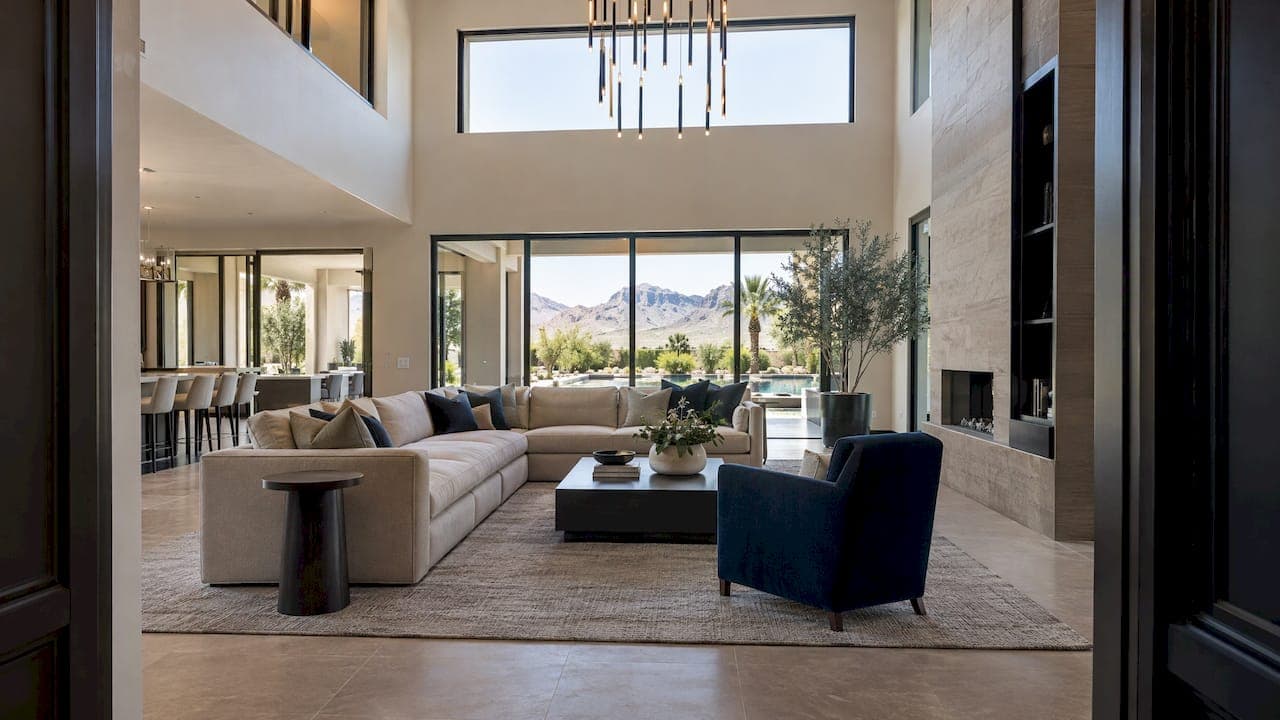
Luxury home staging in Las Vegas is the curated styling of a high-end residence, with scaled furnishings, art, textiles and light, so that buyers see a finished way of life rather than empty rooms or someone else's belongings. Done well, it begins several weeks before photography, concentrates on the living room, primary suite and kitchen, and is priced by the size and value of the home. What follows explains each of those decisions, from first walkthrough to removal, so that you can judge a staging plan on its merits.
TL;DR
- Staging helps buyers picture the home as their own: 83% of buyers' agents said it made visualization easier, according to the National Association of Realtors (NAR).
- Put the budget into the living room, the primary bedroom and the kitchen, the three spaces buyers rank highest.
- Schedule the staging consultation two to three weeks before photography, and longer for a large estate.
- Las Vegas staging fees are commonly quoted from the low thousands into the tens of thousands, scaled to the home's size and price.
- Stage for the desert: shade, indoor-outdoor flow, views and the sense of resort-like ease that draw out-of-state buyers.
Table of Contents
- What luxury staging actually involves
- Why staging matters when buyers see the home online first
- The rooms that deserve the investment
- Staging for the desert, not for a generic catalog
- The staging timeline, from consultation to installation
- What luxury staging costs in Las Vegas
- How to judge whether a plan suits your home
- Our perspective
- Work with a team that plans the whole presentation
- FAQ
- Sources
What luxury staging actually involves
Staging a residence at this level is closer to curation than to decorating. A designer walks the property in person to study its architecture, take measurements and understand your timeline and listing goals. A quote and agreement follow, then a custom design plan, delivery, installation and a final styling pass. According to one Las Vegas staging firm's published process, the engagement closes with removal once the home has sold, scheduled with appropriate notice.
The distinction that matters most at the outset is whether the home is vacant or occupied. A vacant house needs warmth and an honest demonstration of scale: where the dining table sits beneath a double-height ceiling, how a great room accommodates both conversation and a view. An occupied house is approached by editing. Strong existing pieces stay, distractions go, and curated inventory fills the gaps. The same source describes both approaches, and in our experience the occupied home is often the more delicate project, because a seller's cherished collection must be reframed rather than simply removed.
The objective is the same in each case. Buyers at this price point are not shopping for square footage; they are weighing a lifestyle, and the staging should speak to that buyer's profile, to the architecture and to the price point rather than adding furniture indiscriminately.
Why staging matters when buyers see the home online first
The first showing of a luxury listing now happens on a screen. RISMedia observes that in markets such as Las Vegas, relocation buyers from California, New York and beyond often submit offers based on digital content and virtual tours, which makes the quality of the visuals critical. The same article notes that most buyers struggle to visualize potential in a vacant property, while in an owner-occupied home, personal décor, dated furnishings, clutter or even scent can dilute the emotional impact.
The national data is consistent with that. NAR's 2025 Profile of Home Staging reports that 83% of buyers' agents said staging made it easier for buyers to visualize a property as a future home, and 31% said it made buyers more willing to walk through a home they had seen online. On price, the picture is more measured and worth stating plainly: 17% of buyers' agents reported a 1% to 5% increase in the value offered, while 41% reported no effect. NAR's press release adds that 29% of agents observed a 1% to 10% increase in the dollar value offered for staged homes, and that 30% of sellers' agents saw a slight reduction in time on market after staging, with 19% seeing a significant one.
The sensible reading is that staging is a tool for attention and confidence, with a price benefit in a meaningful share of sales. On a property valued in the millions, even a modest improvement in the offers received can be significant against the cost of staging.
The rooms that deserve the investment
Not every room carries equal weight. In the NAR report, buyers named the living room as the most important space to stage at 37%, followed by the primary bedroom at 34% and the kitchen at 23%. Sellers follow the same instinct: according to NAR, the living room is staged most often at 91%, then the primary bedroom at 83%, the dining room at 69% and the kitchen at 68%.

For a Las Vegas luxury home, we would translate that into a hierarchy of effort.
The great room and living areas
Scale is the first discipline. Furniture sized for an ordinary room appears lost beneath a twenty-foot ceiling, so seating groups, rugs and lighting must be proportioned to the volume. Staging guidance from a local firm on what makes a $2 million home sell says the styling should highlight architecture, views, great rooms, primary suites, staircases and indoor-outdoor entertaining areas, and that is a sound checklist for any estate.
The primary suite
The primary bedroom is where a buyer imagines retreat. Restrained bedding, layered textiles, quiet lighting and an uncluttered sightline to the view or the spa-like bath do more than any amount of ornament. The suite should feel like a hotel of the highest order, and yet unmistakably private.

The kitchen
At this level, the kitchen is often already exceptional, so staging is a matter of editing: clear counters, a few deliberate objects, perhaps a bowl of citrus or a tray of glassware at the island. The goal is to let the cabinetry, stone and appliances speak.
Staging for the desert, not for a generic catalog
A home in Summerlin, MacDonald Highlands or Southern Highlands is not a suburban house in another climate, and the staging should not look as though it were furnished from a national template. Design guidance on desert-smart luxury homes in Las Vegas emphasizes shade, durable materials, privacy, water-smart landscaping and functional indoor-outdoor spaces that stay comfortable through the year. Those are precisely the qualities buyers respond to when they see them presented well.
In practice, that means a few considered choices. Dress the covered patio as a true outdoor living room, with seating, a dining arrangement and soft lighting, because for many buyers it is the heart of the property. Present the pool and spa area as a composed scene rather than an afterthought. Draw back drapery to frame the mountain, golf course or skyline view, and soften glare so the room reads comfortably at the brightest hour of the day. Keep palettes in the warm neutrals, stone and muted earth tones that echo the landscape. Where the home sits within sight of the Strip, a quiet evening vignette on the terrace can translate the view into something close to art.
For buyers relocating from colder, denser places, the story is one of space, light and ease. Our guide to moving to Las Vegas as a luxury buyer explains why many of them are drawn here, and the staging should reinforce exactly that impression. Readers comparing value against coastal markets may also appreciate why Las Vegas luxury costs less than Manhattan, since staging often needs to show buyers what that extra space can become.
The staging timeline, from consultation to installation
The process runs in a clear sequence, and the calendar matters as much as the design. The sequence is: an in-person walkthrough, a quote and agreement, a design plan, delivery and installation, final styling, and removal after the sale. A local staging firm recommends scheduling the consultation two to three weeks before the target photography date, which allows for design planning, seller preparation and coordination with the photographer.
For a large estate, we advise starting earlier. Custom selections, sourcing and sizeable furniture orders can lengthen the schedule, and a home that is occupied needs time for editing and storage. A sensible order of operations looks like this:
- Meet with your listing agent to set the pricing strategy, target launch and the buyer profile you expect.
- Complete repairs, deep cleaning and landscape refreshment before the designer begins, so the staging is never working around unfinished tasks.
- Approve the design plan and the agreement, including the contract term and renewal terms.
- Install, style and walk the home with your agent before photography.
- Coordinate cleaning, photography and the MLS launch so that the home goes live looking its best.
- Arrange removal with the required notice once the property sells.
One firm's published agreement describes a 30-day initial term followed by month-to-month renewals, which illustrates why a prompt launch matters: staging is a rental of furnishings, and the clock runs while the home is on the market.
What luxury staging costs in Las Vegas
Fees reflect the size of the home, the quantity of furnishings, the length of the contract and the quality of the inventory. One Las Vegas firm's pricing overview for 2026 states that investments generally span from $2,500 to $50,000 or more, and that its own tiers rise with list price, from $1,995 for listings under $500K to $7,995 for listings over $3M. Treat these as an indication of the market rather than a quotation; every proposal depends on the property.
Four variables explain most of the difference between one proposal and another.
Occupancy. A vacant home generally needs more inventory than an occupied one, where existing pieces are retained.
Scope. Staging only the entry, great room, kitchen and primary suite is a different commitment from furnishing every bedroom, the office and the outdoor areas.
Duration. Monthly rental structures mean a longer time on market adds to the cost, which is one more argument for pricing the home correctly from the first day.
Inventory quality. Oversized sectionals, designer lighting, original art and custom pieces cost more to supply, and they are what make a multimillion-dollar home look appropriate to its price.
A useful test of a proposal is whether it explains where each dollar goes and why. A plan tailored to your architecture, price point and likely buyer is worth more than one that simply lists rooms.
How to judge whether a plan suits your home
A good staging plan answers four questions without hesitation. Does it respect the architecture, rather than competing with it? Is the furniture scaled correctly to the ceilings and room dimensions? Is it curated for the buyer who is most likely to purchase, whether that is a relocating family, a second-home buyer or an investor? And is it coordinated with photography and launch, so the work appears at the moment it matters most?
It is also worth asking how the designer will treat the outdoors, since in Las Vegas the terrace, pool and shaded lounge are part of the floor plan. Your listing agent should be involved from the first walkthrough, because pricing, staging and marketing are one strategy. If you are weighing a different property type, our seller's guide to luxury condos in Las Vegas addresses how the approach changes for high-rise living, and our note on luxury appraisals in Summerlin and MacDonald Highlands helps you understand how condition and presentation sit alongside value.
Our perspective
Staging is not decoration for its own sake; it is the final chapter of a sales strategy. In our work with Las Vegas luxury sellers, we treat presentation, pricing and exposure as a single plan, and we begin that conversation before a single piece of furniture is ordered.
Our approach is to study the home as a buyer would, then decide with you which rooms must carry the story. We bring the discipline of expert negotiation and a clear view of how buyers evaluate lifestyle and value, so that every staging decision serves the price you intend to achieve.
Because our listings are backed by the global network of Sotheby's International Realty, the finished presentation is designed to travel: in photography, in film, and in front of the out-of-state buyers who so often make their first visit through a screen. Our luxury marketing is built for that audience, and staging is the foundation on which it rests.
We would rather you spend wisely on the three or four spaces that matter than scatter a budget across every room. That is the counsel we offer to every seller who trusts us with an address.
Yelena
Work with a team that plans the whole presentation
If you are preparing to sell, we invite you to begin with a conversation about the property, its likely buyers and the moment to launch. Our seller representation and luxury marketing are designed to bring staging, photography and global syndication together, so the home reaches the right audience looking its finest.

To explore how we can help, visit YH Luxury Homes and tell us about your property. For a broader view of the current climate, our overview of Las Vegas luxury real estate market trends offers useful context before you set a price.
FAQ
Is staging worth it for a luxury home in Las Vegas?
For most sellers it is a sound investment. NAR's 2025 data shows that 83% of buyers' agents said staging helped buyers visualize the home as their own, and a share of agents reported higher offers and shorter time on market. Results vary by property, so your listing agent should help you decide how much to stage.
Which rooms should I stage first?
Begin with the living room, the primary bedroom and the kitchen, which buyers ranked as the most important in NAR's report. After that, add the dining area, the entry and the outdoor living spaces, which carry particular weight in the Las Vegas climate.
How far ahead of listing should I begin?
Schedule the consultation at least two to three weeks before photography, and earlier for a large or occupied estate that needs editing, sourcing or custom selections. Arranging cleaning, repairs and landscape refreshment before installation keeps the schedule smooth.
Can an occupied home be staged, or must it be vacant?
Both are possible. In an occupied home, strong existing pieces are kept, distractions are edited away, and curated inventory supplements what remains. The aim is a space that feels spacious, calm and ready for a new owner.
Sources
- 2025 Profile of Home Staging, National Association of Realtors
- NAR Report Reveals Home Staging Boosts Sale Prices and Reduces Time on Market
- The New First Showing Is Online, RISMedia
- Luxury Home Staging Questions Answered
- What Makes a $2M Home Sell: Luxury Staging Las Vegas
- Listing Agent Staging Timelines for Las Vegas
- How Much Does Home Staging Cost in Las Vegas in 2026?
- Desert-Smart Luxury Home Design in Las Vegas