
The fastest route to a stronger price and a shorter listing period is a written luxury marketing plan built on four pillars: professional visuals, selective staging, targeted distribution, and disciplined pricing. Before you sign with any agent, insist on that plan in writing, itemized deliverable by deliverable. Executed well, this approach tends to produce faster sales and firmer offers than a generic listing ever could.
TL;DR:
- A detailed, written marketing plan should specify photography, video standards, and distribution channels, including ownership of assets and reshoot policies.
- Effective luxury distribution targets select portals, paid social to high-net-worth individuals, broker outreach, and concierge services for out-of-state buyers, not just portal volume.
- Staged outdoor entertaining spaces and key rooms like the living room and primary bedroom typically provide the highest ROI for luxury listings in Las Vegas.
- A realistic marketing timeline allocates three phases: asset creation in the first two weeks, active promotion for six weeks, and evaluation and adjustments afterward.
- The best agents demonstrate proven results with local luxury homes, transparent reporting, and offer a customized, written marketing plan before signing any agreement.
Table of Contents
- What Belongs in a Luxury Home Marketing Las Vegas Package
- Where Should Your Luxury Listing Actually Be Advertised?
- Staging Priorities and What NAR Data Says About ROI
- What to Require in Writing Before You Sign
- How Long Should Luxury Home Marketing Take in Las Vegas?
- Choosing a Luxury Listing Agent: What to Ask
- How Yelena Horton and YH Luxury Homes Execute This Playbook
- Legal and Regulatory Considerations for Luxury Home Sales in Las Vegas
- Amenities That Actually Move Luxury Buyers in Las Vegas
- Open House Strategy for High-End Las Vegas Buyers
- Privacy and Security in Luxury Home Marketing
- Preparing a Luxury Home Beyond Staging
- Why Marketing Choices Should Follow Buyer Psychology, Not a Template
- Work With YH Luxury Homes on Your Marketing Plan
- Sources
- FAQ
What Belongs in a Luxury Home Marketing Las Vegas Package
A seller paying for luxury home marketing in Las Vegas should know exactly what "marketing" buys before a single photograph is taken. Vague promises about "premium exposure" or a "luxury package" are marketing copy, not deliverables. What follows is what a credible package actually contains, and why each piece earns its place.
Photography and video form the foundation. Buyers' agents rate photos as the single most influential marketing asset, with video and virtual tours also highly important, according to NAR's 2025 Profile of Home Staging. For a property above $2 million, that means full-resolution imagery shot in natural light, a twilight sequence that shows how the home reads after dark (critical in a market where outdoor living and pool lighting sell the lifestyle), and a cinematic walkthrough video edited for social and email distribution, not just the MLS.
Aerial footage matters more in Las Vegas than in most markets. Drone footage capturing mountain sightlines, golf course frontage, or a Strip view corridor tells buyers something a ground-level lens cannot. A Matterport or comparable 3D tour lets out-of-state buyers, a significant share of the luxury pool here, walk a property before booking a flight.
A dedicated property microsite, separate from the MLS listing, gives an agent room to tell the home's story: architect, builder, notable features, neighborhood context, and a press-quality photo gallery, a key element of effective content marketing services. It also becomes the landing page for paid social campaigns and direct email outreach, where a generic portal listing cannot.
Staging deserves its own line item. NAR's data shows the living room, primary bedroom, and kitchen are the rooms buyers' agents consider most important. In Las Vegas specifically, staged outdoor entertaining spaces often outperform staging a secondary bedroom, because indoor-outdoor living and pool views are what differentiate a $3 million listing from a $1.5 million one.
Three questions protect you on every deliverable:
- Who owns the photography and video assets after closing, you or the brokerage?
- Does the agent commit to refresh photography if the home sits unsold past a defined window (60 to 90 days is typical)?
- Are aerial and Matterport costs included in the marketing plan, or billed separately if the home doesn't sell in the first cycle?
Pro Tip: Ask to see the actual property microsite from a past luxury listing, not a demo reel. A live example shows you exactly how your home's story will be told, and whether the agent's "cinematic video" claim matches reality.
Where Should Your Luxury Listing Actually Be Advertised?
More portals is not the same as more qualified buyers. A listing can appear on a dozen national real estate sites and still miss the out-of-state executive relocating for tax reasons or the investor scouting a second home near the Strip. Distribution for a luxury property has to be built around who buys at that price point, not how many logos appear on a marketing one-sheet.
Effective luxury distribution in Las Vegas usually layers four channels:
- MLS plus targeted portal syndication. The MLS remains the backbone, but a strong MLS strategy pairs it with syndication to portals that attract high-net-worth traffic specifically, rather than every aggregator that will take a feed.
- Paid social targeting and retargeting. Platforms that let an agent target by income band, zip code, and behavioral signals (recent luxury searches, relocation interest) reach buyers a public portal listing never touches. Retargeting ads that follow a warm prospect after they've viewed the microsite keep the property visible during the weeks a buyer is comparing options.
- Direct mail and broker-to-broker outreach. In a market where a meaningful share of luxury buyers work through referral networks, a direct campaign to top-producing brokers, both locally and in feeder markets like Los Angeles or the Bay Area, often surfaces a buyer before the listing goes fully public.
- Concierge activations. Private previews for out-of-state buyers, coordinated with a relocation concierge service, convert interest into showings without waiting for an open house to generate traffic.
Out-of-state relocators and investors make up a real share of the Las Vegas luxury buyer pool, and a concierge-plus-off-market outreach approach expands reach into exactly that group rather than competing for the same local buyers every agent already has on a list.
Ask any agent to define "qualified engagement" before you judge a marketing report. A hundred social impressions mean nothing. What matters is verified showings, pre-qualified buyer inquiries, and broker callbacks, the numbers that predict an actual offer.
Staging Priorities and What NAR Data Says About ROI
Staging is not decoration. It's a targeted investment, and the data on what it returns is more specific than most sellers realize.
A meaningful share of agents report that staging increased the dollar value buyers offered by a small percentage, and many observed that staging reduced the home's time on market, according to NAR's 2025 Profile of Home Staging.
That's a meaningful swing on a $2 million to $10 million property, where even a 2% offer increase translates into tens of thousands of dollars, but it also means staging is not a guarantee. It's a lever, not a certainty, and the size of the lever depends heavily on which rooms get the investment.
For a luxury listing, blanket staging of every room wastes budget. The data points to a selective approach:
- Living room first. Rated most important by 37% of buyers' agents, and the room that sets the tone for the entire showing.
- Primary bedroom second. At 34% importance, this is where buyers picture themselves living, not just visiting.
- Kitchen third. Weighted at 23%, still significant but lower priority than the two above.
- Outdoor entertaining space, Las Vegas specific. Pool decks, outdoor kitchens, and covered patios often outperform staging a guest bedroom, because indoor-outdoor flow is a defining feature buyers here actively search for.
Cost ranges vary widely depending on square footage and whether furniture is rented or owned by a staging company, but sellers should expect a proposal in the low thousands for a focused, three-to-four-room approach on a luxury property, rather than a flat per-room rate. What matters more than the total is the contract language around it: who pays for staging, whether it's included in the marketing plan or billed as a pass-through, and for how long the staged furniture stays in place before a rental clock resets.
NAR's data shows staging compensation arrangements vary: some agents cover staging personally, some require sellers to pay before listing, and many decide based on the specific situation. None of those arrangements is inherently wrong, but a seller who doesn't ask the question upfront risks an unexpected invoice mid-listing.
Pro Tip: Request that staging line items be itemized separately from photography and video in your marketing plan. Bundled "creative services" pricing makes it nearly impossible to tell whether you're overpaying for one category to subsidize another.
What to Require in Writing Before You Sign
The gap between what a "luxury marketing package" promises and what it actually delivers almost always comes down to what got put in writing. Verbal assurances about "extensive exposure" or "premium placement" carry no weight once you've signed a listing agreement. A written, itemized plan does.
Here's the checklist that separates a serious proposal from marketing language dressed up as a plan:
- Exact photography and video specifications (resolution, twilight shots, drone footage, editing turnaround time).
- A named list of syndication portals and paid platforms, not a general claim of "wide exposure."
- A defined ad spend cap for paid social and retargeting campaigns, with reporting frequency specified.
- A refresh photography policy tied to a specific days-on-market trigger.
- Clear language on who owns the photo and video assets after the listing ends or the home sells.
- Staging cost responsibility, spelled out per the compensation categories above rather than left as "to be determined."
Watch for a handful of red flags in any proposal. Ambiguous phrases like "comprehensive luxury exposure" with no accompanying deliverable list are a signal the agent hasn't built a real plan, just a pitch. The absence of an asset ownership clause is another: without it, you may not have the right to reuse your own home's photography if you relist with a different agent later. And any proposal that bundles staging, photography, and advertising into a single flat number without a breakdown makes it impossible to negotiate or compare against a competing offer.
Pro Tip: Ask two competing agents for their written marketing plans side by side. The differences in specificity, not the sales pitch that accompanies them, will tell you more about who will actually execute than any conversation will.
If a paid influencer or social media personality is part of the campaign, confirm the agent's team understands FTC disclosure requirements for endorsements. Undisclosed paid promotion isn't just an ethical gray area; it's a regulatory exposure that can attach to your listing if it isn't handled correctly.
How Long Should Luxury Home Marketing Take in Las Vegas?
Timeline expectations should be grounded in current market conditions, not last year's headlines. Las Vegas inventory rose noticeably year-over-year, as reported by Realtor, and typical days on market increased as well. More competing listings means buyers have more leverage to negotiate, which raises the stakes on getting the marketing right from day one rather than correcting course after a slow first month.
A realistic marketing timeline for a Las Vegas luxury listing generally breaks into three phases:
- Weeks one and two: asset production. Photography, video, aerial footage, staging installation, and microsite build. Rushing this phase to "get the listing live" almost always costs more in reduced buyer interest than the delay would have cost in time.
- Weeks two through six: active distribution and initial showings. This is when paid social, retargeting, direct mail, and broker outreach should be running simultaneously, not staggered.
- Week six onward: evaluate and adjust. If showing activity is thin or feedback points to pricing resistance, this is the point to revisit price positioning, refresh photography, or relaunch the listing with updated marketing rather than letting it sit stagnant.
Given the current inventory climb, price positioning from the start matters more than it did a year or two ago. A listing priced to test the market and adjusted downward after 60 days of silence loses the momentum that a correctly priced, well-marketed home builds in its first two weeks.
Choosing a Luxury Listing Agent: What to Ask
The right agent for a luxury sale isn't necessarily the one with the flashiest marketing deck. It's the one whose track record, network, and transparency hold up under direct questioning.
Four criteria matter most when comparing proposals:
- Track record in your specific price band. An agent who closes primarily $500,000 to $800,000 homes may not have the buyer network for a $4 million estate, regardless of how strong their overall sales numbers look.
- Buyer network access. Ask specifically how many out-of-state or investor buyers the agent has closed with in the past 12 months, and whether they can name the referral sources.
- Staging and creative vendor relationships. Established relationships with staging companies and photographers usually mean faster turnaround and more consistent quality than an agent building a vendor list from scratch for your listing.
- Reporting transparency. Weekly reporting on showings, inquiries, and marketing performance should be a stated commitment, not an assumption.
Ask every candidate the same three questions and compare answers directly: Can you provide a written marketing plan before I sign? Can you show me results from a comparable local luxury listing, including the actual list price and days on market? And if a brokerage claims an unusually fast average sale time, ask for the specific examples behind that number, including whether off-market deals or price reductions were part of the calculation.
Pro Tip: A brokerage that hesitates to put its marketing plan in writing before you sign is telling you something important about how it will handle your listing after you do.
How Yelena Horton and YH Luxury Homes Execute This Playbook
Yelena Horton built YH Luxury Homes around the specific gaps that leave luxury sellers exposed: vague marketing promises, limited buyer networks, and negotiation strategies that favor the brokerage's timeline over the client's outcome. Her approach centers on exclusive access to off-market properties, giving both buyers and sellers a competitive edge that a purely public listing strategy can't match, backed by Sotheby's International Realty's global referral network.
The service list maps directly onto the pillars covered above:
- Seller representation built around a written, itemized marketing plan rather than a generic package.
- Luxury Marketing that includes professional photography, video, and targeted distribution tailored to the property's buyer profile.
- Relocation Concierge support for out-of-state buyers and sellers navigating a move tied to the transaction.
- Expert Negotiation focused on client positioning throughout every stage of the offer process.
- Investment Perspective and Financing Insight for sellers weighing next steps, including reinvestment.
The process runs in the sequence outlined earlier in this piece: asset production first, staging decisions made selectively rather than room by room, concierge outreach activated for qualified out-of-state buyers, and distribution measured by showing quality rather than portal count.
Legal and Regulatory Considerations for Luxury Home Sales in Las Vegas
Nevada requires specific disclosures in every residential sale, and luxury properties carry additional complexity around HOA documentation, custom construction permitting history, and, in some cases, water rights or easements tied to larger parcels. A seller's disclosure form covering known material defects is mandatory regardless of price point, and skipping it or filling it out incompletely creates liability that follows the seller well past closing.
Verify your agent's license standing directly through the Nevada Real Estate Division rather than taking a business card at face value. It takes minutes and confirms the broker is authorized to represent you at the price point you're selling.
For high-value transactions, title work deserves extra scrutiny. Confirm parcel boundaries and any recorded easements through the Clark County Assessor before marketing begins, not after an offer arrives. Discovering a boundary discrepancy mid-escrow can delay or derail a sale that was otherwise moving smoothly.
If your marketing plan involves paid influencers or social media endorsements, remember that FTC rules require clear disclosure of any paid relationship. This applies to real estate marketing the same way it applies to any other paid promotion, and an agent unfamiliar with these requirements is exposing your listing to unnecessary regulatory risk.
Amenities That Actually Move Luxury Buyers in Las Vegas
Certain features consistently earn a dedicated section in Las Vegas luxury marketing because they answer the specific lifestyle questions high-end buyers ask here. Resort-style pools with swim-up features or negative-edge designs photograph well and speak directly to the indoor-outdoor living buyers expect in this climate.

Mountain and Strip view corridors deserve their own callout in any marketing microsite, since view quality can shift a property's positioning by a meaningful price band even within the same neighborhood. Home theaters, wine cellars, and dedicated home gyms, once considered optional upgrades, now read as standard expectations at the upper end of the market rather than differentiators.
Smart home integration, covering climate, security, and lighting systems, has moved from novelty to baseline expectation among buyers relocating from markets where that technology is already standard. Guest casitas and multigenerational living spaces matter increasingly for buyers relocating extended families together, a pattern common among the out-of-state relocation segment.
Golf course frontage and gated community access remain strong differentiators in specific submarkets, particularly for buyers prioritizing privacy alongside lifestyle amenities. Marketing that highlights these features with dedicated photography, rather than folding them into a general gallery, tends to generate more qualified inquiries per listing.
Open House Strategy for High-End Las Vegas Buyers
Traditional weekend open houses rarely serve luxury properties well. High-net-worth buyers generally prefer private, scheduled showings over walking through a home alongside strangers, and a marketing plan that treats a $3 million listing like a $400,000 starter home, misreads the buyer.
Private broker previews, held before any public showing, let top-producing local and out-of-state agents walk the property with their own qualified clients in mind. This approach often surfaces a serious buyer before the listing ever needs a public open house.
When a public showing does make sense, by-appointment scheduling with pre-qualification, confirming proof of funds or lender pre-approval before a showing is booked, protects both the seller's time and the property's exposure. Twilight or evening previews work particularly well in Las Vegas, showcasing pool lighting and outdoor entertaining spaces at the hour they're actually used.
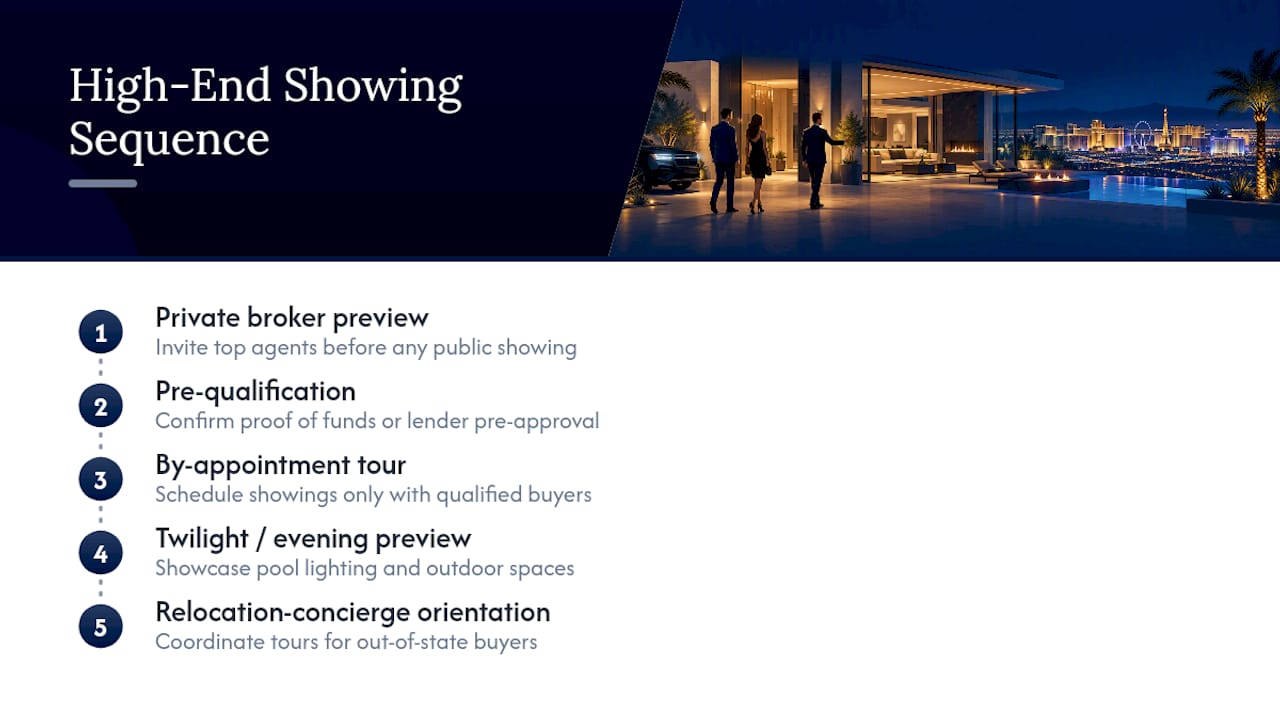
Coordinating a showing schedule with a relocation concierge service allows out-of-state buyers to combine a property tour with broader market orientation, often converting a single visit into a serious offer rather than a preliminary look.
Privacy and Security in Luxury Home Marketing
High-profile sellers face a genuine tension: marketing needs visibility to attract the right buyer, while privacy concerns argue for discretion, particularly for public figures or sellers concerned about the security implications of publishing detailed floor plans and interior photography publicly.
Off-market marketing addresses part of this directly. Sharing property details through a private broker network rather than public MLS syndication limits exposure while still reaching qualified buyers, an approach particularly relevant for sellers who value discretion over maximum public reach.
When a listing does go public, consider limiting exact address details in marketing materials until a showing is confirmed, and review whether smart home system information, security camera locations, or safe room details should be omitted from marketing copy entirely. A written marketing plan should address these choices explicitly rather than leaving them to whoever happens to be drafting listing copy that week.
Preparing a Luxury Home Beyond Staging
Staging addresses presentation, but a handful of preparation steps matter specifically at the luxury price point and get overlooked more often than they should.
Pre-listing inspections, covering the roof, HVAC systems, pool equipment, and any custom features like elevators or home automation systems, surface issues before a buyer's inspector does, preserving negotiating leverage rather than surrendering it mid-escrow. Assembling documentation for custom construction, permits, warranties on major systems, and any architectural or designer credentials associated with the build, gives buyers confidence that supports a higher offer.
Landscaping and exterior maintenance deserve a dedicated review separate from staging, since curb appeal on a luxury property often involves mature landscaping, water features, or hardscaping that takes weeks, not days, to refresh if it's fallen behind. Sellers should also confirm HOA or community documents are current and readily available, since delays retrieving these mid-transaction can stall closing on higher-value properties where buyers' attorneys review every detail closely.
Why Marketing Choices Should Follow Buyer Psychology, Not a Template
The biggest mistake I see sellers make is asking for the same marketing package regardless of who is actually going to buy their home. A golf course estate targeting a relocating executive needs a different emphasis than a Strip-view penthouse targeting an investor. I've watched targeted concierge outreach connect a seller with a serious buyer faster than months of broad public exposure ever did, simply because the outreach matched the buyer's actual profile. Insist on deliverables in writing, tailored to your property, not a template pulled from someone else's listing.
— Yelena
Work With YH Luxury Homes on Your Marketing Plan
Yhluxrealestate offers Las Vegas sellers access to off-market buyer networks and negotiation strategies designed around client positioning rather than generic scripts.
When you reach out, expect a written marketing plan before you sign anything, covering photography and video specifications, a named distribution list, staging recommendations specific to your property, and a realistic timeline based on current Las Vegas inventory conditions. Yhluxrealestate's services span seller representation, luxury marketing execution, relocation concierge support for out-of-state buyers on the other side of your transaction, and negotiation focused on your net outcome rather than a fast close. If pricing strategy or net proceeds are on your mind, reviewing common concession mistakes before you list can save real money at the negotiating table.
Contact Yhluxrealestate to request a written marketing plan for your property and see exactly what a Sotheby's-backed strategy looks like before you commit to anything.
Sources
The staging figures and buyer priority data throughout this piece come from the 2025 Profile of Home Staging, the most current national survey of agents on staging outcomes. Disclosure guidance for paid endorsements draws from the FTC's endorsement guides. Local inventory and pricing trends come from realtor.com's Las Vegas market coverage. For license verification and property records, the Nevada Real Estate Division and Clark County Assessor remain the primary public resources.
- 2025 Profile of Home Staging (National Association of Realtors)
- Guides Concerning the Use of Endorsements and Testimonials in Advertising (FTC)
- Realtor
FAQ
How Much Does Luxury Home Marketing Cost in Las Vegas?
Costs vary based on the property and the scope of photography, video, staging, and paid distribution, so specific pricing is best requested directly from your agent. Yhluxrealestate provides a written marketing plan with itemized deliverables during an initial consultation, available through its website.
Does Staging Really Increase the Sale Price?
Staging can help, though the effect varies. Nearly three in 10 agents report staging increased offers by 1% to 10%, and about half observed reduced time on market, according to NAR's 2025 staging data. Selective staging of the living room, primary bedroom, and outdoor entertaining areas tends to deliver the strongest return for luxury properties specifically.
How Long Does It Take to Sell a Luxury Home in Las Vegas?
Timelines depend on pricing accuracy and marketing execution, but current conditions matter: Las Vegas inventory rose 6.9% year-over-year and days on market increased, according to realtor.com. A well-marketed, correctly priced luxury home typically sees strongest activity in the first two to six weeks after listing.
What Should Be in a Written Luxury Marketing Plan?
A credible plan itemizes photography and video specifications, a named list of syndication and paid platforms, an ad spend cap, staging responsibility, and asset ownership terms. Ambiguous "luxury package" language without these specifics is a warning sign, not a benefit.
Why Choose Yhluxrealestate for Luxury Home Marketing in Las Vegas?
Yhluxrealestate, led by Yelena Horton, offers exclusive access to off-market properties and a global referral network through Sotheby's International Realty, alongside relocation concierge support and negotiation strategy focused on client positioning. Sellers receive a written marketing plan before signing, covering the full scope of deliverables discussed throughout this guide.