
Las Vegas real estate is defined by median home prices roughly 50–60% lower than those in Los Angeles, a gap that reshapes what buyers can realistically afford, own, and build wealth with. Understanding how Las Vegas compares to Los Angeles real estate means weighing price per square foot, state tax structures, and market depth side by side. For homebuyers and investors evaluating both cities in 2026, the differences are not merely numerical. They reflect two fundamentally distinct visions of property ownership, lifestyle, and long-term financial positioning.
How do housing prices compare between Las Vegas and Los Angeles?
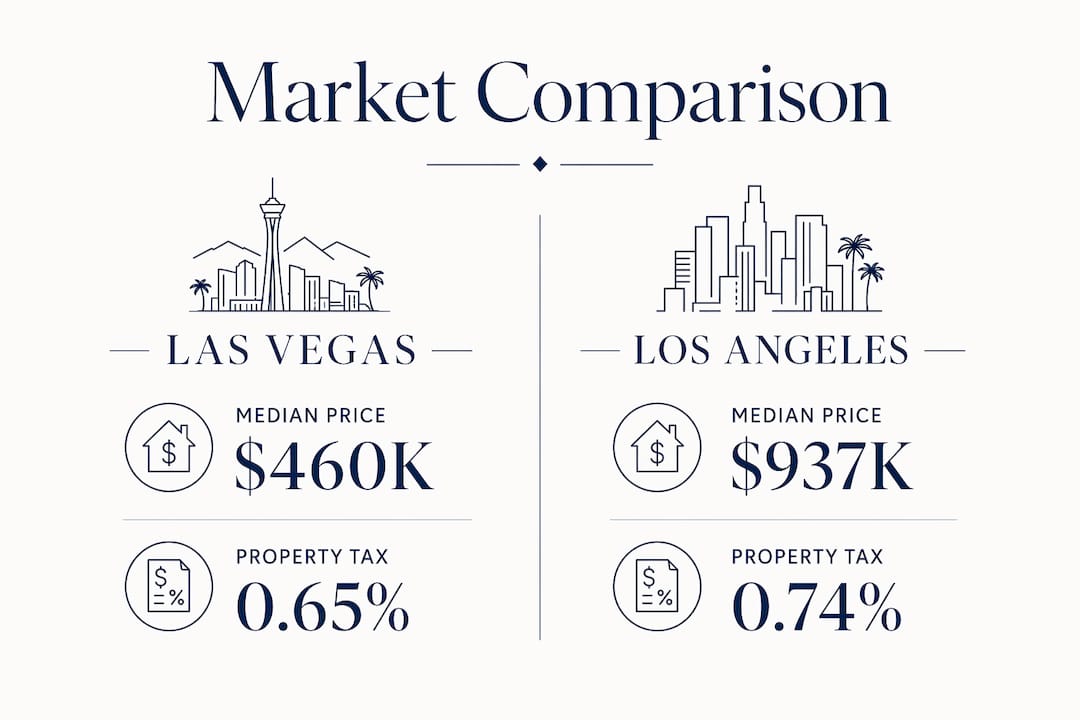
The price gap between these two markets is the defining fact of this comparison. Median home prices in Las Vegas range from approximately $440,000 to $481,000 as of early 2026, while Los Angeles median prices range from $849,000 to $1,025,000. That spread means a buyer with a $900,000 budget commands a luxury property in Las Vegas but a modest home in Los Angeles.
Price per square foot tells an equally striking story. Las Vegas averages approximately $253 per square foot, compared to $628 per square foot in Los Angeles. A buyer spending $500,000 in Las Vegas receives nearly twice the physical space of a buyer spending the same amount in Southern California.

Rental costs follow the same pattern. Rent savings for tenants relocating from Los Angeles to Las Vegas can exceed $1,000 per month, a figure that compounds meaningfully over time for investors evaluating yield potential. Utility and grocery costs are broadly comparable between the two cities, so housing remains the primary driver of the overall cost difference.
| Metric | Las Vegas | Los Angeles |
|---|---|---|
| Median home price | $440,000–$481,000 | $849,000–$1,025,000 |
| Price per square foot | ~$253 | ~$628 |
| Monthly rent savings vs. LA | $1,000+ advantage | Baseline |
| Overall cost of living | ~18% cheaper than LA | Baseline |
Pro Tip: When evaluating Las Vegas listings, request price-per-square-foot data for the specific neighborhood rather than the metro average. Summerlin and Henderson carry premiums that can push figures well above the $253 citywide average.
One nuance buyers must absorb: Las Vegas is not uniformly affordable for its own residents. Local households earning a typical income of approximately $66,105 spend roughly 42% of that income on housing costs, well above the historical benchmark of 31.7%. That pressure signals a market where prices have risen faster than local wages, creating competitive conditions that out-of-state buyers with stronger purchasing power can navigate more effectively.
What tax advantages affect real estate buyers in each city?
Nevada's tax structure is one of the most consequential factors in the Las Vegas versus Los Angeles real estate market comparison. Las Vegas buyers pay no state income tax, while Los Angeles residents face California's top marginal rate of up to 13.3%. For a high-income buyer earning $500,000 annually, that difference alone can represent tens of thousands of dollars in annual savings.
Property tax rates add another layer of advantage. Clark County carries an effective property tax rate of approximately 0.48%, compared to 0.68% in Los Angeles County. On a $1,000,000 home, that gap translates to roughly $2,000 in annual savings before any other deductions are considered.
Nevada's asset protection laws further distinguish the market for affluent investors. Nevada's homestead exemption protects up to $605,000 of primary residence equity from most general creditors. California offers no comparable protection at that level, making Nevada a structurally superior environment for wealth preservation.
The practical cost-of-living picture rounds out the tax story. Las Vegas ranks approximately 18% cheaper than Los Angeles on aggregate cost-of-living indexes, driven primarily by housing and taxes rather than everyday expenses. For investors calculating net returns, that 18% structural advantage compounds across every year of ownership.
Pro Tip: High-net-worth buyers relocating from California should consult a tax attorney before establishing Nevada residency. California's Franchise Tax Board applies strict residency tests, and a premature or incomplete move can trigger continued California tax liability.
How do Las Vegas and Los Angeles luxury markets differ?
The Los Angeles luxury market operates as a global trophy market, sustained by international capital and severe supply constraints. Los Angeles luxury properties frequently trade above $5 million, with a strong share of cash buyers drawn from international wealth pools. Supply in prime Los Angeles neighborhoods, including Bel Air, Beverly Hills, and Pacific Palisades, is structurally limited by geography and zoning. That scarcity sustains prices even during broader market corrections.
Las Vegas luxury is defined by a different set of values. Affluent California buyers are increasingly drawn to Las Vegas master-planned communities, attracted by newer inventory, resort-caliber amenities, and the compounding effect of tax savings. Communities such as Summerlin, MacDonald Highlands, and The Ridges offer guard-gated estates, golf course frontage, and mountain views at price points that would purchase a fraction of comparable Los Angeles real estate.
"Buyers relocating from Los Angeles to Las Vegas often upgrade to larger, higher-quality homes while maintaining relative proximity to the West Coast, leveraging the significant tax savings and home price gaps to reposition their wealth." — Finance, Yahoo
The investment risk profiles of the two markets differ in kind, not just degree. Los Angeles offers deep liquidity and a global buyer pool, meaning well-positioned properties rarely sit unsold for long. Las Vegas offers faster appreciation potential in growth corridors, but its market is more sensitive to economic cycles and interest rate shifts. Investors seeking capital preservation favor Los Angeles. Investors seeking growth and tax efficiency increasingly favor Las Vegas.
What lifestyle factors influence the choice between these markets?
Lifestyle considerations carry real financial weight in any relocation decision. Average commute times in Las Vegas average 25.7 minutes, compared to 30.7 minutes in Los Angeles. That five-minute daily difference accumulates to nearly 40 hours of recovered time per year, a meaningful quality-of-life distinction for buyers who value time as a finite resource.
Community structure differs sharply between the two cities. Las Vegas is built around master-planned developments that integrate residential, commercial, and recreational amenities within walkable or short-drive distances. Los Angeles is a sprawling urban mosaic where neighborhood character, school quality, and commute burden vary dramatically block by block.
Climate and outdoor access shape buyer preferences in ways that pricing data cannot capture. Las Vegas offers 300-plus days of sunshine annually and proximity to Red Rock Canyon, Lake Mead, and the Spring Mountains. Los Angeles offers coastal access, Mediterranean temperatures, and a cultural density that Las Vegas does not replicate. Neither climate is objectively superior. The question is which environment aligns with a buyer's daily life.
Emerging growth corridors in Las Vegas, including the southwest valley and the area surrounding the Las Vegas Raiders' Allegiant Stadium, signal continued infrastructure investment. That investment tends to lift surrounding property values over time, creating opportunities for buyers who position early in developing neighborhoods.
Key takeaways
Las Vegas offers homebuyers and investors a structurally more affordable market than Los Angeles, with lower prices, lower taxes, and strong asset protection laws, while Los Angeles retains unmatched global luxury market depth.
| Point | Details |
|---|---|
| Price gap is substantial | Las Vegas median prices are 50–60% lower than Los Angeles, with half the cost per square foot. |
| Tax savings are compounding | No state income tax and a lower property tax rate in Nevada create lasting financial advantages. |
| Luxury markets serve different buyers | Los Angeles attracts global capital; Las Vegas attracts value-driven affluent buyers seeking lifestyle and tax benefits. |
| Local affordability pressure exists | Las Vegas residents spend roughly 42% of income on housing, signaling a competitive market despite lower prices. |
| Lifestyle trade-offs are real | Shorter commutes and master-planned communities favor Las Vegas; coastal access and cultural depth favor Los Angeles. |
What I have learned advising buyers across both markets
Working with buyers who are weighing Las Vegas against Los Angeles, I have observed one consistent pattern: the buyers who make the best decisions are the ones who look past the headline price gap and ask harder questions.
The tax savings are real and they are significant. But a buyer who moves to Las Vegas primarily to escape California taxes, without genuinely wanting to live in the Nevada desert, tends to feel the absence of what Los Angeles offered within eighteen months. The lifestyle trade-off is not trivial.
What I find more interesting is the buyer who approaches Las Vegas as a primary wealth-building vehicle. They are not fleeing California. They are making a deliberate allocation decision, treating the price-per-square-foot gap and the homestead exemption as structural advantages to be held for a decade or more. Those buyers tend to be right.
The risk I see most often is underestimating Las Vegas market competitiveness. Because prices are lower, buyers sometimes assume negotiations will be easy. They are not. Well-positioned properties in Summerlin or Henderson attract multiple offers, and buyers without local expertise frequently overpay or lose to better-positioned competitors. Local knowledge is not optional in this market. It is the difference between a sound acquisition and an expensive lesson.
— Yelena
Yhluxrealestate: expert guidance for Las Vegas luxury buyers
Buyers comparing the Los Angeles and Las Vegas luxury markets deserve counsel from someone who knows both the numbers and the neighborhoods with equal depth.

Yhluxrealestate, led by Yelena Horton and backed by Sotheby's International Realty, specializes in Las Vegas luxury properties with exclusive access to off-market inventory that most buyers never see. The relocation concierge service is built specifically for out-of-state buyers navigating the transition from California, providing market evaluations, negotiation positioning, and lifestyle guidance in one coordinated experience. For buyers ready to act with clarity and confidence, Yhluxrealestate delivers the access and expertise that the Las Vegas luxury market demands.
FAQ
What is the median home price difference between Las Vegas and Los Angeles?
Las Vegas median home prices range from approximately $440,000 to $481,000 as of early 2026, compared to $849,000 to $1,025,000 in Los Angeles. That gap represents a 50–60% price advantage for Las Vegas buyers.
Does Nevada have a state income tax for homeowners?
Nevada has no state income tax, while California imposes a top marginal rate of up to 13.3%. This difference is one of the primary financial drivers behind California buyer migration to Las Vegas.
Is Las Vegas real estate a good investment compared to Los Angeles?
Las Vegas offers stronger growth potential and tax efficiency, while Los Angeles provides deeper liquidity and global buyer demand. The better investment depends on whether a buyer prioritizes appreciation potential or capital preservation.
How does the Las Vegas luxury market compare to Los Angeles?
Los Angeles luxury trades above $5 million with international capital support and constrained supply. Las Vegas luxury centers on master-planned communities with newer inventory and lifestyle amenities at lower price points, attracting affluent buyers seeking value alongside exclusivity.
What lifestyle differences should buyers consider when choosing between the two cities?
Las Vegas offers shorter average commutes of 25.7 minutes versus 30.7 minutes in Los Angeles, master-planned community living, and desert recreation. Los Angeles offers coastal access, cultural depth, and a Mediterranean climate that Las Vegas does not replicate.