
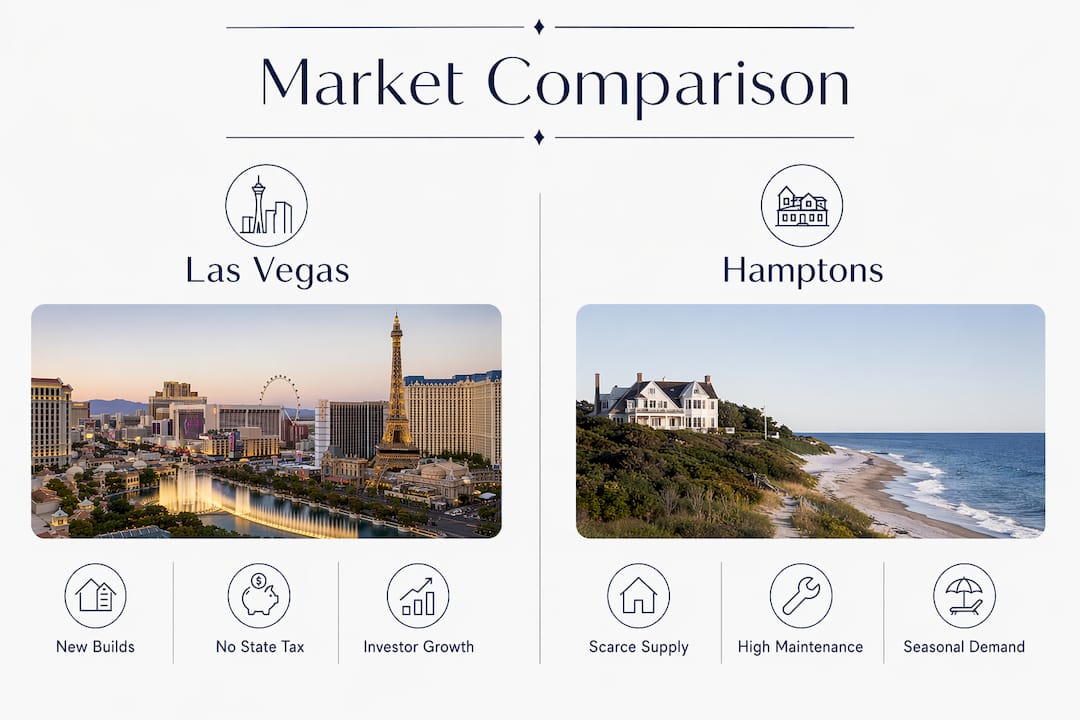
Las Vegas and the Hamptons are defined by fundamentally different luxury second home profiles, and understanding how Las Vegas compares to Hamptons second homes is the first step toward a sound acquisition decision. The Hamptons represent old-money coastal prestige, where scarcity drives values and seasonal ritual governs the calendar. Las Vegas, by contrast, is a city of deliberate reinvention, where new construction and tech integration define the luxury tier. IRS second home classification rules apply equally to both markets, yet the tax environments, property characteristics, and lifestyle propositions diverge sharply. For high-net-worth buyers and investors, the choice between these two destinations is not simply geographic. It is a statement of financial philosophy.
How Las Vegas compares to Hamptons second homes in 2026 market conditions
The Hamptons luxury market operates on scarcity as its primary currency. Median home values in East Hampton sit near $1.86 million, while premium village properties approach $4.98 million. That pricing reflects land constraints, historic zoning, and a buyer pool that prizes exclusivity above all else.
Seasonal rental demand reinforces those values with remarkable force. Luxury seasonal rentals in the Hamptons have reached $2.5 million for a full seasonal lease, with $1 million monthly rents now routine at the top tier. The mid-August "trophy" period commands rates 30%–50% higher than early July, compressing the most lucrative rental window into a matter of weeks.
Las Vegas presents a structurally different picture. The market recorded a 27% surge in investor purchases among top metros in 2026, reflecting strong and accelerating institutional confidence. Inventory is not constrained by geography or historic preservation codes. Buyers can commission custom estates on generous lots, with timelines and specifications that the Hamptons resale market simply cannot match.

The demand dynamics in each market reward different buyer profiles. Hamptons buyers accept illiquidity and high carrying costs in exchange for prestige and a proven appreciation track record. Las Vegas buyers accept a shorter price history in exchange for customization, lower taxes, and a rental market that operates year-round rather than for eight weeks each summer.
How do tax rules and financing affect second home ownership in each market?
The IRS defines a second home by a specific occupancy threshold, and that definition governs financing terms in both markets. A property qualifies as a second home when the owner occupies it for at least 14 days per year, or 10% of the total days it is rented, whichever is greater. The property must also sit at least 50 miles from the owner's primary residence and be rented for fewer than 180 days annually.
Maintaining second home status matters because it unlocks materially better mortgage rates and conditions than an investment property classification. Lenders treat second homes more favorably than pure rental assets, which translates into lower down payment requirements and reduced interest rates. Misclassifying a property, or allowing rental activity to exceed IRS thresholds, can trigger reclassification and higher financing costs.
State tax policy creates a decisive divergence between the two markets. Las Vegas benefits from no state income tax and comparatively low property tax rates, reducing the annual cost of ownership in ways that compound significantly over a decade. New York, which governs Hamptons properties, imposes state income tax, and Suffolk County property tax assessments on high-value estates add a substantial recurring burden.
Pro Tip: Structure your rental calendar carefully before closing. Exceeding the IRS rental day threshold converts your second home into an investment property in the eyes of your lender and the tax code, which affects both your mortgage rate and your deduction eligibility.
Buyers who understand IRS second home rules before signing a purchase agreement protect themselves from costly reclassification. The tax advantage in Las Vegas is not marginal. For a $3 million property, the absence of state income tax and lower property tax rates can represent tens of thousands of dollars in annual savings compared to an equivalent Hamptons holding.
What lifestyle and property characteristics set these two markets apart?
Las Vegas luxury real estate is defined by new construction. Buyers commission estates with the latest architectural language, smart home systems, resort-caliber pools, and climate-controlled wine cellars built to specification from the ground up. There is no inherited floor plan to work around, no aging mechanical system to replace, and no historic preservation board to negotiate with.
The Hamptons resale market operates on entirely different terms. Many of the most coveted properties carry significant renovation requirements. Hamptons luxury homes often require expensive renovation to modernize layouts and systems, and those costs directly reduce net investment returns. A $5 million acquisition can require an additional $1 million or more to bring mechanical systems, kitchens, and primary suites to contemporary standards.
Service expectations also differ in ways that surprise buyers accustomed to full-service resort environments. Hamptons rentals typically exclude staff, and weekly agency hiring for chefs, butlers, and housekeepers ranges from $8,000 to $24,000. Broker fees on rentals reach up to 12.5%, and occupancy taxes add a further layer of cost. The all-in booking cost routinely runs 25%–40% above the headline rental rate.
Las Vegas luxury estates, particularly those managed within amenity-rich communities, integrate concierge services, security, and property management into the ownership structure. That integration reduces the friction of remote ownership and makes the property genuinely usable on short notice, which matters for buyers who travel frequently and value spontaneity.
Pro Tip: When evaluating a Hamptons property, commission a full mechanical and systems audit before making an offer. Renovation costs on older estates are frequently underestimated, and they erode the return profile that the headline price implies.
How do investment perspectives and long-term value compare?
The Hamptons' appreciation case rests on a foundation of prestige and finite supply. Coastal zoning restrictions, historic district designations, and a buyer pool of global wealth ensure that demand consistently outpaces available inventory. That scarcity supports values through economic cycles, though it also means that entry prices are high and carrying costs are unrelenting.
Hamptons second homes incur high hidden costs including municipal tax premiums, legal fees, and ongoing maintenance that managed resort properties do not carry. The trade-off between capital appreciation potential and lifestyle ease is real, and buyers who underestimate carrying costs often find that their net return is far lower than the gross appreciation figure suggests.
Las Vegas offers a different appreciation thesis. The market's growth is driven by population inflows, corporate relocations, and a diversifying economy that extends well beyond hospitality. Custom new construction allows buyers to build equity through specification rather than waiting for a resale market to recognize improvements. Lower property taxes and the absence of state income tax reduce the annual drag on returns.
| Investment Factor | Las Vegas | Hamptons |
|---|---|---|
| Entry price range | Broad, with new builds available across tiers | High, with premium village properties near $4.98M |
| Property tax burden | Comparatively low | High, with Suffolk County premiums |
| State income tax | None | New York state income tax applies |
| Renovation risk | Minimal on new construction | Significant on resale estates |
| Rental season | Year-round | Compressed to summer months |
| Appreciation driver | Population growth, customization | Scarcity, prestige, coastal zoning |
For buyers who use a second home six to ten weeks annually, fractional ownership can be 40%–60% more cost-effective than outright purchase over a ten-year horizon. That model reduces maintenance obligations, eliminates security concerns during vacancy, and preserves capital for other allocations. It is a structure worth modeling before committing to full ownership in either market.
Key Takeaways
Las Vegas and the Hamptons serve fundamentally different buyer priorities, and the right choice depends on whether you value customization and tax efficiency or prestige and coastal scarcity.
| Point | Details |
|---|---|
| Market profile diverges sharply | Hamptons values rest on scarcity; Las Vegas growth is driven by population inflows and new construction. |
| Tax environment favors Las Vegas | No state income tax and lower property taxes reduce annual carrying costs compared to New York-governed Hamptons holdings. |
| IRS classification governs financing | Occupying the property at least 14 days annually preserves second home mortgage rates in both markets. |
| Renovation risk is a Hamptons reality | Older Hamptons estates frequently require costly system upgrades that reduce net investment returns. |
| Fractional ownership merits consideration | For buyers using a second home six to ten weeks annually, fractional models can be 40%–60% more cost-effective over ten years. |
What I have learned from watching buyers choose between these two markets
After years of working with high-net-worth buyers evaluating Las Vegas luxury real estate, I have observed a consistent pattern. Buyers who arrive anchored to the Hamptons prestige narrative often underestimate the total cost of ownership in that market. They see the headline appreciation and the social cachet, and they discount the renovation bills, the compressed rental window, and the staffing costs that arrive separately from the lease agreement.
Las Vegas, by contrast, tends to be underestimated by buyers who associate the city exclusively with entertainment. The luxury residential market here is genuinely distinct from the Strip. Custom estates in guard-gated communities offer privacy, architectural ambition, and a tax environment that rewards long-term holding. The city is becoming something, and buyers who recognize that early tend to be well-positioned.
My honest counsel is this: align your property choice with how you actually intend to use it, not how you imagine you will. If you want a property that functions as a genuine retreat, operates year-round, and carries manageable costs, Las Vegas deserves serious consideration. If the social architecture of the Hamptons is integral to your lifestyle and you have the appetite for its carrying costs, that market will reward patience. The mistake is buying the prestige of one market while expecting the economics of the other.
— Yelena
Luxury Las Vegas second homes, curated for discerning buyers
For buyers who have weighed the Las Vegas vs Hamptons properties comparison and recognize the opportunity that Las Vegas presents, the next step is finding the right property with the right guidance.

Yhluxrealestate, led by Yelena Horton and backed by Sotheby's International Realty, provides access to exclusive Las Vegas listings that never reach the open market. The relocation concierge service addresses every dimension of an out-of-state acquisition, from neighborhood orientation to negotiation strategy. Buyers who are serious about buying a second home in Vegas gain a material advantage through Yhluxrealestate's off-market access and deep knowledge of the local luxury tier. Contact Yhluxrealestate to arrange a private consultation.
FAQ
What is the median home value in the Hamptons in 2026?
Median home values in East Hampton sit near $1.86 million, with premium village properties approaching $4.98 million. Seasonal rental demand at the top tier reaches $1 million per month.
How does Las Vegas tax treatment benefit second home buyers?
Las Vegas properties benefit from no Nevada state income tax and comparatively low property tax rates. That combination reduces annual carrying costs significantly compared to Hamptons properties governed by New York tax law.
What IRS rule determines second home classification?
The IRS requires owner occupancy of at least 14 days per year, or 10% of total rental days, for a property to qualify as a second home. The property must also be located at least 50 miles from the owner's primary residence and rented fewer than 180 days annually.
Is fractional ownership a viable alternative to buying outright in either market?
Fractional ownership can be 40%–60% more cost-effective than full purchase over ten years for buyers who use a second home six to ten weeks annually. It reduces maintenance obligations and eliminates the security and management burden of a vacant property.
Why do Hamptons rental costs exceed the headline rate?
All-in Hamptons rental costs run 25%–40% above the advertised rate once broker fees, occupancy taxes, and staff hiring are included. Weekly staffing for chefs, butlers, and housekeepers alone ranges from $8,000 to $24,000.