
The 2026 baseline conforming loan limit for one-unit properties is $832,750 across most of the country, with high-cost areas allowed a ceiling of $1,249,125. Alaska, Hawaii, Guam, and the U.S. Virgin Islands carry higher statutory figures. Any mortgage that exceeds the conforming limit for its county becomes a jumbo loan, subject to private or portfolio underwriting rather than Fannie Mae or Freddie Mac guidelines.
TL;DR:
- County-level limits vary based on local median home values, making some areas qualify for higher ceilings while others remain at the baseline.
- Crossing the conforming threshold turns a loan into a jumbo, which requires different underwriting, generally involves larger down payments, higher credit scores, and steeper reserves.
- Lenders prefer the FHFA's official county data and updated automated systems to confirm exact limits before proceeding with loan origination.
- Future increases in conforming limits depend on the FHFA's house price index, which can change the borrowing landscape within a year.
Table of Contents
- Jumbo Loan Limits 2026: The Baseline and Ceiling Numbers
- Why County-Level Limits Differ So Much
- Who Sets Jumbo Loan Limits and Why They Rose for 2026
- What Jumbo Territory Means for Your Underwriting and Rate
- How to Confirm the Exact Limit for Your County
- Clark County and High-Cost Counties: Two Real-World Scenarios
- A Las Vegas Perspective on Jumbo Financing Strategy
- Where Jumbo Loan Limits Are Headed After 2026
- Jumbo Loan Limits by State: Why the Gap Is So Wide
- How the Limit Shapes Rates and Loan Terms
- The Secondary Market's Role in Jumbo Lending
- The Editorial Take: Numbers Are the Easy Part
- Financing Support for Luxury and Jumbo Buyers in Las Vegas
- Where to Verify the Numbers Yourself
- Sources
- FAQ
Jumbo Loan Limits 2026: The Baseline and Ceiling Numbers
The Federal Housing Finance Agency raised the 2026 conforming loan limit to $832,750 for one-unit properties across the contiguous United States, Washington, D.C., and Puerto Rico. That figure marks a 3.26% increase over 2025, tracking the rise in the FHFA's house price index rather than any political decision or lender preference.
High-cost areas, where median home values run well above the national baseline, get a ceiling of 150% of that number: $1,249,125 for a single unit. Multi-unit properties scale upward from there. Alaska, Hawaii, and the territories start from a higher baseline by statute, and their ceilings follow the same 150% math from that elevated starting point.
| Units | Baseline (most areas) | Ceiling (high-cost areas) |
|---|---|---|
| 1-unit | $832,750 | $1,249,125 |
| 2-unit | a higher baseline conforming loan limit | a higher ceiling limit in high-cost areas |
| 3-unit | a higher baseline conforming loan limit | a higher ceiling limit in high-cost areas |
| 4-unit | a higher baseline conforming loan limit | a higher ceiling limit in high-cost areas |
Fannie Mae's loan limit tables mirror these figures exactly, as does Freddie Mac, since both government-sponsored enterprises adopt the FHFA's published values without modification. The takeaway for anyone shopping in 2026: if your loan amount sits at or below these numbers for your county, you're working within conforming territory, with all the pricing advantages that brings.
Why County-Level Limits Differ So Much
A property in rural Nevada and a property in Marin County, California play by different rules, even though both sit under the same federal formula. The FHFA raises a county's limit above the national baseline when the local median home value exceeds 115% of that baseline, a mechanism built into the Housing and Economic Recovery Act.
This is why high-cost designations cluster in a predictable set of places for 2026:
- California, especially the Bay Area and coastal Southern California counties
- New York, particularly the counties surrounding New York City
- Massachusetts, concentrated around Boston and its suburbs
- Connecticut, in the counties bordering New York
- Hawaii, where nearly every county qualifies as high-cost
Alaska, Hawaii, Guam, and the U.S. Virgin Islands get separate statutory treatment under HERA, meaning their limits don't follow the same percentage test as the rest of the country; they start higher by law.
Who Sets Jumbo Loan Limits and Why They Rose for 2026
The FHFA holds statutory authority to set conforming loan limits every year under HERA, and it does so using a formula tied to the agency's house price index rather than discretion or negotiation. When home values rise nationally, the baseline rises with them. Freddie Mac's own explanation of the 3.26% increase confirms the mechanism is purely data driven.
A few practical points matter here:
- The FHFA announced the 2026 values on November 25, 2025, giving lenders roughly five weeks to update systems before the new year.
- Fannie Mae and Freddie Mac don't set their own numbers; they adopt the FHFA's figures directly into their guidelines and automated underwriting tools.
- Loan origination systems and Freddie Mac's Loan Product Advisor typically reflect the new limits on loans with note dates in January 2026 or later, though exact rollout timing varies by lender.
If you're closing in late December on a loan just over the 2025 limit, ask your lender directly whether their systems have already flipped to the 2026 figures.
What Jumbo Territory Means for Your Underwriting and Rate
Cross the conforming limit for your county, and your loan stops being eligible for purchase by Fannie Mae or Freddie Mac. It becomes a jumbo loan, which means the lender either holds it in portfolio or sells it to a private investor, and the underwriting rules shift accordingly. Guidelines aren't standardized the way conforming loans are; they vary meaningfully from one lender to the next.
Expect these general patterns, confirmed across lender guidance on 2026 jumbo requirements:
- Credit score expectations climb. Many jumbo programs want scores of 700 or higher, and the strongest pricing often requires 740+.
- Down payments run larger. Ten to 20% or more is common, compared with the 3-5% minimums available on many conforming loans.
- Reserve requirements are steeper. Lenders frequently want six to twelve months of principal, interest, taxes, and insurance sitting in liquid accounts after closing.
- Documentation gets more thorough. Full income verification, asset sourcing, and sometimes two appraisals are standard rather than exceptions.
Rates don't follow a fixed rule. Jumbo pricing can run higher or lower than conforming pricing depending on the lender's investor appetite, your credit profile, and how much liquidity that lender wants to deploy that month.
Pro Tip: If your purchase price sits just above your county's conforming limit, a modestly larger down payment can pull the loan amount back under the threshold, preserving GSE pricing and avoiding jumbo underwriting entirely. Run the math before assuming you need a jumbo lender.
How to Confirm the Exact Limit for Your County
Don't rely on a rounded national figure when a few thousand dollars of variance can change your financing path entirely. Three steps get you a verified number:
- Start with the FHFA's own lookup tool. The agency's county-level dataset includes a searchable map and downloadable CSV and XLSX files covering every county and county-equivalent area for 2026.
- Cross-check Fannie Mae and Freddie Mac. Their published tables and Lender Letters occasionally clarify timing details, like which note dates the new limits apply to, that the FHFA release doesn't spell out.
- Ask your loan officer to confirm system status. Even after the FHFA publishes final numbers, a lender's loan origination system and automated underwriting engine need to be updated before they'll actually process a loan at the new limit.
Questions about methodology or a specific county's classification can go directly to the FHFA at LoanLimitQuestions@fhfa.gov, which the agency lists in its annual release.
Clark County and High-Cost Counties: Two Real-World Scenarios
Clark County, home to Las Vegas, uses the standard 2026 baseline of $832,750 for a one-unit property. Push that purchase price to $900,000 with the same down payment, and the loan crosses into jumbo underwriting.
Compare that with a high-cost county like San Mateo, California, where the ceiling reaches $1,249,125. A buyer there can finance a considerably more expensive property, up to roughly $1.3 million with a modest down payment, and still remain conforming. That gap illustrates why population and price trends in Las Vegas matter to financing strategy: as local values climb, more purchases edge toward the baseline ceiling rather than requiring jumbo financing from the start.
A Las Vegas Perspective on Jumbo Financing Strategy
Yelena Horton raises financing strategy with buyers well before they write an offer, particularly on off-market or luxury properties where timing and leverage matter as much as price. Structuring a deal to land just under Clark County's $832,750 baseline, rather than a few thousand dollars over it, can change which lenders compete for the loan and how quickly it closes.
For out-of-state buyers, the relocation concierge service coordinates jumbo lender requirements, reserve documentation, and appraisal timing before the buyer ever lands in Las Vegas. When a purchase clearly exceeds the conforming ceiling regardless of down payment, the recommendation shifts toward a jumbo specialist with deep portfolio lending experience rather than forcing a conforming structure that doesn't fit the property.
Where Jumbo Loan Limits Are Headed After 2026
The conforming loan limit has risen every year since 2020, moving in step with the FHFA's house price index rather than any fixed schedule.
What's less predictable is the pace.
For buyers planning a purchase 18 to 24 months out, this matters more than it might seem. A property that requires jumbo financing today could fall within conforming limits in two years if local prices stay flat while the national baseline keeps rising. That's a real consideration for move-up buyers in markets like Las Vegas, where the baseline still trails the high-cost ceilings seen in California or New York by a wide margin. Watching the annual FHFA announcement each November, rather than assuming last year's numbers still apply, is the simplest way to stay ahead of the shift.
Jumbo Loan Limits by State: Why the Gap Is So Wide
The distance between a baseline county and a high-cost county isn't a rounding error; it's nearly $417,000 on a single-unit property.
California tells a different story almost entirely. Counties like Santa Clara, San Francisco, and Marin sit at the $1,249,125 ceiling, while more affordable inland counties within the same state, like Fresno or Kern, remain at baseline. That split within a single state catches out-of-state buyers off guard more than any other detail: moving from Sacramento to San Jose can change your conforming eligibility even though both cities are in California.
Hawaii stands apart entirely. Every county there qualifies for elevated limits, and Freddie Mac's published tables note ceiling figures that run slightly above the mainland high-cost maximum in some cases, reflecting the state's statutory baseline under HERA. Alaska follows a similar elevated pattern. For a buyer comparing markets, the practical rule is simple: never assume a limit based on the state name alone. Pull the county-specific figure every time, since two counties in the same state can sit tens of thousands of dollars apart.
How the Limit Shapes Rates and Loan Terms
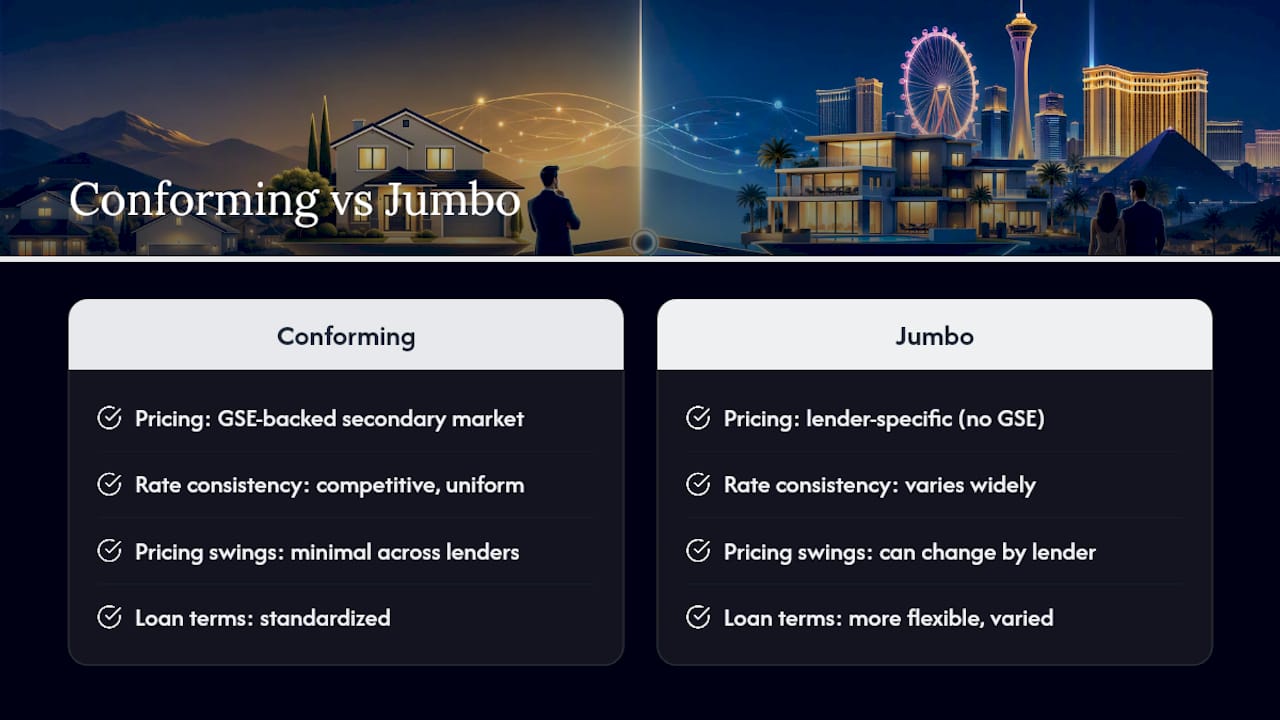
Crossing into jumbo territory doesn't automatically mean a worse rate, but it does mean a different pricing mechanism entirely. Conforming loans benefit from a deep, liquid secondary market where Fannie Mae and Freddie Mac buy loans in bulk, which keeps pricing consistent and competitive across nearly every lender in the country.
Jumbo loans don't have that uniformity. Because reserve and credit requirements vary by lender rather than by GSE guideline, rate quotes can swing more widely from one institution to the next for the same borrower profile. A regional bank chasing portfolio growth might undercut a national lender's jumbo rate by half a point in a given month, then reverse that pricing six months later.
Loan terms tend to be less flexible, too. Interest-only options, adjustable structures, and non-warrantable condo financing show up more often in jumbo programs than conforming ones, simply because portfolio lenders can underwrite outside the standardized GSE box. That flexibility cuts both ways: it can solve a financing problem a conforming loan can't touch, but it also means more due diligence on the buyer's part to compare terms rather than assuming rate parity across lenders.
The Secondary Market's Role in Jumbo Lending
Conforming loans flow into a well-established pipeline: originate, sell to Fannie Mae or Freddie Mac, and the GSEs bundle them into mortgage-backed securities sold to investors worldwide. That pipeline is what keeps conforming rates stable and widely available.
Jumbo loans bypass that system entirely. Since the GSEs can't purchase anything above the conforming limit, jumbo loans get sold instead to private investors, banks, insurance companies, or specialized mortgage real estate investment trusts, through what's known as the private-label securities market. Investor appetite in that market fluctuates with broader credit conditions, which is part of why jumbo pricing can tighten or loosen faster than conforming pricing during periods of economic uncertainty.
This distinction explains why some lenders pull back sharply on jumbo lending during volatile stretches while others keep expanding. A bank funding jumbo loans from its own deposits has different risk tolerance than one relying entirely on selling loans downstream to private investors. For high-net-worth buyers, this means the jumbo lending landscape can shift meaningfully within a single year, even when the FHFA's conforming limits stay fixed until the next November announcement.

The Editorial Take: Numbers Are the Easy Part
The 2026 figures are straightforward enough: $832,750 baseline, $1,249,125 ceiling, adjusted upward for Alaska and Hawaii. What most guidance gets wrong is treating that number as the whole story rather than the starting point for a financing decision.
The bigger mistake buyers make is assuming jumbo automatically means a worse deal. It doesn't. Because jumbo underwriting is investor driven rather than standardized, the right lender relationship can matter more than the loan classification itself. A borrower with strong reserves and clean documentation can often negotiate jumbo terms that beat a conforming loan's flexibility, particularly on jumbo-only features like interest-only structuring.
What deserves more attention than it gets: county-level variation. Buyers comparing markets, especially relocating out of state, routinely underestimate how much the conforming ceiling shifts between neighboring counties. Before assuming a property requires jumbo financing, check the exact county figure. That single step, more than any rate comparison, determines whether you're shopping the conforming market or the private one.
— Yelena
Financing Support for Luxury and Jumbo Buyers in Las Vegas
Comparing conforming and jumbo thresholds is only useful if it connects to an actual property search, and that's where a broker with direct market access changes the outcome. Yhluxrealestate coordinates financing timelines with off-market showings and lender introductions, so buyers aren't discovering a jumbo requirement after they've already fallen for a property that doesn't fit their pre-approval.

Yelena Horton's relocation concierge service works alongside jumbo-specialist lenders to line up reserve documentation, appraisal scheduling, and closing timelines before an out-of-state buyer ever makes an offer, while her negotiation approach helps structure purchase prices that keep deals within conforming limits when that serves the buyer better. If you're evaluating a Las Vegas purchase near the 2026 conforming threshold, reach out to Yhluxrealestate to start matching your financing plan to the right property before you're under contract.
Where to Verify the Numbers Yourself
- FHFA's 2026 announcement and county dataset for the authoritative baseline and ceiling figures
- Fannie Mae's loan limit tables for unit-count breakdowns and lender guidance
- Freddie Mac's Single-Family news page for GSE-aligned figures and year-over-year change explanations
- HUD's high-cost area lookup for cross-referencing county designations
This article is general information, not a substitute for advice from a qualified financial advisor. Consult a qualified financial professional about your own circumstances before acting on anything here.
Sources
- FHFA Announces Conforming Loan Limit Values for 2026
- Loan Limits | Fannie Mae
- 2026 Loan Limits Increase by 3.26% - Freddie Mac Single-Family
- Jumbo loan limits and requirements in 2026
FAQ
What is the current jumbo loan threshold for 2026?
The 2026 conforming loan limit, the point above which a loan becomes jumbo, is $832,750 for a one-unit property in most counties, rising to $1,249,125 in high-cost areas.
Can a 70-year-old get a 30-year mortgage?
Yes. Lenders cannot deny a mortgage based on age under fair lending laws, and a standard loan term remains available to qualifying borrowers of any age as long as income, credit, and reserves meet the lender's standards.
What is the $100,000 loophole for family loans?
This refers to IRS rules allowing family members to lend money with reduced imputed-interest tax consequences below certain thresholds; it's a tax provision, not a mortgage program, and doesn't affect FHFA conforming or jumbo loan limits.
How do I find my county's exact jumbo loan limit for 2026?
Use the FHFA's county-level lookup tool or check Fannie Mae's and Freddie Mac's published tables, then confirm the figure with your lender since loan origination systems don't always reflect new limits immediately after the November announcement.