
The most effective approach to international listing exposure blends three layers working together: syndication across major global portals, targeted multilingual marketing in specific buyer-source countries, and private broker-to-broker outreach for luxury or sensitive properties. Syndication networks, standards-based exchanges like GDX, and paid channels aimed at wealth hubs each serve a distinct purpose. Together, they widen the buyer pool and improve the odds of attracting a qualified, well-capitalized offer.
TL;DR:
- Syndication networks and broker-level exchanges like GDX are essential for reaching qualified international buyers interested in luxury, resort, and investment properties.
- Effective localization, targeted creative content, and multilingual support significantly increase engagement and conversion rates from overseas prospects.
- Private outreach through curated broker networks provides greater discretion and filters for high-value, unique, or high-profile properties.
- Evaluating international listing channels requires assessing audience quality, lead routing, data control, and compliance, not just overall reach or traffic volume.
- A hybrid strategy combining private broker outreach with controlled public syndication optimizes both exposure and buyer qualification.
Table of Contents
- Why International Exposure Matters for Sellers and Brokers
- Where to List: Syndication Networks, Portals, and Standards-Based Exchanges
- Key Criteria for Choosing an International Listing Channel or Partner
- Tactical Marketing Playbook to Attract International Buyers
- Public Listing vs. Off-Market Distribution for Luxury Properties
- A Las Vegas Case in Point
- Where the Conventional Advice Falls Short
- Take the Next Step With Yhluxrealestate
- Sources
- FAQ
Why International Exposure Matters for Sellers and Brokers
Foreign buyers remain a meaningful, if fluctuating, share of the U.S. residential market, and NAR's international transactions report is the benchmark data source brokers cite when building a case for global marketing spend. The numbers matter less as a single figure and more as a signal: foreign buyers tend to purchase at higher price points, often pay in cash, and gravitate toward luxury, resort, and investment-grade assets rather than starter homes.
That pattern shapes strategy. A three-bedroom suburban home rarely benefits from a Mandarin-language listing sheet. A ten-thousand-square-foot estate with mountain views, a trophy commercial building, or a turnkey investment condo almost always does. The buyer pool for those asset classes is genuinely global, and sellers who limit exposure to their local MLS are leaving qualified interest on the table.
The pattern holds across property types: international buyers concentrate in luxury residential, resort and second-home markets, and investment-grade commercial assets, where cash purchases and faster closings are more common than in the broader domestic market.
Sellers who invest in real international exposure tend to see three outcomes:
- A faster sale timeline, since a wider buyer pool means more simultaneous interest instead of a slow trickle of local showings.
- More competing offers, which strengthens negotiating leverage on price and terms.
- Better terms overall, including fewer contingencies from buyers who are relocating for lifestyle, tax, or business reasons and have already done their due diligence.
Where to List: Syndication Networks, Portals, and Standards-Based Exchanges
Global reach starts with syndication, but not all syndication is equal. The International MLS (IMLS) reports the ability to push listings to more than 100 property portals across 60-plus countries, with claimed monthly reach in the hundreds of millions of viewers. That scale matters for raw visibility, though a listing appearing on a foreign portal is only useful if the portal actually serves buyers who transact in that price bracket.
Portal networks like ProperStar aggregate listings for cross-border buyers researching multiple countries at once, often with built-in currency conversion and language switching that a single-market MLS feed cannot offer. HomesGoFast takes a similar approach, positioning itself as a hub specifically for buyers searching outside their home country, which makes it a reasonable add-on for sellers targeting expatriate or retiree buyers rather than institutional investors.

Broker-level distribution works differently. GDX (Global Data Exchange) uses the RESO Web API to let MLSs and broker networks share listing data across borders while each market keeps its own governance and rules intact. That distinction matters for luxury sellers who want their listing discoverable by vetted brokers abroad without it appearing on public consumer portals. Curated distribution models like ADVSR extend this idea further, routing listings through advisor and ambassador networks that reach family offices and private wealth managers rather than the open market.
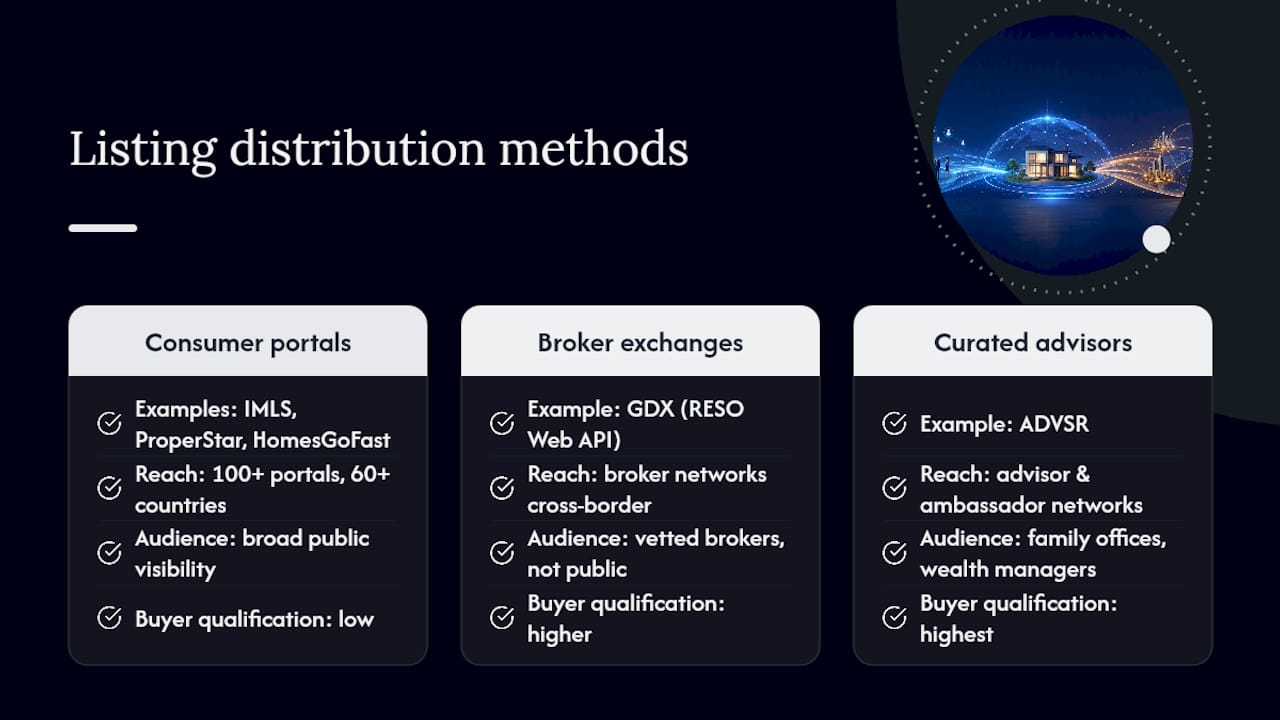
A practical rule of thumb: use consumer syndication (IMLS, ProperStar, HomesGoFast) when the goal is maximum public visibility for a marketable price point. Use standards-based exchange (GDX) and curated advisor networks (ADVSR) when discretion, buyer qualification, or brand control matter more than raw traffic.
Key Criteria for Choosing an International Listing Channel or Partner
Not every platform that claims global reach delivers qualified buyers. Before committing a listing (or a subscription fee) to any channel, evaluate it against these five criteria:
- Audience reach versus lead quality. A portal claiming millions of monthly viewers means little if those viewers are browsing, not buying. Ask for sample lead data: country of origin, inquiry volume by price tier, and how many inquiries convert to a scheduled showing.
- Localization depth. True localization goes beyond a translate button. Check whether currency displays update automatically, whether property descriptions read naturally in the target language, and whether the platform's SEO is actually optimized for search terms used in that country.
- Data control and lead routing. Find out who owns the lead once it comes in. Some networks route inquiries directly to the listing broker, while others insert a referral fee or a third-party agent into the chain without disclosing it upfront.
- Reporting and analytics. Demand real metrics, not vanity numbers. A platform should be able to show view counts by country, inquiry-to-showing conversion, and time-on-listing compared to your local market average.
- Compliance and brand control. Confirm the platform respects your branding, discloses agency relationships correctly, and complies with fair housing and advertising rules in both the listing's home country and the buyer's country.
Platforms like List Globally recommend requesting sample analytics before signing a syndication agreement, a step too many brokers skip because the reach numbers alone sound impressive.
Pro Tip: Ask any platform for anonymized lead data from a listing similar to yours in price and location before you commit. If they can't produce it, that tells you something about the quality of the leads you'll actually receive.
Tactical Marketing Playbook to Attract International Buyers
Visibility alone doesn't close deals. Converting that exposure into qualified interest takes a specific set of tactics, most of which fall into four categories.
Localized creative comes first. Multilingual listing descriptions, currency-localized pricing displays, and downloadable market briefs for priority buyer countries (tax implications, financing options, relocation logistics) all reduce friction for a buyer evaluating a property from another continent. Tools like AgentWrite can help agents produce multilingual listing copy and short-form marketing creative faster than drafting each version manually.
High-impact visual content matters more for international buyers than for local ones, since many will never see the property in person before making an offer. Short-form video, immersive 3D tours, and AI-generated dubbing or subtitles in the buyer's language let a listing communicate scale and finish quality without requiring a flight.
- Build multilingual listing pages and downloadable buyer briefs for your top three source countries.
- Commission a 3D tour and short-form video with localized captions or dubbing.
- Track relocation, visa, and tax-search signals to identify likely buyers before they start browsing listings.
- Staff multilingual chat or a 24/7 response workflow so an inquiry from a different time zone doesn't sit unanswered for eight hours.
Predictive marketing is where the industry's current playbook is heading. Instead of waiting for a buyer to search a specific address, agents track intent signals such as relocation research, international school inquiries, and visa or tax planning activity, then run targeted campaigns in the wealth hubs those signals point toward. Being visible before someone starts formally searching converts more of that hidden demand into a real lead.
Pro Tip: A multilingual chatbot that can at least triage inquiries and schedule a call closes more deals than a perfectly translated brochure that sits unanswered overnight.
Public Listing vs. Off-Market Distribution for Luxury Properties
Public syndication maximizes reach but sacrifices discretion, a tradeoff that matters most at the top of the market. Off-market distribution through private transactions protects a seller's privacy and can filter out unqualified lookers, but it inherently limits the buyer pool to whoever is already inside a trusted broker network.
- Public syndication wins on volume and works well for well-priced luxury homes without unusual privacy concerns.
- Off-market distribution wins on discretion and buyer quality, and suits high-profile sellers, unique architectural properties, or assets priced well above the local comparable range.
- A hybrid sequence often performs best: start with private outreach to vetted brokers through a standards-based network like GDX, then layer in controlled public syndication and targeted paid creative in specific buyer-source markets if a qualified offer hasn't emerged within a set window.
Success gets measured differently depending on the path. Off-market campaigns track qualified showings and broker inquiries rather than page views, while public syndication tracks portal traffic, lead volume, and geographic origin of inquiries. If either approach stalls after 30 to 45 days without serious interest, that's the signal to pivot toward the other.
A Las Vegas Case in Point
Applying this playbook looks different in practice than on a slide deck. At Yhluxrealestate, a relocation concierge service for out-of-state buyers and access to off-market Las Vegas inventory routinely accelerate qualified interest that public syndication alone wouldn't surface, because many high-net-worth buyers relocating for tax or lifestyle reasons never browse public portals at all.
A typical workflow for a luxury Las Vegas listing looks like this:
- Brief the listing internally and determine whether private outreach or public syndication (or both) fits the seller's privacy needs.
- Route the property through the Sotheby's International Realty global network for immediate broker-to-broker visibility abroad.
- Layer in multilingual marketing materials and video for any public syndication component.
- Use negotiation strategy focused on client positioning once qualified showings begin, whether the buyer originated from a private referral or a syndicated portal inquiry.
Where the Conventional Advice Falls Short
Most guidance on international listing exposure treats reach as the whole story: syndicate to more portals, claim a bigger number, call it done. That misses the harder question, which is whether the traffic a platform generates ever turns into a serious, qualified buyer. A listing that appears on 100 portals in 60 countries means very little if none of those viewers can actually close on an eight-figure property.
The sellers and brokers who get this right treat syndication and standards-based broker networks as complementary tools, not competing ones. Public reach through IMLS or portal networks builds top-of-funnel awareness. GDX and curated advisor networks like ADVSR filter that awareness down to buyers who are actually positioned to transact. Skipping the second layer is the single most common mistake I see in how sellers approach global marketing.
For luxury and off-market properties specifically, the sequence matters more than the channel count. Private outreach first, public syndication second if needed, and multilingual creative running underneath both. Read that order, not the portal list, as the real playbook.
— Yelena
Take the Next Step With Yhluxrealestate
Global syndication and multilingual campaigns widen the funnel, but they can't replace what a curated network delivers for a luxury sale: buyers who are already qualified before the first showing. That's the gap Yhluxrealestate fills for Las Vegas sellers. Beyond standard syndication, Yhluxrealestate brings access to off-market inventory and a global buyer network backed by Sotheby's International Realty, meaning your listing can reach vetted international buyers through private broker channels, not just public portal traffic.

For sellers weighing whether to go fully public or protect their privacy, a relocation concierge service handles the logistics for out-of-state and international buyers while negotiation strategy stays focused on your positioning throughout the sale. If you're planning to list a Las Vegas luxury property and want a strategy built around your privacy needs and target buyer geography, reach out to Yhluxrealestate to map out the right mix of syndicated and private exposure for your property.
Sources
Before signing with any platform, read the source material directly rather than relying on a sales pitch. The IMLS syndication announcement spells out exactly which portals and countries are included. The GDX overview explains how RESO Web API interoperability actually works at the data level. NAR's international transactions report remains the most credible source for foreign-buyer statistics, and it's worth checking the latest edition before quoting any figure to a client.
- The International MLS IMLS® Now Provides A Global Syndication Option For Their Members
- 2024 international transactions in U.S. residential real estate report
- International Real Estate Marketing Strategy 2026: The Global Agent’s Playbook
FAQ
What does "international exposure" mean for a property listing?
It means your listing is actively marketed and made discoverable to buyers outside your home country, through syndication to foreign portals, standards-based broker networks like GDX, or targeted campaigns in specific buyer-source markets.
How much of my marketing budget should go toward international buyers?
There's no universal percentage. It depends on your property type and price point: luxury, resort, and investment-grade assets typically justify heavier international spend, while standard residential listings usually see limited return from it.
What's a good platform for reaching international buyers?
No single platform covers every buyer type. Syndication networks like IMLS and portals like ProperStar or HomesGoFast maximize public reach, while GDX and curated networks like ADVSR suit brokers prioritizing discretion and buyer qualification over volume.
Who actually buys U.S. real estate as international buyers?
Foreign buyers span individual relocators, investors, and institutional purchasers, and NAR's international transactions report breaks down buyer origin and purchase patterns by country and property type in detail.
Should luxury sellers avoid public syndication entirely?
Not necessarily. A hybrid approach often works best: start with private broker-to-broker outreach through networks like GDX, then add controlled public syndication if a qualified offer hasn't materialized within a reasonable window.