
Pricing a luxury home to sell is defined as the disciplined process of setting a list price that reflects precise market data, property condition, and buyer psychology to achieve a strong, timely sale. The median U.S. luxury home sale price rose 4.7% year over year to $1.37 million as of may 2026, outpacing non-luxury gains of 1.4% by more than triple. That gap signals a market where sellers hold real leverage, but only when pricing is exact. Mispricing a luxury property, even by a modest margin, triggers extended market time, price reductions, and a final sale price that falls well below potential. The strategies in this guide apply directly to sellers who want to attract qualified buyers and close at the strongest possible number.
What factors determine the right price for a luxury home?
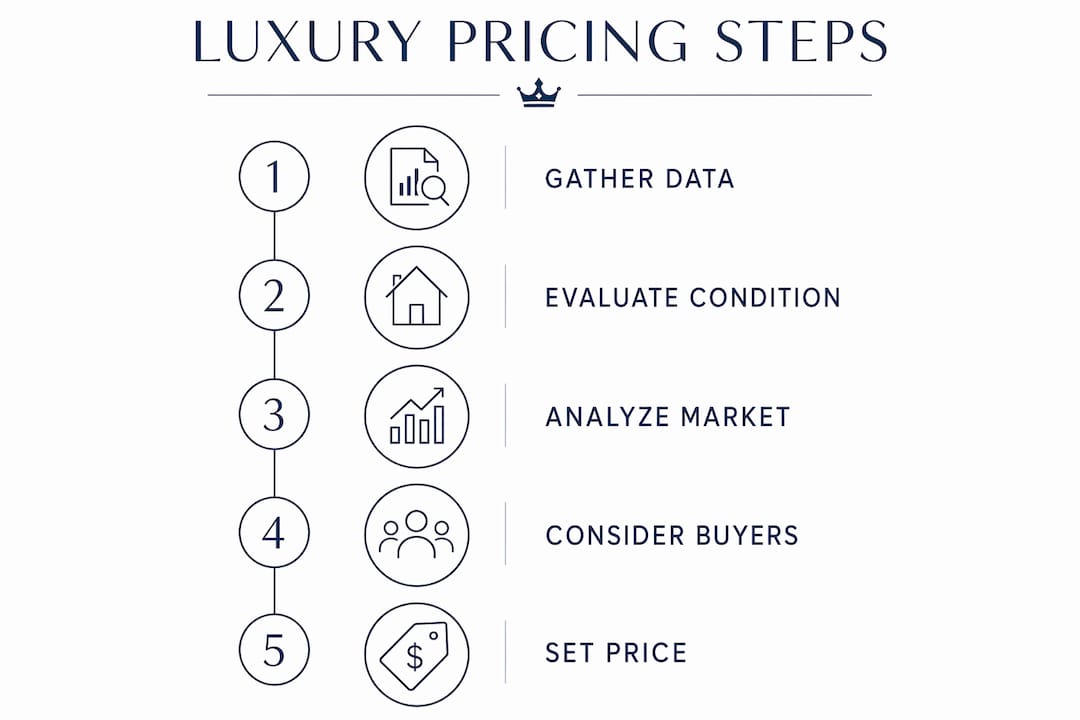
High-end property valuation rests on four core variables: recent comparable sales, property condition, market absorption rates, and buyer demographics. Each one carries weight, and ignoring any single factor produces a list price that the market will reject.
Recent comparable sales form the foundation of any credible pricing analysis. Adjust every comparable for square footage, lot size, condition, location within the neighborhood, and the date of sale. A comparable that closed eight months ago in a rising market requires an upward adjustment; one in a declining micro-market requires the opposite.

Property condition is where luxury pricing diverges most sharply from standard residential practice. Turnkey renovated luxury homes command an 11–14% premium over unrenovated alternatives. That premium reflects real buyer demand, not seller optimism. A seller who prices an unrenovated home at turnkey value is not leaving money on the table; the seller is actively repelling the buyers most likely to close.
Market absorption rates tell you how quickly homes in a given price tier are selling. A tier with a six-month supply is balanced; anything above that favors buyers and demands a sharper opening price. Absorption rates also reveal whether the luxury segment is tightening or softening, which shapes how aggressively a seller can price from day one.
Buyer demographics in the luxury segment skew heavily toward all-cash transactions. Over 50% of micro-market luxury transactions are all cash. Cash buyers move faster and negotiate differently than financed buyers, which means a well-priced home can close in weeks rather than months.
Pro Tip: Price your home using two tiers: a private internal target representing your true minimum acceptable price, and a public list price set to attract serious buyers without signaling desperation. This two-tier approach, drawn from disciplined pricing methodology, keeps your negotiating position intact from the first showing.
How to analyze market data and competition to optimize your list price
Analyzing the luxury real estate market for pricing purposes requires three data layers: active listings, recently closed sales, and pending transactions. Each layer answers a different question.
-
Active listings show you the competition your home faces today. Review every active listing in your price tier within the same neighborhood or comparable micro-market. Note their days on market, price history, and condition. A listing that has sat for 90 days with two price reductions tells you the original price was wrong, and it anchors buyer expectations downward for the entire tier.
-
Recently closed sales are the most reliable pricing evidence. Focus on sales from the past 90 days, adjusting for condition and date. Luxury homes trade at approximately 99.01% of their final list price across North America. That figure means the market is precise. A $3 million home that closes at 99.01% of list sells for $2,970,300. Every percentage point of overpricing costs real dollars.
-
Pending transactions reveal where buyer demand is concentrating right now. A cluster of pending sales in a specific price band signals a sweet spot. Pricing your home at the lower edge of that band can generate multiple offers and compress days on market.
The data source matters as much as the data itself. Professional agents with access to systems like CRMLS pull verified, real-time transaction data. Automated valuation tools such as Zillow use public records with significant lag and no condition adjustments. For a property priced above $1 million, the difference between accurate agent data and an automated estimate can exceed $200,000.
| Data Layer | What It Reveals | How to Use It |
|---|---|---|
| Active listings | Current competition and price anchors | Identify overpriced inventory dragging the tier down |
| Closed sales (90 days) | True market value with condition adjustments | Set your baseline price per square foot |
| Pending transactions | Live buyer demand concentration | Find the price band attracting the most offers |
| Days on market trends | Pricing accuracy signals | Avoid price ranges with high average days on market |
Pro Tip: Track the list-to-sale price ratio for every comparable in your tier. A tight ratio, meaning homes closing near their original list price, confirms that the tier is pricing accurately. A wide ratio signals chronic overpricing across the segment, which you can exploit by entering at a sharper, more credible number.
What pricing mistakes cost luxury sellers the most?
Overpricing is the single most damaging error a luxury seller can make. It functions as a visibility barrier, filtering out the most qualified buyers before they ever schedule a showing. Beverly Hills homes that required price cuts closed for $342,000 below their original list price and spent significantly more time on market. That outcome is not a negotiation result. It is the cost of a wrong opening price.
The most common pricing mistakes in the luxury segment include the following:
- Pricing for renovation value the home does not have. An unrenovated property priced as turnkey will sit. Buyers who can afford turnkey will buy turnkey. Buyers who want a project will not pay turnkey prices. Price the home to reflect its actual condition and attract the right buyer pool.
- Building in negotiating room. Pricing with artificial buffer invites lowball offers and signals to sophisticated buyers that the seller lacks market knowledge. Luxury buyers are not retail shoppers hunting for discounts. They are capital allocators who read pricing signals carefully.
- Ignoring price history signals. Multiple listings, significant repricing, or long market time signal pricing or condition issues to every buyer who researches the property. A home that has been relisted or repriced carries a stigma that a correct opening price prevents entirely.
- Delaying meaningful price adjustments. A $25,000 reduction on a $4 million listing is noise. Buyers notice it, but it does not change their calculus. If a price adjustment is necessary, make it decisive. A reduction of 3–5% moves the needle; a symbolic cut wastes time and erodes seller credibility.
Overpricing a luxury home does not create negotiating room. It creates a record of failure that follows the listing through every subsequent price cut, every relisting, and every buyer conversation. The market remembers, and sophisticated buyers use that history as leverage.
Pro Tip: Set a firm internal deadline before listing. If the home receives no serious offers within 21 days at the opening price, be prepared to make a meaningful adjustment immediately. Waiting longer compounds the stigma and reduces your final sale price further.
How do luxury buyers' motivations affect your pricing strategy?
Luxury buyers operate from a fundamentally different set of priorities than standard residential buyers. Understanding those priorities is not optional for sellers who want to price effectively. It is the difference between a property that attracts confident offers and one that generates cautious, low inquiries.
The defining characteristics of luxury buyer behavior include these patterns:
- Capital preservation over appreciation. Luxury buyers focus on long-term tax positioning and capital preservation rather than speculative gains. A price that reflects genuine market value signals safety. A price that appears inflated signals risk, and these buyers walk away from risk.
- Interest rate insensitivity. Luxury buyers are less sensitive to interest rates than typical buyers. Their purchase decisions hinge on value, condition, and market timing, not financing costs. This means price reductions tied to rate environment arguments carry little weight with this audience.
- Sensitivity to ownership cost transparency. Disclosing HOA assessments, insurance premiums, and special fees upfront prevents late-stage deal collapse. Buyers who discover unexpected carrying costs during due diligence renegotiate aggressively or walk. Factoring those costs into your pricing presentation builds trust and keeps deals intact.
- Preference for clean price histories. A home that enters the market at the right price and sells without reductions signals quality and seller confidence. That signal attracts buyers who are ready to move decisively.
Sellers who understand these motivations can align their luxury listing pricing strategy with what buyers actually respond to, rather than what sellers assume buyers want. The result is a faster sale at a stronger price.
Key Takeaways
Pricing a luxury home to sell correctly from day one is the single most consequential decision a seller makes, because overpricing creates a market record that depresses the final sale price far below what a well-positioned opening would have achieved.
| Point | Details |
|---|---|
| Open at the right price | Homes requiring price cuts close an average of $342,000 below original list in high-end markets. |
| Adjust for renovation status | Turnkey homes command an 11–14% premium; price unrenovated properties to reflect actual condition. |
| Use verified transaction data | Agent-accessed systems like CRMLS deliver precision that automated tools cannot match at the luxury tier. |
| Understand your buyer | Over 50% of luxury micro-market transactions are all cash; these buyers read pricing signals with discipline. |
| Make decisive adjustments | A symbolic price cut wastes time; a 3–5% reduction is the minimum threshold to shift buyer perception. |
What I have learned about pricing luxury homes after years in this market
The sellers who achieve the strongest outcomes share one trait: they treat the opening list price as a strategic commitment, not a starting bid. I have seen sellers in the Las Vegas luxury market price with artificial buffer, convinced they were protecting themselves. What they were actually doing was handing their most qualified buyers a reason to look elsewhere.
The data on list price to final sale price ratio is unambiguous. A tight delta between original list and final close price is the clearest indicator of effective pricing from the outset. Sellers who achieve that tight delta do not get there by luck. They get there by doing the analytical work before the listing goes live, not after the first week of silence.
What surprises most sellers is how quickly the luxury buyer pool forms a consensus about a property. Within the first 10 days on market, the most active buyers in a given tier have already evaluated the listing. If the price is wrong, those buyers move on and rarely return, even after a reduction. The window for a clean, confident sale is narrow, and it opens at the moment of listing.
My advice to every seller I work with is the same: know your number before you list, price it with discipline, and resist the temptation to test the market at a higher figure. The market does not reward optimism. It rewards accuracy.
— Yelena
Pricing your luxury home with Yhluxrealestate
Sellers in the Las Vegas luxury market who want a precise, data-driven approach to high-end property valuation work with Yhluxrealestate. Yelena Horton brings deep knowledge of local micro-markets, verified transaction data, and a disciplined pricing methodology that keeps the list-to-sale price ratio tight from day one.

Yhluxrealestate, backed by Sotheby's International Realty's global network, provides custom market analysis tailored to your property's condition, location, and the specific buyer profile most likely to close. Whether you are selling a turnkey estate or a property that reflects its renovation opportunity in the price, the approach is grounded in what the market will actually bear. Contact Yhluxrealestate to schedule a confidential pricing consultation and position your home for the strongest possible outcome.
FAQ
What is the average price of a luxury home in the U.S.?
The median U.S. luxury home sale price reached $1.37 million as of may 2026, reflecting a 4.7% year-over-year increase. The luxury threshold across North America begins at approximately $900,000.
How long does a well-priced luxury home take to sell?
Well-priced luxury homes typically sell within 23–30 days. Overpriced homes can remain on market for 70 or more days and ultimately close well below the original asking price.
Why does overpricing hurt luxury home sales more than standard sales?
Luxury buyers are sophisticated capital allocators who research price histories carefully. A home with reductions or extended market time carries a stigma that depresses final offers, as seen in Beverly Hills data showing $342,000 gaps between original list and final close price.
Should I factor renovation costs into my luxury home's list price?
Yes. Unrenovated luxury homes must be priced to reflect their actual condition. Pricing an unrenovated property at turnkey value repels both turnkey buyers and value buyers, leaving the home without a natural audience.
How do I know if my luxury home is priced correctly?
Track the list-to-sale price ratio and days on market for recent comparable sales in your tier. If your home receives no serious offers within the first 21 days, the price requires a meaningful adjustment of at least 3–5% to shift buyer perception.