
Luxury property negotiation is defined as the structured process of aligning price, terms, and psychological positioning to secure a high-value real estate transaction on favorable terms. The most effective buyers in the $2M+ market understand that winning a luxury property deal depends far less on the headline number and far more on controlling the narrative, reading seller motivations, and structuring offers that address needs the asking price cannot. Timing, concessions, and psychological leverage routinely determine outcomes in high-end property bargaining. This guide delivers the precise tactics that sophisticated buyers use to close with confidence.
What drives luxury property negotiation beyond price?
The most consequential insight in luxury real estate negotiation is that sellers in the ultra-high-net-worth segment are rarely motivated by price alone. Lifestyle continuity, privacy, legacy, and timing weigh heavily in their decisions. A buyer who understands those motivations holds a structural advantage before a single offer is written.

Narrative control is the first lever. Agents who shape how a property's value is perceived early in the process win more deals than those who simply push for lower prices. Framing your offer as a recognition of the property's distinction, rather than a challenge to its worth, keeps sellers engaged and receptive.
Three psychological principles govern luxury negotiations:
- Authority: Presenting pre-underwritten financing, a verifiable track record of acquisitions, and a clear buyer profile signals that you are a serious counterparty, not a speculative one.
- Strategic silence: Delaying counteroffers signals confidence and creates pressure that reveals the seller's true motivation. Silence is not passivity. It is a deliberate tool.
- Empathy mapping: Identifying whether the seller faces a relocation deadline, an estate settlement, or a lifestyle transition allows you to craft terms that solve their actual problem.
"In ultra-luxury deals, cash offers alone aren't enough. Buyers must demonstrate clean, well-structured terms, financing certainty, and flexible timelines to leverage full advantage."
Understanding seller motivation is more powerful than any single price concession. A seller facing a tight relocation window values a flexible closing date more than an extra $50,000 on the offer price.
How does market timing shape your offer strategy?
Market data is the foundation of any credible offer. Days on market is the single most telling indicator of negotiation room in the luxury segment. Homes listed over 90 days generally offer 8–12% negotiation room below asking price, while homes under 30 days typically yield only 3–5% reductions before sellers disengage. That gap represents hundreds of thousands of dollars on a $3M property.
Anchoring your offer to recent comparable sales, not the asking price, is the correct methodology. Asking price is a seller's aspiration. Comparable sales are the market's verdict. Presenting a well-researched opening offer with documented comparables achieves better engagement and preserves negotiation flexibility, while lowball offers risk offending sellers and closing the conversation entirely.
| Days on Market | Typical Negotiation Room | Recommended Opening Offer |
|---|---|---|
| Under 30 days | 3–5% below asking | 95–97% of list price |
| 30–90 days | 5–8% below asking | 92–95% of list price |
| Over 90 days | 8–12% below asking | 88–92% of list price |
In the $2M–$3M luxury segment, 93–96% of list price is the typical initial offer range for well-priced properties. Knowing where a listing sits within that range before you write the offer separates disciplined buyers from reactive ones.
Pro Tip: Request a full pricing history from your agent before submitting any offer. Price reductions signal seller flexibility and give you a documented basis for anchoring below the current ask.
Earnest money deposits also communicate intent. A larger deposit, relative to market norms, signals financial strength and reduces seller anxiety about deal certainty. That signal alone can shift a seller's willingness to accept a lower price.
Negotiating terms beyond price: credits, timing, and contingencies
The most experienced luxury buyers treat the purchase contract as a multi-dimensional instrument, not a simple price agreement. Seller concessions for repair credits, closing costs, and mortgage rate buydowns can deliver $40,000 to $180,000 in value depending on loan structure and down payment. That range often exceeds what a price reduction of equivalent size would produce after tax and financing effects.
Specific concession categories worth negotiating include:
- Closing cost credits: On a $2M home listed for 45 or more days, $25,000–$40,000 in closing cost credits is achievable. These credits reduce out-of-pocket costs at closing without requiring the seller to formally lower the recorded sale price, which matters for their own comparables.
- Mortgage rate buydowns: Seller-funded rate buydowns reduce monthly payments more effectively than equivalent price cuts. A 1–2% buydown on a $2M loan produces meaningful monthly savings over the life of the mortgage.
- Personal property inclusions: Artwork, furnishings, wine collections, and motorized window treatments are negotiable. These items carry real value and cost the seller less to leave than to move.
Pro Tip: Ask your agent to identify which concessions the seller has already offered to previous buyers who did not close. That history reveals exactly where the seller has flexibility and where they will hold firm.
Flexible closing timelines are among the most underused tools in luxury negotiations. Aligning your closing date with the seller's next acquisition or relocation timeline can be worth $25,000 to $75,000 in perceived value. That figure often exceeds what a price reduction of the same amount would mean to a seller who is already financially comfortable.
Contingencies function as active negotiation levers, not merely protective clauses. Shortening an inspection window from 17 to 10 days signals buyer readiness and communicates confidence in the property's condition. That signal can secure better headline terms in return.
Step-by-step strategies to win luxury property deals
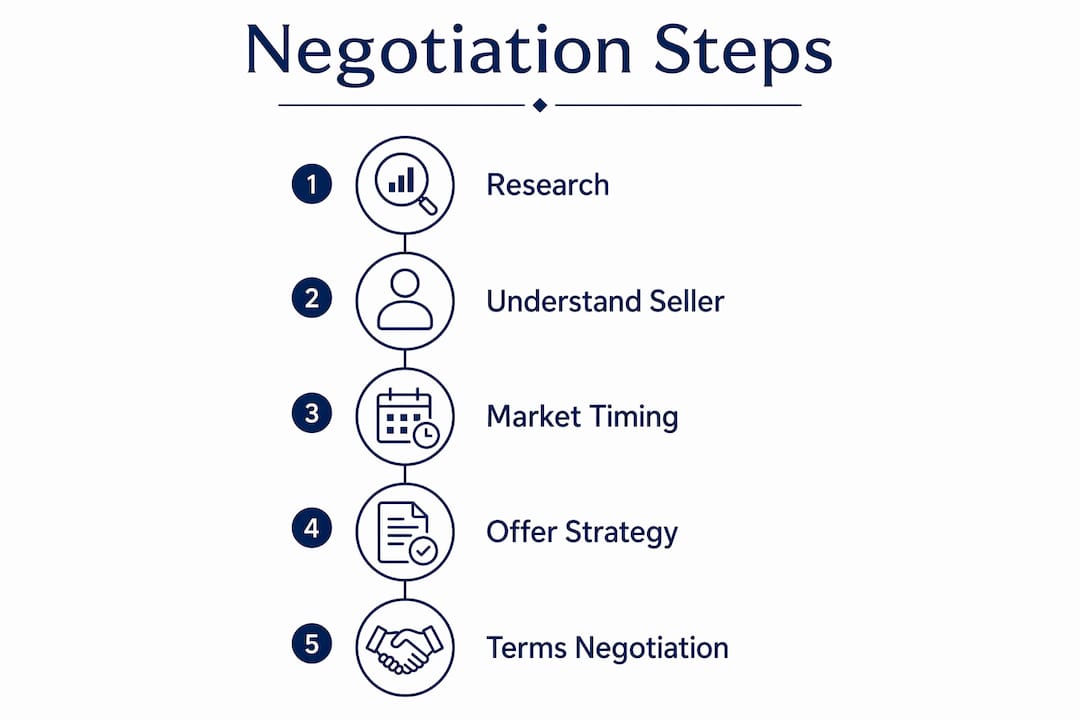
A disciplined process separates buyers who close from those who lose to better-prepared competition. The sequence below reflects how top buyers approach high-end property bargaining from first contact to final signature.
- Complete pre-underwriting before touring. Full loan approval, not pre-qualification, signals to sellers that your financing is certain. This step alone removes one of the most common seller objections.
- Build a complete seller motivation profile. Work with your agent to learn the seller's timeline, their next purchase, and any estate or tax considerations. That profile shapes every term in your offer.
- Anchor with comparables, not emotion. Present your opening offer with a written comparable sales analysis. Sellers who see the data engage; sellers who feel challenged disengage.
- Use silence deliberately after each counter. Strategic silence creates psychological pressure without requiring you to make concessions. Wait 24–48 hours before responding to counteroffers when the market allows.
- Treat the due diligence period as a second negotiation. The 30–60 days post-offer is an active phase. Inspection findings, title review results, and appraisal gaps all create legitimate grounds for credits or price adjustments.
- Offer non-price value to close. Rent-back arrangements, assistance with the seller's administrative transition, and flexible closing terms often secure deals more effectively than additional price concessions by addressing the seller's personal transition needs directly.
Understanding how luxury listing pricing strategies work from the seller's perspective gives buyers a decisive edge at every stage of this process. Buyers who understand how sellers set and defend their prices negotiate from a position of genuine knowledge.
For buyers considering off-market transactions, the same principles apply with one additional layer: the absence of competing offers does not mean the absence of negotiation. Sellers in private transactions often have stronger emotional attachments to their asking price precisely because no market competition has tested it.
Key Takeaways
Winning a luxury property negotiation requires mastering seller motivation, market timing, and term structure simultaneously, not just offering the highest price.
| Point | Details |
|---|---|
| Seller motivation outweighs price | Identify the seller's timeline and transition needs before writing any offer. |
| Days on market signals room | Listings over 90 days offer 8–12% negotiation room; under 30 days, only 3–5%. |
| Terms create hidden value | Closing credits and rate buydowns can deliver $40,000–$180,000 in effective savings. |
| Silence is a negotiation tool | Delaying counteroffers signals confidence and pressures sellers to reveal their floor. |
| Due diligence is a second negotiation | The 30–60 day post-offer period is an active opportunity to reduce costs through credits. |
What I've learned about luxury negotiation that most buyers miss
The most common mistake I see from high-net-worth buyers is treating the offer as the negotiation. They spend weeks preparing their price and then go quiet the moment the contract is signed. The due diligence period is where some of the most significant value is recovered, and most buyers leave it entirely to chance.
The second pattern I observe is an overreliance on price as the primary lever. Sellers in the luxury segment are rarely financially distressed. Cutting $100,000 from a $4M ask may feel significant to the buyer and feel almost irrelevant to the seller. What moves those sellers is certainty, convenience, and the sense that the buyer genuinely values what they have built or curated. A well-structured offer that addresses a seller's relocation timeline, includes a meaningful earnest deposit, and arrives with clean financing will outperform a higher offer that feels uncertain or adversarial.
The Las Vegas luxury market in 2026 rewards buyers who come prepared with data, patience, and a clear understanding of what the seller actually needs. I have seen buyers win properties at prices well below competing offers simply because they offered a closing date that aligned perfectly with the seller's next acquisition. That kind of intelligence is not accidental. It comes from working with an agent who has cultivated relationships in the market long before a listing appears.
Patience is the discipline that separates buyers who close well from those who overpay out of urgency. The right deal, structured correctly, is worth waiting for.
— Yelena
How Yhluxrealestate positions buyers to negotiate and close with confidence
Yhluxrealestate, led by Yelena Horton and backed by Sotheby's International Realty's global network, gives high-net-worth buyers the preparation and positioning that luxury negotiations demand.

Yelena's clients gain access to exclusive off-market listings in Las Vegas, a relocation concierge for out-of-state buyers, and expert offer structuring grounded in current market data. Every engagement includes a thorough analysis of seller motivation, comparable pricing, and term strategy, so buyers arrive at the table with a complete picture rather than a price alone. For buyers evaluating the Las Vegas market from the East Coast or internationally, Yhluxrealestate's approach to evaluating the Las Vegas market ensures that no detail of the local landscape is left unexamined before an offer is made.
FAQ
What is the most effective way to negotiate a luxury home price?
The most effective approach combines a comparable-sales-anchored opening offer with a clear understanding of the seller's timeline and motivations. Price alone rarely closes luxury deals; terms, timing, and certainty of execution carry equal or greater weight.
How much below asking price can buyers negotiate on luxury homes?
Homes listed over 90 days typically offer 8–12% negotiation room, while properties under 30 days on market yield only 3–5% reductions before sellers disengage. The $2M–$3M segment sees initial offers in the 93–96% of list price range for well-priced properties.
What concessions should buyers request in a luxury property deal?
Closing cost credits, mortgage rate buydowns, and personal property inclusions are the most common and valuable concessions. On a $2M home listed 45 or more days, $25,000–$40,000 in closing cost credits is achievable without requiring the seller to formally reduce the recorded sale price.
How do off-market luxury deals differ in negotiation?
Off-market transactions remove competing offers from the equation but often involve sellers with stronger emotional attachments to their asking price. Buyers in private deals benefit from understanding private real estate transactions and must rely more heavily on relationship-building and non-price terms to create movement.
Is the due diligence period part of the negotiation?
The 30–60 day post-offer period is an active negotiation phase. Inspection findings, appraisal results, and title review outcomes all create legitimate grounds for repair credits or price adjustments, and experienced luxury buyers treat this period as a continuation of the deal-making process.