
Marketing luxury property globally is a strategic discipline defined by the precise alignment of asset presentation, buyer psychology, and cross-border market intelligence. The global luxury real estate sector entered 2026 in a state of deliberate recalibration: buyer demand fell from 37.7 to 29.3 on the Prime Sentiment Index, yet price outlook rose from 13.8 to 14.6 in the same period. That divergence is the defining signal for sellers and their advisors. Scarcity, turnkey quality, and tax-stable environments now function as the three structural pillars that attract capital across borders, and off-market access has become a de rigueur advantage for the most discerning high-net-worth buyers.
What are the primary global markets high-net-worth investors target?
The global luxury real estate map shifted considerably in 2025 and into 2026, rewarding markets with constrained supply and favorable currency dynamics. Tokyo led all luxury markets with a 59% year-over-year price increase, driven by foreign buyer demand and yen depreciation that made prime assets extraordinarily accessible to dollar and euro-denominated wealth. Dubai followed with 25% growth, and Manila registered 18%, both benefiting from low transaction taxes and a growing concentration of relocating ultra-high-net-worth individuals. Guangzhou, by contrast, declined 12%, illustrating how regulatory friction and oversupply can erode even well-established luxury corridors.
The structural force behind these divergences is wealth creation itself. Wealth grows at 5.3% annually while global GDP expands at only 3.3%. That gap means affluent capital accumulates faster than the broader economy and seeks assets that preserve purchasing power across jurisdictions. Tax-driven mobility shapes where that capital lands, with investors actively comparing estate tax regimes, capital gains treatment, and residency-by-investment programs before committing to a market.
The practical implication for anyone seeking to market international high-end properties is clear. Markets that combine genuine supply constraints with favorable fiscal environments attract disproportionate buyer attention. Sellers in Tokyo, Dubai, and select Southeast Asian corridors hold a structural advantage that no amount of marketing spend can replicate in oversupplied or tax-hostile markets.
Emerging versus established luxury corridors
Established corridors like London's Mayfair, New York's Upper East Side, and Monaco retain their prestige, but they face intensifying competition from markets that offer comparable quality with superior tax treatment and lifestyle flexibility. Investors building a durable luxury real estate portfolio increasingly allocate across both tiers, treating established markets as stores of value and emerging corridors as appreciation plays.
How to prepare and stage luxury property for international marketing
Turnkey readiness is the single most powerful attribute a luxury property can present to a global buyer. Affluent buyers pay a premium to eliminate renovation risk entirely, and the market has bifurcated sharply between move-in-ready assets and speculative projects requiring years of patience. A fully furnished, professionally serviced property with curated interiors and operational systems commands both a higher price and a faster sale cycle than an equivalent property presented in raw or partially finished condition.
Preparing a luxury property to stage for sale at the international level requires a methodical sequence of decisions.
-
Commission a professional staging consultation from a firm with documented experience in the ultra-prime segment. Staging at this level extends beyond furniture placement to encompass lighting design, scent, art curation, and the calibration of every sensory detail a discerning buyer will register within the first sixty seconds of entry.
-
Audit all mechanical and operational systems before any marketing materials are produced. Buyers at this price point expect uncompromising standards in HVAC, home automation, security infrastructure, and building services. A single deferred maintenance item can signal broader neglect and suppress offer values.
-
Assemble a quality credentials package that documents the developer's track record, construction specifications, and any third-party certifications. Trust Scores reflecting developer governance and delivery history carry more weight with sophisticated buyers than promotional amenity listings. Buyers who have been disappointed by off-plan projects in other markets arrive with heightened scrutiny.
-
Clarify the investment horizon the property serves. Buyers distinguish between near-term occupancy needs and long-term capital appreciation plays. A property with a 2030–2031 completion timeline is unsuitable for a buyer seeking immediate rental income or personal occupancy. Marketing materials must be calibrated to the correct buyer profile from the outset.
-
Produce cinematic-quality visual assets including aerial footage, virtual walk-throughs, and architectural photography that meets the editorial standards of publications like Architectural Digest or The Wall Street Journal real estate section. Global buyers frequently make shortlist decisions remotely before committing to a physical inspection.
Pro Tip: Commission a private preview event for a curated list of qualified buyers before the property enters any public portal. The perception of exclusivity created by a private showing often generates competitive tension that a public listing cannot replicate.
Which channels and networks reach qualified global luxury buyers?
Reaching the right buyer for an overseas luxury home requires channels that operate at the intersection of exclusivity and global reach. The most effective networks are not the most visible ones.
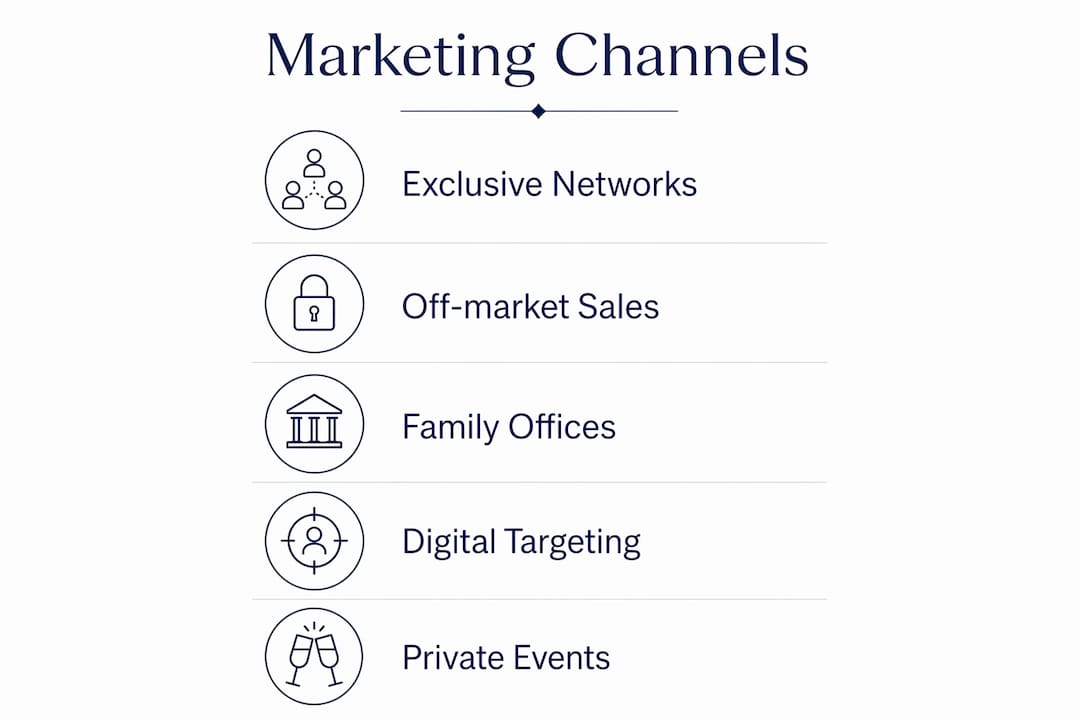
The channels that consistently deliver qualified international buyers share several defining characteristics.
Exclusive real estate networks affiliated with global luxury brands provide immediate access to a pre-qualified buyer pool. Yhluxrealestate operates within the Sotheby's International Realty network, which provides reach across more than 80 countries and a client base that includes family offices, sovereign wealth advisors, and private banking clients who represent the true universe of ultra-high-net-worth buyers.
Off-market transactions have grown in prominence precisely because privacy is a non-negotiable priority for UHNW investors. Off-market luxury transactions allow buyers to evaluate assets without public exposure, protecting both their identity and their negotiating position. Sellers benefit equally, avoiding the reputational signal that a prolonged public listing can create.
Family office and private banking networks function as the most direct path to capital at the ultra-prime level. Advisors within these institutions field acquisition mandates from clients who have already defined their criteria. A property that reaches a family office advisor through a trusted intermediary arrives with an implicit endorsement that no portal listing can provide.
Digital precision targeting complements these relationship-driven channels. Private virtual tours, geo-targeted digital campaigns directed at high-net-worth zip codes and wealth segments, and curated social media content distributed through invitation-only channels all extend reach without sacrificing the exclusivity that defines the asset class.
Pro Tip: When marketing to international buyers, prepare a one-page investment summary that addresses currency exposure, local tax treatment, and net yield projections alongside the property's physical attributes. Buyers evaluating multiple markets simultaneously will prioritize the asset that answers their financial questions first.
What are the strategies to review, negotiate, and close offers globally?
Successfully reviewing and closing offers on luxury properties abroad requires a structured process that accounts for the legal, fiscal, and relational complexity of cross-border transactions.
-
Evaluate every offer through a tax and currency lens first. An offer denominated in a depreciating currency or structured through a jurisdiction with opaque ownership rules carries risk that the headline price does not reflect. Engage a cross-border tax advisor before accepting or countering any offer from an international buyer.
-
Assess the opportunity cost of capital before setting a negotiating floor. Opportunity cost modeling must account for capital locked over multi-year construction timelines, weighed against projected appreciation and alternative liquid returns. A buyer who understands this calculation will negotiate with greater conviction and close with greater confidence.
-
Validate buyer credibility through structured due diligence. International transactions require proof of funds, source-of-wealth documentation, and in many jurisdictions, anti-money-laundering compliance verification. Requesting this documentation early filters uncommitted buyers and protects the seller's timeline.
-
Negotiate on terms, not only price. Closing timelines, furniture and art inclusion, service contract transfers, and property management arrangements all carry monetary value. Sophisticated sellers use these elements to preserve headline price while accommodating buyer preferences that would otherwise stall a negotiation.
-
Build a defined exit strategy before accepting any offer. A well-considered exit strategy accounts for holding period, anticipated market conditions at the point of resale, and the tax treatment of gains in both the property's jurisdiction and the seller's home country. Sellers who enter a transaction without this clarity routinely leave material value unrealized.
The negotiation dynamic in global luxury real estate rewards patience and preparation in equal measure. Buyers who have traveled internationally to inspect a property have already demonstrated serious intent. Sellers who meet that intent with thorough documentation and a clear value narrative close at stronger multiples than those who rely on the asset's physical appeal alone.
Key Takeaways
Effectively marketing luxury property globally in 2026 requires mastering three pillars: market selection grounded in structural drivers, turnkey asset presentation, and access to exclusive buyer networks that operate beyond public portals.
| Point | Details |
|---|---|
| Market selection is structural | Target markets combining scarcity, tax stability, and supply constraints, as Tokyo's 59% growth illustrates. |
| Turnkey readiness commands a premium | Buyers pay above market to eliminate renovation risk; present fully furnished, operationally complete assets. |
| Off-market access is a competitive edge | UHNW buyers prioritize privacy; off-market channels deliver qualified buyers without public exposure. |
| Offer review requires cross-border rigor | Evaluate currency, tax treatment, and opportunity cost before accepting or countering any international offer. |
| Exit strategy protects realized value | Define holding period, resale conditions, and tax implications before closing to avoid leaving gains unrealized. |
What I have learned about marketing luxury property in 2026
The most common mistake I see sellers make is treating global luxury marketing as a volume exercise. They list on every portal, produce standard photography, and wait. That approach works in commodity markets. It fails at the ultra-prime level, where the buyer pool is measured in hundreds, not thousands, and where every detail of the presentation either builds or erodes confidence.
What actually moves these assets is the combination of structural market intelligence and relationship-driven distribution. When I work with clients at Yhluxrealestate, the first conversation is never about the property's features. It is about the buyer profile we are targeting and the network path most likely to reach that specific individual. A family office advisor in Singapore has different priorities than a private banking client in Geneva, and the presentation must reflect that distinction.
The rise of off-market transactions is the most significant structural shift I have observed in recent years. Buyers at the UHNW level have grown deeply averse to public exposure, and sellers who can offer genuine discretion command a relationship advantage that no marketing budget can replicate. The properties that close fastest and at the strongest multiples are almost always the ones that never appeared on a public portal.
The other insight I would offer is this: turnkey readiness is not a preference, it is a price signal. A property that requires renovation tells a sophisticated buyer that the seller either could not afford to prepare it or did not understand the market. Neither interpretation supports a strong offer. The sellers who invest in presentation before marketing consistently outperform those who do not, regardless of the underlying asset quality.
— Yelena
Yhluxrealestate and the global luxury property market
Yhluxrealestate, led by Yelena Horton, brings the full weight of the Sotheby's International Realty network to every client engagement, providing access to qualified buyers and exclusive listings across more than 80 countries. Whether you are preparing to market an ultra-prime asset or seeking off-market acquisition opportunities, the approach is always calibrated to your specific investment horizon and buyer profile.
Yhluxrealestate offers a relocation concierge for out-of-state buyers, expert negotiation positioning, and exclusive access to properties that never reach public portals. For investors and sellers who require uncompromising standards at every stage of the transaction, connect with Yhluxrealestate to begin a conversation grounded in market intelligence and genuine global reach.
FAQ
What drives luxury property price growth in global markets?
Scarcity, tax stability, and turnkey quality are the three structural pillars that attract capital to luxury markets. Wealth creation growing at 5.3% annually outpaces GDP, directing surplus capital toward assets that preserve value across jurisdictions.
How do off-market transactions benefit luxury property sellers?
Off-market transactions protect seller confidentiality, avoid the reputational signal of a prolonged public listing, and deliver buyers who have already demonstrated serious intent. Yhluxrealestate provides access to this channel through its Sotheby's International Realty network.
What does turnkey readiness mean for luxury property buyers?
Turnkey readiness means a property is fully furnished, operationally complete, and requires no renovation before occupancy. Affluent buyers pay a premium for this condition because it eliminates renovation risk and ensures immediate use or rental income.
How should investors review offers on international luxury properties?
Every offer should be evaluated through a tax, currency, and opportunity cost framework before any price negotiation begins. Engaging a cross-border tax advisor and modeling capital opportunity cost against projected appreciation are non-negotiable steps in this process.
Which global luxury markets performed best in 2025?
Tokyo led with 59% price growth, followed by Dubai at 25% and Manila at 18%. These markets combined foreign buyer demand, favorable currency dynamics, and constrained supply to generate outsized returns.