
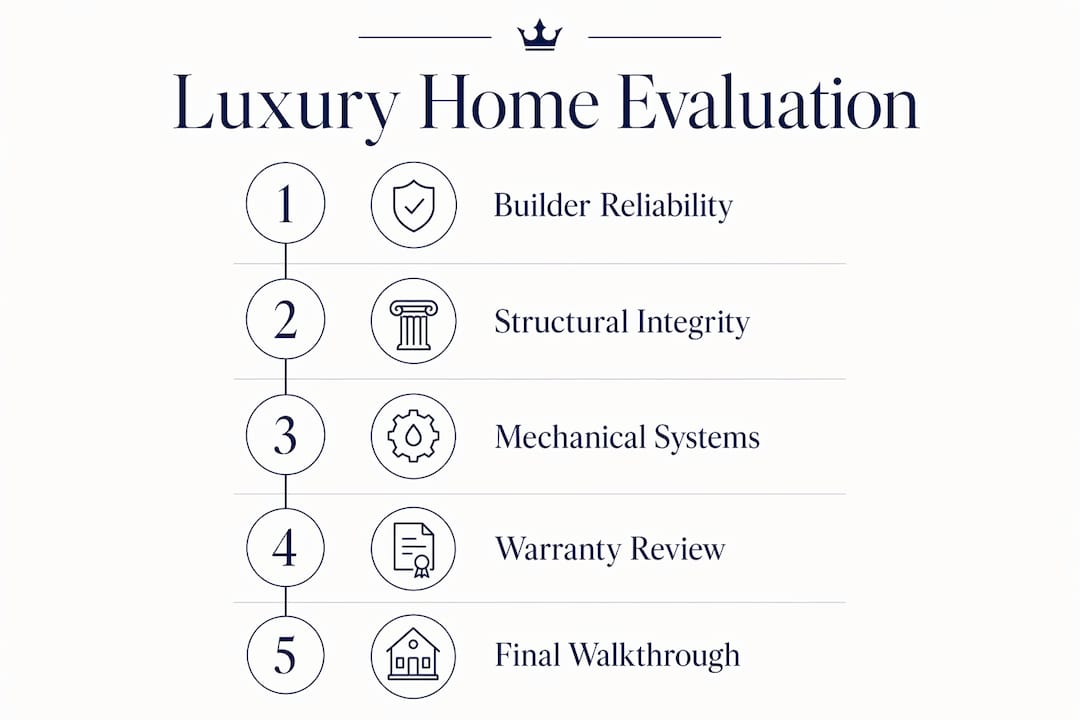
Evaluating luxury home build quality demands a methodical eye trained on what lies beneath the surface, not merely what dazzles at first glance. The most reliable assessment rests on six pillars: the builder's proven track record, the coherence of craftsmanship across every room, the transparency of contracts and pricing, the clarity of communication structures, the quality of mechanical systems, and the rigor of milestone inspections embedded throughout construction. A home priced in the high luxury market is not automatically a well-built home; it is a new home, and build quality is a separate question requiring a separate evaluation.
The core elements to verify before any offer:
- Builder's market longevity and consistency within the luxury segment
- Portfolio quality and craftsmanship coherence across completed projects
- Contract transparency, including clear pricing methodologies and defined scope
- Single-point accountability and structured communication protocols
- Mechanical systems quality, including HVAC zoning, insulation type, and electrical capacity
- Milestone inspection records confirming quality assurance at each build phase
How to evaluate luxury home build quality through builder reliability
A builder's longevity in the luxury segment is among the most telling indicators of sustained quality. Firms that have operated consistently across market cycles tend to maintain stable trade relationships, refined construction processes, and a portfolio deep enough to reveal patterns, both admirable and cautionary.
Craftsmanship portfolios deserve more than a cursory glance at listing photography. Visit completed homes in person when possible, paying particular attention to how finishes transition between rooms, whether millwork alignments remain consistent from the principal suite to the smallest corridor, and whether the overall execution feels deliberate rather than assembled under pressure. Quality assurance embedded at construction milestones catches defects in custom millwork and integrated smart systems during the build, not after the walls are closed.
Contract transparency is equally revealing. A builder confident in their work presents pricing methodologies clearly, defines scope without ambiguity, and does not bury risk in vague allowance figures. The communication structure matters as much as the contract language itself; a single accountable point of contact who can speak to mechanical specifications, subcontractor relationships, and schedule milestones signals an organization that builds with intention.
Trade partner stability is a dimension buyers rarely investigate and almost always regret overlooking. The quality of a luxury home's finish carpentry, tile work, and mechanical installations depends entirely on the subcontractors a builder retains across projects. Builders who maintain long-term relationships with the same skilled tradespeople produce more consistent results than those who assemble new crews for each project.
Four questions that reveal what a walkthrough cannot
The four questions that expose true construction quality during any walkthrough address insulation, subfloor material, window specifications, and HVAC design. These are the systems behind the walls, and spray foam insulation outperforms fiberglass batts for air sealing and noise control, making it the expected standard at the upper tier of the luxury market.
Ask about the subfloor next. Three-quarter-inch tongue-and-groove plywood is stronger and quieter than thinner OSB panels; any flex or bounce underfoot during the walkthrough is a conversation that must happen before signing. Window specifications follow: double-pane low-E glass is the minimum acceptable standard, and the frame material and energy rating reveal where a builder's priorities genuinely lie.
HVAC zoning is where comfort lives or fails. A multi-story luxury home running on a single zone can produce temperature differentials of ten degrees between floors during peak summer months, a design failure that proves expensive to correct after closing. Ask for the tonnage and zone count; a builder who cannot answer that question on the spot has not built the home with the care the price demands.
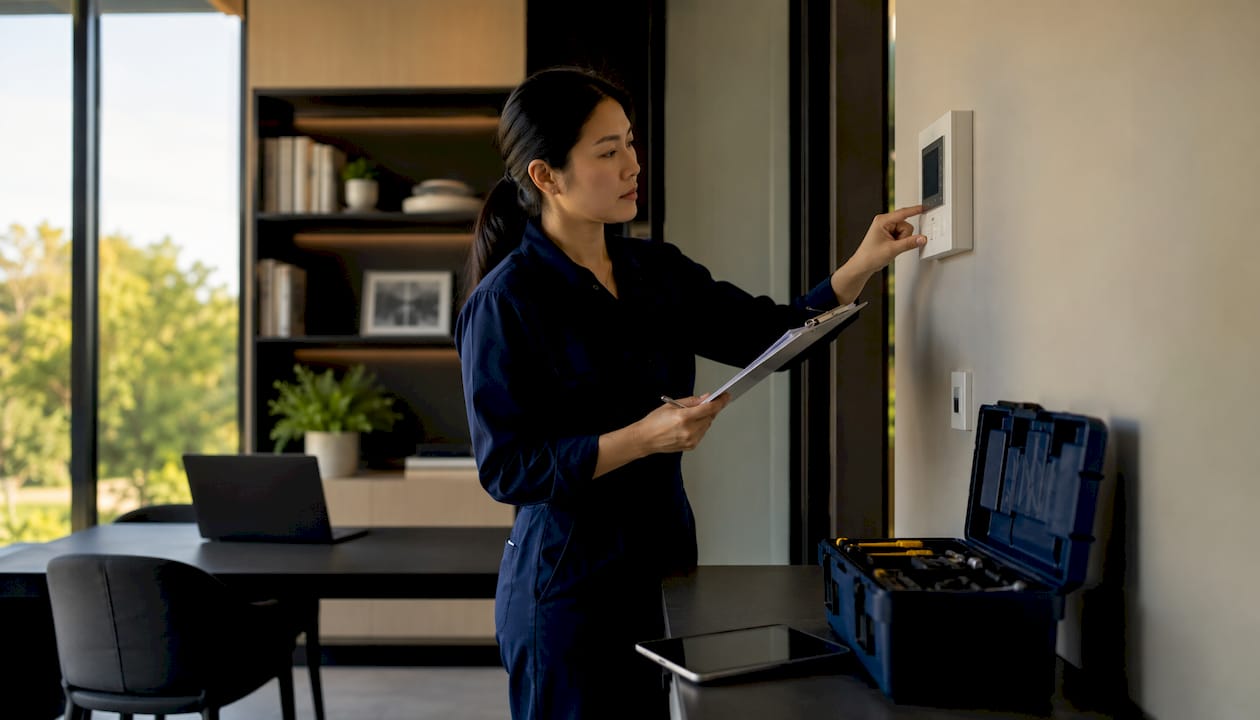
Pro Tip: Request the HVAC commissioning report before closing. A properly commissioned system will have documented airflow readings for every register, confirming the design was not only specified correctly but installed and balanced to perform.
Electrical capacity deserves equal scrutiny. Luxury homes draw electrical service sized appropriately to support HVAC systems, smart-home automation, EV chargers, and commercial kitchen appliances. Older estates upgraded over time may carry the original service panel with inadequate capacity, creating both performance limitations and fire risk.
What warranty documents reveal about a builder's confidence
Every builder presents a warranty document; the buyers who read only the summary page are the ones who discover its limits at the worst possible moment. The exclusions are where a builder's true confidence, or lack of it, becomes legible. Warranty exclusions that exceed the coverage in length signal that the builder has anticipated more failure scenarios than they are willing to stand behind.
Standard new construction warranties in the United States generally include coverage on workmanship, mechanical systems, and structural defects, with terms varying by builder. What varies considerably is how each builder defines the operative terms, specifically what constitutes a defect versus normal settling, and which systems fall under which tier. Those definitions, not the headline coverage periods, determine whether a claim succeeds.
Reading the fine print with counsel before signing is not excessive caution; it is the de rigueur practice of any buyer operating at this level of financial commitment. Builders who construct with uncompromising standards do not need to hedge every term with elaborate carve-outs.
What truly defines authentic luxury build quality
Balanced architectural proportion, encompassing room shapes, ceiling heights, window placement, and spatial flow, is among the most reliable indicators of genuine build quality, and among the most consistently overlooked. A home finished in marble and brass but proportioned incorrectly will never feel settled, regardless of the materials' provenance. Homes with coherent architectural proportion maintain value longer and signal the structural integrity of deliberate design.
The experiential quality of a well-built home is unmistakable. Doors close with a weighted, unhurried finality; windows operate without force, sealing firmly against the frame; floors feel rigid underfoot without the slightest bounce. These are not cosmetic qualities. They reflect the structural stability and the allowances built into the framing for the natural movement every home undergoes across seasons.
Material longevity separates aspirational finishes from lasting ones. Solid wood, high-quality composites, and durable stone surfaces respond to wear and seasonal change in ways that thin veneers and hollow components cannot. The question to ask of any finish material is not how it looks on day one but how it will age across a decade of real use.
Pro Tip: Prioritize foundational craftsmanship indicators, including subfloor rigidity, door and window operation, and mechanical system coherence, over cosmetic finishes. Finishes can be replaced; systems are expensive to redesign.
Mechanical systems design coherence is the final dimension of authentic quality. Vents, access panels, and control layouts placed logically, with organized mechanical rooms and accessible service points, reflect a builder who designed for the life of the home, not merely for the photography of the listing. Smart-home systems built on proprietary platforms can present maintenance liabilities if the original service provider dissolves, making open-platform or widely supported systems the more prudent specification. For a refined perspective on European-standard fittings and how they distinguish foundational quality from cosmetic upgrades, the contrast is instructive regardless of market.
Foundation and waterproofing evaluation
Foundation integrity is the single most consequential structural question in any luxury home assessment. Horizontal or stair-step cracking in block or brick foundations, cracks wider than a quarter inch, and evidence of previous repair work including piers, wall anchors, or carbon fiber straps all warrant a licensed structural engineer's evaluation before any offer proceeds. Drainage grading that directs water toward the structure rather than away from it, and clay-heavy or reactive soil conditions, create long-term stress that manifests gradually and expensively.

Waterproofing extends well beyond the foundation wall. Basement moisture indicators, including efflorescence, musty odors, and staining at wall-floor junctions, suggest water intrusion that may be active rather than historical. Crawl space conditions, specifically standing water, vapor barrier integrity, and pier condition, deserve direct inspection rather than reliance on seller disclosure. A geotechnical report is de rigueur for hillside sites or properties in identified landslide-risk zones.
Building code compliance and permits
Un-permitted renovations create three distinct layers of risk for luxury buyers: insurance may not cover the affected area after a fire or other casualty event; future buyers may discount the price or walk away entirely; and the county retains the authority to require demolition of non-compliant work. These are not theoretical risks. They materialize at the worst possible moments, during a claim or at resale.
The correct method is to pull the full permit history from the county building department and reconcile it against the actual square footage and floor plan. Where discrepancies appear, a buyer must negotiate resolution before closing, either through a retroactive permit filing or a price adjustment that reflects the liability being assumed. Compliance with the International Code Council standards and local permitting requirements is the baseline; luxury builds with bespoke features such as custom millwork, advanced smart-home systems, and premium HVAC installations carry additional compliance dimensions that a specialist inspector is best positioned to verify.
Post-construction maintenance considerations
Luxury homes consume materially more in annual upkeep than standard residences. A reasonable annual maintenance budget for a luxury residence is 1.5–2.5% of the property value each year. Major line items include landscape maintenance, pool upkeep, smart-home system upgrades, and periodic capital outlays such as roof replacement or exterior refinishing.
HVAC systems in luxury homes have an expected lifespan typically exceeding a decade, with well-maintained premium systems potentially lasting longer. Refrigerant type matters: R-22 systems are obsolete and costly to service, making replacement a near-term budget consideration for any home still running that specification. Whole-house generators require annual maintenance and carry finite operational lifespans, with replacement costs that buyers should factor into their long-term holding projections.
Planned development within a three-to-five-year radius of the property can compromise views, privacy, and access in ways that affect both livability and resale value. The county planning department publishes pending permits and zoning changes; reviewing both before signing is a thirty-minute step that most buyers omit and occasionally regret.
Yhluxrealestate brings the depth of evaluation that luxury acquisitions demand, from off-market access and expert negotiation to the kind of granular property assessment that protects buyers at every stage of the process. For buyers navigating the Las Vegas luxury market, Yelena Horton's expertise offers the discernment and global network, backed by Sotheby's International Realty, that transforms a complex transaction into a confident, well-informed decision.
Key Takeaways
Authentic luxury build quality is determined by structural integrity, mechanical system design, and architectural proportion, not by the prominence of the finishes.
| Point | Details |
|---|---|
| Builder track record | Market longevity and stable trade partnerships predict construction consistency more reliably than price alone. |
| Four walkthrough questions | Insulation type, subfloor material, window specs, and HVAC zone count reveal what finishes conceal. |
| Warranty exclusions | Exclusions longer than the coverage itself signal areas where the builder anticipates problems. |
| Permit reconciliation | Pull the county permit history and reconcile it against actual square footage before closing. |
| Annual maintenance budget | Budget 1.5–2.5% of property value per year for ongoing upkeep on a luxury residence. |