
The luxury home buying process is defined by a distinct set of financial, legal, and logistical requirements that separate it categorically from a standard residential purchase. Jumbo financing, off-market property access, specialized inspections, and multi-advisor negotiation teams are not optional refinements in this market. They are the baseline. Understanding how luxury home buying process works before you make your first move is the difference between securing a trophy property and losing it to a more prepared buyer. This guide covers every phase with the specificity that high-end acquisitions demand.
How does the luxury home buying process work, step by step?
The luxury real estate process begins not with a property search, but with financial architecture. Before a serious seller or their representative grants you access to a private listing, your financial credibility must be beyond question. That means a preapproval letter from a jumbo lender or, more compellingly, a proof-of-funds letter that signals your capacity to close without contingency drama.
Access to private listings is often determined more by financial credibility than by price alone. This is a defining feature of the luxury market that many first-time high-end buyers underestimate. Sellers of $3 million-plus properties are not motivated by urgency. They are motivated by certainty.
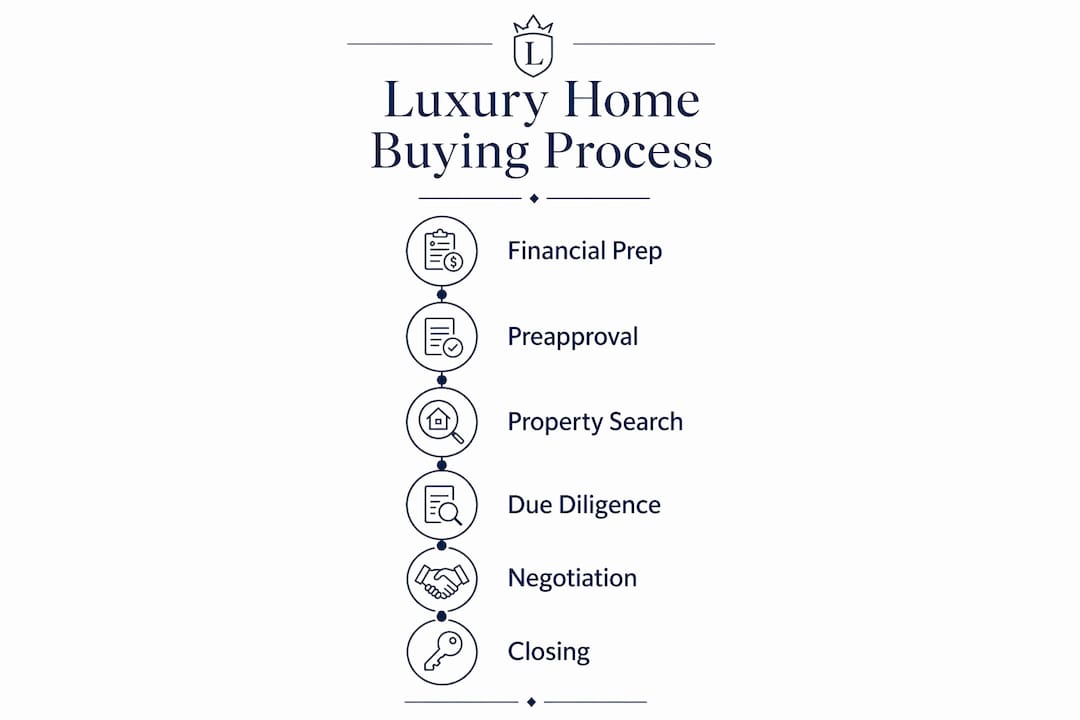
The process then moves through a search phase that spans both public MLS listings and private networks, followed by an offer and negotiation phase where contract terms carry as much weight as the purchase price. Due diligence in luxury real estate is a structured investigation, not a formality. Closing timelines vary significantly based on financing method and property complexity.

What are the financing requirements for a luxury home purchase?
Jumbo loans are the primary financing instrument for luxury home purchases, and they operate under stricter underwriting standards than conforming loans. Jumbo financing requirements include down payments of 10–20% or higher, credit scores of 700 or above, and reserve funds measured in months of PITIA (principal, interest, taxes, insurance, and association dues). These are not negotiable thresholds. They are the floor.
The documentation burden is substantial. Jumbo loan underwriting requires verified income statements, multiple months of asset documentation, and written explanations for any large or unusual deposits. Lenders scrutinize debt-to-income ratios with a rigor that conforming loan officers rarely apply. A buyer with complex income sources, such as business ownership or investment portfolios, should expect a longer preapproval timeline.
Cash purchases eliminate the underwriting timeline entirely and often give buyers a decisive negotiating advantage. Sellers in the luxury segment prize certainty, and a cash offer with a credible proof-of-funds letter from a recognized financial institution signals exactly that. For financed buyers, the strategic equivalent is a fully underwritten preapproval, not a preliminary prequalification.
Key financing considerations for luxury buyers include the following:
- Reserve requirements: Lenders typically require 6–12 months of PITIA in liquid or semi-liquid reserves after closing, not before.
- Credit profile: A score of 700 is the minimum; scores above 740 unlock the most favorable jumbo rates.
- Down payment: Budget for 20% as a baseline. Some lenders require more for properties above $5 million.
- Source of funds: Every dollar of your down payment must be traceable. Gifts, business distributions, or asset liquidations all require paper trails.
- Debt-to-income ratio: Most jumbo lenders cap this at 43%, though some portfolio lenders allow higher ratios for high-net-worth borrowers with substantial assets.
Pro Tip: Engage a jumbo mortgage specialist, not a general loan officer, at least 60 days before you intend to make an offer. The documentation assembly alone can take weeks, and a delayed preapproval costs you properties.
How does luxury home due diligence differ from standard purchases?
Standard home inspections cover the basics: roof, foundation, electrical, plumbing, and HVAC. Luxury property due diligence is a categorically different exercise. Due diligence periods for luxury homes run 14–45 days, compared to the 7–14 days typical in standard transactions. That extended window exists because the inspection scope is exponentially broader.
A properly executed luxury due diligence process includes the following layers:
- General home inspection: A licensed inspector covers structural integrity, roofing, electrical systems, and plumbing across what may be 8,000 to 15,000 square feet of living space.
- HVAC zone inspection: Large estates often have 6–12 independent HVAC zones. Each requires individual evaluation by a mechanical specialist.
- Pool and spa inspection: Equipment, plumbing, tile, coping, and automation systems all require a dedicated pool inspector.
- Smart home technology audit: Smart home systems require a digital security review to confirm that previous owners no longer have access to smart locks, cameras, and automation controllers. This check is absent from standard inspections and represents a genuine security vulnerability if skipped.
- Well and septic inspection: Rural or semi-rural luxury estates frequently rely on private water and waste systems that require specialized testing.
- Permit verification: Additions, guest houses, and amenity structures must be verified against municipal permit records. Unpermitted construction transfers liability to the buyer at closing.
- Marine inspection for waterfront properties: Waterfront luxury homes require underwater surveys of docks, seawalls, and pilings. Seawall undercutting is a non-obvious structural risk that above-grade visual evaluations cannot detect. Marine engineers or divers with remotely operated vehicles (ROVs) are the appropriate specialists.
| Inspection Type | Standard Purchase | Luxury Purchase |
|---|---|---|
| General home inspection | Required | Required |
| HVAC zone inspection | Rarely needed | De rigueur for large estates |
| Smart home digital audit | Not applicable | Critical security requirement |
| Marine/underwater inspection | Not applicable | Required for waterfront properties |
| Permit verification | Occasional | Standard practice |
| Due diligence window | 7–14 days | 14–45 days |
Pro Tip: Schedule all specialized inspectors the moment your contract is executed. Top inspectors in luxury markets book out quickly, and a delayed inspection can leave you with insufficient time to negotiate repairs or exercise your right to terminate.
What negotiation strategies matter in luxury home purchases?
Luxury home negotiations extend well beyond the purchase price. Negotiation leverage in the luxury market shifts toward contract terms and timing rather than price reductions, because comparable sales are sparse and buyer pools are thin. A seller who will not move on price may readily accommodate a favorable closing date, a leaseback arrangement, or the inclusion of custom furnishings and art installations.
The most effective luxury buyers treat the following contract elements as negotiating currency:
- Closing timeline flexibility: Sellers with estate planning considerations or concurrent purchases often value a closing date accommodation more than a price concession.
- Occupancy agreements: A post-closing leaseback, where the seller remains in the property for 30–90 days after closing, can unlock price reductions that a straightforward offer cannot.
- Personal property conveyance: Custom furniture, wine collections, outdoor sculptures, and home theater equipment are frequently included or excluded based on negotiation, not listing terms.
- Contingency structure: A buyer who can waive or shorten financing and appraisal contingencies signals strength. This is where a fully underwritten preapproval becomes a strategic asset.
- Privacy and confidentiality: Many luxury sellers require non-disclosure agreements before granting access to showings. Respecting this protocol, and having your own privacy interests represented, is a mark of sophistication that builds seller confidence.
Ownership structure is another dimension that distinguishes luxury transactions. Using an LLC or trust to hold title is common practice for privacy protection, estate planning, and liability management. This decision requires coordination among a real estate attorney, a CPA, and a wealth manager before the offer is submitted, not after. Restructuring title post-closing is costly and sometimes impossible without triggering tax consequences.
What is the typical timeline for buying a luxury home?
The luxury home buying timeline spans 8–24 weeks from financial preparation to closing, with the search phase representing the widest variable. The table below reflects realistic durations for each phase.
| Phase | Cash Purchase | Financed (Jumbo Loan) |
|---|---|---|
| Financial preparation | 1–2 weeks | 2–4 weeks |
| Property search | 2–12 weeks | 2–12 weeks |
| Offer and negotiation | 1–2 weeks | 1–2 weeks |
| Due diligence | 14–45 days | 14–45 days |
| Appraisal | Not required | 2–4 weeks |
| Closing | 2–3 weeks | 5–8 weeks |
Financed purchases add 45–60 days to the closing phase alone, primarily due to jumbo loan underwriting timelines and the appraisal process. Luxury appraisals are complex because comparable sales are limited and appraisers with luxury market experience are a specialized subset of the profession. Selecting a lender who works with appraisers familiar with your target market reduces the risk of a low appraisal that disrupts the transaction.
The search phase is the most unpredictable element. A buyer with clearly defined criteria in a market with limited inventory may search for 12 weeks or longer. Buyers who access off-market listings through a well-connected agent compress this timeline considerably. The availability of specialized inspectors also affects due diligence duration. In markets where luxury transactions are concentrated, top inspectors are booked weeks in advance.
Key takeaways
The luxury home buying process requires financial credibility, specialized inspections, and strategic negotiation to succeed at every phase.
| Point | Details |
|---|---|
| Financial preparation is the first step | Secure jumbo preapproval or proof of funds before approaching private listings. |
| Due diligence is broader and longer | Budget 14–45 days and engage specialized inspectors immediately after contract execution. |
| Negotiation extends beyond price | Use closing flexibility, occupancy agreements, and personal property inclusions as leverage. |
| Ownership structure requires early planning | Consult a real estate attorney and CPA before submitting an offer to determine LLC or trust titling. |
| Timeline varies by financing method | Cash buyers close in 5–7 weeks; jumbo-financed buyers should plan for 12–20 weeks total. |
What i've learned after years in the luxury market
The buyers who struggle most in luxury real estate are not underfunded. They are underprepared. I have watched well-capitalized buyers lose properties they genuinely wanted because they arrived without a proof-of-funds letter, or because they scheduled their inspectors two weeks after contract execution and ran out of time to negotiate repairs.
The luxury market does not reward hesitation, and it does not forgive procedural gaps. What I tell every client is this: assemble your team before you fall in love with a property. Your jumbo lender, real estate attorney, CPA, and lead inspector should all be identified and briefed before you make your first offer. When the right property appears, and in a market like Las Vegas it can appear and disappear within days, you need to move with the confidence that your infrastructure is already in place.
The smart home security audit is the single most overlooked item in luxury due diligence. I have seen buyers close on $4 million properties and never verify that the previous owner's credentials were removed from the automation system. That is not a minor oversight. It is a genuine vulnerability in a home where security is a primary value proposition.
My final observation: the buyers who achieve the best outcomes are those who treat the purchase as a strategic transaction, not an emotional one. Admire the property. Then negotiate the contract with the same discipline you would apply to any significant investment.
— Yelena
Discover las vegas luxury properties with Yhluxrealestate
Yhluxrealestate, led by Yelena Horton and backed by the global reach of Sotheby's International Realty, offers prospective buyers something the standard market cannot: direct access to off-market Las Vegas luxury properties before they reach public listings. Yelena's expertise spans jumbo financing guidance, ownership structure consultation, and negotiation strategy calibrated to the Las Vegas luxury market's specific dynamics.

For out-of-state buyers, Yhluxrealestate provides a dedicated relocation concierge service that coordinates every logistical element of a long-distance luxury purchase. Whether you are acquiring a primary residence, a second home, or an investment property, the Las Vegas luxury listings available through Yhluxrealestate represent the full spectrum of the market, including properties never publicly listed. Contact Yhluxrealestate to arrange a private consultation and begin your acquisition with the preparation and access that this market demands.
FAQ
What qualifies as a luxury home in real estate?
Luxury real estate is generally defined as residential property priced in the top 10% of a given market, though in major metropolitan areas this threshold typically begins at $1 million and extends well above $3 million for trophy properties.
How much do i need for a down payment on a luxury home?
Jumbo loan down payments typically range from 10–20%, with lenders requiring higher percentages for properties above $5 million. Cash buyers bypass this requirement entirely and gain a significant negotiating advantage.
Why do luxury home purchases take longer to close?
Luxury transactions take longer because jumbo loan underwriting, specialized inspections, and complex appraisals each add weeks to the process. Financed purchases typically require 45–60 days for closing alone, compared to 2–3 weeks for cash transactions.
Do i need a specialized agent to buy a luxury home?
A luxury-focused agent provides access to off-market listings, relationships with specialized inspectors, and negotiation experience with complex contract terms that a general residential agent rarely encounters. In markets like Las Vegas, where private listings represent a significant share of available inventory, this access is a material advantage.
What is a smart home digital audit and why does it matter?
A smart home digital audit verifies that all previous owner credentials have been removed from automation systems, smart locks, and security cameras. Skipping this step leaves a new owner exposed to unauthorized access through systems they believe are secure.