
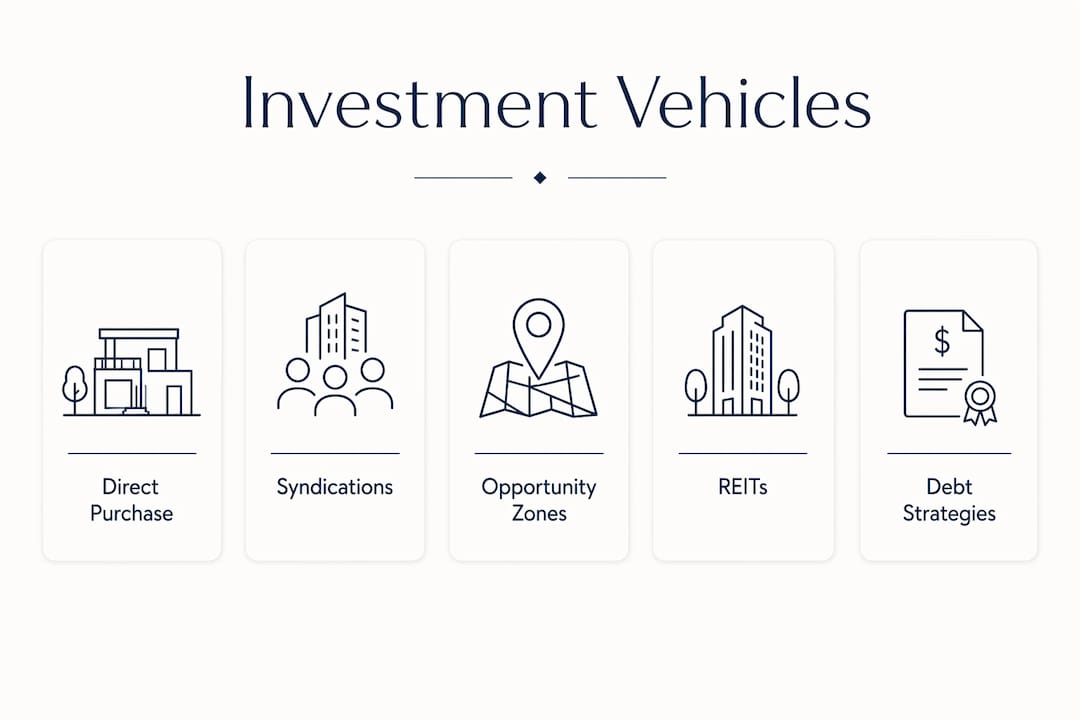
New York investors gain Las Vegas exposure through five primary routes: direct property acquisition, syndications and private equity funds, Opportunity Zone vehicles such as the Integris DLV Opportunity Zone Fund, publicly traded REITs like Vici Properties, and structured debt strategies. The single most consequential next step is engaging a local broker with verified off-market access before committing capital, because the Las Vegas metro rewards granular submarket knowledge far more than macro-level conviction. Clark County's population has grown noticeably since 2020 to approximately 2.4 million residents, and Nevada's absence of state income tax, corporate income tax, and estate tax creates a structural advantage that no amount of spreadsheet modeling can replicate from a Manhattan desk.
Three immediate steps worth taking before any capital moves:
- Retain Nevada-licensed counsel to confirm short-term rental eligibility for your specific parcel and review title and lien status.
- Request an off-market property list from a Las Vegas luxury broker who can document recent closed transactions, not just listings.
- Coordinate with your CPA on the interplay between New York nonresident obligations and Nevada's tax structure, particularly if an Opportunity Zone or 1031 exchange is part of the plan.
Table of Contents
- Why does Las Vegas attract New York capital right now?
- What investment vehicles do New York investors actually use?
- What does the tax and regulatory checklist look like for New York investors?
- What does a rigorous due diligence checklist look like?
- What are the realistic costs and timelines for a New York buyer?
- What is the practical 7-step plan for a New York investor ready to begin?
- How does a Las Vegas luxury broker reduce execution risk for New York investors?
- Key Takeaways
- What Las Vegas brokers actually see from New York investors
- Yhluxrealestate: your Las Vegas partner for out-of-state investors
- Useful sources for deeper research
Why does Las Vegas attract New York capital right now?
The metro's appeal has shifted materially over the past decade. New York investors once viewed Las Vegas as a gaming-dependent, cyclical bet; today, the city's economic base has broadened into sports franchises, tech and data-center operations, healthcare, logistics, and film production infrastructure. East-coast institutional investors have executed multiple nine-figure and billion-dollar transactions across commercial, logistics, hospitality, and multifamily assets, a pattern that signals market maturation rather than speculative enthusiasm.
Population growth is the structural engine beneath all of it. Henderson and North Las Vegas have both grown significantly since 2020, both outpacing the city of Las Vegas proper. A significant share of that inflow originates from high-cost coastal markets, including Los Angeles, the Bay Area, and Seattle, creating a tenant pool of renters who spend one to two years leasing before purchasing. That dynamic sustains rental demand independent of tourism cycles.
Tourism itself remains formidable, with tens of millions of visitors each year and a high volume of passenger traffic through Harry Reid International Airport, figures that underpin hospitality-adjacent strategies while also reminding investors of the metro's cyclical sensitivity. The job base, however, is broadening: education and health services have been growing steadily in a recent twelve-month period and are on pace to become the region's second-largest industry, while tech and data-center employers have planted operations in the southwest valley.
The 2026 market posture rewards disciplined buyers. The market shows moderate negotiating room with many homes selling below list price, indicating a different environment from prior frenzied appreciation periods. This is a materially different environment from the frenzied appreciation of 2021–2022, and it suits the measured, underwriting-first approach that New York institutional capital tends to bring.
Key demand drivers worth tracking:
- Net migration from coastal metros sustaining rental pools in Henderson, North Las Vegas, and the southwest valley.
- Sports and entertainment infrastructure (NFL, NHL, NBA, Formula 1) anchoring hospitality and short-term demand.
- Logistics and industrial growth along the Apex corridor in North Las Vegas, attracting workforce renters.
- Healthcare and tech employment broadening the renter base beyond hospitality workers.
What investment vehicles do New York investors actually use?
Direct property acquisition
Direct purchase of single-family and small multifamily assets offers maximum control and the clearest path to tax-advantaged ownership. Out-of-state buyers typically rely on a local broker for off-market sourcing, a property manager absorbing 8–10% of gross rent, and a local attorney for title and compliance review. The tradeoff is operational complexity: desert maintenance cycles, HVAC replacement timelines, and short-term rental permitting all require local expertise difficult to replicate remotely. Submarket selection is decisive here; North Las Vegas, Henderson, and Summerlin each present a distinct yield-versus-appreciation profile.

Syndications and private equity funds
Pooled vehicles allow investors to participate in larger assets, multifamily complexes, industrial parks, or mixed-use developments, without managing operations. Minimums typically range from $50,000 to $250,000 for individual syndications, with institutional-grade funds often requiring $500,000 or more. Sponsor track record, fee waterfall structure, and preferred-return terms are the three variables that separate well-structured deals from those that transfer risk to limited partners. New York-based buyers and landlords have historically favored large Strip and off-Strip assets through exactly these structures, validating the vehicle for institutional allocators.
Opportunity Zone funds
The Integris DLV Opportunity Zone Fund represents the category of tax-advantaged vehicles targeting designated Opportunity Zones within the Las Vegas metro. For New York investors with substantial capital gains, the mechanics are compelling: deferral of recognized gains, potential step-up in basis, and exclusion of appreciation on the OZ investment itself if held for the required period. What to verify in fund documents includes the specific census tract designations, the fund's deployment timeline, the manager's prior OZ experience, and the exit strategy, since OZ investments carry illiquidity that differs from standard private placements. Confirm SEC Regulation D exemption status and accredited investor requirements before subscribing.
REITs and publicly traded vehicles
Vici Properties and comparable gaming-and-hospitality REITs offer liquid, low-friction exposure to Las Vegas real estate economics without the operational burden of direct ownership. The tradeoff is concentration: a REIT's portfolio is diversified across its own holdings but may not align with the specific submarket or asset class an investor is targeting. For New York investors seeking a first position in Las Vegas before committing to a direct purchase, a REIT allocation can serve as a market-familiarity bridge. Blackstone's real estate vehicles, including its non-traded REIT structures, offer another institutional-grade entry point with broader asset-class coverage.
Debt strategies and structured products
Bridge lending and preferred equity occupy the income-oriented end of the spectrum. These structures typically offer current-pay yields with defined maturities, making them attractive for investors who want Las Vegas exposure without equity volatility. Hedge fund activity in Las Vegas has expanded to include all-weather and alternative credit strategies, broadening the menu beyond classic real estate ownership.
What does the tax and regulatory checklist look like for New York investors?
Nevada's tax structure is genuinely one of the most favorable in the country for landlords. There is no state income tax, no corporate income tax, and no estate or inheritance tax, meaning rental income that would face state-level taxation in New York or California simply does not carry that burden in Nevada. For high-net-worth New York residents, the differential is material and warrants coordination with a CPA before structuring ownership.

The property-tax trap that catches most out-of-state investors is AB 489: Nevada caps annual property-tax increases at 3% for primary residences but permits increases of up to 8% on investment and non-primary properties. An investment property's tax bill can escalate nearly three times faster than an owner-occupant's next door. Build that 8% annual escalation into every 10-year pro forma, not just year one.
Short-term rental rules vary by jurisdiction and are among the most consequential regulatory items for New York investors accustomed to Airbnb-friendly markets. The City of Las Vegas permits only owner-occupied short-term rentals, capped at three bedrooms, with a minimum 660-foot separation from another short-term rental. Unincorporated Clark County operates a capped lottery system, currently closed, with 1,000-foot spacing requirements, 2,500-foot separation from resorts, and a $1 million insurance requirement. Henderson and North Las Vegas each maintain their own permitting and conditional-use frameworks. Confirm the specific parcel's eligibility in writing before removing any inspection contingency.
Cross-jurisdiction obligations for New York investors include nonresident landlord withholding considerations, proper entity structuring for pass-through income, and compliance with Nevada licensing requirements for rental operations. Local counsel is not optional; it is the mechanism by which a well-underwritten deal avoids becoming a compliance problem.
Pro Tip: Coordinate 1031 exchange timing and Opportunity Zone fund subscriptions with both your CPA and Nevada-licensed counsel before signing any purchase agreement. The sequencing of these elections is time-sensitive and errors are difficult to reverse.
This article provides general information only and does not constitute legal, tax, or investment advice; consult qualified counsel and a licensed CPA for guidance specific to your situation and jurisdiction.
What does a rigorous due diligence checklist look like?
Disciplined execution begins well before a purchase agreement is signed. The following checklist reflects the minimum standard for an out-of-state investor:
- Pull verified comparable sales and active listings within a one-mile radius, not metro-level averages.
- Obtain and verify the rent roll, including lease terms, security deposits, and any concessions in place.
- Commission a full title and lien search through a Nevada-licensed title company.
- Review HOA covenants, conditions, and restrictions for rental limitations and fee escalation history.
- Confirm short-term rental eligibility for the specific parcel in writing from the relevant municipality.
- Obtain insurance quotes that account for desert climate exposures: HVAC, roofing, and liability.
- Run a carrying-cost stress test at 10% vacancy and 8% annual property-tax escalation.
Local partner roles for out-of-state investors
| Partner | Primary Role | When to Engage |
|---|---|---|
| Local broker | Off-market sourcing, comps, negotiation | Before any capital commitment |
| Property manager | Leasing, maintenance, rent collection | Early in the process or at closing |
| Nevada-licensed attorney | Title, compliance, entity structuring | During due diligence |
| Local lender / mortgage broker | DSCR or commercial loan origination | Alongside property search |
| CPA with Nevada experience | Tax structuring, pro forma review | Before offer submission |
| General contractor | Inspection support, capex estimates | During inspection period |
Vetting partners remotely requires more than a phone call. Request sample financials from properties under management, documented proof of off-market closings, and references from other out-of-state clients. Local broker expertise and off-market access materially improve execution; the difference between a compelling spreadsheet and a closed transaction often comes down to whether the broker has relationships that surface deals before they reach the open market.
Pro Tip: A credible off-market offering should include a clear title history, a current rent roll or vacancy status, and a disclosure of any known liens or HOA violations. An off-market deal that cannot produce these documents within 48 hours of request is a red flag, not a competitive advantage.
What are the realistic costs and timelines for a New York buyer?
The desert has its own cost structure, and it quietly erodes returns that looked sound on a spreadsheet. The table below reflects typical ranges for a direct single-family or small multifamily acquisition in the Las Vegas metro.
| Cost Item | Typical Range | Notes |
|---|---|---|
| Earnest money deposit | 1%–3% of purchase price | Negotiable; higher deposits signal seriousness in competitive offers |
| Closing costs (buyer) | 1%–2% of purchase price | Title, escrow, recording, and lender fees |
| Inspection and due diligence | $500 | Includes general inspection; specialty inspections additional |
| Initial capex reserve | 3%–5% of purchase price | Desert climate accelerates HVAC and roofing cycles |
| Property management (annual) | A customary percentage of gross rent | Common for out-of-state owners |
| Property tax escalation (annual) | Can be higher on investment properties than on primary residences; important to model in pro forma |
Common financing profiles for out-of-state buyers include DSCR loans, which underwrite to the property's rental income rather than the borrower's personal income, and commercial lending for multifamily assets of five or more units. Agency programs through Fannie Mae and Freddie Mac remain available for one-to-four-unit properties meeting standard guidelines. Down payments for investment properties typically range from 20%–30%, with DSCR products sometimes requiring 25% or more depending on the lender's coverage ratio requirements.
Timeline from initial sourcing to stabilized occupancy:
- Deal sourcing and initial underwriting: two to four weeks.
- Letter of intent and accepted offer: one to two weeks.
- Inspection, due diligence, and financing contingency: fourteen to twenty-one days.
- Closing: thirty to forty-five days from accepted offer.
- Lease-up or tenant transition: two to six weeks post-closing.
A realistic total timeline from first broker conversation to stabilized, income-producing asset is ninety to one hundred twenty days for a straightforward acquisition.
What is the practical 7-step plan for a New York investor ready to begin?
-
Clarify your return objective. Decide whether the allocation targets current cash flow, long-term appreciation, tax deferral, or a blend. This single decision determines submarket, vehicle, and hold period before any other analysis begins.
-
Assemble your advisory team. Retain Nevada-licensed counsel, a CPA with cross-state experience, and a Las Vegas broker with documented off-market access. Do not begin underwriting without all three in place.
-
Define your capital structure. Determine equity available, target leverage, and whether a DSCR loan, commercial facility, or all-cash acquisition best fits the asset type and return model.
-
Select vehicle and submarket. Match the vehicle (direct, syndication, OZ fund, REIT) to your control preference and operational bandwidth. Match the submarket to your return objective: North Las Vegas for yield, Henderson for stability, Summerlin for appreciation.
-
Execute initial due diligence. Apply the full checklist from Section 5: comps, rent roll, title search, HOA review, short-term rental eligibility confirmation, insurance quotes, and carrying-cost stress test.
-
Submit offer and manage closing. Use your local attorney for contract review and title coordination. Confirm all contingency periods in writing and maintain a closing checklist shared with broker, lender, and counsel.
-
Execute a first-90-day operations plan. Introduce the property manager at or before closing, establish maintenance protocols, confirm insurance coverage, and set up rent collection and reporting systems before the first tenant moves in.
How does a Las Vegas luxury broker reduce execution risk for New York investors?
The practical value of a local broker becomes most visible in the gap between a well-modeled deal and a successfully closed one. Consider a representative process: a New York-based investor identifies a target submarket in Henderson, requests an off-market list from Yelena Horton of Yhluxrealestate, and receives three properties that have not yet reached the MLS. One property, a four-bedroom home with a long-term tenant in place, is priced below replacement cost because the seller is motivated by a timeline rather than maximum proceeds. Yelena coordinates a remote inspection via a trusted local contractor, negotiates a seller credit for deferred HVAC maintenance, and introduces the buyer to a Nevada-licensed title attorney and a property management firm with a documented track record in the submarket. The transaction closes in thirty-eight days.
That sequence illustrates what Yhluxrealestate offers out-of-state investors:
- Off-market property sourcing through a network built on years of local relationships, not MLS aggregation.
- Expert negotiation that prioritizes client positioning, including concessions, credits, and favorable closing timelines.
- Relocation concierge services for investors transitioning personal or business operations to Nevada.
- Introductions to vetted local counsel, property managers, and lenders who understand the cross-state investor profile.
- Access to a global network backed by Sotheby's International Realty, extending reach to institutional and international buyers and sellers.
Contact Yhluxrealestate for a tailored investor briefing and an initial off-market property list at yhluxrealestate.com.
Key Takeaways
Las Vegas rewards New York investors who pair disciplined underwriting with a credible local team, selecting the right vehicle and submarket before committing capital.
| Point | Details |
|---|---|
| Five primary vehicles | Direct purchase, syndications, OZ funds, REITs, and debt strategies each suit different return profiles and control preferences. |
| AB 489 property-tax risk | Investment properties can face up to 8% annual tax increases; model full escalation in every 10-year pro forma. |
| Submarket selection is decisive | North Las Vegas leads on yield, Henderson on stability, and Summerlin on long-term appreciation. |
| Due diligence non-negotiables | Title search, short-term rental eligibility confirmation, and a carrying-cost stress test at 10% vacancy are required before closing. |
| Yhluxrealestate local advantage | Yelena Horton provides off-market sourcing, expert negotiation, and relocation concierge services that materially reduce execution risk for out-of-state buyers. |
What Las Vegas brokers actually see from New York investors
The most consistent pattern among New York investors entering Las Vegas is a mismatch between the sophistication of their financial modeling and the granularity of their local knowledge. They arrive with well-constructed pro formas and then underwrite the wrong submarket, or assume short-term rental income that the specific parcel's zoning will not permit, or model property-tax escalation at 3% when the investment-property cap is 8%. These are not errors of ambition; they are errors of distance.
The investors who execute well share a common discipline: they engage local partners before they underwrite, not after. They treat off-market access as a sourcing strategy rather than a bonus feature. And they understand that micro-market selection matters more than metro-level headlines, because nearby zip codes can diverge sharply in appreciation and days on market within a single quarter.
A short checklist of what the best-prepared New York investors do: confirm short-term rental eligibility in writing before removing contingencies; build AB 489 escalation into the pro forma from year one; retain Nevada counsel for entity structuring before the first offer; and request documented proof of off-market closings, not just listings, from any broker they engage.
Yhluxrealestate: your Las Vegas partner for out-of-state investors
New York investors who have done the analysis and are ready to move need one thing above all else: a Las Vegas broker who can open doors that are not on the market yet. Yhluxrealestate, led by Yelena Horton and backed by Sotheby's International Realty's global network, is precisely that resource.

The core services for out-of-state investors are direct and concrete: exclusive off-market property access that bypasses MLS competition; negotiation expertise that secures seller concessions and favorable closing terms; a relocation concierge that manages the logistical complexity of acquiring property from across the country; and warm introductions to Nevada-licensed attorneys, property managers, and lenders who understand the cross-state investor profile. An initial consultation is a focused, no-obligation briefing on current off-market inventory, submarket conditions, and the regulatory items most relevant to your investment strategy.
Request your tailored investor briefing and off-market property list at yhluxrealestate.com.
Useful sources for deeper research
The following sources informed this article and offer substantive next reading for investors conducting independent diligence.
-
Las Vegas Real Estate Investing Report, Metro Deal Report: Current sale-to-list ratios, days on market, and submarket pricing data. Best for underwriting and market-posture analysis; update quarterly.
-
How to Invest in Las Vegas Real Estate in 2026: Detailed submarket breakdowns, AB 489 property-tax mechanics, short-term rental rules by jurisdiction, and carrying-cost guidance. Best for operational due diligence and pro forma construction.
-
East Coast Firm Still Bullish on Las Vegas, Vegas Inc: Institutional transaction evidence and market-maturation context. Best for validating the macro investment thesis with named deal examples.
-
New Yorkers Not Shy About Investing Big in Las Vegas, Las Vegas Review-Journal: Historical pattern of New York capital in Strip and off-Strip assets. Best for understanding the precedent behind current institutional allocation.
-
SEC Rule 506, Regulation D, Investor.gov: Primary source for accredited investor requirements and private placement exemption rules. Consult before subscribing to any syndication or OZ fund.
-
FINRA BrokerCheck: Verify the registration and disciplinary history of any broker-dealer or financial adviser involved in a private placement or structured product. Use before committing capital to any fund vehicle.