
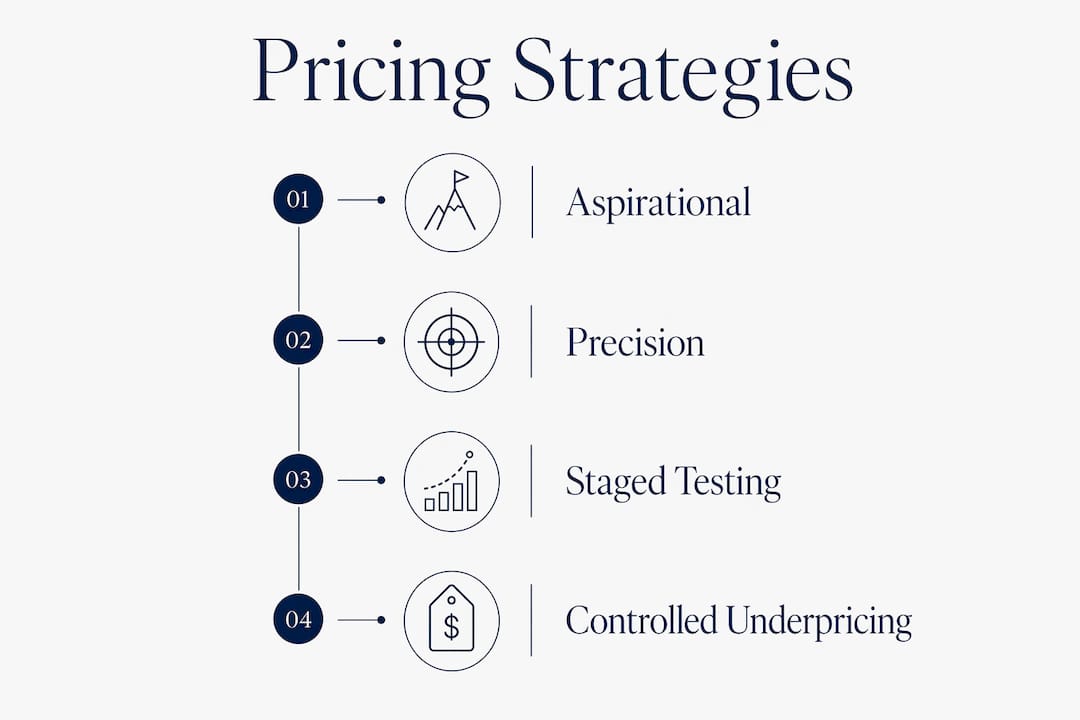
Luxury listing pricing strategies are defined by the deliberate integration of market analytics, buyer psychology, and narrative presentation to position a property at its maximum defensible value. Unlike conventional real estate, where comparable sales largely dictate price, the luxury segment demands a far more nuanced approach. Four primary techniques govern this discipline: aspirational pricing, precision pricing, staged testing, and controlled underpricing. Each serves a distinct purpose depending on buyer composition, inventory depth, and market tier. Understanding how these methods operate is the difference between a property that commands its worth and one that lingers, accumulating the quiet stigma of days on market.
How luxury listing pricing strategies work: the four core techniques
Luxury pricing strategies rely on four primary techniques, each chosen based on buyer composition and inventory constraints. Selecting the wrong technique for the wrong market tier is one of the most costly errors a seller can make.
Aspirational pricing sets the ask above recent comparables, anchored by documented differentiators such as architectural signature, bespoke finishes, or irreplaceable site characteristics. The price is not arbitrary; it is supported by a curated narrative that gives buyers psychological permission to pay a premium. This technique works best when the property possesses genuine scarcity and when the seller's agent can articulate that scarcity with precision.
Precision pricing relies on tight comparable analytics, often drawing from a narrow pool of recent closed transactions within the same micro-market. It is the technique of choice when buyer depth is shallow and the risk of overpricing outweighs the potential upside of aspirational positioning. Precision pricing signals seriousness to analytical buyers who model capital efficiency before submitting an offer.
Staged testing treats the initial list price as a hypothesis. The property enters the market at a considered price point, and buyer feedback, showing frequency, and offer activity are monitored closely. If the market responds with silence, the price is adjusted in small, deliberate increments rather than dramatic cuts. This approach preserves seller leverage while remaining responsive to real demand signals.
Controlled underpricing is the most counterintuitive of the four. The property is listed below its estimated market value to generate competitive interest and, ideally, multiple offers that drive the final price above the ask. This technique is most effective in the mainstream luxury tier, where buyer depth is sufficient to sustain competitive bidding.
| Strategy | Best market tier | Core mechanism |
|---|---|---|
| Aspirational pricing | $10M+ ultra-luxury | Narrative and scarcity justify premium ask |
| Precision pricing | $5M–$8M move-up | Tight comps anchor a defensible number |
| Staged testing | Any tier with thin buyer depth | Adaptive adjustment based on market feedback |
| Controlled underpricing | $3M–$5M mainstream luxury | Competitive bids drive price above list |
Pro Tip: Never apply aspirational pricing without a documented differentiator package. Buyers in the $5M+ range will request justification, and "the seller loves this home" is not a differentiator.
How do buyer composition and market factors influence luxury property pricing?
Luxury buyers are analytical investors who model capital efficiency and tax stability before committing. Setting price based on seller hope leads to longer market times and costlier corrections. This is not a peripheral concern; it is the central reality of pricing in the luxury segment.
Buyer depth, meaning the number of qualified buyers actively seeking a property of a given type in a given market, varies significantly by tier and geography. A property in Las Vegas at $4M competes in a market with meaningful buyer depth. A property at $12M competes in a far thinner pool, where a single buyer's tax situation or liquidity constraints can determine whether a deal closes. Pricing must account for this reality.
Governance structures, HOA covenants, and insurance exposure also carry direct pricing implications. Insurance status is a baseline expectation that prevents buyer walkaways, particularly in coastal California markets where wildfire and flood exposure have made coverage both expensive and difficult to obtain. A property that cannot be insured at a reasonable cost will face buyer hesitancy regardless of its aesthetic merit.
Macro factors compound these local dynamics. Interest rate environments affect the carrying cost calculations that sophisticated buyers run before every acquisition. Liquidity constraints in equity markets can suppress demand even among buyers who appear well-capitalized on paper. Pricing that ignores these conditions is pricing that will eventually require a correction.
Pro Tip: Before setting a list price, model the property from the buyer's perspective. Calculate estimated carrying costs, HOA fees, insurance, and tax exposure. If the total cost of ownership feels punitive, the list price needs to recalibrate.
Why does narrative matter as much as price in luxury real estate?
The property's story is a critical economic tool that justifies premium pricing and differentiates it among luxury buyers. This is not a soft observation about aesthetics. A luxury home's narrative provides economic justification for premium pricing by differentiating the property beyond spreadsheet comparables, giving buyers psychological permission to pay more.
Architectural uniqueness is the most defensible form of narrative. A home designed by a recognized architect, or one that occupies a site with genuinely irreplaceable views or orientation, carries a story that no comparable sale can fully capture. That story, when documented and presented with authority, becomes the foundation of aspirational pricing.
Professional staging, photography, and video are not optional embellishments. Poor presentation relative to aspirational price causes buyer skepticism; investing in professional staging and marketing is a prerequisite to defending premium pricing. A property listed at $8M with mediocre photography signals a disconnect between the seller's expectations and their commitment to the sale.
The sequence of narrative delivery matters as well. Consider how the following elements build a coherent case for price:
- Establish the property's architectural or historical distinction in all listing materials before the price is ever mentioned.
- Document every material upgrade, bespoke finish, and irreplaceable site feature in a formal property profile distributed to buyer agents.
- Commission professional photography and video that captures the property at its most compelling, including dawn and dusk conditions where views are most dramatic.
- Prepare a curated showing experience that reinforces the narrative through sequence, lighting, and sensory detail.
"The price of a luxury home is not a number. It is a statement about what the property represents. The narrative is what makes that statement credible."
How do pricing tactics differ across luxury market tiers?
The three primary luxury tiers operate under fundamentally different pricing logic, and conflating them is a reliable path to underperformance. Mainstream luxury homes in the $3M–$5M range use hook pricing, listing 8%–10% below true market value to create competitive bids. That spread is intentional. It generates showing volume and offer activity that, when managed correctly, produces a final sale price at or above the true market value.
The move-up tier, spanning $5M–$8M, operates with less aggressive underpricing. Listings in this range typically enter the market 3%–5% below market or at flat market value. Buyer depth is thinner, and the competitive bidding dynamic that powers hook pricing in the mainstream tier is less reliable. Precision pricing and staged testing are more appropriate tools here.
Ultra-luxury pricing inverts the conventional model entirely. Properties listed at $10M and above are often priced 5%–10% above estimated market value. This is not optimism; it is a deliberate filter. A price above market discourages unqualified inquiries and signals to serious, capital-ready buyers that the seller is not distressed. Pre-market warmup through curated private showings and global network distribution, such as the reach provided by Sotheby's International Realty, is de rigueur at this tier before any public listing.
Pro Tip: In the ultra-luxury tier, the list price is a negotiation posture, not a ceiling. Build in room for a meaningful concession that still delivers the seller's target net. Buyers at this level expect to negotiate, and a price that leaves no room signals either naivety or desperation.
What are the most common pitfalls in executing luxury pricing strategies?
Most luxury sellers confuse emotional attachment with market value, producing pricing illusions that misalign with actual buyer behavior. This insight from practitioners who work the $5M+ segment consistently is not anecdotal. It is the single most common cause of extended market time in the luxury segment.
The corrective is data-driven discipline. Luxury pricing is a dialogue with the market; small, proactive, data-driven price adjustments prevent the desperation signaling that comes with large reactive cuts. A $200,000 reduction after 90 days on market tells every buyer's agent in the market that the seller is anxious. A $75,000 adjustment after 30 days, framed as a market calibration, preserves dignity and momentum.
Distributing a transparent comparable sales data package to buyer agents before offers are submitted anchors valuation and reduces the risk of leaving equity on the table. Buyer agents who understand the comp basis for a price are less likely to submit lowball offers anchored only to the list price percentage. This practice is standard among the most effective luxury listing agents and remains underused by the majority.
Aligning price with the ideal buyer profile is the final discipline. A property priced for a domestic buyer with a specific tax profile will not perform if the most likely buyer is an international investor with different holding cost sensitivities. Pricing with purpose means understanding who will actually write the check and what that buyer's analytical framework looks like.
Pro Tip: Prepare a formal comp data package before the listing goes live. Include closed sales, active competition, and a clear narrative explaining why this property warrants its position relative to the comps. Distribute it to every buyer agent who schedules a showing.
Key Takeaways
Luxury listing pricing strategies work because they align price with buyer psychology, market tier, and narrative presentation rather than relying on comparables alone.
| Point | Details |
|---|---|
| Four core techniques | Aspirational, precision, staged testing, and controlled underpricing each serve a distinct market tier and buyer profile. |
| Tier-specific logic | Mainstream luxury uses hook pricing 8%–10% below market; ultra-luxury inverts this by pricing 5%–10% above to filter buyers. |
| Narrative as economic tool | A documented property story gives buyers psychological permission to pay a premium beyond what comparables justify. |
| Proactive adjustments | Small, data-driven price calibrations preserve seller leverage; large reactive cuts signal distress and erode negotiating position. |
| Comp data distribution | Sharing a transparent comparable sales package with buyer agents anchors valuation and protects equity before offers arrive. |
Pricing as a conversation, not a declaration
Working in the Las Vegas luxury market has taught me one truth that no pricing model fully captures: the buyer sitting across from you in 2026 is not the buyer from a decade ago. They arrive with financial models, tax advisors, and a clear-eyed view of holding costs. They are not moved by hope pricing. They are moved by evidence.
What I have found is that the sellers who achieve the strongest outcomes are those who treat price as the opening line of a conversation, not a final declaration. They invest in presentation without hesitation, because they understand that a $15,000 staging investment protecting a $7M ask is not an expense. It is a defense. They distribute comp packages before showings because they want buyer agents to arrive informed, not skeptical.
The integration of cold data with a compelling property narrative is not a stylistic preference. It is the mechanism by which premium pricing becomes defensible. At Yhluxrealestate, the approach to pricing is built on exactly this foundation: rigorous market analysis, curated presentation, and constant calibration against real buyer feedback. The market always tells you the truth. The discipline is in listening before the price requires a correction.
— Yelena
Work with Yhluxrealestate to position your luxury property with authority
Pricing a luxury property demands more than a number. It demands a strategy calibrated to your specific market tier, buyer profile, and property narrative. Yhluxrealestate, led by Yelena Horton and backed by the global reach of Sotheby's International Realty, brings precisely that discipline to every engagement in the Las Vegas luxury market. From off-market access to curated showing strategies and comp-anchored pricing frameworks, the service is designed for sellers and buyers who will not accept a generic approach. Contact Yhluxrealestate to begin a conversation about positioning your property for the outcome it deserves.
FAQ
What are the four main luxury home pricing strategy types?
The four primary luxury pricing techniques are aspirational pricing, precision pricing, staged testing, and controlled underpricing. Each is selected based on buyer composition, market tier, and inventory conditions.
How does hook pricing work in the $3M–$5M luxury tier?
Hook pricing lists a property 8%–10% below its true market value to generate competitive bids. When buyer depth is sufficient, the resulting offer activity drives the final sale price at or above true market value.
Why do ultra-luxury properties list above market value?
Pricing above market in the $10M+ tier filters unqualified inquiries and signals that the seller is not distressed. It preserves negotiation leverage and ensures that only serious, capital-ready buyers engage.
How does a property's narrative affect its price defensibility?
A documented narrative of architectural distinction, bespoke finishes, and irreplaceable site features gives buyers psychological justification to pay above comparable sales. Without that narrative, aspirational pricing lacks credibility.
What is the biggest mistake luxury sellers make with pricing?
Confusing emotional attachment with market value is the most common error. Luxury buyers model capital efficiency and tax stability; a price anchored in seller sentiment rather than market data produces extended market time and costly corrections.