
Luxury home valuations operate on an entirely different plane from standard residential appraisals, measuring exclusivity, architectural provenance, and market scarcity rather than simply counting bedrooms and square footage. Where a conventional appraisal leans on a cluster of nearby, nearly identical sales, a luxury property appraisal must contend with the fundamental reality that no two estates of genuine distinction are truly alike. The methodology demands a sophisticated blend of three primary approaches: the cost approach, the sales comparison approach, and the income capitalization approach, each calibrated with bespoke adjustments that honor the singular character of the property under review. Compounding this complexity, emotional and status-driven premiums shape buyer behavior in ways that defy algorithmic capture, requiring appraisers who possess not only technical credentials but also an intimate command of ultra-high-net-worth buyer psychology. The result is a valuation process that is, by its very nature, more art than arithmetic.
How luxury home valuations work: the three core approaches
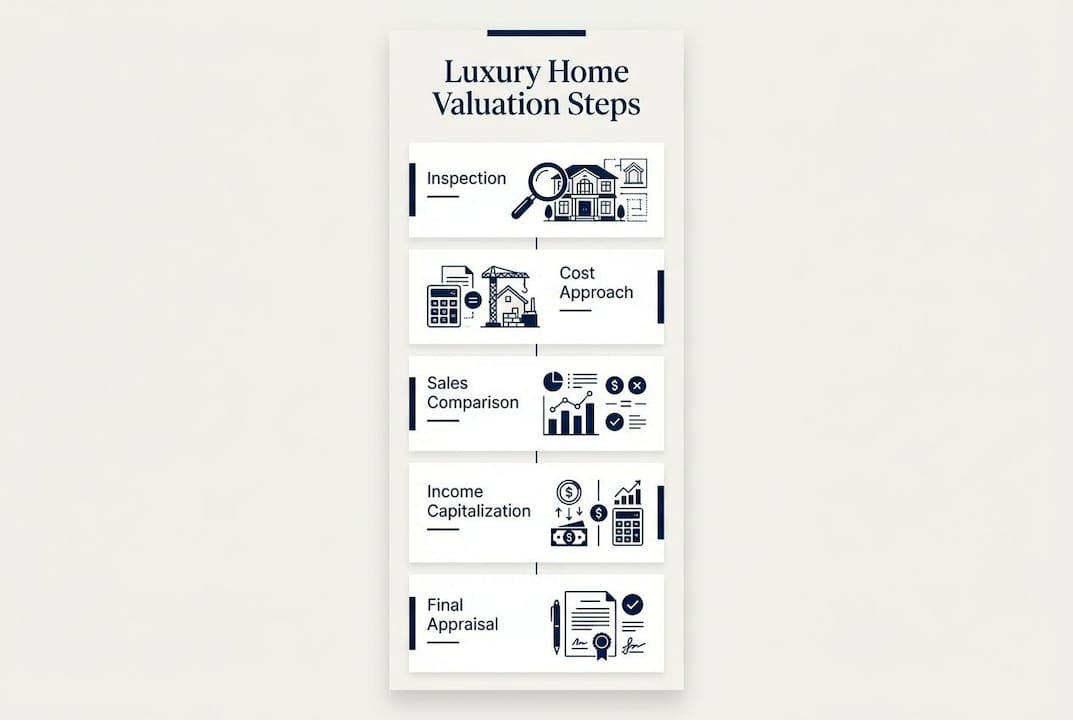
The foundation of any credible luxury property appraisal rests on three methodological pillars, deployed in concert rather than isolation. Blending these three methods materially reduces appraisal disputes during high-value transactions, a consideration of particular consequence when a single percentage point of error can translate into hundreds of thousands of dollars.
The cost approach calculates what it would cost to reproduce the property from scratch at current prices, accounting for custom imported materials, artisanal labor, and the depreciation of older bespoke elements. For estates above $10 million, this method becomes indispensable: custom cost-approach adjustments must account for imported stone, architectural provenance, and unique infrastructure that no standard depreciation schedule was designed to capture. A climate-controlled wine cellar housing two thousand bottles, or an FAA-approved helipad, carries a replacement cost that standard appraisal grids simply cannot accommodate.

The sales comparison approach remains the most familiar method, yet its application in luxury markets demands a far wider evidentiary net. The conventional 3-3-3 rule, which calls for three comparable sales within three miles sold within the past three months, is rarely feasible for luxury estates given the scarcity of truly equivalent transactions. Appraisers routinely extend their search radius up to 10 miles and look back 12–18 months to assemble a defensible peer set. Even then, substantial subjective adjustments are required to account for differences in view corridors, privacy infrastructure, and the pedigree of the design.
The income capitalization approach, once the exclusive province of commercial real estate, has grown increasingly relevant as affluent buyers acquire secondary and tertiary estates as income-producing assets. A well-positioned luxury property capable of generating premium short-term rental income establishes a baseline investment value that complements the other two methods, offering lenders and buyers alike a quantitative anchor grounded in cash flow rather than sentiment alone.
Unique challenges in appraising luxury homes
The scarcity of true comparables is the defining obstacle in high-end property appraisal, and it cascades into every other dimension of the process. When a 12,000-square-foot Mediterranean revival estate with a private yacht dock occupies its own category of one, the appraiser cannot simply average nearby sales and apply a modest adjustment. The evidence must be assembled from fragments: pending contracts, withdrawn listings, expired offerings, and broker intelligence gathered across a regional, sometimes national, market.
Quantifying bespoke features presents an equally formidable challenge. A cryotherapy chamber, a museum-grade security installation, or a sculpture garden may have cost millions to create, yet the appraiser must determine what the market will pay for it, not what the owner paid to build it. A feature that cost $800,000 to install may add only a fraction of that sum to resale value if the buyer pool does not share the original owner's enthusiasm. The valuation must separate construction cost from market utility, a distinction that protects both buyers and sellers from assumptions that feel intuitive but prove financially costly.
Emotional and exclusivity premiums add yet another layer of interpretive complexity. Luxury valuations emphasize exclusivity and emotional premiums beyond mere functional attributes, reflecting buyer preferences for privacy, views, and status that resist precise quantification. The appraiser's narrative report becomes the vehicle through which these subjective adjustments are justified, documented, and rendered defensible under scrutiny from lenders, buyers, and opposing counsel.
Pro Tip: When reviewing a luxury appraisal report, pay close attention to the adjustment grid. If the appraiser has made large dollar adjustments for features like privacy landscaping or architectural provenance without a written narrative explanation, request one. A well-supported adjustment is a negotiating asset; an unsupported one is a liability.
What factors shape the value of a luxury home?
Location, in the luxury context, transcends the familiar real estate maxim and assumes an almost architectural dimension of its own. Exclusive enclaves, gated communities with deep-water access, and properties commanding protected view corridors carry a pricing power that persists even when broader market conditions soften. Privacy features such as gated access, landscape buffering, and strategic layout contribute a tangible valuation premium, one that affluent buyers treat not as an amenity but as a prerequisite.
Architectural provenance occupies a position of singular importance among the five key pillars of luxury property appraisal: architectural provenance, exclusive community enclaves, invisible smart technology, turnkey lifestyle amenities, and sustainable eco-luxury infrastructure. A residence bearing the documented signature of a recognized architect carries what appraisers sometimes describe as an "art market premium," a value increment rooted in cultural prestige rather than structural utility. The rarity of the materials, whether book-matched Italian marble or custom French oak millwork, compounds this premium when verified through architectural archives and permitting records.
Scarcity and uniqueness of amenities drive exponential price premiums at the highest tier of the market. Features such as helipads, professional-grade wellness centers with hydrotherapy pools, and commercial-grade catering kitchens signal to the ultra-high-net-worth buyer that the property functions as a self-contained private resort. The appraiser's task is to translate that signal into a defensible dollar figure, drawing on historical market data across a broad regional footprint.
Luxury market demand, buyer psychology, and economic factors such as stock market performance and tax policy can alter buyer appetite with a swiftness that formal appraisals, by their backward-looking nature, sometimes fail to capture. Timing, therefore, is not merely a market consideration but a valuation variable. An estate brought to market during a period of compressed equity wealth may command a meaningfully different price than an identical property offered during a bull cycle, even when its physical attributes remain unchanged.
The luxury home appraisal process and what to expect
The appraisal of a distinguished estate begins with a thorough property inspection that goes well beyond the walkthrough a standard residential appraiser would conduct. The appraiser catalogs every custom feature, verifies the provenance of materials, and documents the condition of bespoke systems, from smart-home infrastructure to climate-controlled storage. Permit history is cross-referenced against actual square footage and floor plan, because un-permitted additions create layered risks: insurance may not cover the affected area, future buyers may discount the price, and local authorities retain the right to require demolition of non-compliant work.
The expanded comparable search follows, with the appraiser casting a geographic net that may extend well beyond the immediate neighborhood and reaching back through 12–18 months of transaction history to assemble a credible peer set. Each comparable is then subjected to a detailed adjustment grid, with written narrative justifications for every material difference in view, privacy, amenity quality, and architectural distinction. This grid is where the appraiser's expertise becomes most visible and most consequential.
Valuation modeling draws on all three approaches described earlier, weighted according to the property's character and the available evidence. The final report is a document of considerable depth, prepared to withstand scrutiny from buyers, sellers, lenders, and, when necessary, legal review. Standard residential appraisals typically cost $500–$800; a comprehensive luxury property appraisal generally ranges from $2,000 to $10,000 or more, scaling with the complexity of the estate and the depth of the bespoke features requiring specialized analysis.
Qualified luxury appraisers typically hold the MAI designation from the Appraisal Institute, the credential most widely recognized for complex commercial and high-value residential assignments. Beyond credentials, the most capable practitioners bring a network of collaborators: structural engineers, geotechnical consultants, and architects whose specialist assessments feed into the final report and ensure that no material risk escapes documentation.
Expert insights and nuances in luxury home valuations
The most consequential insight in understanding high-end home valuations is also the most frequently overlooked: luxury appraisals are inherently less precise than standard valuations, and they are best understood as defensible foundations for negotiation rather than absolute pronouncements of worth. A seller who treats an appraisal as the final word on value, rather than as one authoritative data point among several, surrenders negotiating latitude that a more sophisticated counterpart will exploit.
For ultra-high-value estates, the appraisal report must be accompanied by specialty inspections that go far beyond a standard residential checklist. Structural engineering assessments, geotechnical reports for hillside foundations, and specialty roof-system evaluations for copper tile or slate are all de rigueur at the $5 million-plus tier. Each specialty inspection carries its own cost, but relative to the asset value, this due diligence represents the highest-return investment a buyer can make before committing.
Documentation of upgrades and renovations carries weight that many sellers underestimate. Appraisers can only assign value to improvements they can verify; an undocumented renovation, however magnificent, may receive no credit in the formal valuation and could, if un-permitted, actively diminish the property's appraised worth. Sellers who assemble a comprehensive documentation package, including architectural drawings, contractor invoices, permit records, and material provenance certificates, place their appraiser in the strongest possible position to defend a premium valuation.
The staging question deserves candid attention. Cosmetic presentation can create a powerful first impression, but appraisers and sophisticated buyers alike are trained to distinguish permanent value from transient aesthetics. Paint, flooring, and fixture selections are changeable; location, lot orientation, ceiling heights, and structural integrity are not. Buyers who conflate the two risk overpaying for a presentation rather than a property.
Pro Tip: When the property is unusual, newly renovated, or occupies a thin luxury niche, commissioning a second independent valuation opinion is a sound practice. Small percentage discrepancies in luxury valuation translate into very large dollar differences, and a second opinion can reveal whether one analyst overweighted a feature or missed a relevant comparable set entirely.
Key Takeaways
Luxury home valuations demand a multi-method approach, specialist expertise, and a clear-eyed understanding of the emotional and market forces that standard appraisals are not designed to measure.
| Point | Details |
|---|---|
| Three-method approach | Blending cost, sales comparison, and income capitalization reduces disputes in high-value transactions. |
| Expanded comparable search | Appraisers extend searches up to 10 miles and look back 12–18 months due to thin comparable sales. |
| Emotional and exclusivity premiums | Privacy, architectural provenance, and status-driven features carry tangible value beyond physical size. |
| Documentation drives defensibility | Permit records, material provenance, and renovation invoices allow appraisers to justify premium adjustments. |
| Appraisals as negotiation tools | Luxury appraisals are defensible foundations for negotiation, not absolute verdicts on a property's worth. |
Yhluxrealestate, led by Yelena Horton and backed by the global reach of Sotheby's International Realty, brings the depth of market intelligence and negotiation acumen that luxury home valuations demand. Whether you are preparing to sell a distinguished Las Vegas estate or evaluating your next acquisition, explore expert guidance grounded in real off-market access and uncompromising standards of client service.
