
A recorded Nevada Declaration of Homestead protects up to $605,000 of equity in your primary residence from most general creditor judgments. That protection is not automatic: you must complete the county form, sign it before a notary, and record it with the Clark County Recorder. Do that now, before any judgment or lien attaches, and the equity you have built stays yours.
TL;DR:
- Recording your homestead declaration before a judgment or lien attaches ensures protection for up to $605,000 of your home's equity against most unsecured creditor claims.
- The exemption applies only to unsecured debts like credit cards and medical bills, not to secured loans, liens, or obligations such as mortgages, taxes, or child support.
- Filing requires an official form, legal property description, notarization, and recorded with Clark County before enforcement actions begin; delays can nullify protection.
- If your home's equity exceeds the cap, the court can order a sale but will first pay out the protected amount, and reinvested proceeds into a qualifying property remain exempt.
- Mistakes like late filing, assuming automatic transfer to trusts, or ignoring liens outside homestead coverage can undermine the protection.
Table of Contents
- What Does a Nevada Homestead Exemption Actually Protect?
- Who Can File, and What the Homestead Doesn't Cover
- How Do I File a Homestead Exemption in Las Vegas?
- What Happens if Your Home Equity Exceeds the Cap?
- Common Mistakes That Undermine Homestead Protection
- What to Bring When You Record Your Homestead Declaration
- A Las Vegas Agent's View on Timing the Filing
- Get Closing Logistics Handled by a Local Team
- Where to Verify These Rules Yourself
- Sources
- FAQ
What Does a Nevada Homestead Exemption Actually Protect?
Equity is the simple part of this equation: it is your home's market value minus whatever you still owe on mortgages or recorded liens. Nevada's homestead statute shields that equity, up to a $605,000 cap, from being seized to satisfy an ordinary money judgment.
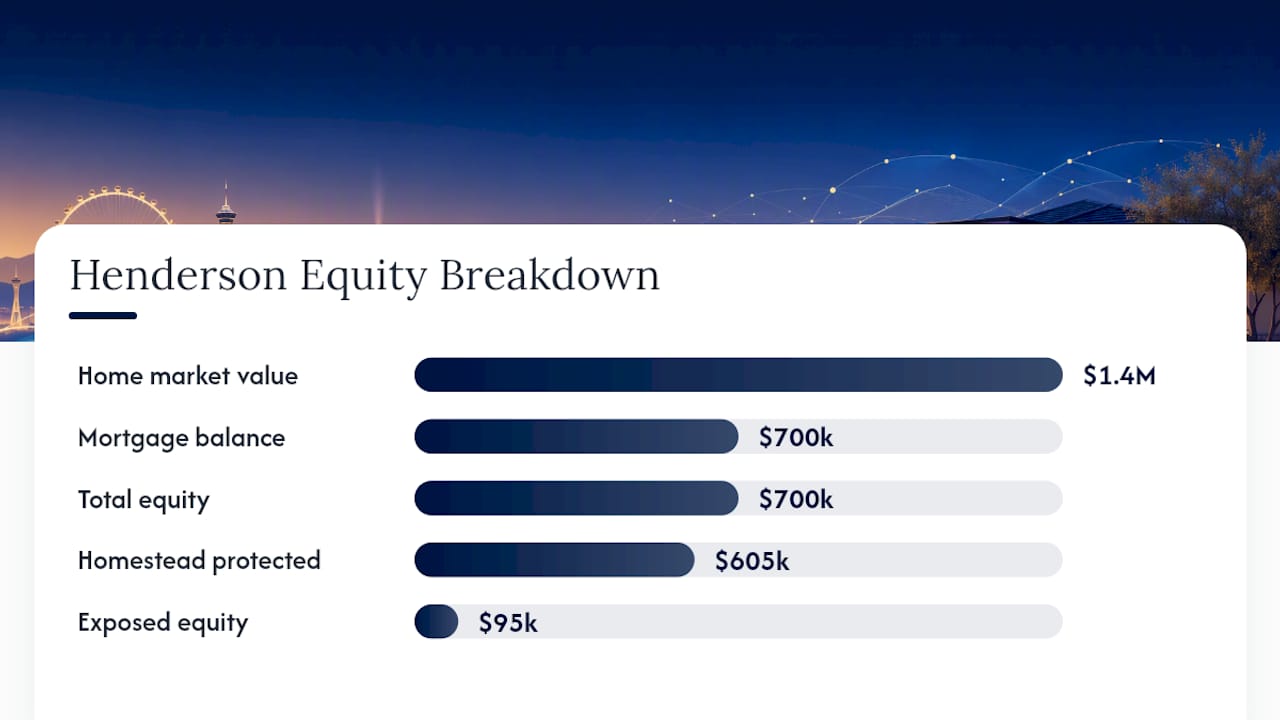
Picture a Henderson home worth $1.4 million with a $700,000 mortgage balance. That leaves $700,000 in equity. A recorded homestead declaration protects $605,000 of it. The remaining $95,000 sits exposed to a qualifying creditor claim, a gap worth knowing about before you assume the whole cushion is safe.
Pro Tip: Recalculate your exposed equity every time you pay down principal or your home's value climbs. A house that once fit entirely inside the exemption can outgrow it within a few years in a market like Las Vegas.
The homestead cap applies specifically to general creditor judgments, the kind that come from:
- Unsecured personal loans and credit card debt
- Medical bills sent to collections
- Civil lawsuit judgments unrelated to the property itself
- Most other unsecured consumer debt
That is the exemption's actual job description. It is a shield against unsecured creditors, not a blanket immunity from every financial obligation tied to the house.
Who Can File, and What the Homestead Doesn't Cover
Nevada law lets an individual owner, either spouse, or a tenant in common file a Declaration of Homestead on a primary residence. Married couples typically file jointly or with one spouse's name covering the household, and the document must be signed and acknowledged before a notary before it means anything legally.
The exemption has real limits, and pretending otherwise is how homeowners get an unpleasant surprise later. Nevada's homestead statute does not shield you from:
- Foreclosure by a mortgage lender or deed of trust holder
- Property tax liens or IRS liens
- Mechanic's liens filed by contractors for unpaid work
- Child support or alimony obligations
- Debts secured by liens you voluntarily consented to in a recorded agreement
In plain terms, the homestead protects you from people you owe money to in general, not from the specific parties who hold a direct claim against the property itself. If you stop paying your mortgage, the homestead declaration does nothing to slow the foreclosure.
One historical wrinkle worth a brief mention: Nevada also recognizes allodial title, an older land ownership designation that once offered even stronger creditor protection than the standard homestead. It is largely a legacy status now, rarely relevant to new purchases, and most Las Vegas homeowners will rely on the standard Declaration of Homestead rather than pursuing allodial title.
How Do I File a Homestead Exemption in Las Vegas?
Recording a Declaration of Homestead in Clark County is not complicated, but it does require a few pieces to line up in the right order. Here is the sequence.
-
Get the official form. Download the Declaration of Homestead form from the Clark County Recorder, rather than relying on a generic template you find elsewhere. The county's version matches what its recording clerks expect to see.
-
Pull your parcel number and legal description. You need the exact legal description of your property, not just a street address. Find it on your recorded deed, or look it up directly through Clark County Real Property Records. Most homeowners can retrieve this themselves without paying anyone for the step.
-
Complete the form legibly. Fill in every field the county requests, matching the legal description exactly as it appears on your deed. Mismatched or abbreviated descriptions are a common reason forms get kicked back.
-
Sign before a Notary Public. The declaration is not valid until it carries a notarized signature. Banks, UPS stores, and title companies throughout Las Vegas and Henderson offer notary services, often at low or no cost if you already bank there.
-
Record the document. Bring the notarized form to the Clark County Recorder's main or a satellite office, or mail it to the main office if you cannot appear in person. Confirm current recording fees and mail acceptance rules on the Recorder's website before you send anything, since fee schedules change.
Pro Tip: Keep a copy of the recorded declaration in the same file as your closing documents, and hand a copy to your title or closing agent. If you ever refinance or sell, having it on hand saves a scramble later.
Double check margins and page formatting against the Recorder's instructions before you submit. Recording offices reject documents for formatting issues far more often than for anything substantive in the content itself.
What Happens if Your Home Equity Exceeds the Cap?
Protection kicks in the moment your Declaration of Homestead is recorded, provided that happens before a creditor initiates enforcement action against the property. File after a lawsuit is already underway, and you may be filing too late to matter for that particular claim.
When a creditor argues your equity exceeds the $605,000 statutory limit, NRS 115 authorizes the court to appoint three appraisers to determine the property's actual equity and whether it can practically be divided. If the appraisers find real equity above the cap and the home cannot reasonably be split, the court can order a sale. You still receive the full $605,000 from the proceeds before any creditor claim touches the rest.
- Appraisers assess current equity, not just the original purchase price
- The homeowner's exempt share comes out of sale proceeds first
- Proceeds stay exempt if reinvested in a qualifying replacement property, identified within 45 days and occupied within 180 days
Bankruptcy adds another layer. Federal bankruptcy law interacts with state homestead exemptions, and in certain circumstances federal rules can limit or reshape what the state exemption otherwise guarantees. Anyone facing insolvency alongside a homestead question should talk to a bankruptcy attorney rather than assume Nevada's cap travels unchanged into federal proceedings.
Common Mistakes That Undermine Homestead Protection
Most homestead problems trace back to timing or paperwork, not the law itself. A homeowner waits until a lawsuit is filed to record the declaration, not realizing that recording after enforcement action begins may leave the specific claim uncovered.
Trusts trip people up too. Move title into a trust after recording your original declaration, and that protection may not automatically transfer to the trust as new owner. The trustee typically needs to record a fresh declaration to keep the coverage intact.
- Filing late, after a creditor has already moved against the property
- Assuming a trust or new title form inherits the old declaration automatically
- Believing homestead protects against refinances or home equity loans, when secured lenders remain outside the shield
- Confusing homestead with property tax relief, when Nevada's 3% tax cap is a completely separate program
- Ignoring HOA liens and mechanic's liens, both of which sit outside homestead coverage
Pro Tip: If you refinance, your homestead declaration usually stays in effect, but confirm with your title company that the new deed of trust does not require a fresh filing under your specific loan terms.
What to Bring When You Record Your Homestead Declaration
Walking into a Clark County recording office prepared saves a return trip. Bring the following.
- Your recorded deed, or at minimum the parcel number and legal description pulled from county records.
- The completed Declaration of Homestead form, already notarized.
- A valid photo ID for identity verification.
- Payment for the recording fee, confirmed in advance through the Recorder's office.
- A spare copy for your own files, since the original stays with the county.
Recorder staff can hand you form copies and help you locate a parcel number, but they cannot draft documents or give legal advice. For anything beyond straightforward recording, that is where an attorney or your title company steps in.
A Las Vegas Agent's View on Timing the Filing
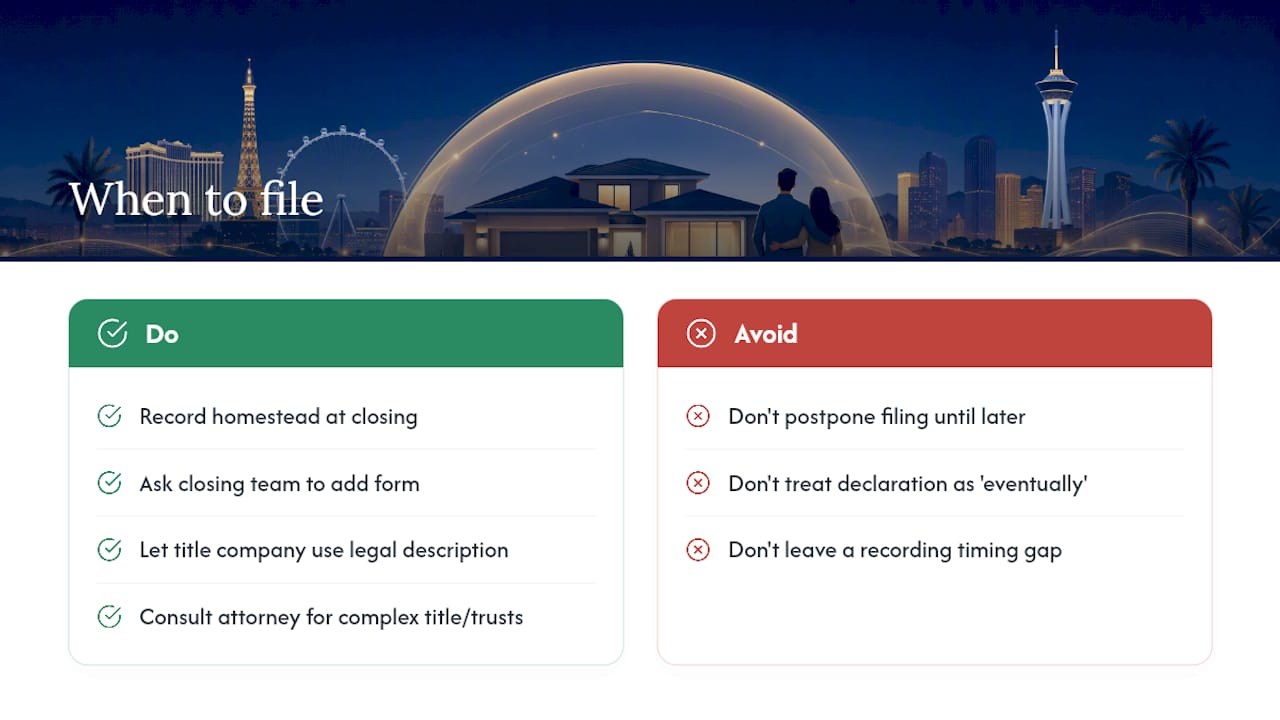
Buyers moving into Las Vegas from out of state often treat the homestead declaration as paperwork to handle "eventually." That instinct is the one thing I would push back on hardest. Recording at or immediately after closing eliminates the timing gap where a creditor could theoretically move against the property before protection exists, a risk that matters more for high-value purchases where the exposed equity is larger.
Title companies and agents typically already have your legal description in hand from the closing package, which makes adding the homestead form to that same checklist a small lift. Anyone relocating across the country for a new home should ask their team to fold this step into closing rather than treating it as a separate errand for later. None of this replaces advice from a real estate attorney on complex title or trust structures, but the mechanics of getting it recorded are straightforward enough to handle at the closing table.
— Yelena
Get Closing Logistics Handled by a Local Team
Local real estate services assist luxury buyers by managing closing paperwork, including parcel lookups, notary coordination, and recording logistics, to support out-of-state buyers unfamiliar with Clark County's process.

A relocation concierge service can pull the legal description from your closing package, coordinate notarization, and keep your Declaration of Homestead on the same timeline as your closing date, so recording never becomes an afterthought. That kind of coordination matters most for buyers managing a move from another state while juggling a dozen other logistics at once. For sellers curious about how sale proceeds and deductions work if a property is ever sold under equity pressure, the seller's net proceeds breakdown is worth a look too. If you are buying or relocating to Las Vegas, reach out to Yhluxrealestate to get your closing checklist, homestead filing included, built into your purchase timeline from day one.
Where to Verify These Rules Yourself
Every figure and rule here traces back to primary sources you can check directly. The Clark County Recorder's homestead page has the official form and current recording locations. The full statutory text lives in NRS Chapter 115, and the county's own homestead brochure summarizes procedures and exclusions in plain language. Readers curious how other states structure similar protections can glance at Florida's homestead exemption rules for comparison, though Nevada's statute governs everything discussed here.
This article is general information, not a substitute for advice from a qualified lawyer. Consult a qualified legal professional about your own circumstances before acting on anything here.
Sources
- Nevada Homestead Declaration (Clark County Recorder)
- NRS Chapter 115 - Homesteads
- Bankruptcy basics — United States Courts
FAQ
How do I qualify for the homestead exemption in Nevada?
You qualify by owning and occupying the property as your primary residence and recording a signed, notarized Declaration of Homestead with the Clark County Recorder. Individual owners, spouses, and tenants in common can all file.
Is there a homestead tax exemption in Nevada?
No, the homestead declaration does not reduce your property taxes. Nevada's 3% tax cap on primary residences is a separate program handled through county assessor offices, not the Recorder.
How do I homestead my house in Las Vegas?
Download the Declaration of Homestead form from the Clark County Recorder, fill it out with your property's legal description, sign it before a notary, and record it in person or by mail with the Recorder's office.
What do I need to bring for a homestead exemption?
Bring your recorded deed or parcel number, the completed and notarized form, a valid photo ID, and payment for the recording fee, plus a spare copy for your own files.