
Homeowners insurance for luxury homes is a specialized policy designed to protect high-value residences at full replacement cost, covering the custom materials, bespoke craftsmanship, and unique features that standard policies routinely leave exposed. Known in the industry as high-net-worth or high-value home insurance, this coverage addresses the profound gap between what a conventional policy pays and what it actually costs to rebuild a luxury residence to its original standard. Providers such as Chubb, PURE Insurance, and AIG Private Client Group have built entire product lines around this need, recognizing that a $3 million home is not simply a larger version of a $300,000 one. The risks, the assets, and the expectations are categorically different.
What is homeowners insurance for luxury homes, and how does it differ?
Luxury home insurance is defined by its coverage thresholds, its valuation method, and the caliber of service it delivers. Replacement cost thresholds typically begin at $750,000 to $1 million, and homes exceeding 4,500 square feet often qualify regardless of their current market value. That distinction matters enormously: a property's market value reflects buyer demand, while its replacement cost reflects the true expense of rebuilding it with matching materials and labor.
Standard homeowners policies settle claims on an "actual cash value" basis, meaning depreciation is subtracted from any payout. A luxury policy, by contrast, operates on an "agreed value" or "guaranteed replacement cost" basis, guaranteeing the full cost to rebuild with identical premium materials even if construction costs rise during the rebuild period, which can span 18 to 36 months. That single distinction can represent hundreds of thousands of dollars in a real claim.

The liability coverage gap is equally significant. Luxury policies provide liability limits ranging from $1 million to $5 million or more, compared to the $300,000 to $500,000 caps typical of standard policies. For a homeowner with a pool, a guesthouse, and household staff, those elevated limits are not a luxury. They are a necessity.
Pro Tip: Request a side-by-side comparison of your current policy's liability limit against the estimated net worth of your household assets. If your liability coverage falls short of your total asset exposure, you are carrying uninsured risk.
How dwelling coverage and replacement cost are assessed for luxury homes
Replacement cost assessment for a luxury residence is a precise discipline, not a formula. Insurers and independent appraisers evaluate premium materials such as hand-laid stone, imported hardwood, custom millwork, and artisan tile, then calculate the labor costs required to source and install them. That figure frequently exceeds the home's market value, particularly in markets where land prices inflate the sale price while the structure itself is assessed separately.
The process for establishing accurate dwelling coverage follows a clear sequence.
First, commission a professional replacement cost appraisal from a certified appraiser who specializes in high-value residential properties. Generic automated valuation tools do not account for bespoke finishes or specialty construction methods.
Second, distinguish between market value and replacement cost before accepting any policy limit. For high-net-worth homes, insurance must be anchored to replacement cost to provide sufficient rebuilding funds. A home appraised at $4 million for sale purposes may carry a $5.5 million replacement cost.
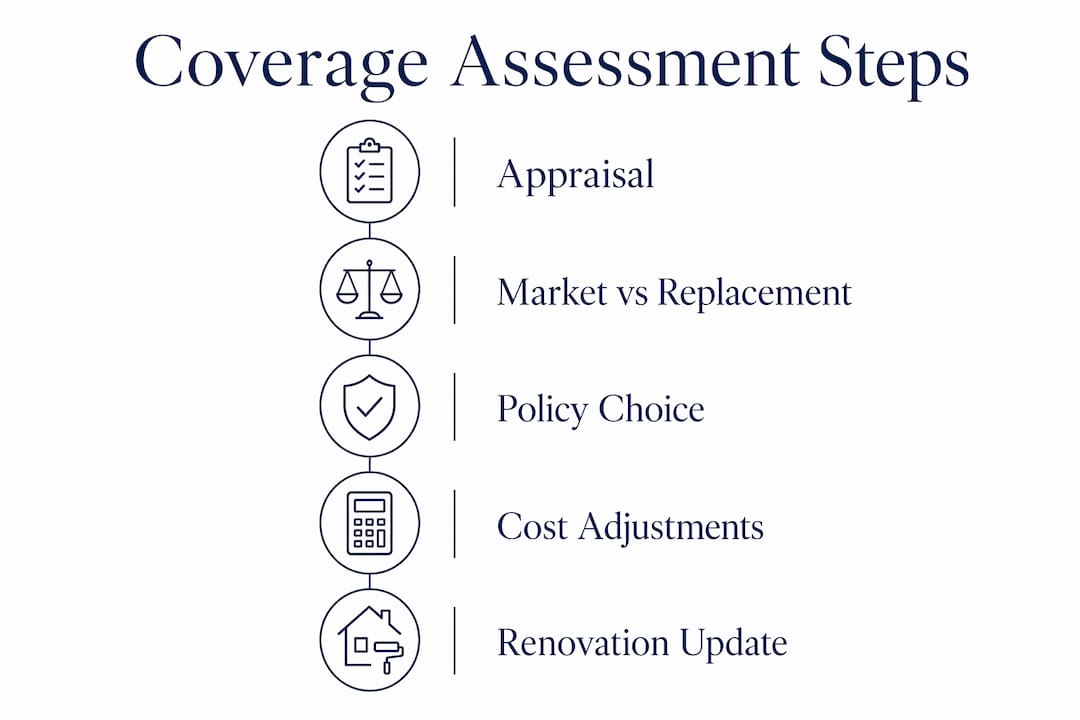
Third, request either an agreed value policy or a guaranteed replacement cost endorsement. Agreed value settlements guarantee payouts sufficient to fully rebuild the property with matching materials, even if construction costs increase during the rebuild period.
Fourth, account for fluctuating construction costs. Material and labor costs in the luxury segment are volatile. A policy written in 2023 may be materially underinsured by 2026 without an annual inflation guard or periodic reappraisal.
Fifth, revisit coverage limits after any significant renovation. A kitchen remodel using imported cabinetry or a primary suite addition with custom stonework changes the replacement cost profile of the home entirely.
Pro Tip: Schedule a replacement cost appraisal every two to three years, not just at policy inception. Construction costs for luxury finishes can shift dramatically, and an outdated appraisal is the most common cause of underinsurance at claim time.
What coverage extensions matter most for luxury residences?
Coverage for luxury residences extends well beyond the dwelling itself. The personal property, the liability exposures, and the cost of temporary displacement all require purpose-built protections that standard policies cannot provide.
Personal property scheduling is the most frequently overlooked gap. Scheduling high-value items such as jewelry, fine art, and collectibles separately ensures protection beyond standard category limits. Automatic jewelry coverage in some policies can be as low as $50,000. A single piece from a serious collection can exceed that figure many times over. Scheduled coverage, backed by a current appraisal, eliminates that exposure entirely.
Additional Living Expenses coverage deserves equal attention. Standard policies cap ALE at 20% of dwelling coverage, a figure that rarely reflects reality for a luxury homeowner. Monthly displacement costs for comparable high-end housing run between $15,000 and $50,000. A luxury policy calibrates ALE limits to actual market rents for comparable residences, not to an arbitrary percentage of the dwelling limit.
The table below summarizes the most consequential coverage extensions available under high-value home insurance policies.
| Coverage Extension | What It Protects | Standard Policy Status |
|---|---|---|
| Scheduled personal property | Jewelry, fine art, collectibles at appraised value | Excluded or severely capped |
| Enhanced ALE | Comparable rental housing at $15,000–$50,000/month | Capped at 20% of dwelling limit |
| Liability for pools and staff | Bodily injury and employment practices claims | Excluded or underinsured |
| Cyber liability | Identity theft, ransomware, smart home breaches | Excluded |
| Earthquake and flood endorsements | Structural loss from seismic or water events | Excluded |
| Worldwide personal property | Contents covered globally, including vacation homes | Domestic only |
Luxury policies also include optional endorsements such as earthquake, flood, water backup, identity theft, and employment practices liability, all of which standard policies routinely exclude. For homeowners with household staff, employment practices liability is particularly consequential, covering wrongful termination and harassment claims that could otherwise result in significant out-of-pocket legal costs.
How to choose and maintain the best insurance for luxury homes
Selecting the best insurance for luxury homes requires evaluating four dimensions: valuation method, service model, coverage breadth, and ongoing maintenance discipline.
The first step is to insist on replacement cost or agreed value coverage. Any policy that settles on actual cash value is structurally inadequate for a luxury residence. Depreciation penalties on custom finishes and premium materials can reduce a payout by 30% to 50% compared to the true cost of rebuilding.
The second step is to choose an insurer with concierge-level claims handling. Affluent homeowners have access to dedicated expert adjusters rather than standard call centers. That distinction is not cosmetic. A claims adjuster who understands the cost of hand-plastered ceilings or custom ironwork will assess a loss accurately. A generalist adjuster will not.
The third step is to work with a broker who specializes in high-net-worth clients. Carriers such as Chubb, PURE Insurance, and AIG Private Client Group do not distribute their luxury products through standard retail channels. A specialist broker provides access to these products and the expertise to structure coverage correctly.
The fourth step is to update personal property appraisals regularly. Underinsurance and obsolete appraisals are the leading cause of claim shortfalls among affluent homeowners. Fine art, jewelry, and collectibles appreciate over time. A policy written against a five-year-old appraisal may pay a fraction of the current value.
The fifth step is to consider an umbrella liability policy to augment even the elevated limits of a luxury home policy. For homeowners with significant net worth, a personal umbrella policy providing $5 million to $25 million in additional liability coverage is a standard component of a complete risk management strategy.
Pro Tip: Ask your broker whether your policy includes accidental breakage and mysterious disappearance coverage for valuables. These two provisions protect against losses that are neither theft nor a named peril, and their absence is a common gap in otherwise well-structured luxury policies.
Key takeaways
Luxury home insurance is the only policy structure that fully protects a high-value residence, because it bases coverage on replacement cost, not market value, and delivers the liability limits, personal property scheduling, and claims expertise that standard policies cannot provide.
| Point | Details |
|---|---|
| Replacement cost is the foundation | Insure at full rebuilding cost, not market value, to avoid catastrophic shortfalls after a loss. |
| Liability limits must reflect real exposure | Luxury policies provide $1M–$5M+ in liability coverage, essential for pools, staff, and guesthouses. |
| Schedule all high-value personal property | Jewelry, art, and collectibles require individual appraisals and scheduled coverage to avoid uncovered losses. |
| ALE limits must match actual displacement costs | Luxury displacement costs run $15,000–$50,000 per month; standard ALE caps are structurally insufficient. |
| Appraisals require regular updates | Outdated valuations are the primary cause of underinsurance claims among high-net-worth homeowners. |
Why I believe most luxury homeowners are underinsured without knowing it
Working with high-net-worth buyers and sellers in the Las Vegas luxury market, I have observed a pattern that repeats itself with striking regularity. Owners of magnificent properties, properties with imported stone, custom cabinetry, and resort-caliber amenities, carry insurance policies that were written years ago against valuations that no longer reflect reality. They assume that because their premium is substantial, their coverage must be adequate. That assumption is one of the most costly misconceptions in luxury real estate.
The distinction between market value and replacement cost is not academic. I have seen properties where the replacement cost exceeded the market value by 40% or more, simply because the land beneath the home carried significant value while the cost of recreating the structure itself was staggering. A standard policy anchored to market value would leave that owner with a profound shortfall after a total loss.
The concierge claims experience that carriers like Chubb and PURE Insurance provide is, in my view, as valuable as the coverage itself. When a loss occurs, the last thing a homeowner needs is to educate a generalist adjuster about the cost of reclaimed wood floors or hand-forged hardware. A dedicated adjuster who already understands these materials resolves claims faster and more accurately.
My counsel to every luxury homeowner is this: treat your insurance review with the same rigor you applied to acquiring the property. Commission a current replacement cost appraisal. Schedule every significant piece of personal property. Confirm your ALE limits against actual rental comps in your market. And work with a broker who specializes in private homesites and high-value properties, not one who happens to offer a luxury product alongside standard lines. The premium difference between adequate and inadequate coverage is rarely as large as homeowners fear. The financial difference at claim time can be devastating.
— Yelena
Protect your luxury home with expert guidance from Yhluxrealestate
Yhluxrealestate understands that a luxury residence represents far more than a financial asset. It is a reflection of uncompromising standards, refined taste, and a life carefully composed. Ensuring that asset is protected with the precision it deserves requires guidance from advisors who operate at the same level of excellence.

Yhluxrealestate, led by Yelena Horton and backed by the global network of Sotheby's International Realty, provides expert advisory on luxury home coverage tailored to the specific profile of each property and its owner. From replacement cost valuation to personal property scheduling and carrier selection, the guidance available through Yhluxrealestate is designed to close the gaps that standard policies leave open. Connect with Yhluxrealestate today to arrange a personalized coverage review and ensure your residence is protected at the level it warrants.
FAQ
What is the minimum value for luxury home insurance?
Luxury home insurance typically applies to properties with replacement costs of $750,000 to $1 million or more, and homes exceeding 4,500 square feet often qualify regardless of their current market price.
How does agreed value coverage differ from actual cash value?
Agreed value coverage guarantees a payout sufficient to fully rebuild the property with matching materials, while actual cash value settlements subtract depreciation, often reducing payouts by 30% to 50% on premium finishes.
Why is scheduling personal property important for luxury homeowners?
Lack of proper scheduling and appraisals is a frequent cause of claim shortfalls among affluent homeowners, because standard category limits, sometimes as low as $50,000 for jewelry, cannot cover the true value of a serious collection.
What does Additional Living Expenses coverage provide for luxury homeowners?
ALE coverage pays for comparable housing during reconstruction. For luxury homeowners, that means monthly costs of $15,000 to $50,000, a figure that standard policy ALE caps routinely fail to meet.
Do luxury home insurance policies cover vacation homes and international contents?
Many high-value home insurance policies include worldwide personal property coverage, extending protection to contents in vacation homes and secondary residences that standard domestic policies do not cover.