
In Las Vegas, HOA rules are governed by NRS Chapter 116, Nevada's statute for common-interest communities, and by your specific community's CC&Rs (covenants, conditions, and restrictions). Before you sign anything, three actions matter more than any other: read the governing documents in full, verify monthly dues and confirm no liens exist against the property, and check the reserve fund's health. Skip these steps and you inherit someone else's unresolved dispute.
- Read the CC&Rs, bylaws, and rules before closing, not after
- Confirm dues are current and no lien has been recorded
- Ask for the reserve study and recent financial statements
Nevada's super-priority lien under NRS 116.3116 can, in narrow circumstances, jump ahead of a mortgage lender's claim, which is exactly the kind of detail a title search should catch but sometimes misses when a seller has quietly fallen behind.
Key Takeaways
Nevada's HOA framework under NRS Chapter 116 sets enforceable rights for homeowners, but protecting yourself still requires reading the CC&Rs and verifying financials before you close.
| Point | Details |
|---|---|
| NRS 116 governs statewide | State law sets the floor for board conduct, fines, and hearings; community rules cannot override it. |
| Verify dues before closing | Unpaid assessments can trigger a super-priority lien under NRS 116.3116 that complicates title. |
| Fees vary by property type | Single-family dues average around $155/month; condos run closer to $310/month in Las Vegas. |
| Fines require due process | Written notice, a cure period, and a hearing right must precede any valid fine. |
| Rental caps affect strategy | Many HOAs limit rental percentages or ban short-term leases outright, independent of county ordinances. |
Table of Contents
- Understanding HOA Rules in Las Vegas Under Nevada Law
- Common HOA Rules and Violations Las Vegas Owners Run Into
- HOA Fees in Las Vegas: Coverage, Ranges, and Reserve Health
- Liens, Super-Priority Claims, and Title Risk
- How Enforcement Works and What Protects You as a Homeowner
- Pre-Purchase Checklist: What to Request Before You Close
- Avoiding and Resolving HOA Disputes: A Practical Sequence
- How Yelena Horton Helps Buyers Navigate HOA Risk
- How HOA Rules Get Amended in Las Vegas
- Homeowner Rights and Responsibilities Under Nevada HOA Rules
- Exceptions and Exemptions Within Las Vegas HOA Rules
- Rental Restrictions and Short-Term Rentals in Las Vegas HOAs
- Attending HOA Meetings and Getting Involved in Governance
- Comparing HOA Rules Across Las Vegas Neighborhoods and Community Sizes
- Authoritative Links and Contacts for Nevada HOA Rules
- What the Rulebook Doesn't Tell You
- Sources
- FAQ
Understanding HOA Rules in Las Vegas Under Nevada Law
Nevada's Common-Interest Ownership Act, NRS Chapter 116, sets the statewide floor for how associations operate. It governs board elections, assessment collection, meeting notice requirements, and dispute resolution across every qualifying community in the state, whether that's a gated golf community in Summerlin or a modest townhome complex near Sunrise Manor. The statute borrows heavily from the Uniform Common Interest Ownership Act, giving Nevada a more standardized legal structure than many states.
Within that framework, four documents do the real work at the neighborhood level:
- CC&Rs set binding restrictions on land use, architecture, and behavior, recorded against the property itself
- Bylaws govern how the association operates internally, including board terms and voting procedures
- Articles of incorporation establish the HOA as a legal nonprofit entity
- Rules and regulations are adopted by the board for day-to-day matters like pool hours or parking
When a community rule conflicts with NRS 116, state law wins. An HOA cannot shorten your right to a hearing or waive your cure period just because its own rules say otherwise.
Common HOA Rules and Violations Las Vegas Owners Run Into
Every Las Vegas HOA writes its own rulebook, but certain violations show up constantly across the valley's master-planned communities. Knowing them in advance saves you a first-year fine.
- Parking restrictions. Overnight street parking, commercial vehicles, and RVs are frequent flashpoints, and many communities authorize towing after a single documented warning.
- Architectural changes without approval. Repainting your exterior, installing solar panels, or replacing desert landscaping typically requires a written application to an architectural review committee first.
- Exterior maintenance lapses. Dead landscaping, visible clutter, and faded paint draw notices quickly in HOAs built around curb-appeal standards.
- Trash and container placement. Bins left curbside outside pickup windows are a near-universal violation category.
- Rental and tenant rules. Many associations cap the percentage of rented units or require tenant registration within a set number of days.
Local guides on avoiding HOA fines in Las Vegas confirm these five categories generate the bulk of enforcement actions. You'll find your community's specific version listed in the resale package, usually under a section labeled "Rules and Regulations" separate from the CC&Rs themselves.
HOA Fees in Las Vegas: Coverage, Ranges, and Reserve Health
Fees vary sharply by property type. Aggregated data on Las Vegas HOA fees puts single-family home dues around $155 a month on average, while condo owners pay closer to $310 monthly, with many master-planned communities falling within a broad qualitative range depending on amenities.
What that money actually funds:
- Desert landscaping and irrigation, a major cost driver given Las Vegas's climate
- Community pools, spas, and clubhouse maintenance
- Master policy insurance covering common areas
- Gated entry staffing and security patrols
- Reserve fund contributions for roof, paving, and infrastructure replacement
Gated and amenity-heavy developments tend to run notably higher than basic communities because pool upkeep and landscaping scale with square footage of common area. That premium is the trade-off for the resort feel many Las Vegas luxury buyers are paying for in the first place.
Pro Tip: Ask for the reserve study, not just the current balance. A community sitting on healthy cash today but facing a roof replacement in three years with no funding plan is a special assessment waiting to happen.
Red flags worth walking away from include reserves funded below 30% of the recommended level, a sudden dues increase exceeding 20% in one cycle, or a board that can't produce the last reserve study on request.
Liens, Super-Priority Claims, and Title Risk
Unpaid assessments in Nevada don't just accumulate as a balance owed. They can become a recorded lien against the title itself, and Nevada's version of that mechanism has real teeth.
Under NRS 116.3116, an HOA holds a super-priority lien that, for a limited portion of unpaid assessments and under specific conditions, can take precedence over even a first mortgage. That structure exists to give associations a realistic path to collect delinquent dues, but it also means that a buyer who doesn't check for outstanding balances can inherit a title complication that has nothing to do with the seller's mortgage standing.
- Title companies in Nevada routinely verify HOA dues are current before closing
- Buyers should independently request proof of payment history early in escrow
- Any outstanding lien must be cleared, or credited against the sale price, before the deed transfers
Pro Tip: Don't rely solely on your title company's standard check. Request the HOA's demand statement directly, in writing, during the first week of escrow so there's time to negotiate a resolution if a balance surfaces.
If you're already deep in numbers on a purchase, our breakdown of a seller's net proceeds calculation shows exactly where lien payoffs get deducted at closing.
How Enforcement Works and What Protects You as a Homeowner
Nevada doesn't let an HOA fine you the moment it spots a violation. The process has required steps, and skipping them can void the penalty entirely.
- Written notice. The association must notify you of the alleged violation in writing, specifying what rule was broken.
- Cure period. You get a defined window to fix the issue before any fine attaches.
- Right to a hearing. If you contest the violation, the board must offer a hearing before finalizing a fine.
- Fine limits and consistency. Fines must follow the association's published schedule; enforcement that targets one owner while ignoring identical violations elsewhere in the community is selective and potentially actionable.
A fine imposed without proper notice, a cure period, or a hearing opportunity can be considered void under Nevada's procedural protections, and an owner who believes enforcement was applied unevenly has a path to challenge it rather than simply pay and move on.
If your board isn't following this sequence, the Nevada Office of the Ombudsman for Common-Interest Communities is your first stop for informal mediation. From there, formal complaints route through the Nevada Real Estate Division (NRED), with statutes of limitation generally running a few years from the violation date depending on the claim type, so don't sit on a dispute indefinitely.
Pre-Purchase Checklist: What to Request Before You Close
A resale package tells you far more about a community than a walkthrough ever will. Request these items in order of priority:
- CC&Rs, bylaws, and rules in their current recorded form
- Financial statements for the past two years
- Reserve study, including funding percentage and upcoming projects
- Meeting minutes from at least the last six months
- Pending litigation disclosures involving the association
- Collection policy and current delinquency statistics
Then ask the manager directly: has there been a special assessment in the last three years, what's the current delinquency rate among owners, and are any capital projects scheduled that aren't yet reflected in dues?
Pro Tip: A delinquency rate above 15% is a meaningful warning sign. It usually means the association is one bad year away from a special assessment landing on your bill instead of the previous owner's.
Ongoing litigation, underfunded reserves, and a pattern of "special" assessments that repeat every few years are the three red flags that should slow down any offer, luxury property or otherwise. Our guide on buying a luxury condo in Las Vegas walks through how these documents affect negotiating leverage.
Avoiding and Resolving HOA Disputes: A Practical Sequence
Most disputes are preventable with a paper trail. Get every architectural approval, pet exception, or rental waiver in writing before you act on a verbal "yes" from a board member.
- Document every interaction with the board or management company, including dates and names.
- Follow the written cure procedure exactly; don't assume informal fixes count.
- Request a hearing the moment you're fined, rather than paying and hoping it goes away.
- Contact the Nevada Ombudsman for informal mediation before filing anything formal.
- Escalate to NRED or small claims only if procedural rights were genuinely violated and mediation stalls.
This sequence costs you almost nothing and resolves the overwhelming majority of disputes before they reach a hearing room.
How Yelena Horton Helps Buyers Navigate HOA Risk
Local pattern recognition matters here. Yelena Horton's years working Las Vegas's luxury corridors mean she already knows which Summerlin and Henderson HOAs run lean reserves and which ones over-fund for exactly this reason.
- Relocation concierge service secures resale packages for out-of-state buyers before they ever tour the property
- Negotiation strategy can build HOA-specific protections into contracts, including seller credits for pending assessments or escrow holdbacks until liens clear
- Off-market access often surfaces homes in communities with stronger financials, simply because those listings never hit the open market's frenzy
How HOA Rules Get Amended in Las Vegas
Amending governing documents isn't a board decision made in an afternoon. NRS 116 requires a specific process, and most CC&Rs layer additional requirements on top of the statutory minimum.
Typically, an amendment starts with a proposal from the board or a homeowner petition, followed by a mandatory notice period informing all owners of the proposed change and the date of a vote. CC&R amendments generally require a supermajority, often 67% of the voting membership, though the exact threshold is set in each community's own declaration and can run higher for major structural changes. Rule changes that don't touch the recorded CC&Rs, like updated pool hours or a revised architectural application form, usually only need board approval after a public comment period, since they carry less legal weight than a recorded covenant.
Once approved, CC&R amendments must be recorded with the Clark County Recorder to take legal effect, which means the change becomes part of the public record tied to every property in the community. This detail matters for owners: a rule change adopted last year that was never recorded may not be enforceable, and it's worth asking the HOA management company for a recording date if you're unsure whether a newer restriction is actually binding.
For buyers, this timeline works both ways. A community currently allowing something you want, like short-term rentals or backyard chickens, could vote to restrict it after you close, and there's rarely a grandfather clause protecting your specific unit unless the amendment explicitly says so.
Homeowner Rights and Responsibilities Under Nevada HOA Rules
Owning inside an HOA means signing on to a defined trade: you gain shared amenities and property-value protection, and you accept limits on individual property use that NRS 116 balances with specific owner protections.
Your rights include access to association financial records upon written request, the ability to attend and speak at board meetings (with narrow exceptions for executive session topics like litigation or personnel), advance notice before any fine, and a hearing if you contest a violation. You also have the right to run for a board seat once you meet the community's eligibility requirements, typically just being a unit owner in good standing.
Your obligations run the other direction: pay assessments on time, follow the architectural approval process before modifying your exterior, maintain your property to the community's documented standards, and disclose the HOA's existence and fee structure if you ever sell. Nevada law also expects owners to receive and retain the governing documents at purchase, which is why the resale package carries legal weight beyond being a courtesy disclosure.
One frequently misunderstood point: a board cannot simply invent a new restriction and enforce it against you retroactively without following the amendment process outlined above. If a rule wasn't in effect and properly adopted at the time of an alleged violation, that's grounds to contest the fine at a hearing.
Exceptions and Exemptions Within Las Vegas HOA Rules
Not every restriction applies uniformly, and knowing the carve-outs can save a homeowner real money and frustration.
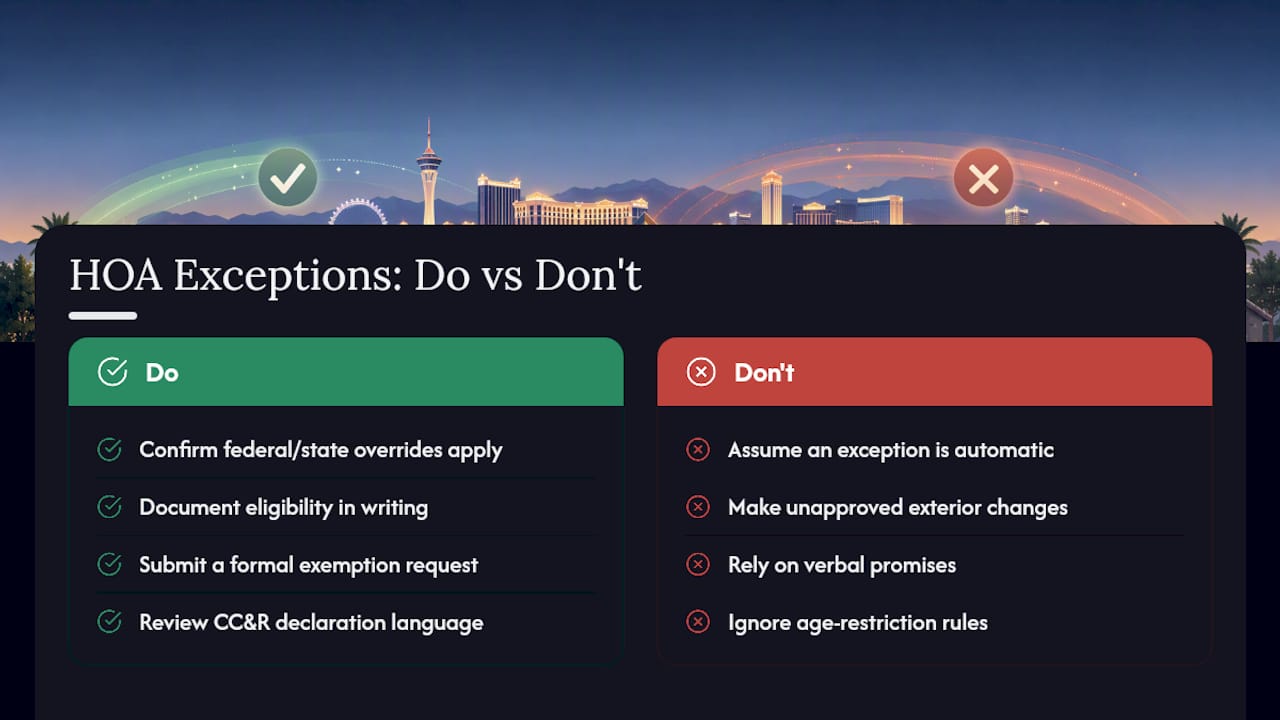
Federal and state law override HOA restrictions in specific situations regardless of what the CC&Rs say. Satellite dish installation under a certain size is protected by federal telecommunications rules that HOAs cannot block outright, though they can regulate placement. Religious displays and certain flags, including the American flag, typically carry protections HOAs cannot fully restrict under Nevada and federal law. Accessibility modifications for owners with disabilities generally must be permitted as reasonable accommodations, even when they alter exterior appearance.
Some exemptions are community-specific rather than legal mandates. Older sections of a master-planned development are sometimes "grandfathered" under prior rule versions if they existed before a restriction was adopted, though this varies significantly by declaration language and isn't guaranteed. Detached single-family homes on larger lots sometimes carry different architectural review thresholds than attached townhomes in the same master association, since fewer shared walls mean less risk of a change affecting a neighbor.
Age-restricted 55-plus communities, common in parts of the Las Vegas valley, operate under separate federal exemptions from certain Fair Housing familial-status rules, which is why they can legally limit residency by age in ways a standard HOA cannot.
None of these exceptions are automatic. Each requires the owner to know the exemption exists, document eligibility, and often submit a formal request rather than assuming the exception applies by default.
Rental Restrictions and Short-Term Rentals in Las Vegas HOAs
Rental policy is where Las Vegas HOA rules intersect most directly with investment strategy, and the rules vary enormously by community.

Many associations cap the total percentage of units that can be rented at any given time, often somewhere between 20% and 30% of the community, with a waitlist system once the cap is reached. Minimum lease term requirements are common too. Some communities require leases of at least six months or a full year specifically to block short-term and vacation rentals.
Short-term rental platforms like Airbnb face a double layer of restriction in Las Vegas: HOA governing documents on top of Clark County or City of Las Vegas short-term rental ordinances, which independently regulate permits, occupancy limits, and licensed operator zones. An HOA can prohibit short-term rentals entirely even in a zone where county ordinance would otherwise allow them, since the CC&Rs function as a private contractual restriction layered over public zoning law.
For investors specifically eyeing Las Vegas for short-term rental income, this makes the HOA's rental policy a first-filter question, not an afterthought. A property in a community that bans anything under a 30-day lease simply isn't viable for that strategy regardless of how favorable the county's licensing rules might be. Always request the rental policy and current rental percentage before assuming a strategy will work in a specific building or master-planned section.
Attending HOA Meetings and Getting Involved in Governance
Board meetings are open to owners in good standing, and Nevada law requires advance written notice, typically posted or mailed a set number of days ahead, along with an agenda listing the topics to be discussed.
Owners generally have the right to speak during a designated comment period, though boards can set reasonable time limits per speaker to keep meetings on schedule. Executive sessions covering litigation, personnel matters, or certain contract negotiations can exclude owners, but routine business, budget discussions, and rule proposals happen in open session where you can observe and comment.
Showing up consistently accomplishes more than most owners expect. Boards in smaller associations are often short on volunteers, and attending even a handful of meetings a year gives you visibility into upcoming assessments, reserve fund decisions, and rule proposals well before they show up as a surprise notice in your mailbox. If you want a seat on the board itself, eligibility is typically limited to being an owner in good standing, meaning current on assessments, with elections held according to the timeline in the bylaws.
Comparing HOA Rules Across Las Vegas Neighborhoods and Community Sizes
The valley's HOA landscape splits roughly into three tiers, and the rules tighten as the amenities grow.
Large master-planned communities like Summerlin or Mountain's Edge often layer a master association's rules on top of sub-HOA rules for individual neighborhoods within them, meaning a single property can answer to two boards with two overlapping (and occasionally conflicting) rule sets. These communities tend to have the most detailed architectural guidelines, given the sheer number of homes involved and the value placed on consistent aesthetics.
Smaller, standalone HOAs, often a single street or a modest townhome cluster, typically run leaner rule books focused on the basics: parking, trash, and exterior maintenance, with far less bureaucracy around approvals since the volunteer board handles far fewer requests.
Gated and luxury communities, common in areas like The Ridges or MacDonald Highlands, generally impose the strictest architectural review standards and the highest fees, reflecting both higher-value properties and more amenities to fund. Condo and high-rise HOAs downtown or along the Strip corridor carry their own distinct structure entirely, with fees often covering building systems, elevators, and shared structural maintenance that a single-family HOA never has to budget for.
Knowing which tier a property sits in tells you almost as much about the buying experience as the price per square foot.
Authoritative Links and Contacts for Nevada HOA Rules
- Nevada Office of the Ombudsman for Common-Interest Communities handles mediation and complaint intake for owners statewide.
- NRS Chapter 116 is the statute governing every common-interest community in Nevada.
- Local fee benchmarks are tracked by resources like Las Vegas HOA fee data, useful for comparing a listing against valley norms.
- If your community's architectural rules touch accessory structures, the tiny home zoning checklist covers related permitting questions worth cross-checking.
What the Rulebook Doesn't Tell You
Most HOA guides treat Nevada's statute like a shield. It's really a floor. NRS 116 stops the worst abuses, the fine with no notice, the hearing that never happens, but it does nothing to stop a financially sound-looking community from being three years away from a five-figure special assessment. That gap is where most buyer regret actually lives, not in some dramatic legal violation.
The conventional advice, "read your CC&Rs," is necessary but incomplete. Reading a rulebook tells you what's prohibited today. It tells you nothing about whether the board has been quietly deferring a roof replacement for six years, or whether a quarter of your future neighbors are behind on dues. That's a financial literacy problem disguised as a legal one, and it's why the reserve study matters more than the CC&Rs for a buyer trying to avoid a nasty surprise.
If there's one thing worth prioritizing above everything else in this article, it's this: treat the HOA's financials with the same scrutiny you'd give a business you were about to buy into, because that's functionally what you're doing. The rules matter. The math matters more.
— Yelena
Sources
FAQ
What law governs HOA rules in Las Vegas?
NRS Chapter 116, Nevada's Common-Interest Ownership Act, governs HOA operations statewide, and your community's CC&Rs add local specifics on top of it.
Can an HOA foreclose on my home for unpaid dues?
Yes. Under NRS 116.3116, Nevada's super-priority lien can, in narrow circumstances, allow an association to foreclose for unpaid assessments ahead of a mortgage lender's claim.
What's a typical HOA fee in Las Vegas?
Aggregated fee data puts single-family home dues around $155/month on average, with condo fees closer to $310/month, though gated and amenity-rich communities run higher.
Can I fight an HOA fine in Nevada?
Yes. Associations must give written notice and a cure period before fining, and you have the right to a hearing; a fine issued without these steps can be void.
Who do I contact if my HOA won't resolve a dispute?
Start with the Nevada Office of the Ombudsman for Common-Interest Communities for mediation before escalating to a formal NRED complaint.
Do Las Vegas HOAs restrict Airbnb rentals?
Many do, either through minimum lease terms or outright bans on stays under 30 days, and these restrictions apply independently of county short-term rental ordinances.