
Yes, foreign nationals can secure U.S. mortgages through specialized foreign national and non-QM programs, most commonly DSCR loans, asset-based financing, or full-documentation foreign-income loans. Expect trade-offs: larger down payments, deeper reserve requirements, and alternative paperwork standing in for the U.S. credit history and Social Security number most lenders assume you have. For investors purchasing rental property, DSCR financing tends to be the most direct qualification path.
TL;DR:
- Foreign nationals typically need a down payment of 25% to 40%, with higher requirements for investment properties and DSCR loans.
- Loan approval depends heavily on documentation, including international credit reports, bank statements, and source-of-funds proof, which must be well-organized.
- Costs include higher rates and larger reserves, often six to twelve months of principal, interest, taxes, and insurance, due to cross-border enforcement risks.
- Most foreign national loans are non-QM, relying on alternative income verification methods like asset-based or DSCR financing, rather than personal credit scores.
- Preparing U.S. banking accounts and seasoning funds at least 60 days before applying can significantly streamline approval and closing.
Table of Contents
- What Is a Foreign National Mortgage in the USA?
- Loan Types That Actually Work for Non-Resident Buyers
- Documents and Banking You'll Need to Prepare
- What It Costs: Down Payments, Reserves, and Rates
- Taxes and Closing Logistics You Cannot Skip
- Financing Investment Property in Las Vegas as a Foreign National
- Why the Standard Advice Undersells the Documentation Work
- How Yelena Horton Helps Foreign Buyers Close With Less Friction
- Sources
- FAQ
What Is a Foreign National Mortgage in the USA?
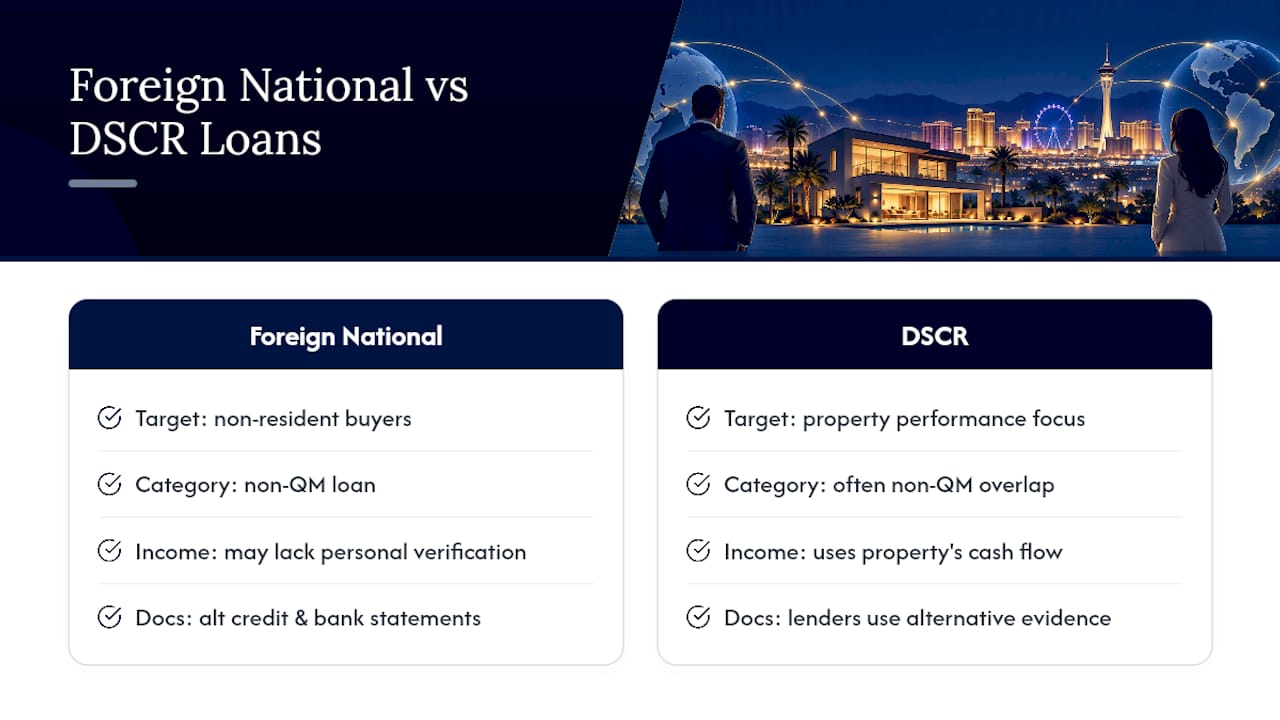
A foreign national mortgage is a loan built for buyers who lack a U.S. credit profile, an SSN, or resident status, but still want to purchase or refinance American real estate. These loans fall under the non-QM category, meaning they sit outside the "qualified mortgage" rules that govern conventional agency lending. That distinction matters because Fannie Mae, Freddie Mac, and FHA programs are largely built around domestic borrowers with verifiable U.S. income and credit files, which leaves most non-resident investors outside their underwriting box.
Instead, lenders offering foreign national loans build their own guidelines around international documentation, such as alternative credit and bank statements in place of a Fico score. DSCR financing frequently overlaps with foreign national lending because both sidestep personal income verification. The difference is scope: DSCR speaks to how a property performs financially, while "foreign national" describes who the borrower is. Many lenders combine the two, offering DSCR-based foreign national loans as their flagship product for overseas investors.
Loan Types That Actually Work for Non-Resident Buyers
Eligibility generally sorts into three groups: buyers living entirely abroad, visa holders currently in the U.S., and permanent residents with green cards. Each faces a different documentation burden, and the loan type you qualify for often depends on which bucket you fall into.
DSCR loans dominate the investment-property conversation. These loans qualify you based on the subject property's rental income rather than your personal earnings, using the debt-service coverage ratio, monthly rent divided by the mortgage payment, as the key metric. A ratio at or above 1.0 is a common benchmark, meaning the rental income covers the debt obligation. DSCR structures avoid personal income verification entirely, which is exactly why they map so cleanly onto cross-border investing: rental cash flow is far easier to document than a foreign paycheck.
Other paths worth knowing:
- Full-documentation foreign-income loans verify actual employment or business income from your home country, usually with translated tax returns and employer letters, and often carry different loan-to-value limits than DSCR products.
- Asset-based loans qualify you using liquid assets or investment portfolios instead of income, useful for retirees or high-net-worth buyers without a steady paycheck.
- ITIN-based mortgages serve buyers who file U.S. taxes using an Individual Taxpayer Identification Number instead of an SSN, common among long-term visa holders or investors with U.S. tax obligations but no residency status.
Documents and Banking You'll Need to Prepare
Lenders underwriting a foreign national mortgage substitute a checklist of alternative proof for the domestic paperwork they can't get. Here's what to gather before you start shopping rates:
- A valid passport and, where relevant, visa or entry documentation confirming your legal basis for being in the U.S.
- International credit reports or bank reference letters from your home financial institution, since a U.S. credit file usually doesn't exist.
- Translated tax returns or income statements if you're pursuing a full-documentation route.
- Bank statements showing seasoned funds, generally two to three months of history, so underwriters can trace where your down payment originated.
- Wire transfer records that satisfy anti-money-laundering and know-your-customer requirements, since large international transfers draw extra scrutiny.
Source-of-funds documentation trips up more foreign buyers than any other requirement. Unsourced or freshly transferred money is the most common loan killer in this category, so building a clean paper trail before you apply saves weeks later.
Opening a U.S. bank account, even remotely through an international private banking desk, tends to smooth the entire process. Holding your reserves in an FDIC-insured account gives lenders a familiar, verifiable structure and gives you depositor protection that a foreign account can't offer.
Pro Tip: Wire your down payment to a U.S. account at least 60 to 90 days before closing. Freshly arrived funds almost always trigger additional underwriting questions, while seasoned funds rarely do.
What It Costs: Down Payments, Reserves, and Rates
Foreign national financing costs more than a conventional loan, and the pricing reflects real underwriting risk rather than arbitrary markup.
- Down payment: Expect a range of 25% to 40% depending on the program and property type, with investment properties generally sitting at the higher end.
- Reserves: Lenders commonly require six to twelve months of principal, interest, taxes, and insurance held in liquid reserves, and investment-focused DSCR loans tend to sit toward the higher end of that range.
- LTV and DSCR interaction: A stronger debt-service coverage ratio, well above the 1.0 benchmark, often unlocks better leverage and pricing, while a ratio near breakeven may cap your loan-to-value or push your rate higher.
- Rate premium: Cross-border enforcement risk is the single biggest driver of the rate gap between foreign national loans and conventional financing. Recovering a defaulted loan from a borrower who has left the country is harder, and lenders price for that difficulty, along with documentation type and property use.
Timeline from pre-approval to closing usually runs 30 to 60 days, longer than a typical domestic purchase. You can compress that window by seasoning your funds early, opening a U.S. account before you make an offer, and working with a lender who specializes in this loan category rather than one treating it as a side product.
Taxes and Closing Logistics You Cannot Skip
Foreign ownership of U.S. real estate carries tax exposure that domestic buyers never think about, and it starts well before you sell.
- FIRPTA withholding: The Foreign Investment in Real Property Tax Act requires closing agents to withhold a percentage of gross sale proceeds when a foreign owner sells U.S. real property, a rule that shapes exit planning from day one.
- Estate-tax exposure: Non-resident owners face different estate-tax thresholds than U.S. citizens, and this is precisely the kind of detail a cross-border tax advisor should review before, not after, you close.
- Ownership structure: Buying personally versus through a U.S. LLC changes how lenders underwrite the loan and how insurers price your policy, so decide on structure before you're under contract.
- Remote closing mechanics: Power of attorney, remote online notarization, and verified wiring instructions let most international buyers finish the transaction without flying in, provided every wire is confirmed by phone through a verified contact, never by email alone.
FIRPTA planning done early, including withholding certificates where applicable, protects far more of your net proceeds than trying to fix it after the sale closes.
Financing Investment Property in Las Vegas as a Foreign National
Las Vegas has become a favored market for DSCR lending among international investors, largely because rental demand here is easy to document and underwriters know the market well. A property generating strong nightly or monthly rental income gives you a clean debt-service coverage ratio, which is exactly what remote underwriting wants to see.
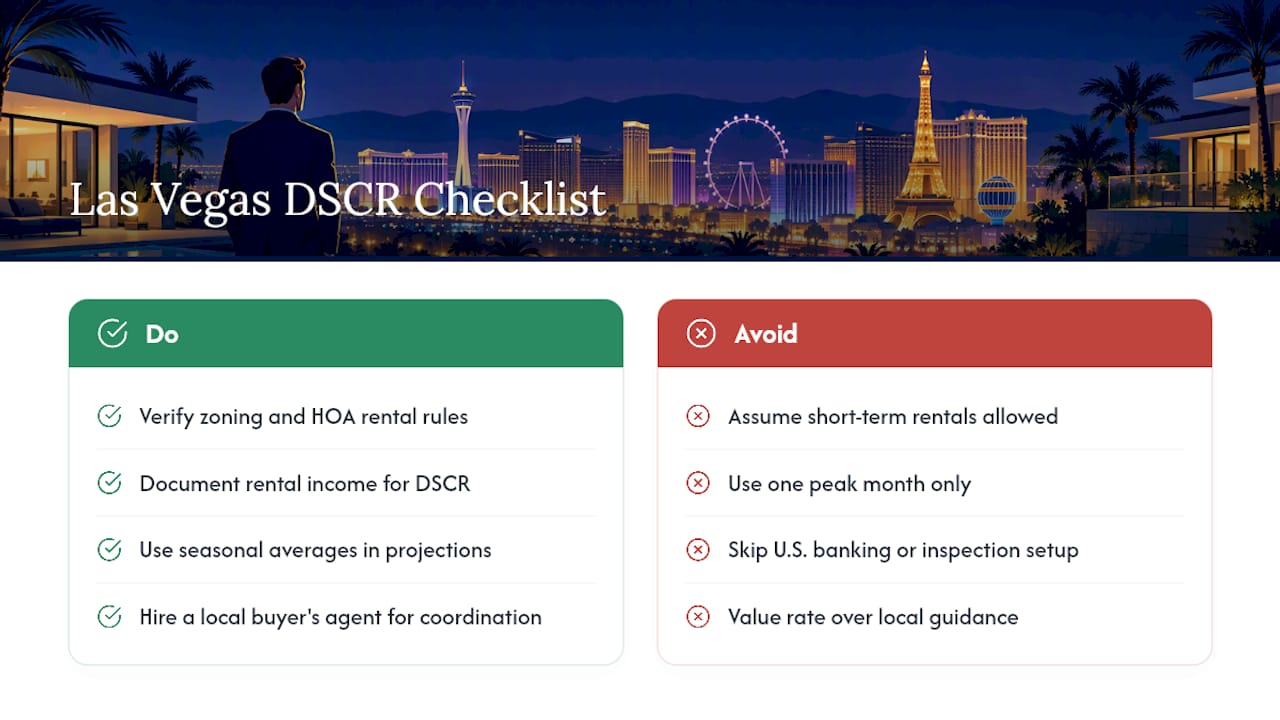
Investors should still walk in prepared. Short-term rental ordinances vary by jurisdiction within Clark County, and HOA rules in many master-planned communities restrict rentals under 30 days, so confirm zoning before assuming a short-term rental model. Seasonal rent swings, higher in cooler months, softer in summer heat, should factor into any DSCR projection rather than relying on a single peak month.
This is where coordinated representation earns its value. A buyer's agent who can introduce you to U.S.-based banking contacts, schedule inspections around your travel calendar, and manage vendor coordination remotely removes much of the friction that stalls cross-border closings. That kind of local, hands-on guidance often matters more than the interest rate itself.
Why the Standard Advice Undersells the Documentation Work
Most guides on foreign national mortgages spend their energy on rates and down payment percentages, treating documentation as a footnote. That gets the priorities backward. The real bottleneck isn't pricing, it's the paper trail. A borrower with clean, seasoned, well-documented source-of-funds records will close in six weeks with a mediocre rate; a borrower without one will stall for months regardless of how attractive their rate looks on paper.
The other blind spot is treating DSCR as a shortcut rather than a strategy. It works because rental income is verifiable across borders in a way personal income rarely is, not because it's easier or cheaper. Buyers who choose DSCR purely to avoid paperwork often end up under-leveraged on properties that could have supported more debt with a slightly stronger income file.
If you take one thing from this guide, prioritize your banking and documentation setup before you fall in love with a property. Rate shopping is the easy part.
— Yelena
How Yelena Horton Helps Foreign Buyers Close With Less Friction
Financing is only half the equation. Yelena Horton's buyer representation and relocation concierge services exist for exactly the friction points this guide covers: coordinating bank introductions before you formalize a loan application, managing inspections and vendor scheduling while you're overseas, and negotiating on your behalf so your position stays strong even when you can't be on the ground. Financing insight is built into that same relationship, helping you understand how a given property's rental profile or purchase structure might align with the loan types discussed above.
The right time to reach out is before you request pre-approval, while you're still assembling source-of-funds documentation and setting up U.S. banking. That's when local guidance saves the most time. Visit Yhluxrealestate to request a consultation and start building your Las Vegas purchase plan around a lender and property strategy that actually fit your situation.
Sources
- Foreign national U.S. mortgage guide — New Omni Bank
- Non-resident alien mortgage guide — HomeAbroad
- FIRPTA withholding — IRS
- FDIC deposit insurance — FDIC
- Mortgage for foreigners in the USA — Quicken Loans
FAQ
Can a Foreign National Get a Mortgage in the US?
Yes. Foreign nationals qualify through specialized non-QM programs, including DSCR loans, asset-based financing, and full-documentation foreign-income loans, all of which accept alternative paperwork instead of a U.S. credit file or SSN.
Can Foreigners Get Mortgage Loans in the USA Without a Social Security Number?
Yes, through foreign national and ITIN-based programs that substitute foreign credit reports and international bank statements for the SSN-linked credit history conventional lenders require.
Does Fannie Mae Allow Foreign Nationals?
Fannie Mae guidelines are built around domestic credit and income verification, so most non-resident investors don't fit its standard box. Some noncitizens, particularly permanent residents with strong U.S. credit, can still access conventional or agency-backed financing, while non-resident buyers typically use non-QM foreign national or DSCR products instead.
What US Banks Offer International Mortgages?
A mix of regional banks, private banking divisions, and non-QM specialty lenders originate foreign national mortgages, with many concentrating on DSCR and asset-based products for international investors. Loan terms and reserve requirements vary meaningfully by lender, so comparing at least two or three specialists before applying is worth the time.
How Much Down Payment Do Foreign Nationals Need for a US Mortgage?
Most foreign national programs require between 25% and 40% down, with investment-focused DSCR loans often sitting at the higher end of that range depending on the lender and property type.