
An exit strategy in luxury real estate is a documented, proactive plan that defines how, when, and at what price you sell a high-value property to protect capital and maximize returns. Most investors treat exit planning as an afterthought. The most effective approach is to finalize your exit plan at purchase, documenting buyer profiles, pricing scenarios, tax implications, and asset preparation before you close. Yhluxrealestate applies this discipline to every luxury transaction in Las Vegas, where micro-market conditions and buyer psychology demand precision from day one.
What is an exit strategy in luxury real estate?
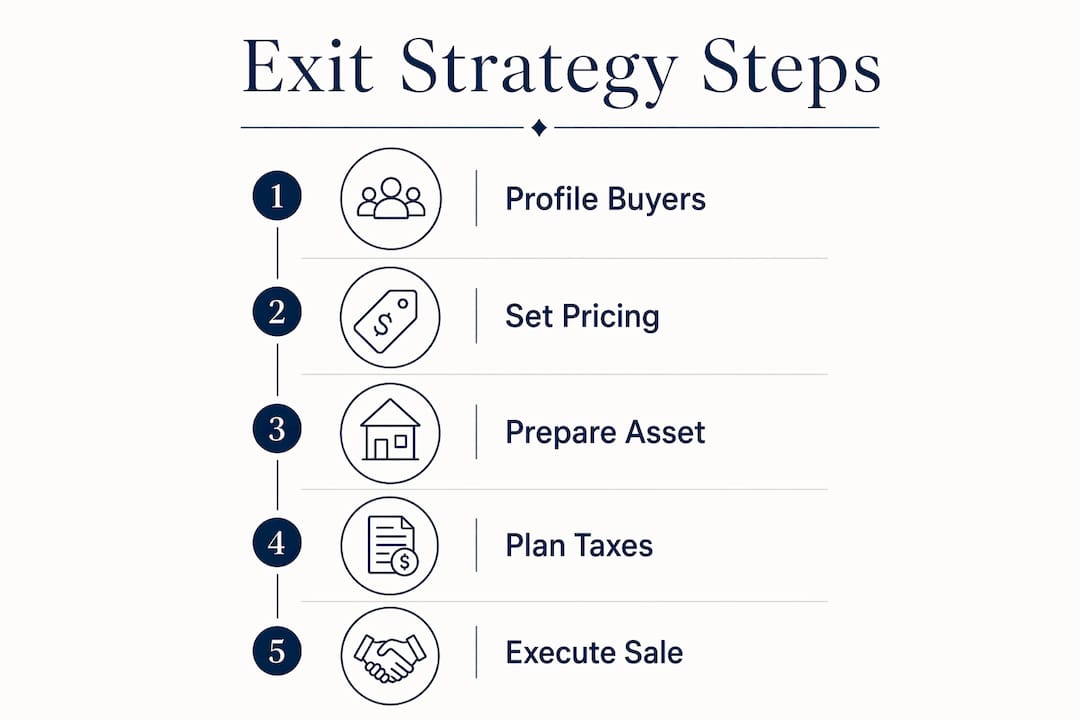
An exit strategy for luxury real estate is the industry term for a pre-planned disposition framework. It covers four pillars: target buyer profiling, pricing stress tests, tax structure, and asset condition. Each pillar must be addressed before acquisition, not after the market shifts or personal circumstances change. Reactive decisions in the luxury segment are costly. A property listed without a clear buyer thesis or pricing rationale signals weakness to the very buyers you need to attract.
The distinction between luxury and mass-market exits is fundamental. Luxury buyers are few, highly informed, and acutely sensitive to how a property is presented and priced. A misstep in positioning, even a single overpriced week on a public listing, can permanently damage an asset's reputation in a market where word travels fast among elite networks. Planning at acquisition gives you the control and reversibility that protect both your capital and your options.

Who are the ideal future buyers for your luxury property?
Buyer profiling is the foundation of every sound luxury property resale plan. The three dominant buyer personas in the upper tier are family seasonal residents, location-independent remote workers, and affluent retirees seeking primary or secondary residences. Each group prioritizes different features, and understanding that distinction at purchase shapes every renovation, furnishing, and marketing decision you make later.
Lifestyle considerations and location micro-markets drive desirability more than square footage or list price alone. A Las Vegas estate with resort-grade outdoor entertaining space appeals to a different buyer than a walkable urban penthouse, even at the same price point. Matching the property's inherent character to the right persona is what separates a swift, premium exit from a prolonged negotiation.
For properties priced above $10 million, aging-in-place features have become a critical consideration. Single-level floor plans, elevator-ready shafts, spa-caliber bathrooms, and smart home accessibility systems now appear on the de rigueur checklist for ultra-high-net-worth buyers. Ignoring this trend at acquisition narrows your future buyer pool considerably.
Pro Tip: Build a one-page buyer persona document at closing. Include the profile, the lifestyle priorities, and the three features that would make this property irresistible to that buyer. Revisit it annually and update it as the micro-market evolves.
Yhluxrealestate conducts buyer persona analysis as a standard part of every acquisition consultation, drawing on Sotheby's International Realty's global network to identify where demand is concentrating before it becomes visible in public data.
How do pricing strategies and market timing optimize luxury resale?
Pricing a luxury property for exit is not an art form. It is a structured, data-driven exercise. The most effective method stress-tests three scenarios against your purchase price plus capital expenditure: a conservative case at minus 5%, a base case, and an optimistic case at plus 5%. Each scenario should be modeled against current verified resales within 500–800 meters of the subject property, not against aspirational asking prices from unrelated listings.
Strategic pricing generates momentum. Properties priced with precision attract 2–4 serious showings in the first week, which is the window that matters most for price integrity. Overpricing, by contrast, triggers a slow accumulation of days on market that forces eventual reductions and signals desperation to the very buyers capable of paying full value.
Timing the luxury market requires aligning your exit window to buyer travel and lifestyle cycles, not to broad economic headlines. The following sequence reflects how disciplined sellers approach timing:
- Identify the peak travel and relocation periods for your target buyer persona (for Las Vegas, this often aligns with late winter and early fall arrivals from colder markets).
- Begin pre-marketing through private networks 90–120 days before your target listing date.
- Prepare the property for photography and private showings at least 60 days out.
- Release to the broader market only if the private network has not produced a qualified offer within the first 30 days.
The fourth step is where most sellers err. Applying mass-market tactics in the luxury segment signals desperation and reduces price leverage. Private networks and curated storytelling consistently outperform broad public listings for properties above the $3 million threshold. Yhluxrealestate's off-market access and global advisor relationships are built precisely for this phase of the exit.
How to prepare your luxury asset and documentation for exit
Asset preparation is the most underestimated lever in luxury property resale. Buyers at the top of the market expect a turnkey experience. Kitchens, bathrooms, and lighting are the three areas that yield the highest return on pre-sale investment. A dated kitchen in a $5 million property does not read as a negotiating chip. It reads as deferred maintenance, and it invites aggressive discounting.
Furnishing strategy matters equally. A fully staged, curated interior allows buyers to experience the lifestyle the property offers rather than project it from an empty shell. Professional staging firms that specialize in ultra-high-net-worth properties understand scale, proportion, and the specific aesthetic vocabulary that resonates with affluent buyers.
The second, often overlooked, element of preparation is documentation. Maintaining an exit file from the day of purchase is one of the highest-leverage habits a luxury investor can develop. This file should contain:
- Warranties for all major systems and appliances, organized by installation date.
- Maintenance records showing service history for HVAC, pool, roofing, and structural elements.
- Legal compliance documentation, including permits, certificates of occupancy, and HOA correspondence.
- Renovation records with contractor details, material specifications, and before-and-after photography.
Complete documentation reduces friction that causes luxury deals to collapse during due diligence. A buyer's counsel reviewing a complete, organized file moves faster and negotiates less aggressively than one facing gaps and uncertainty.
Pro Tip: Store your exit file in a secure digital format with a physical backup. Share access with your attorney and your real estate advisor from day one so that the file is always current and never scrambled together under deadline pressure.
What tax-efficient structures support luxury real estate exits?
Tax planning is the pillar most investors address last and should address first. The two most powerful mechanisms available to American luxury investors are the 1031 exchange and the Delaware Statutory Trust. Both allow capital gains deferral when structured correctly, but they serve different objectives.
| Mechanism | Primary benefit | Best suited for |
|---|---|---|
| 1031 Exchange | Full capital gains deferral into like-kind property | Investors reinvesting into another property |
| Delaware Statutory Trust | Fractional ownership with passive income and deferral | Investors seeking liquidity and reduced management burden |
| Direct sale with no structure | Immediate liquidity, full tax exposure | Investors with losses to offset or low-basis situations |
1031 exchanges and Delaware Statutory Trusts provide tax-efficient mechanisms that allow investors to defer taxes and reposition equity for flexibility. The key constraint with a 1031 exchange is the 45-day identification window and the 180-day closing requirement, both of which demand that your next acquisition be identified before your exit closes. That timeline requires coordination between your real estate advisor, tax counsel, and legal team well in advance of listing.
Non-resident sellers face additional complexity. Withholding obligations vary by jurisdiction and can represent a significant portion of the sale price held in escrow pending final tax determination. Engaging a tax advisor with luxury real estate experience at least 12 months before your target exit date is not conservative. It is the minimum standard for protecting the full value of a high-net-worth disposition.
Ownership structure also affects exit optionality. Properties held in LLCs, trusts, or family limited partnerships each carry different transfer mechanics, liability profiles, and tax treatments. Aligning your ownership structure to your exit thesis at acquisition, rather than restructuring under time pressure, preserves both value and flexibility.
Key Takeaways
A well-executed exit strategy in luxury real estate requires buyer profiling, pricing discipline, asset preparation, and tax planning to be in place from the day of acquisition, not the day of listing.
| Point | Details |
|---|---|
| Plan at acquisition | Document buyer profiles, pricing scenarios, and tax structure before closing, not after. |
| Profile your buyer | Match property features and lifestyle positioning to the specific persona most likely to pay full value. |
| Price with data | Stress-test three pricing scenarios against verified local resales, not aspirational comparables. |
| Maintain an exit file | Organize warranties, permits, and maintenance records from day one to prevent due diligence delays. |
| Use tax-efficient structures | Evaluate 1031 exchanges and Delaware Statutory Trusts with qualified counsel at least 12 months before exit. |
What I have learned about controlling luxury exits
The phrase "capital peace of mind" sounds abstract until you have watched a client lose $800,000 in negotiated concessions because their documentation was incomplete and their buyer sensed uncertainty. Control in a luxury exit is not about timing the market perfectly. It is about making decisions based on no-regrets criteria, where the asset remains legible, desirable, and manageable regardless of where the broader market sits.
The clients who exit well share one habit: they monitor micro-market data continuously. They are not waiting for a headline to tell them the market has peaked. They are analyzing verified resales within 500–800 meters of their property every quarter, comparing those results against their original acquisition thesis, and adjusting their timeline accordingly.
The most common mistake I see is the impulse to go public too early. A luxury property that sits on the open market for 90 days without an offer does not look exclusive. It looks rejected. Private networks, curated outreach to qualified buyers, and a disciplined pre-marketing phase protect both the asset's reputation and the seller's negotiating position. Reversibility is the goal. Every decision made during ownership should keep your options open, not foreclose them.
— Yelena
How Yhluxrealestate supports your exit from day one

Yhluxrealestate brings the full depth of Yelena Horton's Las Vegas market expertise to every stage of a luxury property exit, from acquisition-day planning through final negotiation. The practice offers tailored buyer profiling, pricing scenario modeling, and direct access to off-market buyer networks through Sotheby's International Realty's global reach. Sellers who work with Yhluxrealestate enter the market with a complete exit file, a positioned asset, and a pricing strategy grounded in verified local data. For investors who want to protect capital and maintain flexibility, a consultation with Yhluxrealestate is the most direct path to a controlled, premium exit.
FAQ
What is an exit strategy in luxury real estate?
An exit strategy in luxury real estate is a pre-planned framework that defines when, how, and at what price a high-value property will be sold. It includes buyer profiles, pricing scenarios, tax structure, and asset preparation, all documented at acquisition.
When should I start planning my luxury property exit?
Exit planning begins at acquisition. Finalizing buyer profiles, pricing stress tests, and tax structure before closing gives you the control and flexibility to act decisively when market conditions align with your objectives.
Why do luxury properties sell better off-market?
Off-market sales protect price integrity and the asset's reputation. Public listings that accumulate days on market signal weakness to elite buyers, while private network outreach maintains exclusivity and negotiating leverage.
What is a 1031 exchange and how does it apply to luxury exits?
A 1031 exchange allows an investor to defer capital gains taxes by reinvesting sale proceeds into a like-kind property within a strict 45-day identification and 180-day closing window. It is one of the most effective tax-deferral tools available to luxury real estate investors.
How does an exit file protect a luxury seller during due diligence?
An exit file containing warranties, maintenance records, permits, and compliance documentation removes uncertainty for the buyer's counsel. Complete documentation accelerates due diligence and reduces the negotiating leverage a buyer gains from identifying gaps or deferred maintenance.