
To establish Nevada residency, you must be physically present in the state and create a documented record of intent to remain. Within 30 days of arrival, secure a Nevada driver's license and register your vehicle, then update your auto insurance and voter registration to match. Filing a Declaration of Domicile is optional, but for those retaining ties to a high-tax state, it often proves the wisest early move.
TL;DR:
- Nevada residents must obtain a driver's license and register their vehicle within 30 days of arrival, requiring proof of identity, Social Security number, and two residence documents.
- Building a strong paper trail, including utility bills, lease agreements, bank statements, and voting records, is crucial to withstand tax audits and demonstrate actual residency.
- Establishing legal residency for voting takes only 30 days of physical presence, but in-state tuition and divorce require 12 months and six weeks of documented residence, respectively.
- Converting or replacing out-of-state insurance policies before the 30-day deadline ensures proper vehicle registration and compliance with county emissions testing if applicable.
- Hiring a relocation concierge can streamline the process by scheduling appointments, coordinating paperwork, and helping gather evidence to establish Nevada residency efficiently.
Table of Contents
- What Are Nevada's DMV Requirements for a License or ID?
- What Documents Prove Nevada Residency?
- How Long Does It Take to Establish Residency for Voting, Divorce, or Tuition?
- When Do You Need to Switch Vehicle Registration and Insurance?
- Declaration of Domicile: Optional Step, Real Evidentiary Weight
- How Do You Build a Paper Trail That Survives an Audit?
- How a Relocation Concierge Speeds Up the Paperwork
- What Movers Get Wrong About Nevada Residency
- Let a Relocation Concierge Handle the Logistics
- Where to Find the Official Nevada Residency Rules
- Sources
- FAQ
What Are Nevada's DMV Requirements for a License or ID?
Nevada law sets a firm clock: new residents have 30 days to obtain a Nevada driver's license and register any vehicle they intend to operate within state lines, a rule anchored in NRS 483.245 and NRS 482.385. The process happens in person at a DMV office, and arriving prepared saves an afternoon of frustration.
The Nevada DMV asks for three categories of documentation before issuing a license or state ID:
- Proof of identity, typically a certified birth certificate, valid passport, or existing out-of-state driver's license
- Your Social Security number, verified through a card, W-2, or 1099 form
- Two separate proofs of Nevada residential address, each showing your name and Nevada street address
Not everyone has a lease or utility bill in their own name right away. For those cases, the DMV accepts DMV-005, the Certification of Nevada Residency, a sworn statement used when someone lives with a family member or roommate and lacks independent documentation. A parallel option, the Property Owner Residency Affidavit (DMV-116), works for homeowners in similar situations, according to the DMV's new resident guide.
One more decision point: standard license or REAL ID. REAL ID requires the same base documents plus, in most cases, an original Social Security card rather than a substitute. Whichever you choose, surrender your out-of-state license at the counter. Nevada does not allow you to hold two active driver's licenses simultaneously.
Pro Tip: Schedule your DMV appointment online before the 30-day window closes. Walk-in wait times at Las Vegas locations regularly stretch past two hours, and a missed deadline can complicate your residency timeline for other purposes, like voter registration.
What Documents Prove Nevada Residency?
Two residency documents unlock nearly everything else on this list. The Nevada DMV accepts a defined set of paperwork, but freshness matters as much as the document type itself.
- Utility bills (electric, water, gas, or cable) showing your Nevada address
- A signed lease agreement or mortgage statement
- Recent bank or credit card statements mailed to your Nevada address
- Pay stubs listing your Nevada address
- A Nevada voter registration card
- Nevada vehicle insurance documents
Most of these must be originals or certified copies, generally required to be recent, a detail that trips up applicants who print an old PDF statement and assume it will pass muster.
If none of the standard documents carry your name, because you moved in with a partner, parent, or friend, the DMV-005 Certification steps in as a sworn substitute, paired with one supporting document from the person you live with. Keep both originals and a spare set of certified copies. Some agencies, including lenders and university registrars, will want their own set, and reprinting a bank statement from three months back is far harder than filing an extra copy now.
How Long Does It Take to Establish Residency for Voting, Divorce, or Tuition?
Nevada does not apply one blanket residency period across every legal purpose. The duration depends entirely on what you are trying to accomplish.
- Voter registration: 30 days of state residency, plus 10 days living in your specific voting precinct before you register
- Divorce filings: a six-week residency requirement before a Nevada court will accept your petition
Each threshold hinges on the same two ingredients: physical presence and demonstrable intent to stay. A student claiming Nevada residency for tuition purposes needs a fuller paper trail than a new arrival simply registering to vote, since university registrars scrutinize documentation dated well before the semester begins.
When Do You Need to Switch Vehicle Registration and Insurance?
Vehicle registration runs on the same 30-day clock as your driver's license, and the two errands pair naturally into one DMV visit. Before you register, though, one detail catches many transplants off guard.
- Nevada requires an insurance policy actually written for Nevada; your existing out-of-state policy generally will not satisfy registration requirements
- Contact your insurer before your DMV appointment to convert or replace your policy
- Certain counties, including Clark County, require emissions testing before registration renewal
- Bring your vehicle title, current out-of-state registration, and proof of Nevada insurance to the DMV counter
Pro Tip: Call your insurer a week before your DMV appointment, not the morning of. Underwriting a Nevada policy sometimes takes longer than converting a policy within the same state, especially for luxury or specialty vehicles.
Declaration of Domicile: Optional Step, Real Evidentiary Weight
A Declaration of Domicile is not required to live in Nevada, but it carries more legal weight than any single DMV document. Filed under NRS 41.191] with the county district clerk, the declaration is a sworn, date-stamped statement that Nevada is now your permanent home, listing your current address and any prior residences.
The distinction matters here: residency describes where you live, while domicile describes where you intend to remain indefinitely. You can hold a Nevada driver's license without ever formally declaring domicile, but the declaration becomes powerful evidence if a former state later challenges your move.
- File it as soon as you settle into a permanent address, ideally without unnecessary delay
- Bring identification and be prepared to sign under oath
- Retain a certified copy for your own records, separate from the county's file
The declaration proves especially valuable for anyone who still owns property, runs a business, or spends meaningful time in a state with an aggressive income tax, since it creates an early record that predates any audit inquiry.
How Do You Build a Paper Trail That Survives an Audit?
Filing forms is the easy part. What actually withstands a former state's tax challenge is a consistent, dated record showing you live your life in Nevada, not just your paperwork.
- Secure your Nevada ID and vehicle registration within the 30-day window
- Register to vote and, where relevant, actually vote in Nevada elections
- Sign a Nevada lease or close on a home purchase, and switch utilities into your name
- Open Nevada bank accounts and redirect direct deposits and billing statements
- File any required Nevada tax returns and retain copies
- Track days spent outside Nevada with a simple calendar log
- Scan and back up every receipt, bill, and form the moment you receive it
Behavior matters as much as documents. Limiting time spent in your former state, using your Nevada address consistently on every account, and shifting professional or financial relationships toward Nevada-based providers all reinforce the same story: this is where you actually live now.
Pro Tip: If your former state has a high income tax and you still own property or a business there, consult a tax attorney or CPA before you finalize the move. Bring your travel log, lease or deed, and utility records to that first meeting. Professionals can spot audit triggers you would never think to document on your own.
How a Relocation Concierge Speeds Up the Paperwork
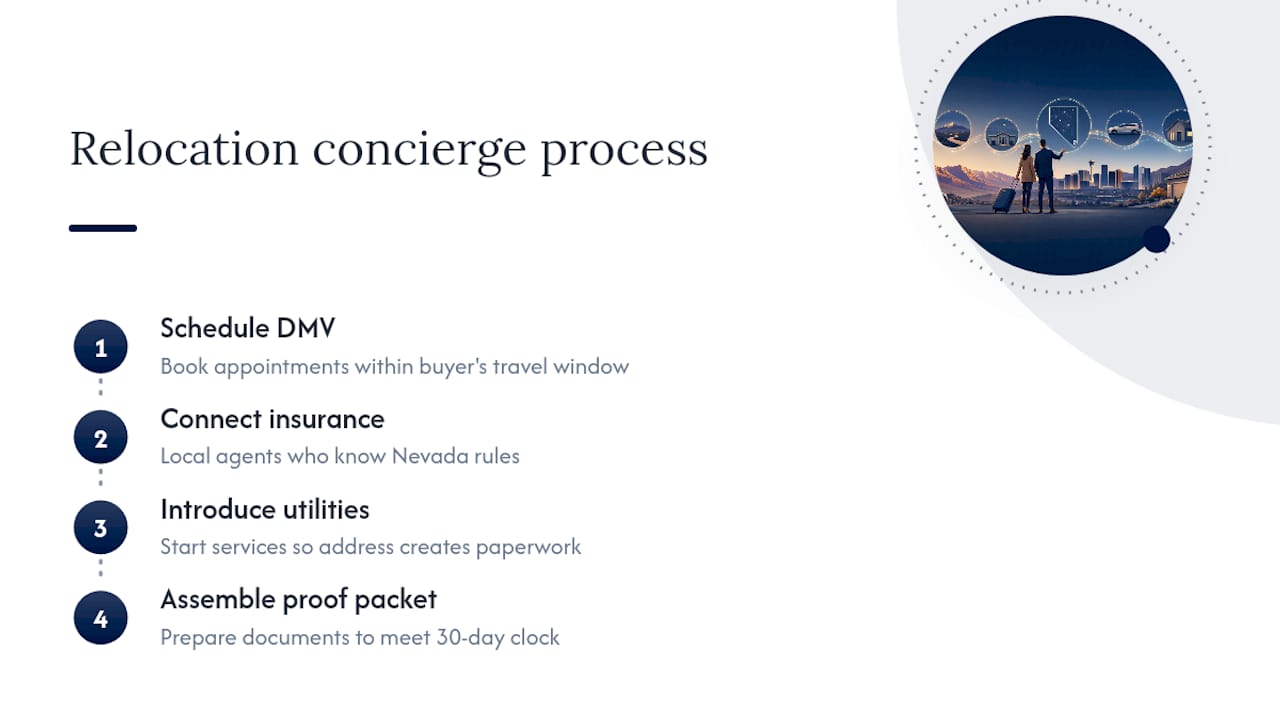
Yelena Horton works with out-of-state buyers relocating to Las Vegas, and much of that work happens before closing day ever arrives. Her relocation concierge service coordinates the practical side of the move: scheduling DMV appointments around a buyer's travel window, connecting clients with local insurance agents who understand Nevada's policy requirements, and introducing utility and service providers so a new address generates paperwork immediately rather than weeks later.
For buyers juggling a cross-country move alongside a 30-day residency clock, having someone assemble the proof packet, rather than chasing it alone between moving trucks, often makes the difference between a smooth transition and a scramble.
What Movers Get Wrong About Nevada Residency
The most common mistake is treating a Nevada address as proof enough on its own, without matching bank accounts, insurance, or a voting record. A close second is waiting past 30 days on the license and registration. When high-tax exposure is real, file the Declaration of Domicile early and talk to an advisor before, not after, the move.
— Yelena
Let a Relocation Concierge Handle the Logistics
Plenty of new Nevada residents manage their own DMV runs, insurance switches, and document gathering, and the checklist above gives you everything needed to do exactly that. But for buyers relocating from out of state while juggling a home purchase, a job transition, and a moving truck, Yhluxrealestate offers a faster path: a relocation concierge who coordinates the logistics around your actual move date instead of leaving you to sequence it all solo.

That means DMV appointments scheduled to fit your arrival window, introductions to local insurance agents who already understand Nevada policy requirements, and help lining up the utility and service providers that generate the address documentation your residency file needs. If you are buying a home in the process, this concierge support runs alongside guidance on what to know before buying a luxury condo in Las Vegas and how to plan a cross-country move to a luxury home without losing track of your 30-day clock. Full-time travelers weighing residency strategy against a mobile lifestyle may also want to review these RV mail and residency options before settling on an address. Visit Yhluxrealestate to request personalized relocation support and start your move on a timeline that actually works.
Where to Find the Official Nevada Residency Rules
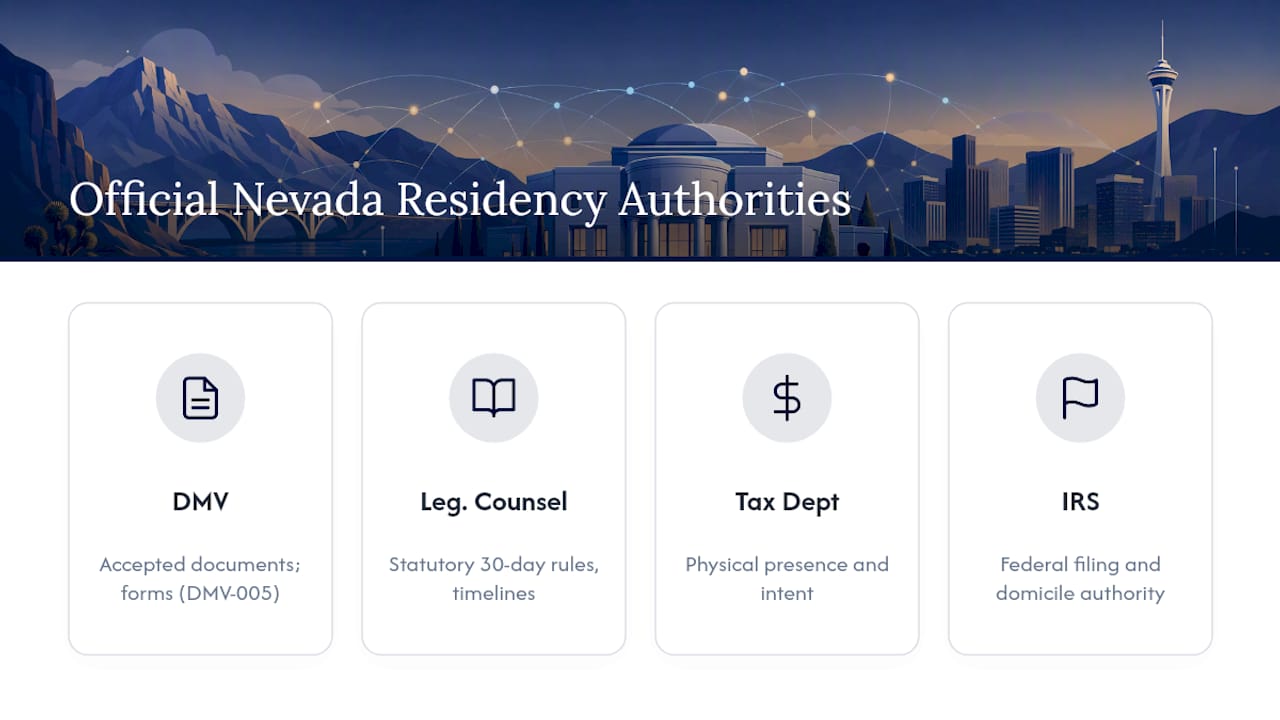
The Nevada DMV's residency page lists every accepted document and current form numbers, including DMV-005. The Legislative Counsel Bureau's residency factsheet lays out the statutory language behind the 30-day rules and purpose-specific timelines. The Nevada Department of Taxation's residency guidance addresses physical presence and intent as they relate to state tax status. For federal filing implications tied to a change of domicile, the IRS remains the authority of record.
Once you have settled in, the Las Vegas community guide covers the practical side of local vendors and utility hookups that round out your residency paper trail.
This article is general information, not a substitute for advice from a qualified lawyer. Consult a qualified legal professional about your own circumstances before acting on anything here.
Sources
- Proof of Identity & Residency Requirements — Nevada DMV
- Nevada Legal Residency — Nevada Department of Taxation
FAQ
Is It Easy to Establish Residency in Nevada?
The administrative steps are straightforward: get a Nevada ID, register your vehicle, and update your voter registration, all within a defined 30-day window. The harder part is building a consistent paper trail of bank accounts, insurance, and physical presence that can withstand scrutiny from a former state's tax authority.
Is There a 183-Day Rule for Establishing Nevada Residency?
Nevada's own thresholds vary by purpose, 30 days for voting, six weeks for divorce, and 12 months for in-state tuition, though other states you are leaving may apply their own day-count rules to determine when you stopped being their tax resident.
How Long Does It Take to Establish Residency in Nevada?
Basic administrative residency, meaning a Nevada license, vehicle registration, and voter registration, can be completed within 30 days of arrival. Legal purposes like divorce or in-state tuition require longer documented periods of six weeks and 12 months, respectively.
What Is the Easiest State to Establish Residency In?
Nevada ranks among the more accessible states because it has no state income tax and clear, published DMV timelines rather than vague residency standards. Working with a relocation concierge can further simplify the process for out-of-state buyers by coordinating appointments and paperwork around your actual move.