
Cost segregation reclassifies portions of an income-producing property into shorter IRS depreciation categories, accelerating deductions that would otherwise unfold over 27.5 or 39 years. For qualifying owners, the math has rarely favored a study more than it does in 2026.
TL;DR:
- Cost segregation yields the greatest benefits for properties with a basis above approximately $500,000, especially after major renovations or new construction.
- A proper engineering-based study involves site inspections, photos, measurements, and detailed asset classification supported by IRS guidance to withstand scrutiny.
- Bonus depreciation rules enacted in 2026 enable immediate expensing of reclassified short-life assets, significantly boosting the financial advantage of cost segregation.
- Owners should coordinate the study timing with their tax professional and property closing to maximize deductions and avoid recapture risks.
- State conformity differences and passive activity limits can reduce the immediate benefit, so thorough planning and modeling are essential before proceeding.
Table of Contents
- What Cost Segregation Real Estate Investors Rely On
- How a Cost Segregation Study Works, Step by Step
- Which Property Types Get the Biggest Lift
- When to Run a Study: Timing and the Form 3115 Look-Back
- Bonus Depreciation and the OBBBA Rules That Changed the Math
- What a Study Costs and What It Returns
- How to Choose a Cost Segregation Provider
- The Trade-Offs: Recapture, State Taxes, and Passive Loss Limits
- Cost Segregation Alongside Section 179 and Other Tax Strategies
- Common Mistakes That Undermine a Cost Segregation Study
- Industries That Benefit Most from Cost Segregation
- Why Tax Timing Deserves a Seat at the Closing Table
- Where to Verify the Rules Yourself
- Sources
- FAQ
What Cost Segregation Real Estate Investors Rely On
Cost segregation is an engineering-based tax strategy that separates a building's cost basis into components the IRS treats differently for depreciation. Instead of depreciating an entire structure over 39 years (commercial) or 27.5 years (residential rental), a qualified study identifies elements like carpeting, decorative lighting, specialty electrical work, and certain site improvements that belong in 5-year, 7-year, or 15-year Modified Accelerated Cost Recovery System (MACRS) categories.
This only applies to income-producing property. A primary residence does not qualify, no matter how elaborate its finishes. Rental homes, apartment complexes, office buildings, retail centers, hotels, medical facilities, warehouses, and self-storage facilities all typically qualify, provided the owner uses the property to generate taxable rental or business income.
Properties that tend to benefit most share a few traits: substantial improvements beyond bare structural shell, a purchase price or construction cost with enough basis to justify the study fee, and a holding period long enough to make front-loaded deductions worthwhile. The IRS technical guidance on cost segregation (P5653) draws the classification line largely along Section 1245 personal property versus Section 1250 real property, and that distinction drives everything downstream in the study.
How a Cost Segregation Study Works, Step by Step
A defensible study follows a sequence that engineering-based providers rarely skip, because each phase builds the documentation trail the IRS expects to see if a return is examined.
- Feasibility estimate. The provider reviews purchase price, construction costs, and property type to estimate potential reclassified basis and whether the fee is worth it.
- Document collection. Closing statements, cost segregation-relevant construction invoices, appraisals, and depreciation schedules get gathered up front.
- Site inspection. An engineer walks the property, measures components, and photographs everything from flooring to parking lot striping to HVAC distribution.
- Engineering cost allocation. Using cost databases and construction cost data, the team assigns dollar values to each component and slots them into 5-, 7-, 15-, or 27.5/39-year buckets.
- Report delivery. The final deliverable includes asset-level schedules, methodology narrative, photos, and citations to IRS guidance supporting each classification.
That final report is what a CPA files against, and it is what an IRS examiner reviews if the deduction gets questioned. The IRS's own guidance stresses that documentation quality, not just the resulting number, is what separates a study that survives scrutiny from one that does not.
Which Property Types Get the Biggest Lift
Not every property justifies the cost of an engineering study, but several categories consistently produce the largest returns:
- Multifamily apartment communities, where finishes, appliances, and site work often represent 20% to 35% of total basis.
- Hotels and resorts, loaded with furniture, fixtures, specialty lighting, and elaborate mechanical systems.
- Self-storage facilities, where security systems, paving, and fencing carry shorter recovery lives.
- Retail centers and restaurants, especially after a buildout or tenant improvement project.
- Medical and specialized facilities, where equipment infrastructure and dedicated electrical work run high.
Major renovations, qualified improvement property (QIP) work, and ground-up construction all trigger a fresh look at reclassification opportunities. As a rule of thumb, properties with a depreciable basis above roughly $500,000 usually clear the threshold where a feasibility estimate is worth requesting; below that, fees can eat too much of the benefit.
When to Run a Study: Timing and the Form 3115 Look-Back
The ideal window is at or near the placed-in-service date, or immediately after a major renovation, since that captures the full basis before depreciation erodes it. But owners who missed that window are not out of luck.
A look-back study lets an owner analyze a property purchased or renovated years earlier and claim the depreciation that should have been taken all along. Rather than amending every prior-year return, the owner files Form 3115, an accounting method change, claims the entire missed depreciation as a single catch-up adjustment in the current tax year. This mechanic becomes especially valuable under permanent bonus depreciation, since the catch-up amount can often be expensed immediately rather than spread out. The EisnerAmper FAQ on cost segregation notes this look-back option is available for properties placed in service in any prior year, which makes timing less of a hard deadline and more of a sequencing decision best made with tax counsel before filing.
Bonus Depreciation and the OBBBA Rules That Changed the Math
IRS Notice 2026-11 lays out the interim eligibility rules and election mechanics for claiming it.
That single change transforms cost segregation from a deferral strategy into an immediate-expensing strategy. Reclassifying $800,000 of a building's basis into shorter-lived categories no longer means spreading that deduction across several years; it usually means writing it off entirely against current income, assuming the owner has sufficient basis and passive income to absorb it. Practitioners at Kaufman Rossin note this shift has widened the pool of properties for which a study makes economic sense. One caveat: not every state conforms to federal bonus depreciation, so the federal benefit and the state benefit need separate modeling before an owner commits to a strategy.
What a Study Costs and What It Returns
Study fees vary by property complexity and size, but most engineering-based providers price within a fairly predictable band.
The ASCSP's introductory guidance illustrates how reclassifying even a modest share of basis can shift a first-year deduction from tens of thousands of dollars to several hundred thousand, depending on property type and total basis. To judge whether a study pencils out, weigh the fee against the present-value benefit of accelerating that deduction, not just the raw dollar figure. A feasibility estimate, usually free or low-cost from a reputable provider, gives that answer before any commitment.
How to Choose a Cost Segregation Provider
The provider matters as much as the strategy itself, since a poorly documented study is a liability waiting for an audit letter.
- Confirm the team uses engineering-based methodology, not a desktop software estimate built from a spreadsheet.
- Ask whether staff hold credentials through the American Society of Cost Segregation Professionals (ASCSP) or work under CPA coordination.
- Request a sample report showing asset-level schedules, site photos, and cost database citations, not just a summary page.
- Confirm the provider offers audit defense support if the IRS questions the classifications later.
Pro Tip: Ask a prospective provider how many of their studies have been examined by the IRS and what happened. A firm with real audit experience will answer specifically; one that has never faced scrutiny may not know where its documentation is thin.
Red flags include reports with no site visit, generic percentage allocations applied across every property regardless of type, and firms unwilling to name the engineering staff who performed the work.
The Trade-Offs: Recapture, State Taxes, and Passive Loss Limits
Accelerated deductions are not free money; they shift tax liability rather than erasing it, and three risks deserve attention before committing.
Depreciation recapture hits hardest on sale. A property sold within a few years of a cost segregation study can face a larger recapture bill than expected.
State conformity varies widely. Some states decouple from federal bonus depreciation entirely, meaning the state return depreciates assets on the old schedule even as the federal return expenses them immediately, a gap Kaufman Rossin's analysis flags as a common surprise.
Passive activity rules and at-risk limitations can also cap how much of the deduction an owner can use in the current year if they do not materially participate in the property.
Cost Segregation Alongside Section 179 and Other Tax Strategies
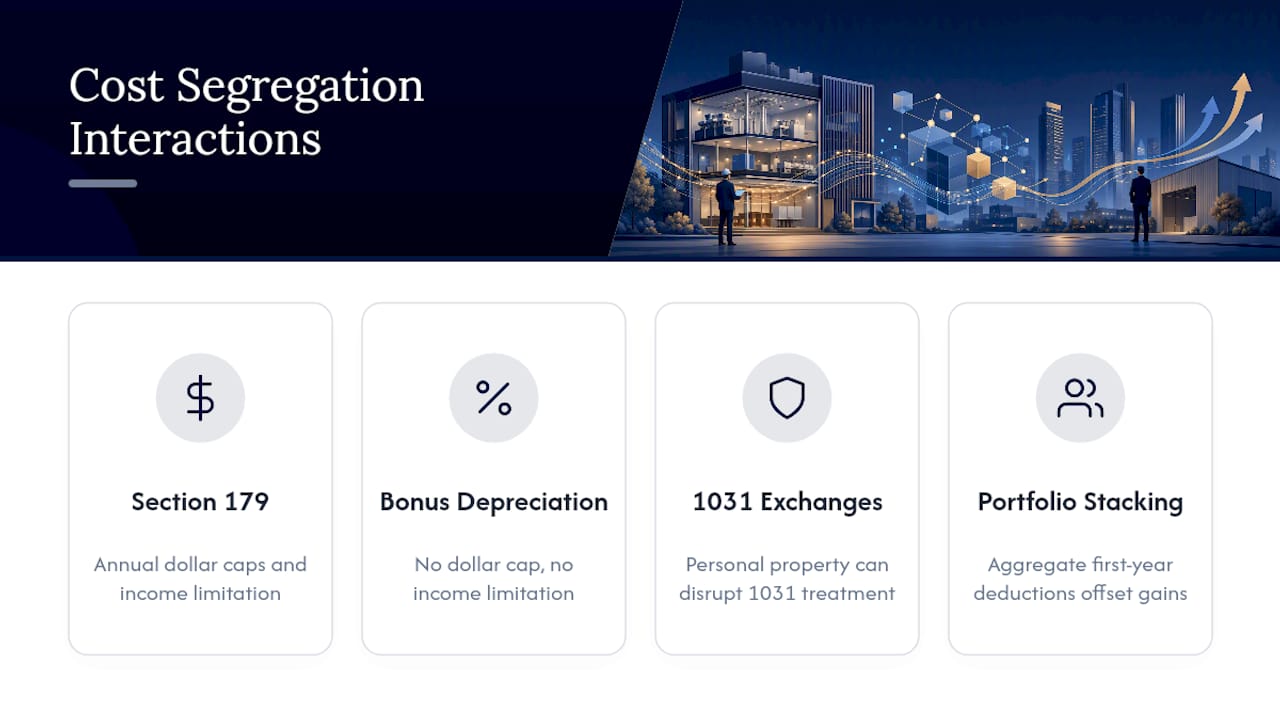
Cost segregation rarely operates alone. Section 179 expensing lets owners immediately deduct the cost of certain tangible personal property and qualifying improvements, subject to annual dollar caps and a business-income limitation, and it interacts directly with the assets a cost segregation study identifies.
The practical difference: bonus depreciation has no dollar cap and no income limitation, while Section 179 does.
Cost segregation also pairs with 1031 exchanges, though carefully. Reclassified short-life assets can complicate the exchange if personal property is involved, since 1031 treatment since 2018 generally applies only to real property, not personal property. A cost segregation study performed before a planned exchange should be coordinated with a qualified intermediary and tax counsel to avoid triggering unintended gain recognition on the personal property component.
Owners running multiple properties can also stack cost segregation studies across a portfolio, using the aggregate first-year deductions to offset gains from an unrelated sale in the same tax year, a sequencing move that works only with careful planning between the CPA and the cost segregation provider.
Common Mistakes That Undermine a Cost Segregation Study
The most expensive mistake is hiring a provider that skips the site visit. A remote, software-generated allocation might look identical to an engineering-based report on paper, but it collapses under IRS scrutiny because it lacks the photographic and measurement evidence examiners expect.
A second common error is running a study on a property with too little basis to justify the fee. A $150,000 single-family rental rarely produces enough reclassified value to offset a $2,500 study cost within a reasonable payback period; a feasibility estimate should always precede the engagement.
Owners also frequently forget to coordinate with their CPA before the study begins, resulting in a report that classifies assets inconsistently with how the CPA has already been depreciating similar components. Selling a property too soon after a study, without modeling the resulting Section 1245 recapture, is another frequent regret. Finally, some owners assume a study automatically applies retroactively; without properly filing Form 3115, prior-year catch-up depreciation simply does not materialize.
Industries That Benefit Most from Cost Segregation
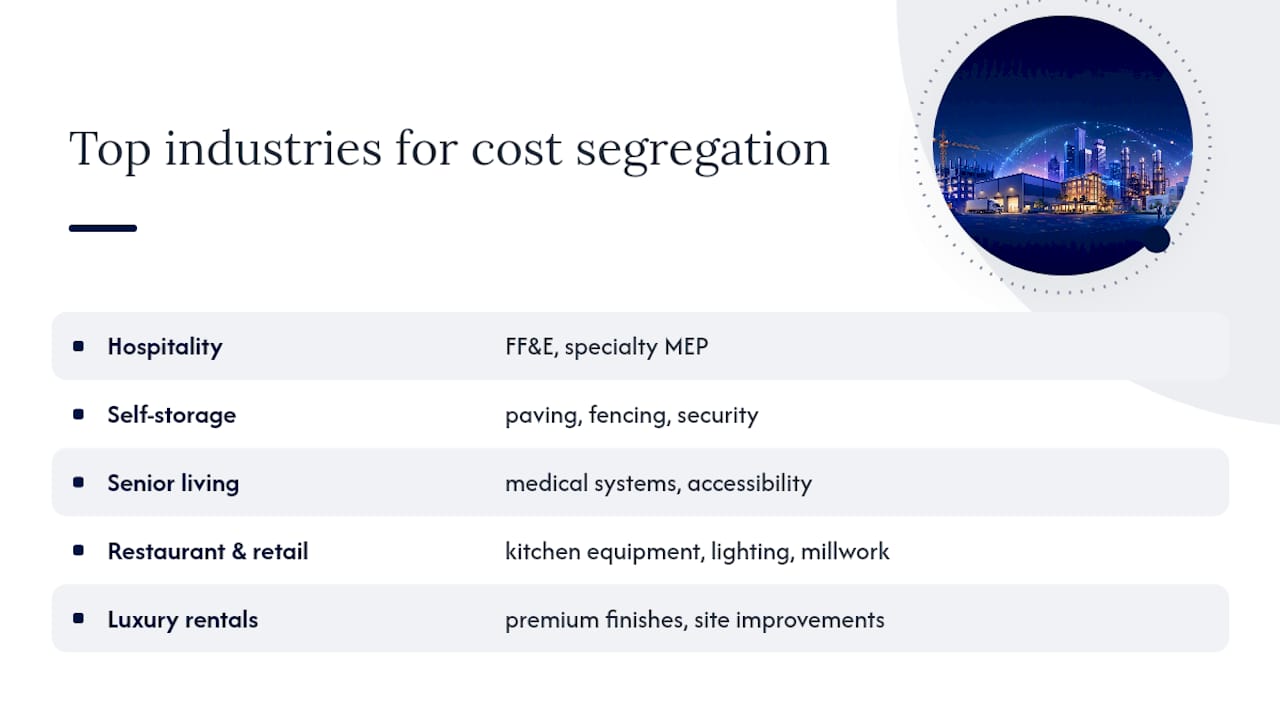
Hospitality stands out as one of the strongest categories, since hotels carry dense concentrations of furniture, fixtures, equipment, and specialty electrical and plumbing work that qualify for shorter recovery periods. Self-storage operators benefit similarly, with paving, fencing, security systems, and climate-control equipment all reclassifiable.
Senior living and assisted care facilities often see outsized results because of the specialized medical infrastructure, call systems, and accessibility features built into every unit. Restaurant and retail buildouts, particularly after a tenant improvement project, frequently yield strong reclassification because so much of the finish-out work, kitchen equipment hookups, decorative lighting, millwork, qualifies outside the standard 39-year bucket.
Luxury residential rental portfolios and high-end short-term rental properties also see meaningful benefit, given the density of premium finishes, custom lighting, and site improvements that separate a luxury property from a standard rental. For owners of income-producing luxury real estate in a market like Las Vegas, where properties frequently combine high basis with elaborate finish work, this is often where the largest per-property deductions surface.
Why Tax Timing Deserves a Seat at the Closing Table
Luxury property decisions rarely hinge on price alone; timing the acquisition, the renovation, and the tax election together is where real value gets captured or lost. I have watched enough transactions unfold to know that an investor who loops in tax counsel before closing, rather than after, tends to walk away with a materially better first-year outcome.
At Yhluxrealestate, coordination with a client's tax advisor happens alongside relocation planning and closing logistics, not as an afterthought once the deed records. That sequencing matters most for out-of-state buyers relocating into Las Vegas, where the interplay between acquisition timing and depreciation elections can shift meaningfully depending on when a property is placed in service.
— Yelena
Where to Verify the Rules Yourself
Primary sources matter more than blog summaries when a deduction this large is on the line. Start with IRS Notice 2026-11 for the current bonus depreciation eligibility rules, and the IRS's cost segregation technical guidance for methodology standards examiners use. The ASCSP offers a clear introduction to engineering-based study standards, while the EisnerAmper FAQ and Kaufman Rossin's 2026 analysis translate the rule changes into practical planning language. Owners actively managing rental portfolios may also find Prop Report's landlord resources useful for tracking the operational side of the properties a study covers.
If you're weighing a luxury property acquisition in Las Vegas where these deductions could shape your first-year returns, Yhluxrealestate coordinates the acquisition timeline with the tax planning conversation from the outset, so the closing date and the depreciation election work together rather than against each other.
This article is general information, not a substitute for advice from a qualified financial advisor. Consult a qualified financial professional about your own circumstances before acting on anything here.
Sources
- IRS technical guidance on cost segregation (P5653)
- Cost segregation and bonus depreciation: What real estate owners need to know in 2026
- 10 Most Common Cost Segregation Questions: Answered
- Introduction to cost segregation — ASCSP
FAQ
What Property Qualifies for Cost Segregation?
Any income-producing property, including rental homes, apartment buildings, retail centers, hotels, offices, and self-storage facilities, qualifies. Primary residences and property held purely for personal use do not.
What Is the 3-3-3 Rule in Real Estate?
The 3-3-3 rule is an investment budgeting guideline, generally suggesting no more than three months of expenses on hand, a home priced at roughly three times income, and a mortgage payment under three times monthly rental potential. It is not a cost segregation or depreciation rule.
What Is the 7% Rule in Real Estate?
It varies by market and investor strategy rather than following a fixed tax code definition.
Do I Need a New Property to Run a Cost Segregation Study?
No. Look-back studies let owners of properties purchased or renovated in prior years claim missed depreciation through Form 3115, an accounting method change, without amending past tax returns.