
Buyers in Las Vegas typically spend a modest percentage of the purchase price on closing costs, while sellers usually face a higher percentage of the sale price consumed once agent commissions, transfer tax, and title fees are subtracted from proceeds. The single figure worth memorizing before either side signs anything: Clark County's real property transfer tax runs $5.10 per $1,000 of value, a cost that follows local custom and is negotiable in contract terms.
TL;DR:
- Clark County's real property transfer tax is fixed at $5.10 per $1,000 of property value and is typically paid by the seller, though it is negotiable.
- Expect buyer closing costs to include lender fees (0.5% to 1% of the loan), appraisal, inspection, title and escrow charges, and prepaid items like homeowner’s insurance and property taxes.
- Seller closing costs mainly involve agent commissions, transfer tax, owner’s title insurance, escrow fees, mortgage payoffs, and prorated property taxes, with commissions now negotiated individually.
- Negotiation strategies like requesting seller concessions, timing closings, and shopping independently for title and escrow can help reduce total closing expenses.
Table of Contents
- Buyer Closing Costs: Line-Item Las Vegas Breakdown
- Seller Closing Costs: Itemized Charges and Net-Proceeds Impact
- Who Pays What in Nevada: Transfer Tax, Prorations, and Escrow Rules
- Worked Examples: Estimating the Full To-Wire Amount
- How to Reduce and Negotiate Closing Costs in Las Vegas
- Loan Estimate vs Closing Disclosure: Three Checks That Prevent Surprises
- Timing, Prepaids, and Las Vegas-Specific Surprises
- How a Las Vegas Luxury Broker Helps Avoid Closing Surprises
- Why Conservative Budgeting Matters for Las Vegas Closings This Year
- How YH Luxury Homes Can Help
- Sources
- FAQ
Buyer Closing Costs: Line-Item Las Vegas Breakdown
A $450,000 purchase in Summerlin or Henderson generates a closing bill whose total depends on the specific line items on the settlement statement typical closing costs in Canada. That range moves depending on loan type, so knowing what drives it matters more than memorizing a single number.
Lender fees make up the largest variable. Origination charges typically run 0.5% to 1% of the loan amount, and buying discount points to lower your rate adds roughly 1% of the loan per point, an upfront trade that only pays off if you plan to hold the mortgage for several years. Appraisals in the Las Vegas Valley generally cost hundreds of dollars, while a standard home inspection also typically costs a few hundred dollars. Neither is optional if a lender is involved, and both are due at the time of service rather than at the closing table.
Title and escrow charges cover the work of verifying clean ownership and holding funds during the transaction. In Nevada, buyers typically pay for the lender's title policy, which protects the bank's interest in the property, while sellers customarily cover the owner's policy that protects the buyer's equity. Escrow fees are usually split between both parties according to a schedule the Nevada Real Estate Division oversees through licensed title and escrow companies, since Nevada closings run through escrow rather than attorneys.
Prepaid items surprise more buyers than any other category because they aren't fees for services. They're deposits.
- Homeowner's insurance: Lenders require a full year paid in advance, often $1,200 to $2,500 depending on coverage and property value.
- Property tax reserves: Expect 2 to 6 months held in escrow, depending on where in the tax cycle your closing date falls.
- Prepaid interest: Covers the daily interest between closing and your first mortgage payment.
- Recording fees: Clark County charges a modest per-document fee to record the deed and mortgage.
- HOA transfer fees: Common in master-planned communities across Henderson, Summerlin, and the southwest valley.
- PMI or UFMIP: Conventional loans under 20% down require private mortgage insurance; FHA loans carry an upfront mortgage insurance premium of 1.75% of the loan amount.
Pro Tip: Ask your lender for the exact per diem interest rate before picking a closing date. Closing on the 28th versus the 3rd of the following month can shift your prepaid interest in several hundred dollars.
Seller Closing Costs: Itemized Charges and Net-Proceeds Impact
Agent commissions remain the largest line item on a Las Vegas seller's settlement statement, though how that figure gets set has changed. Following recent changes, commission rates are no longer published as a fixed industry standard. They're negotiated individually between sellers and their listing agents, and buyer-agent compensation is now a separate conversation rather than an automatic split baked into the listing. Sellers still typically budget a few percentage points of the sale price for total commission, but the exact number is now a negotiation point rather than a foregone conclusion.
The Real Property Transfer Tax is the next fixed cost, and it's genuinely fixed by statute. Clark County's combined state and county real property transfer tax rate is $5.10 per $1,000 of value, and local custom typically assigns this cost to the seller, though the contract can shift it to the buyer if both sides agree.
Beyond commission and transfer tax, sellers typically absorb:
- The owner's title insurance policy, protecting the buyer against defects in the chain of title.
- Escrow fees, split with the buyer per the local fee schedule.
- Mortgage payoff costs, including any prepayment penalties and per diem interest to the payoff date.
- Prorated property taxes and HOA dues owed through the closing date.
- HOA resale package fees, which some Las Vegas communities charge sellers directly for producing disclosure documents.
Builder incentives complicate this picture for sellers of newer construction. A builder offering rate buydowns or design credits to move inventory can pressure resale sellers nearby to offer comparable concessions just to keep a buyer's Loan Estimate competitive, which quietly increases the seller's total cost of sale even when the listing price holds steady.
Who Pays What in Nevada: Transfer Tax, Prorations, and Escrow Rules
Nevada's transfer tax statute applies to any deed conveying property valued above $100, and Clark County's combined state and county rate sits at $5.10 per $1,000 of value. For example, a home sale price times the $5.10 rate per $1,000 of value produces the total transfer tax, which scales linearly with the sale price.
Property tax prorations depend on where your closing date falls within Clark County's tax calendar, which bills in installments across the fiscal year. Whoever owned the property during a given period owes the taxes for those days, so escrow calculates a credit or debit at closing based on the exact date of transfer.
| Cost item | Customary responsibility | Negotiable? |
|---|---|---|
| Real Property Transfer Tax | Seller (local custom) | Yes, by contract |
| Owner's title policy | Seller | Yes |
| Lender's title policy | Buyer | Rarely |
| Escrow fee | Split buyer/seller | Sometimes |
| Recording fees | Buyer (buyer's documents) | Rarely |
| Property tax prorations | Both, per closing date | No (calculated, not chosen) |
For the exact fee schedule your closing will use, the Clark County Assessor's office and the Nevada Department of Taxation both publish current rates rather than relying on a title company's summary sheet.
Worked Examples: Estimating the Full To-Wire Amount
Numbers become real once you attach them to an actual purchase price. Here are three scenarios built on conventional financing with 10% down, illustrating how closing costs scale.
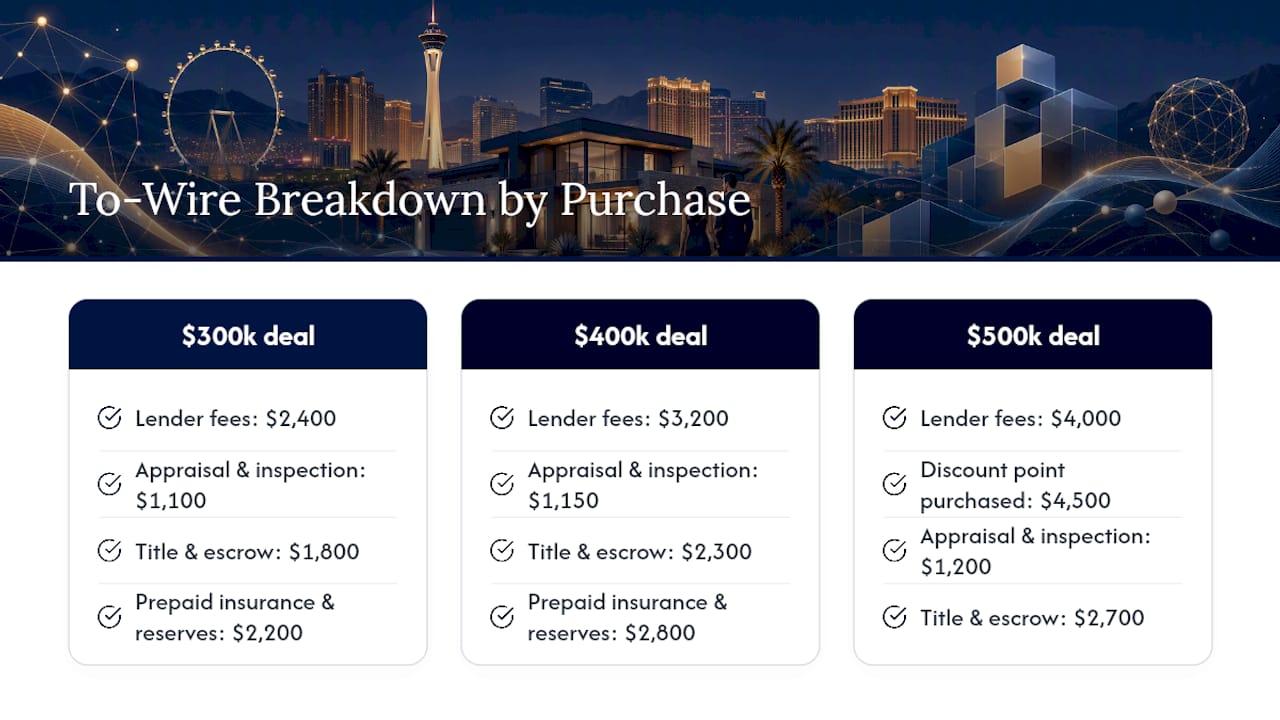
$300,000 purchase, typical scenario: Lender fees around $2,400, appraisal and inspection near $1,100, title and escrow roughly $1,800, prepaid insurance and tax reserves near $2,200, transfer tax at $1,530, and recording plus miscellaneous fees around $400.
$400,000 purchase, typical scenario: Lender fees near $3,200, appraisal and inspection around $1,150, title and escrow near $2,300, prepaid insurance and tax reserves close to $2,800, transfer tax at $2,040, and miscellaneous fees around $450. Total: roughly $11,900.
$500,000 purchase, heavier scenario with one discount point purchased: Lender fees near $4,000 plus a $4,500 point purchase, appraisal and inspection around $1,200, title and escrow near $2,700, prepaid insurance and tax reserves near $3,400, transfer tax at $2,550, and miscellaneous fees around $500. Total: approximately $18,850, reflecting the added upfront cost of buying down the rate.
To adapt these figures to your own deal, swap in your actual down payment percentage, confirm whether your loan program charges UFMIP or PMI, and check your specific closing date against the county tax calendar, since that single variable shifts prorations more than any other line item.
How to Reduce and Negotiate Closing Costs in Las Vegas
Closing costs are far more negotiable than most buyers assume, particularly in a market where inventory sits longer than it did a few years ago.
- Request seller concessions up to your loan program's cap. FHA loans generally allow seller contributions up to 6% of the sale price, VA loans cap concessions differently, and conventional loans scale the allowed percentage with your down payment size.
- Compare a rate buydown against a price reduction. A seller-paid buydown lowers your monthly payment for the life of the loan, while a price cut lowers your loan amount and total interest, so run both scenarios before choosing.
- Shop title and escrow independently. Nevada does not require you to use the company your lender or agent suggests, and fee schedules vary enough between providers to matter.
- Time your closing date near the end of the month. This minimizes prepaid daily interest, since you'll owe fewer days before your first mortgage payment begins.
- Request the HOA resale package immediately after contract acceptance. Waiting until the final week creates unnecessary pressure and sometimes rush fees.
Be skeptical of "no closing cost" loan offers. They typically fold your closing costs into a higher interest rate rather than eliminating them, which can cost you far more over a 30-year term than paying them upfront. Ask your lender to show the rate difference in writing before accepting.
Loan Estimate vs Closing Disclosure: Three Checks That Prevent Surprises
Federal rules give you a real window to catch problems before you sign. Lenders must deliver your Loan Estimate within three business days of application, and the Closing Disclosure must arrive at least three business days before your scheduled closing.
When the two documents don't match, three categories almost always explain the gap:
- Prepaid items shift when your closing date moves, since the per diem interest and tax reserve calculations depend on the exact day funds transfer.
- Escrow reserves can change if your insurance premium or tax estimate was refined between application and closing.
- Lender fees should not increase without explanation. Certain categories are legally capped from rising, so a jump here deserves a direct question to your loan officer.
If the numbers don't reconcile, call your lender first for fee questions and your escrow officer for anything related to title, recording, or proration figures. Bring a government-issued ID, your Closing Disclosure, and proof of your wired funds source to signing. Skipping that last item is the single most common reason a closing gets delayed by hours rather than minutes.
Timing, Prepaids, and Las Vegas-Specific Surprises
HOA capital-contribution and resale-package fees catch more Las Vegas buyers off guard than any other line item, since they're common in master-planned communities across the valley and can add several hundred dollars or more at closing. Request the HOA resale package the day your contract is accepted, not the week before closing.
When a seller is a foreign person, IRS FIRPTA rules require the buyer to withhold a percentage of the sale price at closing and remit it to the federal government, a compliance step that title companies typically manage but that both sides should confirm applies before assuming it doesn't. Build a pre-close checklist that confirms your wire instructions directly with your escrow officer by phone, since wire fraud targeting real estate closings remains one of the most common scams tied to this exact moment in the transaction.
How a Las Vegas Luxury Broker Helps Avoid Closing Surprises
Negotiation leverage on a luxury purchase often comes from access, not just skill. Off-market inventory frequently carries more room for seller-paid credits or rate buydowns because there's no bidding pressure inflating the price, a lever that preserves the sticker price while shifting cash burden away from the buyer at closing.
For out-of-state buyers, a relocation concierge matters most in the weeks before closing, when HOA documents, resale packages, and insurance quotes need to move fast across time zones. On the seller side, understanding how commission structure and transfer tax actually affect your net proceeds calculation before you list prevents an unpleasant number at the closing table.
Why Conservative Budgeting Matters for Las Vegas Closings This Year
Tight inventory in desirable Las Vegas submarkets rewards buyers who budget toward the high end of every range in this guide rather than the low end. Negotiation priorities have shifted, too: credits and rate buydowns often protect a buyer's position better than a straight price cut, since they preserve the appraisal comparable for future refinancing. Verify your Loan Estimate the day it arrives, and keep a cash buffer beyond your calculated to-wire number. Closings rarely go exactly to plan.
— Yelena
How YH Luxury Homes Can Help
Yhluxrealestate exists for buyers and sellers who want a closing table with no last-minute math problems. Rather than discovering a transfer tax surprise or an HOA resale delay days before signing, clients working with Yelena Horton get negotiation strategy built around off-market access, a relocation concierge that chases down HOA and resale documents before they become a bottleneck, and a global referral network backed by Sotheby's International Realty for buyers moving across state lines.

If you're weighing a purchase or sale anywhere in the Las Vegas luxury market and want a clearer picture of what your specific closing costs will look like before you write an offer, reach out through YH Luxury Homes to start that conversation directly with Yelena.
Sources
Confirm transfer tax rates through the Nevada Department of Taxation, check recording fees and tax calendars via Clark County, review disclosure timing at the CFPB, and check FIRPTA rules at the IRS. Nevada buyers exploring assistance programs can also check Home Is Possible Nevada.
- Nevada Department of Taxation — Real Property Transfer Tax
- Consumer Financial Protection Bureau
- Clark County Assessor / Clark County government
- Internal Revenue Service (IRS)
FAQ
How much are closing costs on a $400,000 house in Las Vegas?
Expect closing costs on a $400,000 purchase with conventional financing to cover lender fees, title and escrow, prepaids, and the Clark County transfer tax, with the exact total depending on the details of your transaction.
How much are closing costs on a $500,000 property?
A $500,000 purchase involves closing costs that vary based on choices such as buying discount points; the Clark County transfer tax is a fixed rate applied per $1,000 of value.
How much would closing costs be on a $300,000 home?
Budget closing costs to include transfer tax, prepaids, lender fees, and others, which generally represent a moderate percentage of the purchase price.
Are home prices falling in Las Vegas?
Pricing trends shift by submarket and season, so check current local listing data rather than relying on a single national figure; your closing costs scale directly with whatever purchase price you ultimately agree to.
Who typically pays the Clark County transfer tax?
Local custom in Clark County assigns the $5.10 per $1,000 transfer tax to the seller, though the amount and which party pays it can be negotiated in the purchase contract.
Can a Las Vegas luxury broker help lower my closing costs?
An experienced local broker can negotiate seller-paid credits, rate buydowns, and early access to HOA resale documents, and Yhluxrealestate applies exactly this approach for buyers and sellers in the Las Vegas luxury market.