
Nevada wins the tax comparison for most people moving from California, and the reason is simple: Nevada has no personal income tax, while California charges a top marginal rate near 13.3% on high earners. Property taxes, sales taxes, and business levies shift the math at the margins, but for salaried households and retirees, the income tax gap typically determines the outcome.
TL;DR:
- The primary economic advantage for moving from California to Nevada is the absence of personal income tax, which can save high earners thousands annually.
- Property taxes are lower in Nevada, but assessment rules differ; California’s Proposition 13 caps increases, while Nevada reassesses more frequently but limits annual hikes.
- Income from capital gains and retirement benefits is taxed in California but not in Nevada, making high-income and investment households particularly sensitive to the tax gap.
- Consumption taxes like sales and gasoline taxes are comparable, with Nevada offering slightly lower fuel excise taxes, but differences are minimal in overall household spending.
- Establishing Nevada residency requires clear, documented steps to avoid California audit triggers, including a physical move, changing licenses, voter registration, and banking relationships.
Table of Contents
- California vs. Nevada Taxes at a Glance
- State Income Tax: The Biggest Lever in the California vs. Nevada Taxes Debate
- Property Tax: Prop 13 vs. Nevada's Reassessment Rules
- Sales, Gasoline, and Excise Taxes: Where Nevada's Edge Narrows
- Business and Payroll Taxes for Owners and Employers
- Real Numbers: Three Scenarios Comparing California vs. Nevada Taxes
- Establishing Nevada Residency: Timing and Proof
- A Practical Checklist Before You Relocate
- Why Tax Timing Shapes Luxury Relocation Decisions
- Where to Verify These Numbers Yourself
- Sources
- FAQ
- A Note on Scope
California vs. Nevada Taxes at a Glance
Before wading into brackets and assessment formulas, here is the headline picture for anyone comparing state taxes in California vs Nevada side by side.
- California income tax: progressive brackets topping out near 13.3% for the highest earners, according to the California Franchise Tax Board.
- Nevada income tax: none. The state constitution bars a personal income tax entirely.
- Sales tax: California's base rate is 7.25%, often higher with local add-ons; Nevada's state rate is 6.85%, with a combined average near 8.24%.
- Property tax: effective rates run around 0.70% in California versus roughly 0.50% in Nevada, per Tax Foundation estimates.
A household earning $150,000 could plausibly save well into five figures a year by shifting domicile to Nevada, largely on income tax alone. Treat that as a directional estimate, not a quote. Run the numbers for your own filing status using the FTB's calculator before making any decision, and remember that this article offers general information rather than personalized tax advice.
State Income Tax: The Biggest Lever in the California vs. Nevada Taxes Debate
California taxes wages, business income, and most investment gains through a graduated schedule that climbs from 1% to 13.3%, with the top bracket applying once income clears roughly $1 million for single filers, according to the Franchise Tax Board.
Nevada simply does not participate in this conversation. Its constitution prohibits a personal income tax, so residents earning wages inside the state generally file no state income tax return at all, based on guidance from the Nevada Department of Taxation.
The gap widens further around capital gains and retirement income. California taxes long-term capital gains as ordinary income, meaning a seller who nets $500,000 on a stock sale or business exit pays the same graduated rates as on salary. Nevada taxes none of it. Pension distributions, 401(k) withdrawals, and Social Security follow the same pattern: California taxes most retirement income as ordinary income, while Nevada taxes none of it.
Quick math: a single filer earning $150,000 in wages owes roughly $10,000 to $11,000 in California state income tax after standard deductions, based on the FTB's published brackets. In Nevada, that liability is zero. That single-category difference is often larger than every other tax category combined.

Property Tax: Prop 13 vs. Nevada's Reassessment Rules
California's Proposition 13 sets the base property tax rate at one percent of assessed value and caps annual increases to that assessed value at a low rate, regardless of how much market prices climb, according to the Santa Clara County Assessor. The catch is that Prop 13 assesses property at its acquisition price, not its current market value. Buy a $2 million home today, and you are taxed near that $2 million basis, not the lower number a longtime owner down the street might carry.
Nevada reassesses more closely to market value but caps the annual increase to a primary residence's tax bill at a few percent in many counties.
- A newly purchased $1.5 million California home carries a materially higher property tax bill than an identical Nevada home, even with Nevada's higher assessment frequency.
- Longtime California owners with a decades-old, low acquisition basis can end up paying less annually than a new Nevada buyer.
- Nevada's real property transfer tax, assessed per $500 of value and stacked with county add-ons in places like Clark County, can exceed California's base documentary transfer tax at closing.
- Buyers should model both the purchase-year tax hit and the multi-year holding pattern, not just the headline rate.
Anyone modeling a purchase should also run the net proceeds math on the California side of the sale, since transaction costs there differ meaningfully from Nevada's closing structure.
Sales, Gasoline, and Excise Taxes: Where Nevada's Edge Narrows
Consumption taxes are the one category where Nevada's advantage shrinks. California's base sales tax sits at 7.25%, but local district taxes push many cities well above that. Nevada's base rate of 6.85% carries a combined average near 8.24%, close enough to California in some counties that the difference barely registers on a monthly budget.
Gasoline tells a different story. California's excise tax on fuel ranks among the highest in the nation, while Nevada's per-gallon rate runs meaningfully lower, making road trips and daily commutes cheaper across the state line. Cigarette and other targeted excise taxes also tend to run lower in Nevada, which matters more for specific spending habits than for the average household budget.
Business and Payroll Taxes for Owners and Employers
California charges an 8.84% corporate tax rate plus an $800 minimum franchise tax on most entities, according to the Franchise Tax Board, regardless of whether the business turns a profit. Nevada has no corporate income tax, but it applies a Modified Business Tax on payroll above a quarterly threshold and a Commerce Tax on gross revenue above $4 million, per the Nevada Department of Taxation.
The practical effect depends on your business model. High-margin, low-payroll businesses generally do better in Nevada. Payroll-heavy operations with thin margins sometimes find Nevada's payroll-based levies less forgiving than they expected, since the tax hits regardless of net profit.
Real Numbers: Three Scenarios Comparing California vs. Nevada Taxes
Percentages are abstract until you attach a paycheck to them. Here is how the math plays out across three common situations.
- $75,000 salary, single filer. California state income tax runs roughly $3,500 to $4,000 after standard deductions. Nevada: zero. Combined with modest property and sales tax differences, total annual savings from moving typically land in the several thousand dollar range annually.
- $150,000 salary, married filing jointly, homeowner. California income tax lands near several thousand dollars, depending on deductions. If the California home has a low Prop 13 basis from a long hold, property tax savings shrink; if it is a recent purchase, Nevada's lower effective rate adds further savings on top of the income tax gap.
- $500,000+ earner with a capital-gains event. A business sale or large stock liquidation taxed at California's top marginal rate can generate a six-figure state tax bill. Nevada's zero income tax on that same gain is where the dollar gap becomes largest, since capital gains treatment overwhelmingly drives the outcome for high earners.
One consistent theme across all three scenarios: income tax differences drive most of the savings, and property or sales tax shifts rarely reverse that advantage for mid-to-high earners, according to Tax Foundation analysis of state revenue structures. Deductions, filing status, and the Alternative Minimum Tax all move these numbers, so treat every figure here as a starting point for a real calculator run, not a final answer.
Establishing Nevada Residency: Timing and Proof
California does not release a taxpayer from its income tax simply because they bought a Nevada address. Residency and domicile hinge on where your life actually centers, and California's Franchise Tax Board looks at concrete factors: days physically present in each state, location of your primary home, driver's license and voter registration, where your doctor and dentist are, and where your business and banking relationships sit.
Establishing Nevada domicile generally means relocating your permanent home, registering to vote and obtaining a driver's license in Nevada, spending the majority of the tax year there, and shifting banking, healthcare, and professional relationships accordingly. Keep dated records of the move: utility setup dates, lease or closing documents, and a travel log if you split time between states.
Audit triggers tend to cluster around inconsistency. A taxpayer who claims Nevada residency but keeps a California home, California doctors, and a California-based business often draws scrutiny. The safest approach documents a clean, decisive break rather than a gradual, ambiguous one.
A Practical Checklist Before You Relocate
Running your own numbers before committing to a move saves far more stress than discovering a surprise tax bill after the fact.
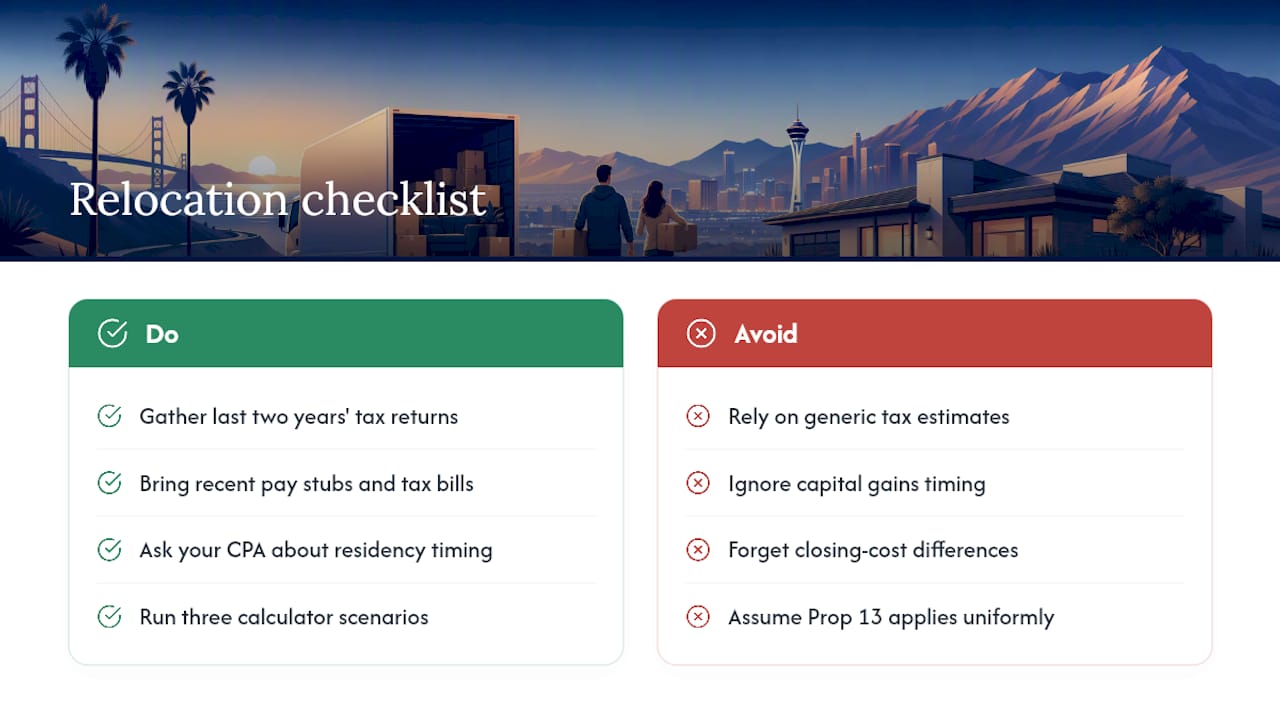
Gather your last two years of tax returns, recent pay stubs, current property tax bills, and any closing statements from prior real estate transactions. These documents let a CPA model your actual liability rather than a generic estimate.
Bring specific questions to your advisor: How will my residency timing affect this tax year's filing? What happens to capital gains recognized before versus after the move? Will 1099 or business income face different treatment once I'm a Nevada resident?
If a home purchase is part of the plan, ask about transfer taxes, escrow fees, HOA structures, and how Prop 13's acquisition-value basis will apply to your specific purchase price. Buyers weighing a cross-country move should also factor closing-cost differences into the total relocation math, not just the recurring tax rate.
Pro Tip: Run at least three calculator scenarios, current income, a projected raise, and a hypothetical liquidity event like a business sale, before finalizing a move date. Tax timing around a large capital gain can be worth more than the move itself.
Why Tax Timing Shapes Luxury Relocation Decisions
For high-net-worth buyers, the income tax gap between California and Nevada often accelerates a decision that lifestyle alone would have made eventually. A pending liquidity event, a business sale, a stock vesting schedule, tends to be the actual trigger, with the tax savings determining the calendar rather than the destination.
Clients relocating from California typically ask less about headline rates and more about sequencing: when to close on a Las Vegas property relative to a taxable event, and how residency documentation should read before that event occurs. These are exactly the timing questions a relocation concierge is built to help coordinate alongside your CPA. Yhluxrealestate works with out-of-state buyers navigating this exact intersection of tax strategy and property acquisition, backed by Sotheby's International Realty's global network.
Where to Verify These Numbers Yourself
Every figure in this article traces back to a primary source, and you should check them directly before making a residency decision. The Franchise Tax Board's calculator and rate tables let you run your exact filing status against current California brackets. The Nevada Department of Taxation explains income tax rules and business levies in plain terms. Tax Foundation's state profiles offer side-by-side effective rate comparisons, and Santa Clara County's Prop 13 explainer breaks down assessed-value mechanics in detail. For rental property owners weighing the numbers, RentTrust's guide to lowering rental expenses covers recurring ownership costs that intersect with property tax planning.
Sources
- Income Tax in Nevada — Nevada Department of Taxation
- Tax calculator, tables, rates — California Franchise Tax Board
- Taxes in Nevada — Tax Foundation
- 2026 California tax rates & rankings — Tax Foundation
- Understanding Proposition 13 — Santa Clara County Assessor
FAQ
Are Nevada taxes better than California?
For most wage earners and retirees, yes. Nevada's lack of a personal income tax typically outweighs its slightly higher combined sales tax, making the overall burden lower for most households.
Is it cheaper to live in Nevada vs. California?
Generally, yes, primarily because of the income tax gap rather than day-to-day living costs, though housing prices and local spending habits can narrow or widen that gap depending on where in each state you land.
How much is $100,000 a year after taxes in Nevada?
Nevada imposes no state income tax, so salary income is only reduced by federal income tax and payroll taxes, leaving take-home pay meaningfully higher than the same salary would net in California.
How much is California state tax on $100,000 income?
A single filer earning income in California typically owes several thousand dollars in state income tax after standard deductions, based on the Franchise Tax Board's published brackets, though exact liability depends on filing status and deductions claimed.
A Note on Scope
This article offers general information for planning purposes and is not tax or legal advice. Tax rates, thresholds, and rules change, and individual circumstances, filing status, deductions, and residency history all affect your actual liability. Confirm current figures with the Franchise Tax Board, the Nevada Department of Taxation, and a licensed CPA before making a residency or relocation decision.
— Yelena